






















































The Power of Data Analytics
The power of data analytics in business decision making. Learn how data analytics improves efficiency, customer understanding, and drives growth.

Business decisions once depended heavily on experience and intuition. Leaders looked at past trends, trusted their judgment, and moved forward. While this approach worked in slower markets, today’s business environment is far more dynamic. Every interaction, transaction, and process now generates data, and organizations that know how to use this information gain a clear advantage.
Data analytics helps businesses move from guesswork to clarity. Instead of relying on assumptions, companies can identify patterns, understand customer behavior, and predict future outcomes. This shift has made data analytics one of the most valuable capabilities for modern organizations. When used effectively, it supports better planning, reduces risk, and helps businesses grow with confidence.
Understanding Data Analytics
At its most basic, data analytics involves examining raw data to draw conclusions and identify patterns. Data analysts apply a range of statistical techniques to the data, transforming a seemingly overwhelming mountain of information into digestible insights. The power of data analytics lies in its ability to handle both structured and unstructured data, ranging from sales metrics to customer feedback. It can help identify trends, reveal hidden correlations, and forecast future scenarios, giving businesses the information they need to make informed decisions.
Data analytics is now widely used across organizations of all sizes. From monitoring website performance to tracking supply chains, businesses rely on analytics to understand what is happening and why.
Research shows that data-driven organizations are more productive and profitable than those that rely only on intuition. This highlights how analytics is becoming a key part of business strategy rather than just a technical function.
Types of Data Analytics
Understanding the different types of data analytics helps businesses apply the right approach for decision-making.
Descriptive Analytics
This type focuses on understanding what has already happened. It uses historical data to identify patterns and trends.
Diagnostic Analytics
Diagnostic analytics helps answer why something happened. It explores data to find root causes behind business outcomes.
Predictive Analytics
Predictive analytics uses past data to forecast future events. Businesses use it to anticipate demand, customer behavior, and market changes.
Prescriptive Analytics
This type suggests possible actions. It helps decision-makers choose the best option based on data insights.
These four types together provide a complete decision-making framework for organizations.
How Data Analytics Influences Decision Making
1. Improving Efficiency: Data analytics can identify bottlenecks and inefficiencies in business processes. This allows companies to streamline operations and reduce waste, resulting in significant cost savings. According to a report from Nucleus Research, businesses make back $13.01 for every dollar they spend on analytics.
2. Enhancing Customer Understanding: Understanding customer behavior is key to business success. With data analytics, businesses can segment their customer base, predict customer behavior, and personalize their offerings, leading to increased customer satisfaction and loyalty. Recent studies show that 71% of consumers prefer personalized brands, highlighting the growing importance of data analytics in understanding customer needs.
3. Driving Innovation: Data can stimulate innovation by revealing trends and gaps in the market. By leveraging these insights, businesses can develop new products or services that meet emerging customer needs.
Real-World Examples of Data Analytics in Action
Companies across various industries have successfully leveraged data analytics to revolutionize their decision-making processes.
1. Netflix
The streaming giant uses data analytics to understand viewer preferences and make content recommendations. This has not only enhanced user experience but also informed their decision to produce original content.
2. Amazon
Amazon has revolutionized online shopping with its use of data analytics. The e-commerce giant uses analytics to personalize shopping experiences, optimize its logistics, and even predict future sales.
3. Starbucks
Starbucks uses data analytics to understand customer preferences and habits. This data-driven approach informs their menu decisions, store locations, and even the design of their stores.
These examples demonstrate how data analytics improves both customer experience and operational efficiency.
Industries Using Data Analytics
Data analytics is widely used across sectors:
-
Retail improves inventory and demand forecasting
-
Healthcare enhances patient care and operational planning
-
Banking detects fraud and manages risk
-
Manufacturing predicts maintenance needs
-
Marketing improves campaign targeting and performance
This broad adoption highlights the universal value of analytics.
The Tools Behind the Work
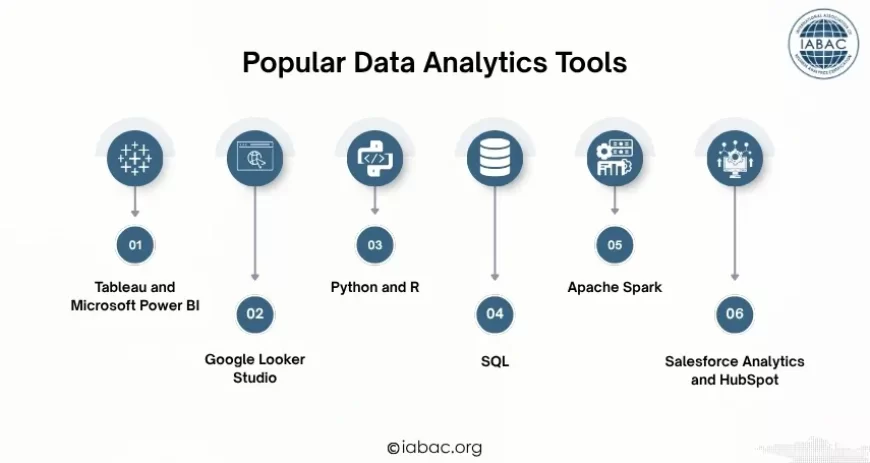
Different businesses need different tools depending on their scale, technical resources, and what they're measuring. Here's a practical overview:
-
Tableau and Microsoft Power BI are visualization and dashboard platforms widely used by both analysts and non-technical teams.
-
Google Looker Studio is free and increasingly capable for businesses already in the Google ecosystem.
-
Python and R are used by data scientists for statistical modeling, machine learning, and custom analysis.
-
SQL remains the foundational language for querying structured databases — still essential for anyone working seriously with data.
-
Apache Spark handles large-scale data processing for businesses dealing with massive datasets.
-
Salesforce Analytics and HubSpot bring customer data insights directly into sales and marketing workflows without requiring separate analytics tooling.
For most small and mid-size businesses, starting with one platform that consolidates your most important data sources is more valuable than building a complex multi-tool stack. Simplicity and consistency beat sophistication in the early stages.
How to Actually Get Started
Step 1: Define what you're trying to answer
Analytics projects fail most often when they start with data rather than questions. Before touching any tool, identify the specific business problems you want to solve. Starting with a clear question makes every subsequent decision easier.
Step 2: Audit what data you already have
Most businesses sit on more useful data than they realize — CRM records, transaction histories, email open rates, support tickets, website analytics. Assess what exists, check the quality, and identify the gaps before looking for new sources.
Step 3: Pick the right tool for your stage
A business doing $2M in annual revenue doesn't need an enterprise data warehouse. Match your tooling to your actual needs and the technical capabilities of your team, with room to grow into.
Step 4: Build data literacy across the team
Analytics tools are only useful if people know how to interpret what they show. Investing in basic data literacy training across departments — not just for the analytics team — pays off faster than any software purchase.
Step 5: Tie every initiative to a measurable outcome
Without clear ROI tracking, analytics projects drift. Define success metrics upfront, measure them consistently, and be willing to change course when the data tells you something isn't working.
Challenges of Data Analytics
Despite its benefits, businesses face several challenges:
-
Poor data quality affecting accuracy
-
Data privacy and security concerns
-
Shortage of skilled professionals
-
Managing large data volumes
Addressing these challenges ensures effective use of analytics.
The Future of Data Analytics
Looking ahead, the future of data analytics promises even more exciting developments. Advances in AI and machine learning will enable even more powerful predictive analytics. Meanwhile, the rise of edge computing will allow for real-time data processing and decision-making, even in remote locations. Furthermore, as privacy concerns continue to shape the digital landscape, we can expect to see more emphasis on secure and ethical data handling practices. This will include transparency in how data is used, as well as robust data protection measures.
Data analytics isn't a technology trend you can afford to wait out. It's a fundamental shift in how decisions get made — moving from intuition-led to evidence-led, from periodic to continuous, from reactive to predictive.
The businesses treating data as a core operational asset — not just an IT function or a reporting formality — are consistently outperforming those that don't. The gap is widening, but it's not too late to close it.
The starting point isn't the most sophisticated tool or the largest dataset. It's a clear question, clean data, and a genuine commitment to letting the answers inform what you do next. Applied consistently over time, that combination is where the real power of data analytics lives.
Developing practical analytics skills can support career growth and business success, and pursuing a structured program like Data Analytics Certification can help build a strong foundation in real-world data analytics applications.

-
 Kamala nandhiniIt cleared my doubts about data analytics, thank you
 -
carlos joseThis blog highlighted the practical applications of data analytics in decision-making, It is very informative as well
-
Thamburu sunnyThank you for breaking down the benefits of data analytics in a way that's easy for students to understand.
-
Priyadarshini SThanks for highlighting the role of data analytics in helping businesses stay competitive.









