






















































The Future of Certified Data Analysts
Find how certified data analysts are shaping the future, the skills you need, career growth, salaries, and why certification matters in 2026.

Data has emerged as the new currency in the vast environment of modern business. As organizations seek to harness the power of data to make informed decisions, the role of data analysts has become increasingly crucial. And across the globe, this shift is happening faster than most people realize.
Every business decision today — from pricing a product to predicting customer behaviour — runs on data. Companies that once relied on gut feeling now rely on dashboards. Teams that once operated in silos now collaborate around a single source of truth: data. This is the world certified data analysts are stepping into, and it has never been more full of opportunity.
The Rise of Data Analytics
The growth of data analytics is not just impressive — it is historic. Consider what is happening across industries right now:
-
E-commerce companies use data to personalize every customer interaction at scale.
-
Hospitals across the US, Europe, and Asia are analyzing patient records to predict health risks before they become crises.
-
Banks worldwide are detecting fraud in real time using pattern recognition.
-
Governments are using analytics to improve public service delivery and policy decisions.
-
Even traditional industries like agriculture, logistics, and manufacturing are building their first dedicated analytics teams.
This widespread adoption spans every continent and every sector — making data analytics one of the most universally transferable careers available today. Whether you are based in Mumbai, London, Toronto, or Dubai, the skills are the same and the demand is equally strong.
What Does a Data Analyst Actually Do?
Before chasing a certification, it helps to understand what the work really involves. A data analyst collects, cleans, and interprets data to answer business questions and solve real problems. They work across industries — from finance and retail to healthcare and government — anywhere in the world.
On any given day, a data analyst might be:
-
Pulling data from company databases using SQL
-
Cleaning messy datasets and fixing inconsistencies
-
Building dashboards in Power BI or Tableau for leadership teams
-
Running statistical analysis to spot trends and patterns
-
Presenting findings to stakeholders who have never written a line of code
The job is as much about communication as it is about technical skill. The best analysts do not just find answers in data — they turn those answers into decisions that business teams can act on, regardless of geography or industry.
Skills Every Certified Data Analyst Needs in 2026
The skills bar has risen significantly. Employers across the globe are no longer satisfied with just Excel knowledge. Here is what the market is actually looking for:
Technical Skills:
-
SQL: For extracting and querying data from databases. Non-negotiable at every level, in every country
-
Python: Beginner-friendly, with powerful libraries like Pandas and NumPy for data manipulation
-
Excel: Still widely used for quick analysis and reporting, especially in finance and operations
-
Tableau or Power BI: For turning raw numbers into visual stories that drive decisions
-
Basic Machine Learning: Understanding clustering, classification, and regression adds significant value
-
Cloud Platforms: Familiarity with AWS, Azure, or Google Cloud is increasingly expected in senior roles globally
-
R: Particularly valued in research, academia, and healthcare analytics
Soft Skills:
-
Communication: Explaining findings clearly to non-technical stakeholders across cultures and time zones
-
Problem-solving: Knowing which question to ask before you even touch the data
-
Critical thinking: Not just reporting what the data says, but understanding what it means
-
Attention to detail: One wrong formula can mislead an entire business decision
These skills translate across borders. A data analyst trained to this standard is hireable in Singapore, Germany, the UAE, Canada, or anywhere businesses run on data — which is everywhere.
The Need for Certified Data Analysts
-
Growing demand for data analysis expertise has led to an increased need for certified data analysts.
-
Employers prioritize professionals with proven skills and credentials to handle the complexities of data analysis.
-
Certification programs provide structured training and validation of proficiency in data analysis tools, techniques, and methodologies.
-
However, the value of these certifications remains a question for many aspiring data analysts.
-
Candidates must weigh the benefits of certification against factors such as industry requirements, career goals, and personal investment.
Which Certifications Are Worth It in 2026?
Not all certifications carry equal weight with employers. Here are the ones that are globally recognized and consistently valued across industries:
IABAC - Certified Data Analyst Certification. This is one of the most respected and globally recognized certifications for data professionals today. IABAC offers a structured certification pathway that covers data analytics, data science, business intelligence, and AI — making it ideal for professionals at every stage of their career.
Google Data Analytics Professional Certificate (Coursera). An excellent entry point for beginners. Widely recognized across industries and countries, it covers the full data analysis workflow from cleaning to visualization.
IBM Data Analyst Professional Certificate. Strong for building a comprehensive foundational skill set. Backed by one of the world's most recognized technology brands.
Microsoft Certified: Power BI Data Analyst Associate. Highly valued in enterprise environments, BFSI sectors, and organizations running on the Microsoft ecosystem globally.
Tableau Desktop Specialist. The preferred certification for roles focused on data visualization and business intelligence reporting.
Look at open job postings in your target country and industry, and let those requirements guide which certification you pursue first. Combining IABAC with a tool-specific certification like Power BI or Tableau is a particularly strong strategy for standing out in a global job market.
Step-by-Step Roadmap: From Beginner to Certified Data Analyst
Whether you are a fresh graduate or a working professional switching careers, here is a practical path forward that works regardless of where you are in the world:
-
Learn the basics first: Start with Excel, SQL, and fundamental statistics. These are the building blocks everything else rests on.
-
Pick a visualization tool: Power BI or Tableau. Employers everywhere love candidates who can communicate data visually.
-
Learn Python: Focus on Pandas, NumPy, and Matplotlib. This takes you from entry-level to a far more competitive candidate.
-
Get certified: Start with IABAC for a globally recognized credential, then add a tool-specific certification like Power BI or Tableau.
-
Build a portfolio: Work on real datasets from Kaggle or government open data portals. Even two or three strong projects will do more for your resume than a dozen certificates.
-
Do an internship or freelance project: Real-world experience accelerates your learning and builds credibility with employers.
-
Apply consistently: Use LinkedIn, Indeed, Glassdoor, and company career pages in your target market. Do not wait until you feel fully ready.
Participating in hackathons and data competitions along the way is also an underrated way to sharpen your skills and get noticed by recruiters globally.
Salaries and Job Roles: What Certified Data Analysts Earn Around the World
Salaries vary by region, but the career trajectory is consistently strong everywhere data analytics has taken hold.
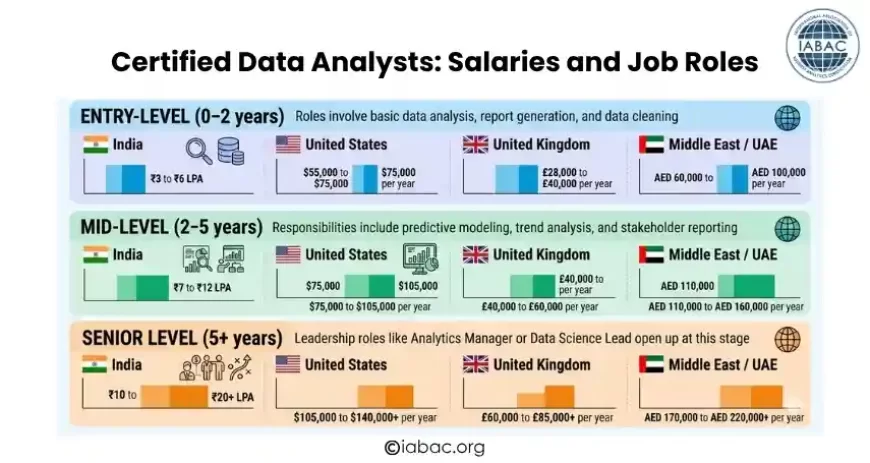
Entry-Level (0–2 years)
-
India: ₹3 to ₹6 LPA
-
United States: $55,000 to $75,000 per year
-
United Kingdom: £28,000 to £40,000 per year
-
Middle East / UAE: AED 60,000 to AED 100,000 per year
-
Roles involve basic data analysis, report generation, and data cleaning
Mid-Level (2–5 years)
-
India: ₹7 to ₹12 LPA
-
United States: $75,000 to $105,000 per year
-
United Kingdom: £40,000 to £60,000 per year
-
Middle East / UAE: AED 110,000 to AED 160,000 per year
-
Responsibilities include predictive modeling, trend analysis, and stakeholder reporting
Senior Level (5+ years)
-
India: ₹10 to ₹20+ LPA
-
United States: $105,000 to $140,000+ per year
-
United Kingdom: £60,000 to £85,000+ per year
-
Middle East / UAE: AED 170,000 to AED 220,000+ per year
-
Leadership roles like Analytics Manager or Data Science Lead open up at this stage
Specialized Roles (Data Scientists, ML Analysts) Compensation at this level is significantly higher across all markets, often exceeding the senior analyst ranges by 30–50%, with top earners in the US clearing $150,000+ annually.
Continuous learning and staying updated with global industry trends are crucial for maximizing earning potential throughout your career — no matter where you are based.
Top Industries Hiring Data Analysts Globally
Data analysts are in demand across every major economy. The top sectors actively hiring worldwide include:
-
Technology and SaaS: Google, Microsoft, Amazon, Salesforce, and thousands of mid-size tech companies
-
Banking, Financial Services & Insurance (BFSI): JPMorgan, HSBC, Goldman Sachs, and regional banks everywhere
-
E-commerce and Retail: Amazon, Alibaba, Walmart, and direct-to-consumer brands globally
-
Healthcare and Pharma: Pfizer, Johnson & Johnson, and a rapidly growing healthtech sector
-
Consulting: McKinsey, Deloitte, Accenture, and PwC all have large analytics practices
-
Telecom: Vodafone, AT&T, and regional carriers building data-driven customer experience teams
-
Government and Public Sector: Increasingly investing in analytics for policy, infrastructure, and public services
The analyst who pairs strong technical skills with deep knowledge of a specific industry will consistently have a competitive edge in any job market worldwide.
Career Progression: Where This Path Can Take You
A Data analyst is often the launchpad, not the destination. As you gain experience and deepen your expertise, a natural global career progression looks like this:
Junior Data Analyst → Data Analyst → Senior Data Analyst → Data Scientist / BI Developer → Analytics Manager → Head of Analytics / Chief Data Officer
Many analysts also move into specialized tracks such as:
-
Business Intelligence (BI): Building enterprise reporting systems for global organizations.
-
Product Analytics: Helping tech product teams understand user behaviour across markets.
-
Risk Analytics: Widely used in banking and insurance firms worldwide.
-
Marketing Analytics: Measuring campaign performance and customer lifetime value across regions.
Each of these paths has its own strong earning ceiling and long-term career depth, and all of them are in demand across multiple continents.
Will AI Replace Data Analysts?
This is the question on everyone's mind globally — and the honest answer is no, but your role will evolve.
AI-powered tools can automate certain repetitive tasks:
-
Generating routine reports and summaries
-
Flagging anomalies in large datasets
-
Running basic queries on structured data
-
Creating first-draft visualizations from raw inputs
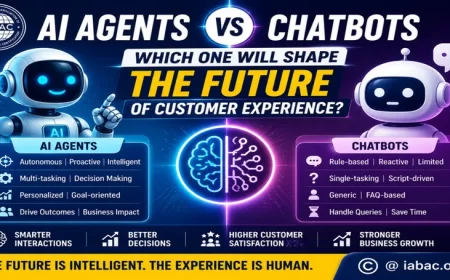
But what these tools cannot do is replace human judgment, domain knowledge, and business context. Interpreting why a trend is happening, asking the right question before pulling data, and translating findings into decisions that actually change business outcomes — that is still deeply human work.
The analysts who will thrive globally are those who learn to work alongside these tools rather than compete with them. Think of it as upgrading your toolkit, not replacing your role. An analyst who understands both the data and the business will always be more valuable than any automated system alone.
Certification Worthiness and Career Prospects
One of the primary considerations for aspiring data analysts is whether certification adds tangible value to their careers. The answer largely depends on various factors, including the specific industry, job role, and individual career goals. In many cases, certification can enhance credibility, demonstrate proficiency to employers, and open doors to new opportunities. Moreover, certified professionals often command higher salaries compared to their non-certified counterparts.
Future Outlook: Seizing Opportunities in the Data Economy
Looking ahead, the demand for certified data analysts is set to grow even further across the world, driven by digital transformation, increasing data volumes, and rapid advancements in technology. As businesses everywhere strive to extract maximum value from their data, skilled analysts will play a pivotal role in driving strategic initiatives, optimizing processes, and maintaining competitive advantage.
The World Economic Forum's Future of Jobs Report identifies data analytics as one of the most critical skill sets for the next decade. Both private companies and governments are investing heavily in analytics infrastructure — which means more jobs, better salaries, and more meaningful problems to solve for those who are prepared.
With the right skills, the right certification — including IABAC for global recognition — and the right mindset, certified data analysts can build a rewarding, future-proof career anywhere in the world.
The demand for certified data analysts is only going to grow from here. Every industry, every market, every business size needs people who can make sense of data and turn it into clear decisions. The path is not complicated — learn the right tools, earn a globally recognized certification like IABAC, build real projects, and keep growing. Opportunities do not wait, and neither should you. Whether you are just starting out or leveling up your career, there has never been a better time to step into the data economy. Your skills will travel anywhere in the world with you.