


















































Why You Need Training for Business Analytics Certification
Understand why formal training is essential for earning a business analytics certification. Discover the benefits of structured learning in analytics.

In business analytics, keeping up with the changes is important. That's why continuous learning and improving your skills are important. As more and more companies depend on data to make decisions, there's a growing demand for people who know their stuff. This is the role of advanced Business Analytics Certification training. Business analysts play a big role in understanding trends and making businesses run better. To be good at it, you need to know about things like data visualisation, predictive analysis and stats analysis. That's where certification programmes come in handy. They use practical projects to ensure that you understand all of this and more.
A certification in business analytics can have a significant impact on your career. Employers are always looking for people who can analyse data well, and having that certification shows them you've got what it takes. Whether you want to move up in your current job or find a new one, being certified can help you stand out. But it's not just about the basics. With advanced training, you can specialise in things like Artificial Intelligence, Data Science, and Machine Learning. This increases your market value and gives you access to new opportunities.
Exploring the Fast Changes in Data Analytics
Businesses are increasingly using data analysis to make informed decisions, improve their processes, and stay ahead of the competition. There are so many different tools and methods for analysing data now, like Business Analytics, Predictive Analytics, Data Visualisation, and Machine Learning. Additionally, new ones are constantly emerging, so professionals must possess a wide range of skills.Getting a certification in business analytics is important in this situation. Employers want to hire people who not only know the theory behind data analysis but also have hands-on experience using different software to understand big sets of data.
More information and what that means for you
-
AI is shifting the job: In 2026, industry reports show that AI and augmented analytics are no longer optional — they're built into basic analytics process steps. That changes what you need to know: it’s not only how to code models but also how to interpret AI outputs and check them for bias and reliability.
-
Tools that matter: The basics remain: SQL for data queries, Python or R for modelling, and visualisation tools such as Power BI and Tableau to explain findings. Employers continue to list these as top must-haves. If you're training for certification, make sure your programme includes hands-on labs for these tools.
-
From dashboards to data products: organisations increasingly treat analytics outputs as reusable products, not just one-off reports. That pushes analysts to think like product builders: version control, documentation, and customer onboarding matter.
Practical examples you can use in portfolio work
-
Build a mini data product: a small dashboard and a one-page guide with business rules and assumptions.
-
Create a predictive model for retention and include a short "model risk" note that explains where it might fail.
-
Add an SQL script that demonstrates how you prepare the data; recruiters read code snippets.
Understanding the Challenges of Keeping Up in Analytics with a Business Analytics Certification
From using big data to using advanced analytics techniques, finding useful information can be hard. But staying important in this changing field isn't just about knowing the technical stuff; it's also about being flexible, looking ahead, and understanding what's changing. Let's discuss the challenges that business analytics professionals encounter and the significance of certification.
-
New Technology Arrives Quickly: The rapid advancement of technology is a major issue in analytics. New tools and ways of doing things pop up all the time, so it's hard for professionals to keep up. People must continue to learn because what was cool yesterday might not be cool tomorrow. Getting certified in business analytics helps people learn about the newest trends and technologies, making sure they stay important in the industry.
-
Dealing with Lots of Complicated Data: There's so much data out there now, and it's complicated. Making sense of all this information isn't easy. It takes not just technical skills but also knowing a lot about the subject and thinking ahead. Business analysts play a big part in turning raw data into useful information, but they need the right skills to handle all kinds of data. A good business analytics certification like the Certified Business Analytics Expert teaches professionals how to handle different data problems.
-
Businesses Change Their Minds a Lot: What businesses need and want is always
changing because of market changes, rules, and what people like. So, analytics pros have to be able to change their plans quickly. They need to know a lot about how businesses work, what's happening in the industry, and what their company wants. Having a business analytics certification shows that someone not only knows the technical stuff but also understands how businesses work, which makes them useful to their company.
-
Working with Different Teams: To do analytics well, you'll need help from a variety of departments, including IT, marketing, finance, and operations. But getting everyone to work together and agree on things isn't easy. Business analysts need to be good at talking to people and working with others. A good business analytics certification teaches not only technical skills, but also interpersonal skills such as communication, leadership, and negotiation.
How training helps you overcome these challenges
-
Structured updates: A modern certification programme will give you a curriculum that is updated regularly; not just slides, but labs, recorded sessions, and templates for communication. Look for programmes that state their last syllabus update date.
-
Hands-on practice with messy data: The biggest gap I see between candidates is not theoretical knowledge; it’s experience cleaning bad data. Your training should force you to clean, join, and validate datasets.
-
Customer storytelling: The best programmes include modules on writing one-page executive summaries, creating slide decks for non-technical audiences, and running a short workshop. These soft skills separate senior analysts from juniors.
-
Cross-functional simulations: Great programmes simulate working with a product manager, a DBA, or a marketer, so you learn negotiation and prioritisation.
Tactical checklist — what to verify in your training
-
Real datasets: Are you working with datasets that mimic real business noise (missing values, multiple formats)?
-
End-to-end projects: Do you deliver a full project — data ingestion → model → dashboard → client memo?
-
Career support: Does the programme teach resume/portfolio prep and offer exams?
-
Recency: When was the syllabus updated?
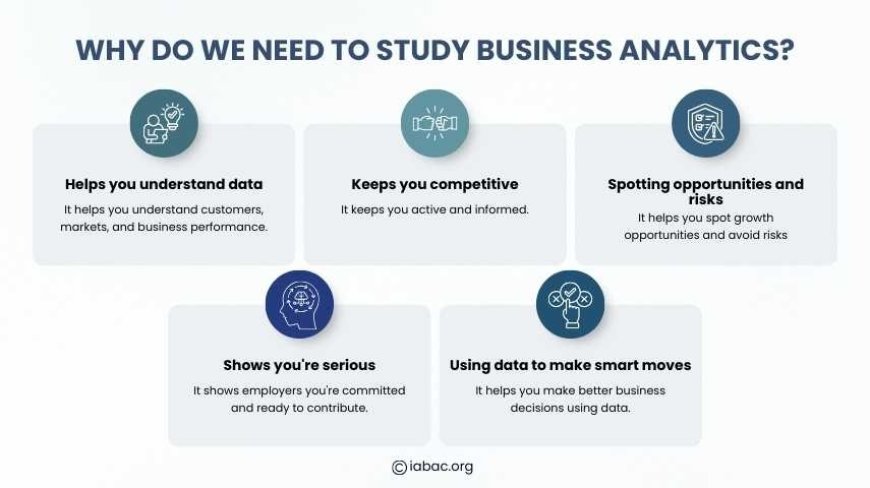
Why do we need to study business analytics?
A Business Analytics Certification is important because it helps people learn how to look at data in a smart way. This is super useful for businesses because they can then make better decisions based on what the data is telling them.
Here are some reasons why it's important:
-
Helps you understand data: By studying for a Business Analytics Certification, you'll get better at understanding things like what customers like, how the market is doing, and how to make your business run smoother.
-
Keeps you competitive: Knowing about business analytics helps you stay ahead of the game. You'll understand what's going on in your industry better than others who don't have the certification.
-
Spotting opportunities and risks: With this certification, you'll learn fancy techniques to find cool chances for growth and also how to avoid things that could hurt your business.
-
Shows you're serious: Businesses like it when they see someone has a Business Analytics Certification. It tells them you're dedicated to doing your job well and that you're ready to help them succeed.
-
Using data to make smart moves: knowing how to use data is like having a superpower. With this certification, you'll learn how to make great decisions for your business based on what the data says.
Direct benefits for your career (and how to show them)
-
Faster hiring decisions: Recruiters often filter candidates by certifications and projects. A certification coupled with 1–2 concrete projects makes screening easier and faster.
-
Salary lift: Employers pay a premium for proven analytics ability. In India, for example, median business analyst salaries range widely by experience, but certified candidates with strong portfolios regularly command higher offers.
-
Role flexibility: With analytics skills you can move horizontally (marketing → finance) or up to roles such as Analytics Manager, Data Strategist, or Product Analytics Lead.
- Risk control: Certification programmes often teach data governance basics, how to log assumptions, how to version models, and how to check for bias. Those are skills that reduce costly mistakes.
How to prove value quickly after certification
-
Ship a short, measurable project in 60–90 days. Example: "Reduced turnover by 4% in Q2 by building a triage dashboard and a logistic regression model" — that’s measurable and speaks to impact.
-
Keep visuals simple: a single slide with three metrics (baseline, post-change, next step) and a one-line ask gets you meetings.
Bold main takeaways
-
A certificate plus a short, impact-focused project beats five certificates with no proof.
-
Learning to explain results to non-technical people often pays off faster than learning one more library.
Looking into the Importance of Training for a Business Analytics Certification
Businesses depend heavily on data to make decisions, so having expertise in business analytics is super important. That's why getting certified in this field is a big deal. Here's why it's crucial to get training for a Business Analytics Certification:
-
Recognition: When you're certified in business analytics, it shows employers that you're good at analysing data to help businesses make smart choices. Having that certification can make you stand out from other job applicants because it proves you know your stuff when it comes to handling complex data and finding useful insights.
-
Getting Better Skills: Training for a business analytics certification helps you learn all the latest tools and techniques used in the field. You'll do things like analysing data, making models, and creating visuals to understand it better. This not only makes you better at analysing data but also teaches you more about the business world, so you can solve real problems.
-
Moving Up in Your Career: If you want to move up in your job or switch to a new career, having a business analytics certification can help. Lots of companies are looking for certified people to lead their data projects, which can mean better jobs and more money. Plus, being certified might mean you get to work on more interesting projects and learn even more.
-
Keeping Up with What's New: Business analytics is always changing with new technology and ideas. By getting certified, you'll stay up-to-date on the latest trends and tools. This helps keep your skills fresh and makes you valuable to your company because you can use data to help them grow and do better.
Getting trained for a business analytics certification is super important. Training programmes help you learn the skills, tools, and methods you need for analysing data in business. This training doesn't just teach you technical stuff; it also helps you think critically and solve problems better. When you invest in this training, you're not only making yourself more employable, but you're also helping your company succeed by making smarter decisions and plans based on data.
How to pick the right training program
-
Curriculum match: Ensure the syllabus includes SQL, a programming language (Python/R), one BI tool, statistics, and a capstone project.
-
Instructor background: Look for instructors with real-world analytics experience, not just academic credentials.
-
Project feedback: Does the programme provide mentor review or feedback on your capstone? That feedback is priceless.
-
Placement and network: Some programmes have hiring partners or alumni networks that can help you get interviews. Verify the program’s placement claims with recent alumni if possible.
Suggested 6–8 month learning roadmap (if you're working full-time)
-
Months 1–2: Core skills — SQL + Excel + basic statistics. Deliverable: one data-cleaning notebook.
-
Months 3–4: Modelling & scripting — Python/R + basic predictive models. Deliverable: one predictive model with evaluation.
-
Months 5–6: Visualisation & storytelling — dashboard + slide deck for a non-technical audience. Deliverable: 1 dashboard + 1-pager.
-
Months 7–8: Final project & interview prep — end-to-end case study, mock interviews, resume polishing. Deliverable: portfolio-ready capstone and 5 mock interviews.
Project ideas for capstone (pick one and run with it)
-
Sales estimation for a retail chain with SKUs and promotions.
-
Customer segmentation for a subscription product, with CLTV estimates.
-
Fraud detection prototype using anomaly detection on transaction data.
-
Supply chain delay analysis with root-cause heatmaps.
How to demonstrate certification ROI to your manager
-
Offer a pilot: Commit to a 30–60 day pilot where you apply one new method from your course to a small team problem.
-
Show measurable KPIs: Pick one or two metrics that matter (conversion rate, turnover, lead velocity) and show expected vs actual lift.
-
Keep asking lightly: Request 4–8 hours of access to systems and one client meeting. Smaller requests result in quicker approvals.
Market signals you should watch (short list)
-
Job skills: SQL, BI tools, Python, statistics, and model explanation skills remain top top-requested skills.
-
Hiring trends: Roles are expanding into analytics-adjacent titles like Data Strategist and Analytics Translator.
-
Compensation: Salaries vary by market and experience; certified candidates with impactful projects often sit at the higher end of the range.
Practical next steps (what I’d do if I were you)
-
Pick one good programme, not three cheap ones. Depth and feedback beat checklist certifications.
-
Build a 60–90 day project plan aligned to your current role so you can show immediate impact.
-
Keep one public work of art: a short dashboard link or GitHub repo with a clear guide — easy to show in interviews.
-
Practice communication: write a one-page executive summary for every project. Recruiters love clarity.
-
Update your LinkedIn with project highlights (not just the certificate name). Recruiters search for project keywords.
Training for a Business Analytics Certification isn’t just something you do to add another line to your resume. It’s a practical way to build skills that actually help you perform better at work, solve real business problems, and stay competitive in a job market that keeps changing fast. When you invest time in structured training, you’re not only learning tools—you’re learning how to think, how to communicate insights clearly, and how to make decisions backed by data. What really moves your career forward is the combination of updated skills, hands-on projects, and clear business impact. A certification helps you build all three when you choose the right programme and apply what you learn consistently. You’ll be able to handle messy datasets, explain insights to leaders, and contribute to decisions that shape how your company grows. Whether you’re trying to switch careers, move into a more analytical role, or simply stay ahead in your current job, now is the right time to take your training seriously. The demand for skilled analysts has never been higher, and companies value professionals who can blend technical skills with clear business thinking.
If you're ready to grow, start with one step: pick the right programme, work on one strong project, and stay consistent. Your future opportunities will grow with every skill you build.