

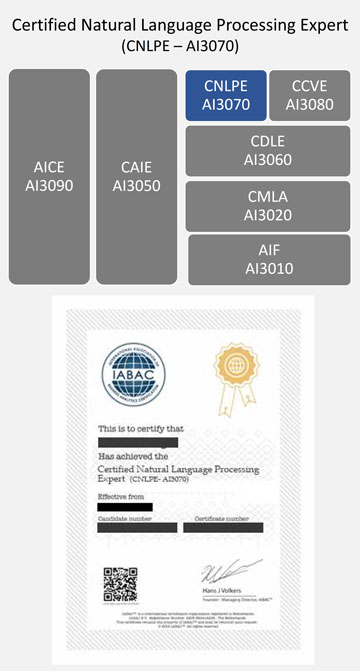
Certified Natural Language Processing Expert Certification (CNLPE – AI3070)

  • Learn NLP: Learn how computers understand and work with human language. This course will teach you how to use text data to find useful information.
  • Show Your Skills: Get a certificate that proves you know NLP. It can help you stand out in the field of artificial intelligence.
  • Get Better Job Options:  NLP experts are needed in many fields like health, banking, and tech. This course can help you find more job chances and improve your resume.
image

Download Syllabus

Enquire Now
 200/-
(Including all taxes)

Becoming a Certified Natural Language Processing (NLP) Expert can open many career opportunities. This certification shows that you understand how NLP works, including its methods, tools, and uses. It helps you stand out when applying for jobs.
Many companies today are looking for people who know how to work with text data. If you’re certified in NLP, you’re more likely to get noticed by employers. You’ll learn how to work with things like text classification, sentiment analysis, named entity recognition, and text generation. These skills are useful in areas like healthcare, finance, marketing, and customer support.
Getting certified not only helps you grow in your career but also helps your company improve its work. NLP can make work processes smoother, improve customer experiences, and help businesses do better in their field.

Why NLP Certification Is Helpful:

✅ Shows your skills in working with text data

✅ Makes your resume more attractive to employers

✅ Opens up jobs in tech, healthcare, finance, marketing, and more

This certification also allows you to explore different roles like data scientist, AI researcher, machine learning engineer, or consultant. NLP is used in many fields, so you have the chance to work on different types of projects and gain new experiences.
To get this certification, you’ll go through a training program that teaches the basics of NLP, machine learning, and deep learning. You’ll also get hands-on experience using popular tools and libraries. Most certification programs include exams, projects, and tasks to check your understanding and skills.
image

Not sure about your success rate?

image

COURSE SYLLABUS

Introduction to Natural Language Processing


  •  Introduction to NLP and its applications
  •  Key concepts and challenges in NLP
  •  Overview of NLP libraries and frameworks

Text Preprocessing for NLP


  •  Tokenization and stemming
  •  Stop word removal and punctuation handling
  •  Text normalization techniques
  •  Part-of-speech tagging and syntactic parsing

Sentiment Analysis and Opinion Mining


  •  Introduction to sentiment analysis
  •  Feature extraction for sentiment analysis
  •  Sentiment classification algorithms (Naive Bayes, SVM, etc.)
  •  Aspect-based sentiment analysis
     

Named Entity Recognition (NER)


  •  Introduction to NER and entity types
  •  Rule-based and statistical NER approaches
  •  Named entity recognition with deep learning models
  •  NER evaluation and benchmark datasets
     

Language Modeling and Text Generation


  •  N-gram language models
  •  Neural language models (e.g., LSTM, Transformer)
  •  Text generation using language models
  •  Evaluation metrics for language models

 Machine Translation


  •  Introduction to machine translation
  •  Rule-based and statistical machine translation
  •  Neural machine translation (seq2seq models)
  •  Evaluation and metrics for machine translation

Question Answering Systems


  •  Overview of question answering systems
  •  Information retrieval for question answering
  •  Text comprehension and machine reading comprehension
  •  Evaluation of question answering systems
     

Text Summarization


  •  Extractive and abstractive summarization
  •  Text ranking algorithms for extractive summarization
  •  Sequence-to-sequence models for abstractive summarization
  •  Evaluation metrics for text summarization

Topic Modeling


  •  Latent Dirichlet Allocation (LDA)
  •  Probabilistic topic models
  •  Topic modeling evaluation
  •  Applications of topic modeling

Advanced NLP Techniques


  •  Neural network architectures for NLP (e.g., CNN, RNN)
  •  Attention mechanisms in NLP
  •  Transfer learning in NLP
  •  Ethical considerations in NLP
     

Find Authorized Training Providers

Certified Natural Language Processing Expert

(Test Preparation Study Guide)

Get your free study guide for the Certified Natural Language Processing Expert Certification, the ultimate credential in NLP. Enhance your expertise and excel in the field of language processing. 


The Benefits

International Credential

IABAC is a widely recognized credentialing framework based on European commission funded EDISON Data Science body of knowledge. This credential provides distinction as high potential certified Data Science Professionals enabling better career prospects.

Global Opportunities

IABAC certification provides global recognition of the relevant skills, thereby opening opportunities across the world.

Specialization

IABAC Certification designed to cater to the job requirements of all experience levels and specializations, which suits roles aligned with the industry standards.

Relevant and updated

IABAC CPD (Continuing Professional Development) program enables credential holders to update their skills and stay relevant to the industry requirements.

Higher Salaries

On an average, a certified professional earns 30-40% more than their non-certified as per recent study by Forbes.

Summits & Webinars

In addition, IABAC members will have exclusive access to seminars and Data Science summits organised by IABAC partners across the globe.

Not sure which certification suits your goal? Get a free counselling

ARTIFICIAL INTELLIGENCE CERTIFICATIONS

COURSE FAQs

How long does it take to get a Certified Natural Language Processing Expert Certification after the exam completion?

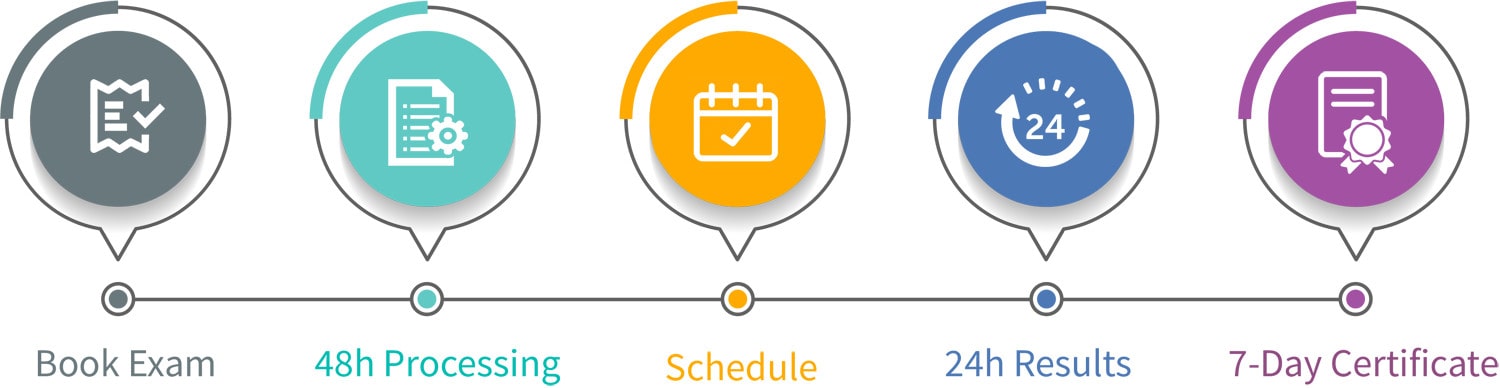
The time taken for Certified Natural Language Processing Expert certification after the exam completion is usually 10 working days.