



















































What is the Future of Artificial Intelligence?
Find out how AI will shape our future, transform industries, everyday life, and careers, and how humans and machines will work together.


I have worked regularly with artificial intelligence and have seen its transformation from a research issue to an integral part of our everyday lives. I've seen how it's affecting sectors like healthcare, banking, and education, where it's resolving issues more quickly and efficiently than ever.
AI is changing how we live and work, from clever systems in hospitals to smart assistants on our phones. To provide you with a better understanding of the possible applications of AI in the future, I would like to share my experiences and observations.
Understanding Artificial Intelligence
Before we can discuss the future, we need first to understand what artificial intelligence is.
The study of building devices and software that have human-like thought, learning, and decision-making skills is known as artificial intelligence. AI systems may study data, identify trends, and get better over time instead of just following fixed instructions.
Examples include:
-
Voice assistants like Alexa and Siri.
-
Recommendation systems on Netflix, YouTube, and Amazon.
-
Self-driving cars that navigate roads.
-
Medical AI tools that help doctors detect diseases.
These examples show how AI is already present in our daily lives, frequently without our knowledge.
Why AI is So Important
AI is more than a tool; it is a powerful force with the capacity to transform how we live and work. Here are several reasons for the importance of AI:
-
Efficiency: AI can handle huge amounts of data considerably faster than humans.
-
Accuracy: It lowers human error in fields like finance and healthcare.
-
Cost-saving: AI is used by businesses to automate processes and reduce expenses.
-
Innovation: AI drives innovation in everything from smart cities to new medicines.
Given these advantages, it is clear why governments, companies, and researchers are making huge investments in AI.
The Present State of AI
AI is currently at an advanced state, but still in development. The majority of AI systems in use today are narrow AI, which means they are made for particular purposes. A translation app, for instance, can assist with translating material from English to Spanish, but it is unable to make medical diagnoses or operate a vehicle.
However, general AI may be developed in the future, allowing machines to think and learn in a variety of ways similar to humans. The real adventure starts at that point.
Future of AI in Different Industries
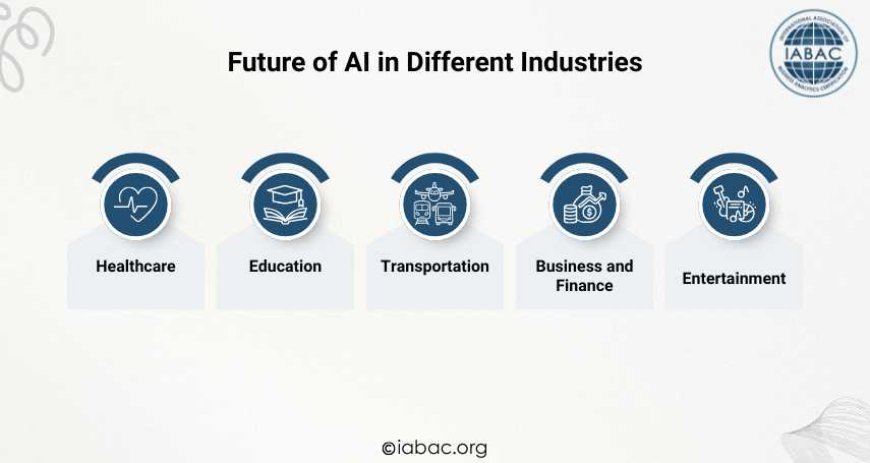
AI is predicted to change almost every sector. Let's discuss a few important areas:
1. Healthcare
AI will significantly contribute to better healthcare. Doctors can use it to predict outbreaks, suggest therapies, and identify diseases like cancer early on. Imagine a time in the future when artificial intelligence can review your medical history and develop a customized treatment plan for you.
2. Education
In the classroom, AI will customize learning for students. AI tutors could modify courses according to each student's skills and limitations rather than using a one-size-fits-all teaching approach. Learning could become easier and more fun as a result.
3. Transportation
Travel will be safer and quicker thanks to AI-powered traffic systems and self-driving automobiles. There might be fewer accidents, less traffic, and more effective public transportation in the future.
4. Business and Finance
AI will keep assisting companies in better decision-making, supply chain optimization, and customer behaviour prediction. AI in banking can deliver safer transactions and identify fraud in a matter of seconds.
5. Entertainment
AI-generated movies and games, as well as music suggestions, will make entertainment personalized. In the near future, you may see AI actors or virtual concerts.
Everyday Life with AI
AI will become more integrated in our daily lives in the future. Automated temperature, lighting, and security adjustments will make smart homes even more intelligent. In addition to responding to your inquiries, AI assistants will also take care of your emails, scheduling, and grocery shopping.
Our interactions with technology will likewise change. Digital encounters will become more organic and human-like as voice and gesture-based systems take the role of typing and clicking.
Is AI a Good Future Career?
Whether AI is a suitable career choice is one of the most frequently asked questions. The answer is definitely yes.
Professionals with expertise in AI are in high demand. Businesses require professionals who can develop AI systems, evaluate data, and use AI to address social and commercial issues. AI expertise is in high demand across industries, including banking, healthcare, and even agriculture, in addition to tech giants like Google and Microsoft.
Here are some reasons why AI is a great career:
-
High Demand: All businesses want qualified AI specialists.
-
Good Salary: Jobs involving AI frequently offer competitive compensation packages.
-
Many Jobs: You can work as a machine learning specialist, data scientist, AI engineer, or even in AI ethics.
-
Skills for the Future: AI is not a passing trend. Gaining knowledge of AI now will help you in future employment.
However, to enter this field, one must have good skills in data analysis, programming, and mathematics. Due to the quick growth of the sector, upskilling and continuous learning are important.
The Role of Humans in the AI Future
It's important to keep in mind that AI won't ever completely replace people. Rather, humans and AI will collaborate.
For example:
-
AI will be used by doctors as a tool, but human judgment will always be important.
-
While using AI-powered learning resources, teachers will continue to serve as mentors and advisors.
-
AI will be used by businesses for data, but human creativity and planning will always be important.
To put it briefly, AI will assist humans rather than completely replace them.
Preparing for the AI Future
People need to be ready to live in a world driven by AI. Here's how:
-
Learn new skills: Put your attention on abilities that AI cannot readily replace, such as creativity, problem-solving, and emotional intelligence.
-
Understand technology: Any career will benefit from having a basic understanding of data and artificial intelligence.
-
Adapt to change: Show flexibility and be willing to use AI tools.
In order to prepare the workforce for this new era, educational programs and certifications will be important.
It has a bright future ahead of it. AI has the potential to significantly enhance our lives in a variety of ways, including safer transportation, more intelligent healthcare, and individualized education. But there are drawbacks as well, like prejudice, losing one's work, and privacy issues.
The secret is using AI sensibly, making sure that humans and robots cooperate for the benefit of everybody. The real future of AI will be shaped as we proceed by finding a balance between ethics and innovation.
Getting trained and certified, such as through AI Certification, is a great first step if you want to keep ahead in this interesting industry.