




















































AI Product Management Certification Skills and Scope
Learn about AI product management certification covering key skills, career scope, tools, and opportunities to lead AI-driven product strategy and delivery.


Somewhere in an office, a data scientist is saying, “The model accuracy is 94%.”
A business head is asking, “So… will this increase revenue?”
An engineer is muttering, “We need more data.”
And everyone is silently hoping someone in the room understands what is going on.
That “someone” is an AI Product Manager.
Artificial Intelligence is everywhere now. It recommends what people watch, predicts what they buy, detects fraud before banks notice it, and even helps doctors read medical scans. But AI does not turn into useful products by itself. It needs direction, planning, clear goals, and someone who can translate business needs into AI solutions. This is where an ai product management certification becomes very powerful.
This article explains the skills, career scope, cost, duration, difference from traditional product management, and the industries hiring AI Product Management certified professionals across the world.
What Is AI Product Management?
AI Product Management is about managing products that use Artificial Intelligence and data models to make decisions or predictions.
These products include:
- Recommendation engines (like Netflix and Amazon)
- Chatbots and virtual assistants
- Fraud detection systems in banking
- Healthcare diagnosis tools
- Customer prediction systems in marketing
- Image recognition tools
- Demand forecasting systems
Unlike traditional products, AI products do not follow fixed rules. They learn from data and improve over time. Managing such products requires a special mix of business understanding and AI knowledge.
You do not build the model. You make sure the model solves the right problem.
Why This Role Is Growing Fast
More than 70% of companies worldwide are investing in AI projects. A surprising number of these projects struggle, not because the technology is bad, but because:
- The wrong problem was chosen
- The data was not ready
- Expectations from AI were unrealistic
- Teams were not aligned
Companies now understand they need professionals who can connect business goals with AI capabilities. This is why an Artificial Intelligence Certification focused on product management is becoming highly valued.
Skills You Gain from an AI Product Management Certification
A good ai product management certification teaches practical knowledge that can be used immediately in real projects.
1. Understanding AI and Machine Learning Basics
You learn how AI models work, what training data means, and what terms like accuracy, precision, recall, and bias really mean in business terms.
2. Identifying the Right AI Use Cases
You learn that not every problem needs AI. This alone saves companies time and money.
3. Understanding Data
AI runs on data. You learn:
- Types of data
- Data quality problems
- Data privacy and compliance
- Data preparation basics
4. AI Product Lifecycle
From idea to deployment:
- Problem definition
- Data collection
- Model building
- Testing
- Deployment
- Monitoring model performance
5. Working with Data Scientists and Engineers
You learn how to communicate clearly with technical teams without writing code.
6. Defining AI Success Metrics
AI products are measured differently:
- Model accuracy
- False predictions
- Model drift
- Business impact
7. Responsible and Ethical AI
Understanding bias, fairness, and safe use of Artificial Intelligence.
8. Roadmapping AI Products
Planning releases based on model readiness, not just feature readiness.
Difference Between AI Product Management and Product Management
|
Aspect |
Product Management |
AI Product Management |
|
Focus |
Features and user experience |
Data, models, and predictions |
|
Team dependency |
Engineering |
Data science + engineering |
|
Metrics |
Engagement, revenue |
Accuracy, bias, prediction quality |
|
Behavior |
Fixed features |
Learning and improving system |
|
Challenges |
Design and usability |
Data quality and model behavior |
|
Planning |
Feature roadmap |
Data and model roadmap |
Traditional product managers manage features. AI product managers manage systems that learn.
Scope of AI Product Management Certification
Professionals with an Artificial Intelligence Certification in product management can work as:
- AI Product Manager
- AI Program Manager
- AI Strategy Consultant
- AI Product Owner
- AI Solutions Manager
- AI Business Analyst
Because AI is used across industries, the scope is not limited to one sector.
Industries Hiring AI Product Management Certified Professionals
Organizations across the world are using Artificial Intelligence to improve decisions, reduce costs, and deliver better customer experiences. As AI adoption increases, companies need professionals who can guide these AI initiatives from idea to impact. This is where people with an AI Product Management Certification become valuable.
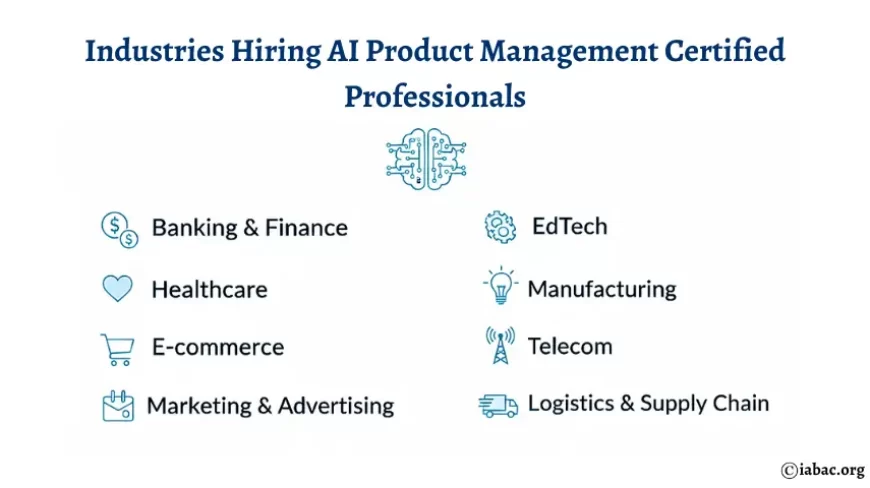
Below is a detailed look at how different industries use AI and why they hire AI product management professionals.
1) Banking and Finance
Banks and financial institutions depend heavily on data. AI systems are used every second to monitor transactions, predict risks, and protect customers.
Where AI is used:
- Fraud detection systems that monitor millions of transactions in real time
- Credit scoring models that assess loan eligibility
- Risk prediction tools for investments and insurance
- Chatbots for customer service
- Personalized financial product recommendations
Why AI Product Managers are needed:
These systems must be accurate, fair, and compliant with strict regulations. AI Product Managers ensure the right data is used, model results are understood, and business goals such as security and customer trust are achieved.
2) Healthcare
Healthcare generates large amounts of patient data, reports, scans, and medical records. AI helps doctors make faster and more accurate decisions.
Where AI is used:
- Medical image analysis (X-rays, MRIs, CT scans)
- Disease prediction models using patient history
- Patient data analytics for treatment planning
- Hospital resource planning and patient flow prediction
- Virtual health assistants
Why AI Product Managers are needed:
Accuracy in healthcare is critical. AI Product Managers make sure models are trained with quality data, tested properly, and used responsibly to support doctors without replacing human judgment.
3) E-commerce
Online shopping platforms use AI to understand customer behavior and improve sales.
Where AI is used:
- Product recommendation systems
- Customer behavior prediction
- Inventory and demand forecasting
- Dynamic pricing systems
- Chatbots and virtual shopping assistants
Why AI Product Managers are needed:
These AI tools directly affect customer experience and revenue. AI Product Managers align business goals like sales growth with AI capabilities and ensure models keep improving with new data.
4) Marketing and Advertising
Marketing has become highly data-driven. AI helps businesses reach the right audience at the right time.
Where AI is used:
- Customer segmentation
- Campaign performance prediction
- Personalization engines for ads and emails
- Lead scoring models
- Social media sentiment analysis
Why AI Product Managers are needed:
Marketing teams depend on AI outputs for decision-making. AI Product Managers ensure the predictions are reliable and meaningful for campaign strategies.
5) EdTech (Education Technology)
Online learning platforms use AI to understand how learners study and where they struggle.
Where AI is used:
- Learning pattern analysis
- Performance prediction
- Personalized course recommendations
- Automated assessments
- Student engagement tracking
Why AI Product Managers are needed:
These systems must truly improve learning outcomes. AI Product Managers help design AI tools that support learners and educators effectively.
6) Manufacturing
Factories and production units use AI to improve efficiency and reduce downtime.
Where AI is used:
- Predictive maintenance of machines
- Quality inspection using computer vision
- Production demand forecasting
- Supply usage optimization
- Worker safety monitoring
Why AI Product Managers are needed:
AI systems here directly affect production costs and quality. AI Product Managers ensure these tools are reliable and integrated smoothly into operations.
7) Telecom
Telecom companies handle millions of users and large network data every day.
Where AI is used:
- Customer churn prediction
- Network optimization
- Service quality monitoring
- Automated customer support
- Usage pattern analysis
Why AI Product Managers are needed:
AI Product Managers make sure AI tools improve customer satisfaction and network performance without errors.
8) Logistics and Supply Chain
AI plays a big role in moving goods efficiently from one place to another.
Where AI is used:
- Route optimization for deliveries
- Demand forecasting
- Warehouse automation
- Shipment delay prediction
- Inventory planning
Why AI Product Managers are needed:
These AI systems reduce delays and costs. AI Product Managers ensure accurate data flow and meaningful predictions for operations teams.
Cost of AI Product Management Certification
The cost varies depending on the provider and depth of curriculum.
On average worldwide:
- Foundation level: $200 – $400
- Professional level: $500 – $1,200
- Advanced global certifications: $1,500+
Considering the career growth and demand, this cost is often seen as a strong investment.
Duration of AI Product Management Certification
Most certifications are designed for working professionals.
Typical duration:
- 4–6 weeks for foundation programs
- 8–12 weeks for detailed programs
- Self-paced options available
Average learning time: 5–8 hours per week.
Who Should Take This Certification?
This certification is useful for:
- Product managers moving into AI roles
- Business analysts working with data teams
- Project managers handling AI projects
- Marketing, finance, and operations professionals using AI tools
- Professionals wanting to enter AI roles without coding
No programming background is required.
Real Business Impact of AI Product Managers
AI projects often fail because teams are not aligned. AI Product Managers help by:
- Setting realistic expectations
- Translating AI output into business action
- Reducing project delays
- Improving adoption of AI systems
- Preventing data misuse
They bring clarity to AI initiatives.
Career Growth After AI Product Management Certification
Professionals often experience:
- Role transition into AI-focused teams
- Better salary growth compared to traditional product roles
- Opportunities in global AI projects
- Leadership roles in AI initiatives
Since this role is still emerging, competition is lower and opportunity is higher.
Why Companies Prefer Certified Professionals
An Artificial Intelligence Certification proves that the professional:
- Understands AI concepts clearly
- Knows how AI products function
- Can manage AI risks
- Understands ethical AI usage
- Can coordinate across teams
This builds employer confidence.
Practical Knowledge You Can Use Immediately
After completing an ai product management certification, professionals can:
- Identify AI opportunities in their current organization
- Speak confidently with data teams
- Define AI metrics clearly
- Plan AI-based product features
- Improve existing AI systems
This knowledge is practical, not theoretical.
The Future Scope of AI Product Management
AI adoption is increasing every year. Companies are building AI-powered tools for decision-making, automation, and prediction.
AI Product Management sits at the center of this growth because it connects business needs with AI capability. This role is expected to become standard in organizations using Artificial Intelligence.
AI products are not like regular software. They learn from data, change over time, and behave differently from rule-based systems. Managing them requires special understanding. An ai product management certification helps professionals gain this understanding in a structured way. It opens doors to industries where Artificial Intelligence is shaping the future of decisions, services, and products.
For professionals who want to work with AI without becoming programmers, this path offers strong career scope, real-world knowledge, and long-term relevance. And the next time a data scientist says, “The model accuracy is 94%,”
someone in the room will calmly say,
“Great. Here is how we turn that into business value.”