
























































How Data Analytics Companies Drive Business Growth?
Understand how data analytics companies drive business growth by improving revenue, marketing ROI, operational efficiency, and strategic decision-making.

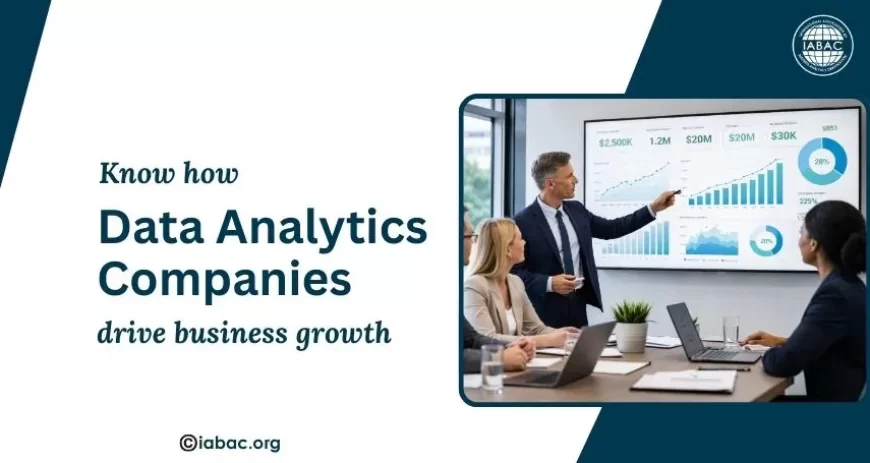
Businesses often invest in marketing, operations, and technology, yet struggle to see consistent growth because decisions are not backed by clear insights.
Data analytics companies change that equation. They help organizations understand
What is actually driving revenue?
Where is money being lost?
Which opportunities deserve attention?
Instead of guessing, leaders gain clarity about customer behavior, market demand, and internal performance through deeper analytics knowledge. This clarity improves strategy, strengthens execution, and reduces costly mistakes.
When data is interpreted correctly and aligned with business goals, growth becomes structured, measurable, and sustainable rather than uncertain or reactive.
Transforming Raw Data into Strategic Decision Intelligence
Data analytics companies begin by gaining clarity on business objectives. Growth requires direction, whether it is increasing market share, improving customer retention, enhancing operational efficiency, or entering new segments. Analytics teams translate these goals into measurable KPIs and structured data frameworks.
Their approach typically includes
-
Data collection from multiple internal and external sources
-
Data cleaning and normalization to ensure accuracy
-
Integration across CRM, ERP, marketing platforms, and finance systems
-
Development of centralized dashboards and real-time reporting systems
Once the foundation is built, enterprise data analytics solutions apply predictive modeling, clustering, and statistical forecasting to deliver forward-looking insights. Instead of relying on intuition, leadership teams gain clarity backed by evidence.
This impact improves:
-
Budget allocation decisions
-
Pricing strategies
-
Product development roadmaps
-
Expansion planning
-
Resource optimization
Growth becomes structured rather than reactive.
What Services Do Data Analytics Companies Provide for Business Growth?
Data analytics companies offer structured services designed to align analytics capability with measurable business outcomes.
Core services include:
Data strategy development
Defines how data will be collected, managed, and aligned with business goals to support measurable growth.
It ensures every analytics initiative contributes directly to revenue, efficiency, and long-term scalability.
Business intelligence implementation
Transforms raw data into structured dashboards and reports that guide daily decision-making.
It provides leadership teams with clear visibility into performance, trends, and operational gaps.
Predictive analytics modeling
Predictive analytics uses historical and real-time data to forecast future outcomes such as demand, revenue, and customer behavior.
This enables proactive planning instead of reacting to unexpected shifts in the market.
AI integration and automation
Embeds intelligent systems into workflows to improve speed, accuracy, and consistency across operations.
Automation reduces manual effort while enhancing productivity and decision precision.
Data governance and compliance frameworks
Establishes policies and controls to ensure data accuracy, security, and regulatory compliance.
It builds trust by protecting sensitive information and maintaining consistent data standards.
Advanced analytics consulting
Provides expert guidance on applying analytics to solve complex business challenges. It bridges the gap between technical capabilities and strategic business outcomes.
How Do Data Analytics Companies Increase Revenue?
Revenue growth depends on accurate customer understanding and demand forecasting. Data analytics firms analyze behavioral data, purchase history, digital engagement patterns, and transactional records to create advanced customer intelligence models.
Through segmentation and predictive analytics, businesses can:
Identify high-value customer segments
This means finding the group of customers who generate the most revenue, buy frequently, or have the highest lifetime value. By analyzing purchase patterns, engagement levels, and demographics, businesses can focus more attention and resources on customers who contribute the most to growth.
Anticipate churn risks
Churn risk refers to customers who are likely to stop buying or cancel subscriptions. By studying behavior changes such as reduced engagement, delayed payments, or declining purchase frequency, companies can identify warning signs early and take action before losing those customers.
Personalize marketing campaigns
Instead of sending the same message to everyone, personalization tailors content, offers, and recommendations based on customer preferences and behavior. This makes communication more relevant, increases engagement, and improves the chances of conversion.
Improve conversion rates
Conversion rate improvement focuses on turning more visitors or leads into paying customers. By analyzing user journeys, drop-off points, and buying behavior, businesses can adjust messaging, pricing, or website experience to encourage more completed purchases.
Optimize cross-sell and upsell strategies
Cross-selling suggests related products, while upselling encourages customers to choose higher-value options. By understanding buying patterns, companies can recommend the right products at the right time, increasing average order value without aggressive selling.
Optimizing Marketing Performance and ROI
Marketing budgets require measurable impact. Analytics firms enhance marketing effectiveness by tracking performance across channels, campaigns, and customer journeys.
Key contributions include:
-
Attribution modeling to determine conversion-driving channels: Identifies which marketing channels contribute most to conversions so budgets can be allocated more effectively.
-
A/B testing to optimize creative elements: Compares different versions of ads, emails, or landing pages to determine which variation delivers better performance.
-
Customer acquisition cost analysis: Measures how much is spent to acquire each new customer to ensure marketing investments remain profitable.
-
Campaign performance forecasting: Uses historical data to predict how future campaigns are likely to perform before full-scale execution.
-
Marketing mix modeling: Analyzes the combined impact of various marketing channels to understand how each contributes to overall revenue growth.
With analytics-driven clarity, businesses eliminate inefficient spending and redirect investment toward high-performing channels. This strengthens lead quality, conversion rates, and overall return on ad spend.
Precision marketing becomes a growth accelerator rather than an expense center.
Improving Operational Efficiency and Cost Optimization
Growth also depends on margin protection. Data analytics companies analyze operational workflows to identify inefficiencies, bottlenecks, and cost leakages.
Operational analytics focuses on:
Supply chain optimization
Supply chain optimization focuses on improving the flow of goods, information, and resources from suppliers to customers. By analyzing delivery timelines, transportation costs, demand patterns, and supplier reliability, businesses can reduce delays, lower expenses, and ensure products reach customers efficiently.
Inventory forecasting
Inventory forecasting predicts how much stock will be needed based on past sales trends, seasonal demand, and market behavior. Accurate forecasting prevents overstocking, reduces storage costs, and avoids stockouts that can lead to lost sales and dissatisfied customers.
Production planning
Production planning determines what to produce, when to produce it, and in what quantity. By aligning production schedules with demand forecasts and resource availability, businesses can minimize waste, control costs, and maintain steady output without operational disruptions.
Workforce analytics
Workforce analytics examines employee productivity, attendance patterns, workload distribution, and staffing needs. This helps organizations allocate the right number of employees at the right time, improving efficiency while avoiding overstaffing or burnout.
Vendor performance tracking
Vendor performance tracking evaluates suppliers based on quality, delivery consistency, pricing, and reliability. Monitoring these metrics helps businesses build stronger supplier relationships, negotiate better terms, and reduce risks caused by poor vendor performance.
Predictive demand forecasting ensures optimal inventory levels, reducing holding costs and stockouts. Workforce analytics aligns staffing with demand cycles.
The outcome includes:
-
Reduced operational waste
-
Faster turnaround times
-
Improved service delivery
-
Enhanced profitability
Enterprise analytics transforms cost management into a strategic advantage.
How Do Data Analytics Companies Improve Strategic Decision-Making?
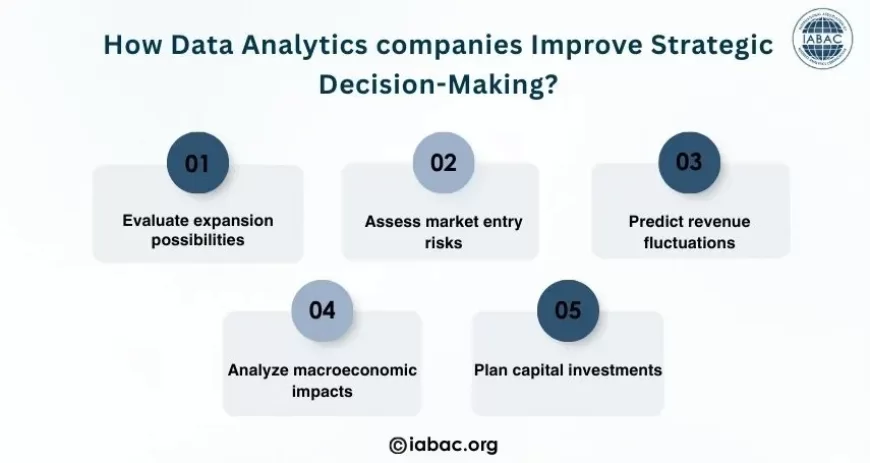
Strategic growth requires long-term clarity. Data analytics companies develop forecasting and scenario modeling frameworks that simulate various business outcomes.
Scenario planning enables leaders to:
-
Evaluate expansion possibilities by analyzing demand trends, competitive positioning, operational capacity, and projected returns before scaling into new markets.
-
Assess market entry risks by reviewing regulatory factors, competitor strength, cost structures, and potential operational challenges prior to investment.
-
Predict revenue fluctuations by examining historical performance, seasonal patterns, and market indicators to prepare for income variability.
-
Analyze macroeconomic impacts by studying inflation, interest rates, and industry growth signals that influence strategic business decisions.
-
Plan capital investments effectively by aligning projected returns, cash flow forecasts, and long-term objectives with funding allocation decisions.
Executive dashboards simplify complex analytics into actionable insights. Leadership teams gain confidence in decisions because projections are grounded in structured data modeling.
This alignment between analytics and executive strategy accelerates performance-driven decision-making.
Strengthening Risk Management and Compliance
As organizations scale, risk exposure increases. Data analytics firms implement predictive monitoring systems for financial, operational, and cybersecurity risks.
Applications include:
-
Fraud detection models
-
Credit risk scoring
-
Regulatory compliance tracking
-
Financial anomaly detection
-
Cybersecurity analytics
By identifying irregular patterns early, companies prevent losses and protect brand reputation. Predictive risk management supports sustainable expansion while maintaining compliance standards.
Driving Innovation Through Advanced Analytics and AI Integration
Modern data analytics companies integrate AI-powered systems to enhance automation and predictive capabilities.
Advanced solutions include:
-
Machine learning-based demand forecasting: Uses historical sales data and behavioral patterns to accurately predict future product or service demand.
-
Recommendation engines: Suggest relevant products or content to customers based on their preferences, behavior, and purchase history.
-
Natural language processing for sentiment analysis: Analyzes customer reviews, feedback, and social media conversations to understand public sentiment and brand perception.
-
Automated decision systems: Applies predefined rules and predictive models to make instant business decisions with minimal human intervention.
-
Real-time analytics dashboards: Provide live performance insights through visual reports that support faster and data-driven decision-making.
AI-driven analytics reduce manual intervention, accelerate insight generation, and improve forecasting precision.
Innovation becomes embedded in daily operations, supporting long-term competitiveness.
Enabling Data-Driven Culture Across Organizations
Sustainable growth requires cultural alignment. Analytics firms help businesses embed data-driven practices across departments.
This involves:
-
Standardized reporting frameworks
-
Cross-functional data sharing
-
Performance dashboards aligned with KPIs
-
Analytics capability training
A data-driven culture strengthens accountability, transparency, and strategic consistency.
Over time, this shift compounds growth results.
Accelerating Digital Transformation Initiatives
Digital transformation depends on modern data architecture. Data analytics companies modernize legacy systems and implement scalable analytics ecosystems.
Key initiatives include:
-
Cloud data warehousing centralizes business data in a scalable environment, enabling faster access, real-time analysis, and seamless collaboration across teams.
-
Automated data pipelines streamline the collection, processing, and movement of data between systems, reducing manual effort and ensuring consistent data accuracy.
-
Secure data governance frameworks establish clear policies for data quality, privacy, access control, and compliance to protect organizational information.
-
API integrations across platforms connect different software systems, allowing smooth data exchange and unified reporting across departments.
Digital maturity supported by analytics enhances agility and responsiveness in competitive markets.
Measuring Growth Through Performance Metrics and KPIs
Analytics-driven growth requires measurable benchmarks. Data analytics companies establish performance tracking frameworks aligned with business objectives.
Growth-focused KPIs include:
-
Customer lifetime value: Measures the total revenue a business can expect from a customer throughout their entire relationship with the company.
-
Revenue per user: Calculates the average income generated from each active customer over a specific period.
-
Conversion rates: Tracks the percentage of prospects or visitors who complete a desired action such as a purchase or sign-up.
-
Operating margins: Indicates the percentage of revenue remaining after covering operating expenses, reflecting overall efficiency.
-
Customer acquisition cost: Determines the total cost incurred to acquire a new customer through marketing and sales efforts.
-
Retention rate: Measures the percentage of customers who continue doing business with the company over a defined time period.
Real-time dashboards visualize trends and enable continuous performance optimization.
Measurement clarity ensures scalability and sustainability.
Continuous Optimization Through Iterative Analytics
Growth is dynamic. Data analytics companies implement continuous improvement models through:
-
Regular model retraining
-
Performance audits
-
Experimentation frameworks
-
Data validation processes
Rather than a one-time implementation, analytics becomes an ongoing growth engine.
Data analytics companies drive business growth by converting enterprise data into strategic insight, improving revenue performance, optimizing operations, strengthening marketing precision, enhancing risk management, and enabling AI-driven innovation. Organizations looking to operationalize these strategies can access a structured network to engage experienced analytics professionals aligned with their growth objectives. Through structured services and scalable enterprise analytics solutions, businesses achieve measurable, sustainable growth supported by intelligence rather than assumption. As organizations increasingly depend on analytics-driven decisions, professionals with validated expertise through industry-recognized certifications play an essential role in implementing these strategies effectively.