





























































How Sovereign AI Could Change AI Careers Forever
See how Sovereign AI is reshaping AI careers, national investments, infrastructure costs, talent shortages, and new job opportunities across global industries.

The artificial intelligence industry is going through a big change. For years, a small group of tech giants in places like Silicon Valley controlled most of the world's AI power. Developers everywhere depended on their cloud systems and APIs to build anything useful.
Now, a new idea is taking over: Sovereign AI.
Countries and large companies are starting to see the risks of depending on outside providers for something as important as AI. Because of this, Sovereign AI is changing how the tech industry works. This is not just a political or technical issue; it will affect the career of almost anyone working in AI. Let's see more about Sovereign AI.
What is Sovereign AI?
Before looking at the career impact, it helps to understand the term clearly. Sovereign AI refers to a nation's or organization's ability to develop, deploy, and control its own artificial intelligence infrastructure, models, and data without relying on external providers.
A few things are driving this shift:
Data Safety and National Security
Governments handle sensitive information like healthcare records and infrastructure data. This kind of data cannot be processed on servers owned by foreign companies, since it creates security risks for the country.
Protecting Local Language and Culture
Most AI models are trained mainly on English and Western data. Because of this, they often fail to understand other cultures and languages properly. Building local models helps fix this gap.
Political and Economic Reasons
Countries face limits on advanced computer chips from other nations. On top of that, there is a strong desire to grow local tech industries and reduce dependence on outside providers.
Sovereign AI Investments Around the World
The European Union's push to build AI factories, the UAE's work on its own AI model, and India's investment in local AI infrastructure are all examples of this trend.
The European Union has invested about 10 billion euros in supercomputers and AI factories between 2021 and 2027. This funding comes from a joint EU program called EuroHPC. Today, 19 AI factories are already running across Europe.
In the UAE, the Technology Innovation Institute built Falcon, an open-source AI model trained locally on Emirati infrastructure by teams based in Abu Dhabi. This sovereign push is backed by serious capital: what began as a 1.5 billion dollar Microsoft investment in G42 grew into a 15.2 billion dollar strategic alliance running through 2029, as reported by the Times of Israel.
According to the Press Information Bureau, Government of India, the country's push runs through the IndiaAI Mission. The government approved a budget of 10,371.92 crore rupees, or about 1.1 billion dollars, over five years. This money funds compute infrastructure, datasets, foundation models, and AI talent development. The mission started with a target of 10,000 GPUs. It has now onboarded 38,000 GPUs and supports homegrown models like BharatGen.
These three regions are not the whole picture. According to the CNAS Sovereign AI Index, the UAE and Japan together account for more than two-thirds of all disclosed sovereign AI spending worldwide, and the Middle East and East Asia combined make up over 80% of total tracked investment.
Out of 139 sovereign AI projects tracked globally, most of the money goes into infrastructure like data centers and compute, not model building or datasets. This means the money and the jobs are not spread evenly. Some regions are moving fast while many others are still in early planning stages.
The Real Costs Behind Sovereign AI
Building national AI systems is far more expensive and slower than most headlines suggest. Professionals entering this space should understand the practical roadblocks governments and companies are facing.
Rising infrastructure costs
According to Goldman Sachs Research, global electricity demand from data centers is projected to rise 50% by 2027 and 165% by the end of the decade. In France alone, electricity use by data centers could grow nearly fourfold by 2035.
Talent shortages are a bigger problem than most people realize
Building sovereign AI systems needs skilled people, and right now, there simply are not enough of them. Around the world, AI talent demand is more than three times higher than supply.
According to the second talent, companies and governments are competing for roughly 1.6 million open AI roles, but only about 518,000 qualified people are available to fill them. This gap is not the same everywhere. The Asia-Pacific region faces the worst shortage, with close to four open roles for every one qualified candidate.
A country can build data centers and buy chips fairly quickly, but training enough skilled engineers and researchers takes years, not months.
Adoption still lags behind investment
Despite billions in funding, only 13.5% of EU companies currently use AI. This shows a wide gap between infrastructure spending and actual use on the ground.
Uneven private capital participation
Between 2023 and mid-2025, the US attracted 66% of global venture capital in AI start-ups, compared with just 12% in Europe. This slows how fast sovereign projects can scale without heavy public subsidy.
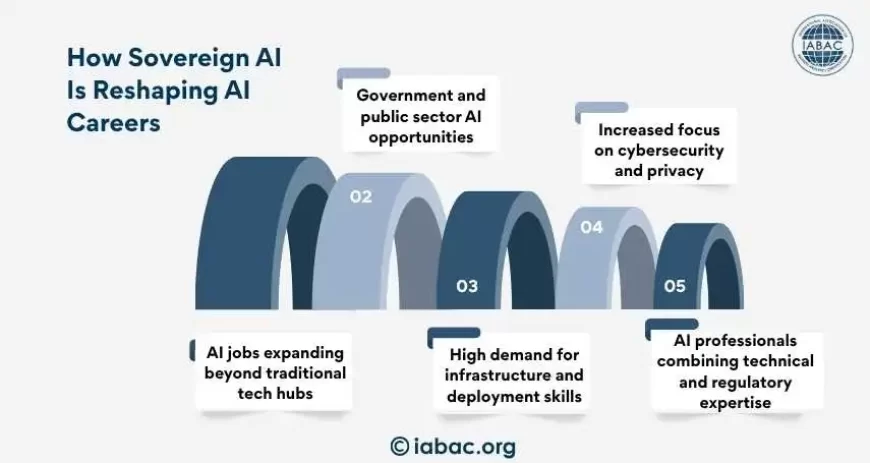
Jobs Are Spreading Out, Not Staying in One Place
Sovereign AI is not moving at the same speed everywhere. Each country is also taking its own path.
The United States lets private companies lead AI progress. China relies on state support and large domestic companies. India is testing a mixed model that blends public funding with private and open-source partnerships.
Industries are moving at different speeds too. Regulated sectors like finance and healthcare tend to move slower because of compliance rules. This means Sovereign AI career opportunities will show up unevenly. Some regions and industries will see them sooner than others.
In the past, if you wanted a strong career in AI, you almost had to move to San Francisco, Seattle, London, or Beijing. Money, computing power, and talent were all packed into a few places. This created a narrow but clear career path. Sovereign AI is breaking that pattern.
More Local Tech Hubs Will Grow
As countries build their own AI systems, they will need local people to build and maintain them. This means AI jobs will spread out across many regions instead of staying centered in a few cities. New hubs will grow in places like Berlin, Paris, Abu Dhabi, Bangalore, Singapore, and Toronto.
This is a big opportunity for AI professionals. You will not need to move across the world to work for a large tech company to have a strong AI career. Sovereign AI projects, often backed by governments, will create high-paying, advanced jobs closer to home. This will also bring more diverse ideas and perspectives into the field.
More Government and Public Sector AI Jobs
Private companies have driven most AI progress so far. But Sovereign AI is closely tied to national interests, so public sector AI jobs will grow. Governments will need AI experts to manage national data, check models for bias, and make sure AI follows local laws.
This gives professionals the chance to work on projects with real impact, like smart city systems, public healthcare tools, and education technology.
Skills Will Shift Toward Efficiency and Security
The AI professional of the future will look different from the one now. In the past, the most valuable skill was scaling huge models and pushing parameter counts higher.
In the Sovereign AI era, efficiency, security, and local knowledge will matter more.
From Using APIs to Building and Optimizing Models
Many AI developers currently work by sending requests to outside AI providers and showing the results. Sovereign AI will need developers who can run models on their own systems, adjust them for specific hardware, and manage the full process from training to deployment.
What to learn: Model compression (making models smaller and faster), edge computing, container tools, and lower-level programming languages for hardware work.
Stronger Focus on Cybersecurity and Privacy
When AI is built and run locally, its security becomes a matter of national or company safety. Models can be attacked through data poisoning or extraction attempts. AI professionals will need solid cybersecurity knowledge to protect these systems.
What to learn: Privacy-preserving methods, encrypted computing, and techniques that let AI process data without exposing it directly. These skills will be highly valuable.
Becoming a Well-Rounded Technologist
Because Sovereign AI depends on local context, professionals will need more than coding skills. They will need to understand technology, local law, and local culture together. An AI engineer working on a project in India, for example, will need to understand local business practices, privacy rules, and language details to build something that actually works.
What to learn: Local regulations, industry-specific knowledge (such as local healthcare or finance systems), and language processing methods for non-English languages.
Companies Are Building Their Own Sovereign AI Too
Sovereign AI is not only a government trend. Large companies are also building their own private AI systems. Worried that their data could end up training public models or that competitors could gain an edge, big companies are building internal AI tools.
This corporate version of Sovereign AI will add even more jobs. Companies will hire AI talent to build internal models trained only on their own data, hosted on their own servers, and used only by their employees.
In-House AI Teams Will Grow
For years, many companies relied on outside AI services. This shift is bringing AI work back in-house. Large companies in finance, healthcare, and manufacturing will build their own AI teams. For AI professionals, this means job opportunities in almost any industry, not just tech companies.
Finance: Building private AI systems to catch fraud, manage risk, and handle trades without sending sensitive data outside the company.
Healthcare: Building local AI tools that can help diagnose illness and manage patient records while following strict privacy laws.
Challenges AI Professionals Should Be Aware Of
Sovereign AI brings real opportunity, but it also comes with challenges worth understanding.
Risk of Narrow, Disconnected Skills
If every country and company builds its own closed AI system, the industry could become fragmented. An engineer who understands the specific rules and setup of one country's sovereign system may find it hard to apply those exact skills elsewhere.
There is also a deeper dependency problem:
- About 70% of sovereign AI projects still depend on at least one foreign partner, mostly US companies, according to the CNAS Sovereign AI Index.
- One chip maker alone supplies GPUs for more than half of all tracked infrastructure projects worldwide.
- True independence is rare. Most countries are shifting which part of the AI stack they depend on, not removing dependency altogether.
How to handle it: Keep a strong base in core AI principles. While daily work may be local, your understanding of math, algorithms, and machine learning theory should still apply anywhere.
Repeating Work That Already Exists
Sovereign AI often means building things from scratch instead of using ready-made tools. Teams may spend months building and testing infrastructure that already exists elsewhere. This can slow down innovation.
How to handle it: Use open-source collaboration where possible. Sharing non-sensitive tools with the wider community, even within local limits, reduces repeated effort.
Ethical Questions Around State-Backed AI
Working on national AI projects can raise difficult questions. Sovereign AI can support good causes like public healthcare, but it can also be used for surveillance or control by governments with poor human rights records.
How to handle it: Build a clear personal set of ethical standards. Before joining a national AI project, look closely at its goals, the government's record on rights, and how the technology could be used.
How to Prepare for This Shift
If you want your career to stay strong through this shift, start building the right skills now. What worked in a job search a few years ago may not be enough in the years ahead. Here is a simple plan:
Learn open-source models well
Do not rely only on AI services owned by other companies. Learn to download, adjust, and run open-source models on your own systems
Learn infrastructure and operations
Shift some focus from model design to the full AI lifecycle. Learn to set up servers, manage hardware clusters, and deploy models securely.
Study local rules and laws
Get familiar with data privacy and AI laws in your region. Being the person who understands both AI and local compliance will make you valuable.
Build expertise in one specific industry
Sovereign AI projects tend to be specialized. If you understand both AI and a specific local industry, such as agriculture, banking, or manufacturing, you will be in strong demand.
Build both local and global connections
Attend local meetups and events. At the same time, stay connected with the wider tech community online to keep up with global trends.
A New Chapter for AI Careers
The age of one central AI system controlling everything is ending. Sovereign AI is changing how technology gets built, used, and governed around the world. For AI professionals, this is not something to fear; it is a real opportunity.
By spreading job opportunities, creating new specialized roles, and requiring a mix of technical, legal, and cultural skills, Sovereign AI is opening up AI careers to more people in more places. You do not need to work for one of the world's biggest tech companies to be part of the AI field. Whether you work on local hardware setups, curate cultural datasets, or manage AI compliance, this shift will bring years of meaningful work.
The future of AI is local, secure, and built by people close to home. Professionals who prepare for this now, including through structured AI certifications, will be ready to lead this next chapter.
Sources & References:
European Commission:
https://digital-strategy.ec.europa.eu/en/policies/ai-factories
Times of Israel:
https://blogs.timesofisrael.com/how-the-uae-became-an-emerging-superpower-in-the-global-ai-economy/
Press Information Bureau, Government of India:
https://www.pib.gov.in/PressNoteDetails.aspx?ModuleId=3&NoteId=156786&lang=1®=3
CNAS sovereign AI index
https://interactives.cnas.org/reports/sovereign-ai-index/