














































Data Science and Analytics Courses: Skills, Careers, and Learning Path
See how employer hiring trends are changing the value of Data Science certifications in 2026, with insights into skills, roles, and career opportunities.

Key Takeaways
- Working with data has gone from a specialist skill to something nearly every industry now expects.
- Good courses in 2026 mix statistics, machine learning, and basic AI knowledge all in one place.
- A certificate by itself is rarely enough — what matters most is having real projects to show.
- Beginners, working professionals, developers, marketers, and executives all need different starting points.
- IABAC is one of the recognized global bodies for data science certifications in business analytics and data science.
- The biggest gap in analytics education is not missing content — it is missing real practice on real, messy data.
- People who combine technical skills with the ability to explain what the data means to non-technical teams tend to go furthest in their careers.
Every industry today runs on data. But most professionals were never trained to actually use it. Marketing teams sit on piles of customer information they never fully analyze. Operations leaders make gut decisions because no one translated the dashboard into a clear recommendation. At the same time, job postings for data analyst, data scientist, and analytics manager keep growing — even as hiring in some tech areas slows down. This gap is exactly why Data Science and Analytics Courses have become one of the most searched categories in professional education. You will find university degrees, short bootcamps, online courses, and certification bodies — all claiming to prepare you for the same broad field. Some of them are thorough and rigorous. Many are not. And the gap between "finished a course" and "can actually do the job" is often much bigger than course marketing suggests.
This guide explains what data science and analytics actually involve, how courses are typically built, what to look for in 2026, and how to put together a learning plan that matches your actual goals — whether that is your first analyst job, a move from a technical background into data science, or simply making better decisions as a manager who will never write a line of code.
What Data Science and Analytics Actually Mean
Data science and analytics are often used as if they mean the same thing, but they describe two related and distinct areas of work.
- Data analytics is mainly about looking at existing data to answer specific questions: What happened? Why did it happen? What should we do next? It leans on descriptive and diagnostic methods — dashboards, reports, statistical summaries, and trend analysis.
- Data science goes further. It uses statistical modeling, machine learning, and sometimes deep learning to build systems that can predict or automate decisions: What will happen? What is the best action to take? It requires more programming, model building, and engineering knowledge.
In practice, most working professionals sit somewhere between the two. And most good courses today teach a mix of both, because employers rarely hire someone who can only do one.
How These Courses Are Usually Built
Most structured programs, regardless of the provider, follow a similar structure — even when the branding differs:
- Foundations — statistics, probability, data types, and basic ways to display information visually.
- Tools — spreadsheets or SQL to start, then a programming language such as Python or R.
- Core techniques — data cleaning, exploratory analysis, hypothesis testing, and dashboarding tools.
- Applied modeling — regression, classification, clustering, and in more advanced programs, full machine learning pipelines.
- Business application — turning technical output into recommendations, KPIs, and reports that stakeholders can actually use.
- Capstone project — a portfolio piece using a real or realistic dataset, reviewed by an instructor or mentor.
- Certification exam — a proctored or project-based assessment that gives employers something to verify.
What separates providers usually comes down to depth (how far they go into machine learning and AI), rigor (how much real project work is required versus passive video watching), and recognition (whether employers in your target field actually know and trust the credential).
Types of Data Science and Analytics Courses
Not all courses serve the same purpose. Here is how the main options break down:
- University degree programs (bachelor's or master's in data science, statistics, or analytics) offer the deepest grounding in theory and are best for people early in their careers who can commit one to two or more years.
- Professional certification programs sit between short courses and full degrees. They are built for working professionals, typically take a few months, and end in a credential employers can recognize. This is where bodies like IABAC operate, partnering with training providers to deliver structured, certification-backed programs — making them a strong path for those seeking formal Data Science Certifications.
- Bootcamps are intensive, short-duration programs — usually three to six months — focused heavily on job readiness and portfolio building, typically at a higher cost, aimed at career changers.
- Self-paced online courses are the most flexible and least structured option. They are useful for adding to existing skills or testing whether you enjoy the subject before committing to something more rigorous.
- Corporate and executive training is designed for leaders and managers who need to work comfortably with data for decision-making — not hands-on technical work. These programs are shorter, lighter on coding, and more focused on strategy.
Who Should Take Which Course?
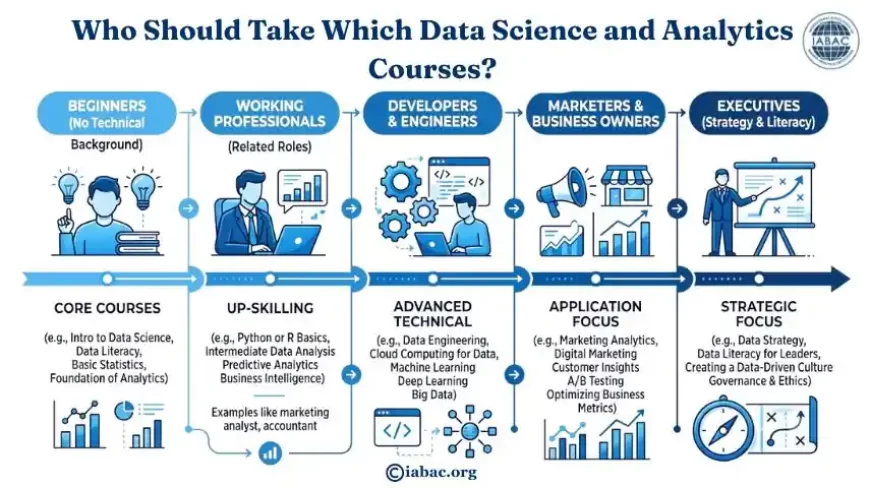
Beginners with no technical background should start with data literacy and analytics basics — statistics, spreadsheet skills, and an introduction to SQL or Python — before moving on to anything labeled "data science."
Working professionals in related roles — business analysts, finance teams, operations managers — often benefit most from a structured certification program that builds on what they already know. IABAC-aligned certification tracks are designed for exactly this kind of transition.
Developers and engineers usually already know how to code and should focus on statistics, machine learning theory, and model deployment rather than basic programming.
Marketers and business owners benefit most from applied analytics courses covering customer data, attribution, and experimentation like A/B testing — not deep machine learning.
Executives need courses on data strategy and data literacy — teaching them how to ask the right questions and read model output critically, not how to build the models themselves.
Benefits of Structured Education in This Area
Faster skill-building. Structured programs compress years of self-directed trial and error into months of guided practice with clear milestones.
- Credibility with employers. A recognized certification — especially one that requires an exam or a project defense — gives employers a way to verify your skills beyond your resume.
- A portfolio you can actually show. Good programs require you to build real, demonstrable work. That portfolio is the single strongest predictor of hiring success in this field.
- Feedback that catches bad habits early. Instructor or mentor review catches problems like data leakage, overfitting, or poor chart choices far earlier than self-study does.
- Skills that move across industries. The same core skill set applies in retail, healthcare, finance, and logistics — making this one of the most transferable professional investments you can make.
- Better decision-making in your current job. Many people take Data Science and Analytics Courses not to change careers but to do their current job better.
Challenges and Common Pitfalls
- Too much beginner content, not enough depth. Many courses stop at basic dashboarding and descriptive statistics, leaving learners with a certificate but no ability to handle messy, real-world data.
- Learning too many tools without going deep on any. Knowing ten tools at a surface level is worse than knowing three tools well. Employers care about your ability to reason through a data problem — not your list of software names.
- Earning a certificate without doing real work. A certificate earned only through multiple-choice quizzes, with no hands-on project, rarely translates to job readiness.
- Skipping the math. Statistics and probability are the real foundation of this field. Courses that jump straight to "import a library and run it" produce learners who cannot explain why their models fail.
- Ignoring business context. Technically strong analysts who do not understand the business context of their data often produce answers that are technically correct but practically useless.
- Over-relying on AI tools. With generative AI now able to write code and interpret results, there is a real risk of learners leaning on AI without understanding what it produces — and that gap shows up immediately in interviews and on the job.
Real-World Examples of What These Skills Make Possible
- Retail demand forecasting. A mid-sized retail chain trained its planning team through a structured analytics program. Analysts who had been relying on manual spreadsheet forecasting learned time-series modeling and built a forecasting system that cut stockouts during seasonal peaks.
- Customer churn reduction. A subscription business had scattered customer data across billing, support, and product-usage systems. After analysts completed applied machine learning training, they built a churn-prediction model that flagged at-risk customers early enough for the retention team to step in — cutting voluntary churn measurably over two quarters.
- Healthcare operations. A hospital administration team used analytics training focused on operational data — patient flow, staffing, wait times — to find bottlenecks in their emergency department, leading to a scheduling change that reduced average wait times.
- Financial risk scoring. A regional lender trained its credit team through a business analytics certification, moving from static credit-scoring rules to a more detailed, evidence-based risk model that improved approval accuracy without increasing default rates.
These are illustrative examples of common outcomes across industries, reflecting what well-structured analytics education is built to produce.
Tools and Technologies Commonly Taught
A solid 2026 curriculum typically covers:
- Languages: Python and/or R; SQL for querying relational databases
- Data handling: pandas, dplyr, or equivalent libraries
- Visualization: Power BI, Tableau, or open-source charting libraries
- Statistics and ML: scikit-learn, statistical testing frameworks, and applied generative AI tools for data work
- Big data (advanced): Spark, distributed computing basics, and cloud data warehouse concepts
- Version control: Git basics, Jupyter notebooks
- Business intelligence: dashboarding and reporting tools for communicating with non-technical teams
The specific tools matter less than whether the course explains why a tool is used for a given problem — not just the steps to use it.
A Practical Learning Path, Phase by Phase
Phase 1 — Foundations (4–8 weeks) Build core statistics knowledge: descriptive statistics, probability, distributions, correlation versus causation, and basic hypothesis testing. Learn spreadsheet analysis and introductory SQL.
Phase 2 — Programming and Data Handling (6–10 weeks) Learn Python (or R), focusing on data cleaning, manipulation, and exploratory analysis. This is where learners either build real confidence or quietly drop off — do not skip hands-on practice with imperfect, real datasets.
Phase 3 — Applied Analytics (6–10 weeks) Learn visualization best practices, build dashboards, and practice turning data into a one-page business recommendation. This phase should push you to communicate findings to a non-technical audience.
Phase 4 — Machine Learning Basics (8–12 weeks) Regression, classification, clustering, model evaluation, and an honest look at overfitting and bias. This is typically where formal certification programs — including IABAC-aligned tracks — place most of their assessed coursework.
Phase 5 — Specialization (ongoing) Choose a direction: business analytics, applied machine learning, data engineering, or a domain specialty such as marketing analytics, financial analytics, or healthcare analytics.
Phase 6 — Certification and Portfolio (parallel to Phases 4–5) Work toward a recognized certification exam while building two to three portfolio projects using real or realistic datasets, ideally tied to your target industry.
Phase 7 — Continuous Learning Data science and analytics tools change quickly, especially with generative AI capabilities. Plan ongoing learning time even after certification.
Common Failure Points in Learning Journeys
- Starting with machine learning before understanding statistics — leads to practitioners who can run models but cannot interpret or trust the output.
- Watching videos passively without doing applied projects — the single biggest gap between certificate holders and job-ready candidates.
- Having no portfolio to show employers — technical skill without evidence of applied work is hard to sell in interviews.
- Choosing a course based on the provider's name alone — curriculum depth and project requirements matter far more.
- Underestimating the time commitment — quality analytics education done properly takes months of consistent effort, not a weekend.
- No plan for staying current — skills from a single course can go stale within a couple of years without ongoing practice.
Trends Shaping Data Science and Analytics Courses in 2026
- Generative AI as a core skill, not an add-on. Courses are now teaching how to use AI tools to speed up analysis — while still requiring learners to validate and interpret AI-generated output on their own.
- Analytics and engineering skills merging. The line between "analyst" and "analytics engineer" is blurring, with more courses including data pipeline and data quality basics.
- Business storytelling as a differentiator. As technical execution becomes partly automatable, translating findings into clear decisions is becoming the more valuable — and harder to automate — skill.
- Micro-credentials and stackable certifications. Instead of one large program, more learners are combining smaller, verified credentials into a broader skill profile over time.
- Greater emphasis on data ethics and governance. With increasing regulatory attention on privacy and AI use, courses are adding responsible-use and governance modules.
- Domain-specific tracks. Generic data science programs are giving way to healthcare analytics, marketing analytics, financial analytics, and similar specialized tracks that map more directly to real hiring needs.
Career Opportunities After Completing a Course
A solid education in Data Science and Analytics opens doors to roles including:
- Data Analyst — reporting, dashboarding, and descriptive analysis for business teams
- Business Analyst — bridging business needs and data-based recommendations
- Data Scientist — building predictive models and applied machine learning solutions
- Analytics Engineer — building and maintaining the data pipelines that feed analytics tools
- Marketing Analyst — attribution modeling, campaign analysis, and customer segmentation
- Financial / Risk Analyst — credit scoring, fraud detection, and forecasting
- Analytics Manager / Decision Scientist — senior roles blending technical oversight with strategic business input
Career growth in this field tends to reward professionals who move beyond pure technical work toward business impact and clear communication over time.
How to Choose the Right Course or Certification
When looking at a specific program, ask:
- Does it include hands-on projects using real or realistic datasets — not just quizzes?
- Is there a capstone project you can add to a portfolio?
- Does the curriculum go beyond descriptive statistics into applied modeling, if that is your goal?
- Is the certifying body recognized in your target industry or region? For business analytics and data science, IABAC is one of the established global certifying bodies that training providers build their Data Science and Analytics Courses around.
- Does the course cover business communication and storytelling, not just technical execution?
- Is there a renewal or continuing education path as tools and techniques change?
Comparing Learning Formats
|
Format |
Typical Duration |
Best For |
Trade-off |
|
University degree |
1–4 years |
Early-career, research-track roles |
Highest time and cost |
|
Professional |
3–6 months |
Working professionals, |
Requires self-discipline |
|
Bootcamp |
3–6 months, |
Career changers wanting |
Higher cost, |
|
Self-paced |
Flexible, weeks |
Supplementing skills, |
Least structure, |
Soft Skills That Actually Determine Who Advances
Technical training gets most of the attention in course marketing, but the professionals who move ahead fastest consistently combine technical execution with skills that most courses barely touch:
Business framing. Being able to take a vague question — why are sales down? — and translate it into an answerable analytical question is arguably more valuable than any single modeling technique.
Telling a story with data. A technically perfect analysis that nobody understands or acts on has zero value. Learning to build a clear narrative — problem, evidence, recommendation — around a chart or model output is a separate skill from building the model itself. Managing stakeholders. Analysts often work between technical teams and business leaders who do not share a common vocabulary. Learning to manage expectations, explain uncertainty, and push back on unrealistic requests is a practical skill best developed through real project work, not lecture slides.
Healthy skepticism about your own results. Good analysts question their own output before presenting it — checking for data issues, confounding variables, or sampling bias — rather than presenting the first result a model returns as ground truth. Being comfortable with ambiguity. Real business data is messy, incomplete, and often contradictory. Courses that only use clean, textbook datasets can leave learners completely unprepared for what actual workplace data looks like. Look for programs that build these skills into assignments — for example, requiring a written business recommendation alongside a technical model, or asking learners to defend their approach to a non-technical reviewer.
What Employers Actually Look For
Beyond the certificate, hiring managers evaluating candidates in 2026 tend to weigh a consistent set of signals:
A demonstrable portfolio with at least one or two projects that used real, messy, or semi-structured data — not just a polished textbook dataset.
- End-to-end thinking — can the candidate walk from business question through data collection, analysis, and final recommendation, not just the modeling step in isolation?
- Clear communication in the interview itself. Candidates who can explain a technical concept to a non-technical interviewer in plain language consistently rate higher than those who default to jargon.
- Familiarity with the tools the employer actually uses — which is why researching the tech stack of your target employers before finishing a course pays off.
- A verifiable, recognized certification — this is part of why certifying bodies with exam-based or project-based verification, like IABAC, carry more weight with employers than certificates issued just for completing a video course.
- Honest self-assessment. Candidates who can clearly describe what they do not yet know — and how they plan to learn it — are often viewed more favorably than those who overstate their expertise.
Budgeting Time and Cost
One of the most common planning mistakes is underestimating the real time required:
- Foundational statistics and tools: 4–8 weeks at 5–8 hours per week, studying alongside a full-time job.
- Programming proficiency (Python/SQL): another 6–10 weeks at a similar pace, assuming no prior coding background.
- Applied analytics and visualization: 6–8 weeks, ideally with at least one complete project cycle.
- Machine learning basics: 8–12 weeks, since this stage typically has the steepest learning curve.
- Certification exam preparation: 2–4 additional weeks of focused review, depending on the exam format.
Most working professionals should plan for six months to a year to reach a genuinely job-ready skill level — not the "a few weeks" timelines that course marketing sometimes implies. Costs vary widely by format: self-paced courses cost the least but require the most self-discipline, while bootcamps and structured certification programs cost more but provide more built-in accountability and project review.
Industry Demand Signals Worth Watching
- Persistent demand outside of tech. Analytics hiring has spread well beyond technology companies into retail, healthcare, logistics, manufacturing, and financial services — meaning these skills have value even for professionals who do not want to work at a tech company.
- Higher expectations at the entry level. Roles once considered entry-level data analyst increasingly expect basic familiarity with statistical testing and at least one programming language, reflecting how much the baseline bar has risen as more of the workforce has upskilled.
- Growing overlap with AI literacy. Job postings increasingly list experience working with AI tools alongside traditional analytics skills, as generative AI has become embedded in day-to-day analytical work rather than a separate specialty.
- Continued value of domain expertise. Analysts who combine data skills with deep knowledge of a specific industry consistently do better than generalists with data skills alone.
Frequently Asked Questions
How long does it take to become job-ready in data analytics?
Actionable Next Steps
- Honestly assess your starting point — basic statistics and tools, or already ready for applied modeling.
- Choose a learning path based on your target role, not the most popular course on the market.
- Focus on programs with real project work and a capstone you can show employers.
- Pursue a recognized certification aligned to your goals — verify the curriculum and exam structure directly with the certifying body.
- Build a small portfolio of two to three projects before applying for roles or seeking promotion.
- Set a recurring reminder to revisit your skills every 12–18 months as tools and best practices continue to change.