



















































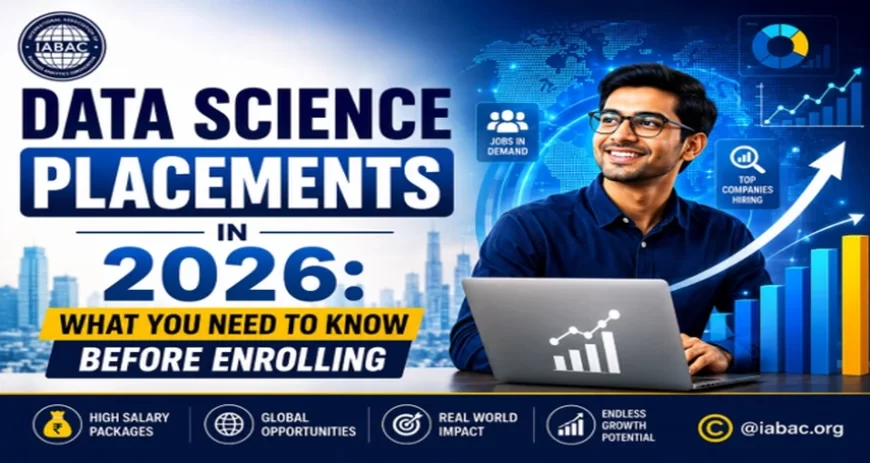
Data Science Placements in 2026: What You Need to Know Before Enrolling
Data Science placements in 2026 are evolving with AI. Learn placement trends, hiring insights, salaries, and what to check before enrolling in a course

Finding a data science course is easier than finding one that genuinely prepares you for employment. Over the past few years, I've seen many aspiring professionals compare institutes based almost entirely on placement percentages. While placement support is important, employers rarely hire candidates because they completed a course. They hire individuals who can solve business problems, communicate insights clearly, and demonstrate practical experience through projects.
This is where many professionals struggle. They spend months learning algorithms, statistics, and programming but overlook portfolio development, interview preparation, and industry exposure. As hiring practices continue to evolve in 2026, understanding how Data Science Placements actually work has become just as important as choosing the right curriculum.
As professionals gain hands-on experience, many choose structured certifications to validate their skills, learn industry-recognized frameworks, and stay aligned with evolving best practices. Certifications alone do not guarantee employment, but they often help candidates demonstrate commitment to continuous learning and standardized knowledge during recruitment. Several globally recognized organizations provide certification pathways, including IABAC, IBM, Microsoft, Google, SAS, and Databricks. The most valuable certification is usually the one that complements practical project experience and aligns with your long-term career goals rather than simply adding another credential to your resume.
Why Data Science Placements Look Different in 2026
The hiring market for data science has matured significantly. A few years ago, organizations were primarily searching for candidates who understood machine learning algorithms and statistical techniques. Today, employers expect professionals who can connect technical skills with measurable business outcomes.
One pattern I've noticed while working with organizations across different industries is that hiring managers increasingly prioritize practical thinking over theoretical knowledge. A candidate who can explain how they improved a forecasting model or automated reporting for a business process often creates a stronger impression than someone who has memorized every machine learning algorithm.
This shift is influencing Data Science Placements across training institutes and universities. Placement success now depends on several interconnected factors, including technical capability, business understanding, communication skills, and adaptability.
Organizations hiring in 2026 are looking for professionals who can contribute from the first few months rather than requiring extensive retraining after joining.
Understanding How Data Science Placements Actually Work
A common misconception is that placement support guarantees a job offer. In practice, placement teams facilitate opportunities, but the final hiring decision depends entirely on candidate readiness.
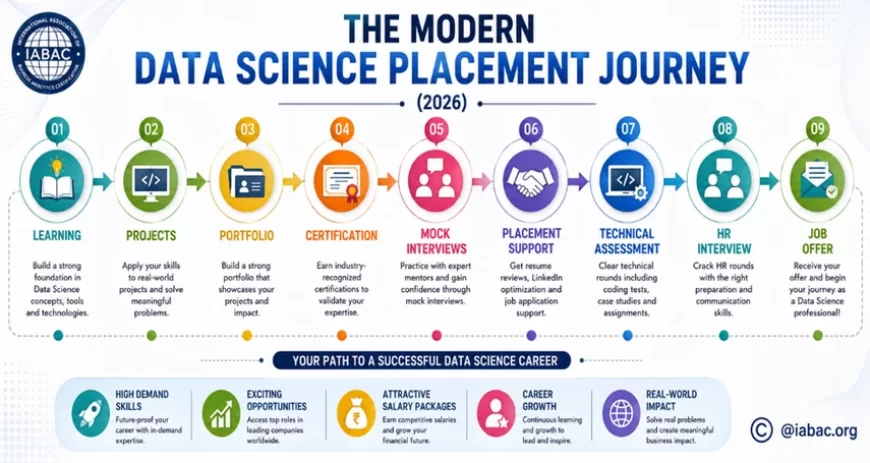
Most placement ecosystems follow a structured process.
Employer Partnership Development
Training providers establish relationships with companies looking to recruit data professionals. These organizations range from startups to multinational enterprises operating across finance, healthcare, retail, manufacturing, consulting, and technology.
The quality of employer partnerships often has a greater impact than the number of hiring companies listed on a website. Candidates should evaluate whether recruiters regularly participate in hiring drives and whether alumni are employed across diverse industries.
Candidate Preparation
Before interviews begin, learners usually receive preparation in areas such as:
- Resume optimization
- LinkedIn profile enhancement
- Portfolio development
- Mock interviews
- Aptitude assessments
- Technical interview practice
- HR interview preparation
Many employers now review GitHub repositories and project documentation before scheduling interviews. A strong portfolio frequently becomes the deciding factor between candidates with similar educational backgrounds.
Interview and Assessment Process
Depending on the organization, recruitment may include multiple stages:
- Online aptitude assessment
- SQL and Python coding evaluation
- Statistics and machine learning questions
- Business case study
- Technical interview
- HR discussion
Some companies have replaced lengthy theoretical interviews with practical business case assessments that evaluate how candidates think through real problems.
Data Science Hiring Trends Shaping Placements in 2026
The demand for data professionals continues to evolve alongside artificial intelligence, cloud computing, and enterprise automation. Reports from organizations such as LinkedIn, the World Economic Forum, Deloitte, and IBM consistently highlight the growing importance of data-driven decision-making across industries.
Rather than recruiting specialists for narrowly defined roles, many organizations are hiring professionals who understand multiple aspects of the modern data ecosystem.
Current Data Science hiring trends include:
- Greater demand for AI-assisted analytics
- Increased adoption of cloud-based data platforms
- Higher expectations for SQL and Python proficiency
- More emphasis on business communication skills
- Growing need for responsible AI and data governance awareness
- Preference for candidates with production-ready project experience
One lesson many hiring teams learn is that technical expertise alone rarely predicts workplace success. Professionals who can explain analytical findings to business stakeholders often progress more quickly within organizations.
What Recruiters Evaluate Beyond Technical Skills
Many students assume interviews focus only on coding and algorithms. While technical competence remains essential, employers increasingly assess how candidates approach real business challenges.
Recruiters often evaluate four key dimensions.
Business Understanding
Data scientists solve organizational problems rather than mathematical exercises.
Interviewers frequently ask questions such as:
- How would you improve customer retention?
- Which business metrics would you monitor?
- How would you measure project success?
Candidates who understand business objectives generally perform better than those who immediately discuss algorithms.
Problem-Solving Ability
Here's what actually happens during many interviews.
Instead of asking candidates to define Random Forest or Gradient Boosting, interviewers present incomplete datasets, ambiguous business requirements, or operational challenges.
The objective is not finding the perfect answer.
Recruiters want to observe structured thinking, prioritization, and decision-making.
Communication Skills
One challenge many technically strong candidates face is explaining complex analytical concepts to non-technical stakeholders.
Organizations value professionals who can:
- Present findings clearly
- Justify recommendations with evidence
- Simplify technical concepts
- Collaborate across departments
Strong communication often differentiates high-performing data scientists from equally skilled peers.
The tools used in data science continue to change.
Hiring managers increasingly seek candidates who demonstrate curiosity, adaptability, and continuous learning rather than relying solely on existing technical knowledge.
Skills That Improve Data Science Placement Outcomes
Technical knowledge remains the foundation of every successful data science career. However, placement success usually depends on combining multiple competencies into a practical skill set.
The most employable candidates typically demonstrate proficiency across several areas.
Programming and Data Manipulation
Python and SQL remain core requirements for most Entry-level Data Science jobs. Recruiters expect candidates to clean, transform, analyse, and query datasets efficiently.
Understanding version control through Git and familiarity with APIs can further strengthen employability.
Statistics and Machine Learning
A solid understanding of statistics helps professionals select appropriate analytical techniques and interpret results correctly.
Employers generally expect knowledge of:
- Probability
- Hypothesis testing
- Regression
- Classification
- Clustering
- Feature engineering
- Model evaluation
Rather than asking candidates to memorize formulas, interviewers increasingly focus on practical application.
Data Visualization
Business leaders rely on visual insights rather than raw datasets.
Professionals should be comfortable using tools such as Power BI, Tableau, or Python visualization libraries to communicate findings effectively.
Cloud and AI Tools
Many organizations now build data platforms in cloud environments.
Knowledge of platforms like Microsoft Azure, AWS, or Google Cloud can improve employability, especially for candidates targeting enterprise roles.
What Makes One Candidate More Employable Than Another?
After observing numerous recruitment cycles, one consistent pattern stands out.
Candidates with similar certifications often receive very different placement outcomes.
The difference usually comes down to practical evidence of their skills.
Instead of listing twenty technologies on a resume, successful candidates often showcase three or four well-documented projects that demonstrate:
- Business problem identification
- Data collection and preparation
- Model selection
- Performance evaluation
- Business recommendations
- Clear documentation
A recruiter can usually distinguish between copied academic projects and original work within the first few interview questions.
This is why portfolios, internships, hackathons, and collaborative projects continue to carry significant weight during Data Science Placements.
The Modern Data Science Placement Journey (2026)
One of the biggest changes in the employment market is that data science is no longer limited to technology companies. Organizations across nearly every industry generate large volumes of data and need professionals who can convert that information into practical business decisions.
This broad adoption has significantly expanded Data Science career opportunities. Employers are hiring data professionals not only to build predictive models but also to improve operations, reduce costs, enhance customer experiences, and support strategic planning.
Here are some of the sectors actively recruiting data science talent in 2026
|
Industry |
Typical Business Problems |
Common Data Science Roles |
|
Banking & Financial Services |
Fraud detection, credit risk, customer segmentation |
Data Scientist, Risk Analyst, ML Engineer |
|
Healthcare |
Disease prediction, patient analytics, hospital operations |
Healthcare Data Scientist, Clinical Analyst |
|
Retail & E-commerce |
Demand forecasting, recommendation systems, pricing optimization |
Data Analyst, Data Scientist |
|
Manufacturing |
Predictive maintenance, quality control, supply chain optimization |
Industrial Data Scientist |
|
Telecommunications |
Customer churn prediction, network optimization |
Data Scientist, Business Analyst |
|
Insurance |
Claims analytics, fraud detection, underwriting |
Analytics Consultant |
|
Logistics & Supply Chain |
Route optimization, inventory forecasting |
Supply Chain Data Scientist |
|
Consulting |
Business intelligence, digital transformation, AI implementation |
Analytics Consultant, AI Consultant |
One lesson many organizations learn is that successful data scientists understand the business context behind the data. For example, a forecasting model built for a retailer differs significantly from one developed for a hospital or a financial institution. Industry knowledge often becomes a competitive advantage during interviews.
What Types of Data Science Jobs Will Be Available in 2026?
The demand for data professionals is becoming more specialized. Rather than hiring generalists for every task, organizations are creating focused roles based on business requirements and technology stacks. This trend is also reflected in the World Economic Forum's Future of Jobs Report, which highlights the growing demand for AI, data, and technology professionals across industries.
Some of the most common Data Science jobs in 2026 include:
This remains one of the most sought-after roles. Responsibilities typically include data preparation, machine learning, statistical analysis, experimentation, and communicating business insights.
Machine Learning Engineer
These professionals focus on deploying and maintaining machine learning models in production environments. Software engineering and cloud computing skills are often essential.
Data Analyst
Many professionals begin their careers here before transitioning into data science. The role emphasizes SQL, visualization, reporting, and business analytics.
AI Engineer
As generative AI becomes more integrated into enterprise workflows, organizations increasingly seek professionals who can develop AI-powered applications while ensuring responsible AI practices. Google's Responsible AI resources provide useful guidance on developing AI systems responsibly and ethically.
Business Intelligence Developer
Business Intelligence specialists design dashboards and reporting systems that support decision-making across departments.
Data Engineer
Without reliable data pipelines, even the best machine learning models cannot perform effectively. Data engineers build the infrastructure that enables analytics and AI initiatives.
Entry-Level Data Science Jobs: What Employers Really Expect
Many learners assume entry-level roles require years of experience. In reality, employers understand that graduates and career changers are still developing professionally. What they expect is evidence that candidates can apply what they have learned.
Typical Entry-level Data Science jobs include:
- Junior Data Scientist
- Data Analyst
- Business Analyst
- Analytics Associate
- Junior Machine Learning Engineer
- Reporting Analyst
- BI Analyst
- AI Operations Associate
From my experience reviewing hiring processes, employers rarely expect junior candidates to design enterprise-scale AI systems. Instead, they look for professionals who can contribute to existing projects while continuing to learn.
Strong entry-level candidates typically demonstrate:
- Practical projects solving business problems
- Clean and readable code
- SQL proficiency
- Statistical reasoning
- Data visualization skills
- Effective communication
- Curiosity and willingness to learn
One common mistake is spending months mastering advanced algorithms while neglecting SQL or business communication. In practice, these foundational skills are used far more frequently during the first year of employment.
How to Evaluate Data Science Placement Claims Before Enrolling
This is where many prospective students make costly decisions.
Marketing materials often emphasize placement percentages without explaining how those numbers were calculated. Before enrolling, it is worth asking detailed questions rather than relying solely on promotional claims.
Consider evaluating the following aspects.
Placement Transparency
Ask whether the institute publishes:
- Number of students eligible for placements
- Number actually placed
- Average salary range
- Median salary
- Highest salary
- Hiring companies
- Alumni success stories
Transparent institutions are usually comfortable sharing this information.
Employer Network
Instead of focusing on the number of partner companies, understand the quality of those relationships.
Questions worth asking include:
- Do recruiters conduct regular hiring drives?
- Are alumni working in reputable organizations?
- How often are placement events organized?
- Which industries recruit graduates?
Practical Learning Environment
A curriculum should include opportunities to apply concepts through:
- Capstone projects
- Industry case studies
- Hackathons
- Internships
- Portfolio development
- Peer collaboration
These experiences often prepare candidates more effectively than lecture-based learning alone.
A common misconception is that placement preparation and skill development are separate goals. In reality, sustainable placement outcomes usually result from strong skills rather than interview coaching alone.
|
Placement-Focused Approach |
Skill-Focused Approach |
|
Prioritizes interview preparation |
Builds long-term technical capability |
|
Resume optimized early |
Portfolio developed through real projects |
|
Focus on aptitude tests |
Focus on solving business problems |
|
Short-term placement objective |
Long-term career growth |
|
Limited project exposure |
Extensive practical implementation |
|
Job offer is the immediate goal |
Continuous professional development is the objective |
The strongest learning programs typically combine both approaches, helping learners build employable skills while also preparing them for recruitment processes.
Real-World Hiring Scenario
Consider a retail company looking to improve inventory forecasting.
Situation
The organization experiences frequent stock shortages during seasonal demand, leading to lost sales and dissatisfied customers.
Challenge
Management wants more accurate demand predictions but has inconsistent historical sales data and limited forecasting expertise.
Solution
A junior data scientist joins the analytics team and collaborates with experienced colleagues to:
- Clean historical sales data
- Analyse seasonal purchasing patterns
- Build a forecasting model
- Create Power BI dashboards for planners
- Monitor forecast accuracy over time
Outcome
Within several months, planners gain better visibility into demand trends, enabling more informed inventory decisions and reducing stock shortages.
This example illustrates an important point. Employers often hire entry-level professionals not because they already know every solution, but because they demonstrate structured problem-solving, technical fundamentals, and the ability to work within a team.
Common Mistakes That Reduce Placement Success
After observing numerous recruitment cycles, several patterns appear repeatedly.
Learning Too Many Tools
Many candidates try to learn every programming language, cloud platform, and machine learning library simultaneously.
Employers generally value depth over breadth. Demonstrating confidence in Python, SQL, statistics, and one visualization platform often creates a stronger impression than superficial knowledge of many technologies.
Ignoring Business Context
Technical solutions should always address business objectives.
A model with excellent predictive accuracy has limited value if it cannot solve a practical organizational problem or be understood by decision-makers.
Projects frequently fail to showcase the candidate's thinking.
Recruiters appreciate documentation that explains:
- Business objective
- Dataset
- Methodology
- Challenges encountered
- Results
- Lessons learned
Good documentation demonstrates professionalism and communication skills.
Neglecting Interview Practice
Even highly capable candidates can struggle if they have never explained their projects aloud.
Mock interviews, peer reviews, and technical discussions help build confidence before meeting recruiters.
Choosing the Best Data Science Certification
Professionals often ask whether earning the Best Data Science certification guarantees employment.
The honest answer is no.
Certification should be viewed as one component of professional development rather than a replacement for practical experience.
When evaluating certification programs, consider factors such as:
- Curriculum relevance
- Industry alignment
- Hands-on learning opportunities
- Assessment quality
- Recognition among employers
- Continuous curriculum updates
- Availability of practical projects
An effective certification should help you understand industry frameworks while reinforcing the skills employers expect during recruitment.
Similarly, an Industry-recognized Data Science certification can strengthen a candidate's profile by validating knowledge against recognized standards. Providers such as IABAC, Microsoft, IBM, Google, SAS, and Databricks offer certifications that address different career stages and specializations. The most suitable option depends on your existing skills, career objectives, and the roles you plan to pursue.
Best Practices to Improve Your Placement Prospects
Successful candidates often follow a structured approach rather than relying on last-minute interview preparation.
Some practical recommendations include:
- Build a portfolio with three to five original projects.
- Maintain an updated GitHub repository.
- Strengthen SQL and Python fundamentals before exploring advanced AI topics.
- Participate in hackathons or open-source initiatives.
- Practice explaining projects in business language.
- Stay informed about emerging AI and analytics trends.
- Seek feedback from mentors and industry professionals.
- Continue learning after securing your first role.
One pattern I've noticed is that professionals who treat learning as an ongoing process tend to adapt more effectively as technologies and business needs evolve.
The future of Data Science Placements will likely be shaped by advancements in artificial intelligence, automation, and cloud computing rather than by traditional hiring metrics alone.
Industry perspectives from organizations such as the World Economic Forum, LinkedIn, Microsoft, IBM, McKinsey, and the Stanford AI Index consistently point toward increasing demand for professionals who combine technical expertise with business understanding, ethical AI practices, and continuous learning.
Rather than replacing data scientists, AI-powered tools are changing how they work. Routine coding tasks can increasingly be automated, allowing professionals to focus more on problem definition, model evaluation, governance, stakeholder communication, and strategic decision-making.
For aspiring professionals, this means long-term employability will depend less on memorizing specific tools and more on developing adaptable skills, practical experience, and the ability to solve meaningful business problems.
Frequently Asked Questions
1. How important are Data Science Placements when choosing a course?
Data Science Placements are an important consideration, but they should not be the only factor. A strong placement ecosystem is valuable when it is supported by quality training, industry-relevant projects, experienced mentors, and employer partnerships. Before enrolling, evaluate the curriculum, practical learning opportunities, alumni outcomes, and placement transparency rather than relying solely on advertised placement percentages.
2. Which skills are most important for Data Science jobs in 2026?
Most employers look for a combination of technical and business skills. Core competencies typically include Python, SQL, statistics, machine learning fundamentals, data visualization, problem-solving, and communication. Familiarity with cloud platforms and AI-assisted analytics tools is becoming increasingly valuable as organizations modernize their data infrastructure.
3. Can beginners get entry-level Data Science jobs without prior work experience?
Yes. Many Entry-level Data Science jobs are designed for graduates and career changers. Employers generally understand that junior candidates are still building professional experience. What makes a difference is demonstrating practical ability through projects, internships, hackathons, GitHub repositories, and a clear understanding of how analytical solutions address business problems.
4. Does a Data Science certification guarantee placement?
No. Certifications validate knowledge and demonstrate commitment to continuous learning, but they do not guarantee employment. Recruiters usually evaluate a combination of technical skills, project experience, communication ability, interview performance, and cultural fit. A certification is most effective when supported by practical experience and a strong portfolio.
5. How can I improve my chances of getting placed after completing a Data Science course?
Focus on developing skills that employers consistently value. Build original projects, strengthen Python and SQL fundamentals, participate in industry competitions, maintain an active GitHub profile, practice technical interviews, and learn to explain your work in business terms. Continuous learning and networking with professionals can also improve career opportunities.
6. What industries offer the best Data Science career opportunities?
Data science professionals are employed across finance, healthcare, retail, manufacturing, telecommunications, logistics, insurance, consulting, government, and technology sectors. As organizations continue investing in digital transformation and AI initiatives, Data Science career opportunities are expanding well beyond traditional technology companies.
7. How should I evaluate the best Data Science certification?
Instead of selecting a certification based solely on popularity, consider whether it aligns with your career goals and current skill level. Look for programs that include practical projects, updated curricula, industry relevance, recognized assessment standards, and opportunities to apply concepts in real-world business scenarios.
Choosing a course based only on placement advertisements can lead to unrealistic expectations. Successful Data Science Placements are usually the outcome of consistent skill development, practical experience, industry exposure, and effective interview preparation rather than any single factor.
The hiring landscape in 2026 continues to reward professionals who combine technical expertise with business understanding and strong communication skills. Employers increasingly seek candidates who can solve real organizational problems, collaborate across teams, and adapt to evolving technologies.
Before enrolling in any program, take time to evaluate the curriculum, faculty expertise, project opportunities, employer partnerships, alumni outcomes, and placement support. Ask informed questions, review transparent placement information, and choose a learning path that helps you build capabilities that remain valuable throughout your career—not just during your first job search.
Ultimately, long-term success in data science comes from developing the ability to learn continuously, apply analytical thinking to business challenges, and deliver measurable value. Those qualities will remain relevant regardless of how hiring trends evolve in the years ahead.
Continue Building Your Professional Expertise
Building a successful career in data science is an ongoing journey rather than a single milestone. Practical experience, mentoring, collaboration on real projects, and continuous learning all contribute to long-term professional growth. Many professionals also pursue structured certifications to benchmark their knowledge against recognized industry standards and stay current with evolving practices. Organizations such as IABAC, Microsoft, IBM, Google, SAS, and Databricks offer certification pathways designed for different career stages and areas of specialization. The right choice depends on your career aspirations, existing skills, and preferred learning approach. By combining hands-on experience with structured learning, professionals are better prepared to adapt to new technologies and create meaningful business impact throughout their careers.