






















































Are Fresher Data Science Jobs Still in High Demand?
Learn job-ready skills through Masters in Data Science, Data Science Classes, and Data Science Certifications to support entry-level career opportunities.


Let me say something honestly. Every few months, someone on the internet declares that Data science is “finished.” According to them, AI tools will replace everyone, companies are not hiring anymore, and freshers have no chance of getting into the industry. That sounds dramatic, but it is not true. Data science jobs are still growing across the world. Companies continue hiring freshers, salaries remain strong, and businesses still need people who can work with information, understand patterns, and help teams make smarter decisions.
What has changed is this: companies are now more selective.
A few years ago, learning basic Python and completing one online course was often enough to get attention. Today, recruiters expect more. They want proof that you can actually solve problems, work on projects, and explain your work clearly.
That may sound difficult, but it is actually good news.
Why? Most applicants still apply with weak résumés, unfinished projects, and no practical understanding. If you build proper skills and present them correctly, you immediately stand out. If you are searching for fresher data science jobs in 2026, this guide will help you understand what companies are really looking for, what skills matter most, how certifications help, and how to improve your chances of getting hired.
The Demand for Data Science Jobs Is Still Strong
Let us begin with facts.
Reports from global hiring platforms and labour studies continue showing strong growth in data science and AI-related jobs. Businesses across banking, healthcare, retail, finance, manufacturing, and technology are investing heavily in analytics and machine learning teams.
According to international job studies:
- Data science and AI specialist roles remain among the fastest-growing careers globally.
- Data scientist positions are expected to grow much faster than average jobs through 2032.
- Millions of new analytics and AI-related jobs are expected by 2026.
- Companies in many countries are struggling to find qualified professionals.
That last point is important.
The issue is not that there are “too many data scientists.” The issue is that there are too many people with incomplete skills.
Many applicants know basic theory but struggle with practical tasks like:
- cleaning messy datasets
- writing SQL queries
- building complete projects
- explaining results properly
- Understanding business problems
This is why companies continue searching for candidates who can actually do the work.
Why Freshers Feel the Market Is Difficult
Now let us talk about the confusing part.
If companies are hiring, why do so many freshers struggle to get interviews?
The answer is simple: competition has increased.
Online learning became extremely popular over the last few years. Thousands of people completed short courses and started applying for the same positions. Recruiters now receive hundreds of applications for one opening.
Most of those résumés look identical:
- same online tutorials
- same beginner projects
- same copied GitHub repositories
- same skill lists
That creates a problem for recruiters. They need a fast way to separate serious candidates from casual learners.
This is where projects, certifications, and communication skills become very important. A strong portfolio immediately shows that you can apply your knowledge. A recognised certification adds credibility. Good communication proves you can work with teams and explain your thinking.
Together, these things help you move ahead of the crowd.
What Companies Want From Freshers in 2026
After reviewing hundreds of entry-level job descriptions across different countries, one thing becomes very clear: companies are asking for the same core skills again and again.
Here are the skills that appear most often in fresher data science job postings.
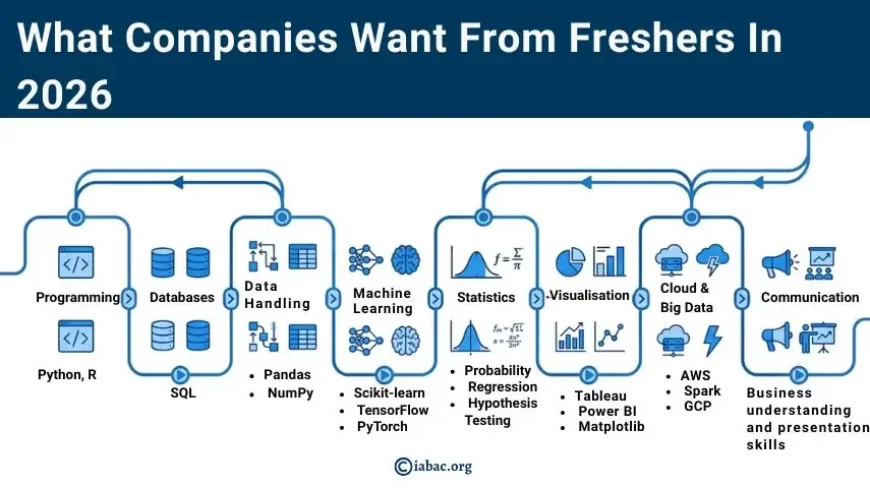
Notice something important here.
Python and SQL appear almost everywhere.
Many freshers spend too much time chasing advanced tools while ignoring the basics. But companies still care most about strong foundations.
If you can:
- write clean Python code
- work comfortably with Pandas
- understand SQL properly
- explain statistics clearly
you already become more employable than many applicants.
Communication also matters much more than people realise.
A company does not only want someone who builds models. They want someone who can explain:
- What the model does
- Why the result matters
- What action should be taken next
That skill alone can separate average candidates from strong ones.
Why Projects Matter More Than Degrees
This may sound uncomfortable, but many hiring managers care more about your projects than your university name.
A degree is useful, but projects show practical ability.
When recruiters look at a fresher profile, they usually ask one important question:
Can this person solve actual problems?
A proper project answers that question better than theory alone.
The best fresher portfolios usually contain:
- 3 to 5 completed projects
- clear business problems
- clean documentation
- proper visualisations
- model evaluation
- deployment or presentation
Let us look at a strong example.
Example of a Strong Fresher Project
Project Topic: Predicting hospital readmission rates using patient records.
Dataset: Public healthcare dataset with ICU patient records.
Process:
- Data cleaning using Pandas
- Analysis and visualisation
- Feature engineering
- Baseline model with Logistic Regression
- Improved model using XGBoost
- Model explainability using SHAP
- Deployment using Streamlit
Outcome: The model identified patients at high risk of returning to the hospital within 48 hours after discharge.
Final Presentation:
- GitHub repository
- PDF project summary
- Short video explanation
This single project tells recruiters many things:
- You understand Python
- You can work with healthcare data
- You know machine learning basics
- You understand explainability
- You can communicate clearly
One strong project like this is far more valuable than ten incomplete notebooks.
The Simple Formula Recruiters Use
Most hiring managers do not officially use a formula while reviewing candidates, but their thinking usually follows a similar pattern.
You can think of hiring decisions like this:
Candidate Value Score
- Technical Skills → 35%
- Project Portfolio → 30%
- Certification Credibility → 20%
- Communication Skills → 15%
This explains why projects and certifications matter so much. Together, portfolio quality and certification already influence half the hiring decision. The good news is that every part of this formula can be improved with effort.
You can:
- improve technical knowledge
- build stronger projects
- earn recognised certifications
- practice explaining your work
Nothing here depends on luck alone.
Industries Hiring Freshers Right Now
Many freshers think only software companies hire data scientists.
That is completely wrong. Almost every industry now uses analytics, machine learning, and AI systems.
Some of the biggest hiring sectors include:
|
Industry |
Approximate Share of Fresher Hiring |
|
Technology & Software |
28% |
|
Banking & Finance |
22% |
|
Healthcare & Pharma |
18% |
|
Retail & E-Commerce |
14% |
|
Manufacturing |
10% |
|
Other Industries |
8% |
Finance companies use analytics for:
- fraud detection
- credit scoring
- customer analysis
Healthcare companies use it for:
- patient prediction
- treatment analysis
- hospital management
Retail companies use it for:
- recommendation systems
- sales forecasting
- customer behaviour tracking
This means you do not need to target only famous tech companies. Strong opportunities exist across many industries.
Why Certifications Still Matter
There is a lot of confusion around certifications.
Some people say certifications are useless. Others believe certificates alone guarantee jobs. Neither is true.
A certification becomes valuable when:
- The organisation is recognised
- The assessment is respected
- The syllabus matches industry needs
This is why industry-recognised certifications hold more value than random completion certificates.
For freshers, certifications provide something important: trust.
Recruiters receive applications from many people claiming to know machine learning, Python, and analytics. A recognised certification acts as third-party proof that your skills were properly tested. This is one reason why many freshers choose recognised programs from organisations like IABAC.
An industry-recognised Data Science Certification shows employers that:
- Your knowledge meets industry standards
- You completed structured learning
- Your skills were evaluated seriously
That can improve interview opportunities, especially for freshers without work experience.
Salary Growth for Freshers
Data science salaries remain strong compared to many other entry-level careers. Global salary reports continue showing higher starting salaries for certified and project-ready candidates.
Average trends show:
- Non-certified freshers generally start lower
- Candidates with practical portfolios earn more
- Industry certifications improve salary potential further
- Strong projects plus certifications create the best results
This happens because companies are willing to pay more for candidates who require less training after joining.
If a fresher already understands:
- Python
- SQL
- analytics workflows
- machine learning basics
- project deployment
They become productive much faster.
That increases their value.
The Biggest Mistake Freshers Make
The biggest mistake is not lack of intelligence.
It is lack of completion.
Thousands of learners start:
- machine learning tutorials
- Kaggle notebooks
- Python courses
- certification programs
Very few actually finish complete projects properly.
Recruiters notice this immediately.
A half-finished portfolio creates a weak impression.
Instead of starting ten projects, focus on completing three excellent ones.
A finished project should include:
- problem statement
- cleaned dataset
- analysis
- visualisation
- modelling
- evaluation
- explanation
- documentation
Completion matters more than quantity.
Communication Is a Career Skill
One overlooked skill in data science is communication.
You may build an excellent model, but if you cannot explain:
- What it means
- Why it matters
- What action should follow
Your value becomes limited.
Good communication does not mean speaking complicated English.
It means:
- being clear
- being organised
- explaining results simply
Many companies prefer candidates who can explain ideas clearly over candidates who only use technical jargon.
Practice presenting your projects in simple language.
That skill will help in:
- interviews
- presentations
- teamwork
- leadership opportunities later
A Simple 90-Day Plan for Freshers
If you are serious about getting your first data science job, here is a practical approach.
Days 1–30
Focus on:
- Python basics
- Pandas
- NumPy
- SQL
- statistics fundamentals
Complete one small project using a public dataset.
Days 31–60
Build a more advanced project.
Start learning:
- machine learning algorithms
- model evaluation
- visualisation tools
Prepare for an industry-recognised certification like IABAC.
Days 61–90
Complete your projects fully.
Create:
- GitHub portfolio
- LinkedIn profile
- polished résumé
Earn your certification and begin applying for targeted fresher roles.
Why Freshers Still Have an Advantage
Many people fear that AI tools will reduce opportunities for freshers.
The reality is more interesting.
Freshers entering the industry today are learning alongside modern AI systems from the beginning. They are already becoming comfortable with:
- AI assistants
- automated workflows
- large language models
- analytics tools
Older professionals often need time to adjust to these systems. Freshers, however, are learning them naturally as part of their training. That creates opportunity.
Future data science roles will involve:
- working with AI systems
- evaluating AI outputs
- building automation workflows
- improving business decisions using analytics
Freshers who understand these changes are entering the industry at the right time.
Governments and Companies Are Investing Heavily
Another important point many people ignore is this: Countries around the world are investing heavily in AI and analytics education.
Governments and businesses understand there is a shortage of skilled professionals.
As a result:
- Universities are updating programs
- Companies are creating fresher hiring pipelines
- Training initiatives are increasing
- Analytics teams are expanding
This creates a long-term opportunity for candidates who prepare seriously.
So, are fresher data science jobs still in high demand?
Yes. Absolutely.
The demand is real, salaries remain strong, and opportunities continue growing across industries. But companies now expect more than basic course completion.
They want candidates who can:
- work with data confidently
- solve practical problems
- communicate clearly
- build strong projects
- show verified skills
That is why certifications, portfolios, and practical understanding matter more than ever before. The good news is that all of these things can be built step by step.
You do not need to be perfect. You do not need years of experience. You do not need to know every tool.
You simply need:
- strong fundamentals
- completed projects
- consistent practice
- recognised credentials
- clear communication
A fresher with those qualities is highly employable in today’s market. The opportunities are there. Now the focus should be on preparing yourself properly and taking action consistently.