


















































Limitations of Artificial Intelligence: Current Challenges & Future Fixes
Current AI faces limits in accuracy, bias, data needs & explainability, but ongoing research aims to improve reliability, fairness & real-world performance.


AI Is Powerful But Not Perfect
If 2024–2026 taught us anything, it’s this:
AI can do incredible things but it also fails in surprising ways.
We’ve seen AI:
-
write code in seconds
-
diagnose diseases faster than doctors
-
predict trends better than analysts
-
generate images, videos, and music
-
pass MBA, law, and medical exams
Yet at the same time, this same AI can:
-
give wrong answers with full confidence
-
misidentify people
-
generate biased results
-
break when data is messy
-
make decisions no one can explain
-
“hallucinate” facts that never existed
This duality superhuman ability + shocking limitations is exactly why understanding AI’s boundaries is so important.
AI is not magic.
AI is not perfect.
AI is not even fully “intelligent” the way we imagine intelligence.
We’ll explore the real limitations of artificial intelligence, the current challenges holding Artificial Intelligence back, and the future fixes that researchers believe will reshape the next decade of AI.
What Are the Limitations of Artificial Intelligence?
The limitations of artificial intelligence are the weaknesses, constraints, and failures in how AI learns, understands, decides, or behaves.
AI can be powerful, but it is still limited by:
-
data
-
compute
-
human input
-
ethics
-
logic
-
real-world unpredictability
Think of AI like a brilliant student with three big flaws:
-
It remembers everything but understands very little.
-
It follows patterns but lacks common sense.
-
It predicts outcomes but cannot explain its own reasoning.
These limitations shape every AI system in the world from chatbots to self-driving cars.
Why It’s Important to Understand AI’s Limitations
We rely on AI everywhere:
-
Google Search uses AI to understand our questions and deliver the most relevant information within seconds.
-
Netflix depends on AI to analyze our viewing habits and recommend movies or shows we are most likely to enjoy.
-
Banks use AI-driven systems to scan millions of transactions and instantly detect suspicious or fraudulent activity.
-
Hiring platforms rely on AI to filter resumes, evaluate candidates, and speed up recruitment decisions.
-
Medical professionals use AI tools to interpret scans, spot early signs of disease, and support faster diagnosis.
-
Social media platforms use AI to personalize our feeds, decide what we see, and influence how content spreads.
-
Navigation apps use AI to predict traffic patterns, suggest faster routes, and prevent delays.
-
Businesses depend on AI analytics to understand trends, forecast outcomes, and guide strategic decisions.
But if we don’t understand its limitations, we risk:
-
wrong decisions
-
biased outcomes
-
privacy failures
-
over-reliance
-
business risks
-
ethical violations
Knowing what AI can’t do is just as important as knowing what it can do.

1. AI Lacks Common Sense
AI can beat world chess champions, but it cannot answer simple reasoning questions reliably.
Example:
Ask an AI “If I put a glass on the edge of a table and push it slightly, what happens?”
It may answer correctly…
or it may confidently hallucinate something entirely different.
Humans learn common sense through lived experience.
AI learns patterns through data.
Why this is a problem:
-
AI struggles with unexpected situations
-
Self-driving cars misinterpret rare events
-
Chatbots fail at basic reasoning
-
Robots cannot handle unpredictable tasks
Future Fix:
Researchers are working on Common Sense AI frameworks, but we are still far from giving machines real-world intuition.
2. AI Hallucinates (Makes Up Information)
Hallucination = when AI generates confident, but false or imaginary information.
Example:
AI may invent:
-
fake laws: AI may create legal rules or sections that look real and sound official, even though those laws don’t exist in any real legal document or government system.
-
fake statistics: AI can produce numbers, percentages, or data points that look correct and well-researched, but they are fully made up and not based on any real study or report.
-
fake people: AI sometimes invents names, profiles, jobs, and background stories that seem completely believable, even though the person is not real and has never existed.
-
fake medical facts: AI may give medical explanations, symptoms, or treatment advice that sound scientific, but they are not supported by real medical research and can be totally incorrect.
-
fake quotes: AI can generate quotes and attach them to famous people, authors, or experts, even though those individuals never actually said those words.
-
fake URLs: AI often creates website links or references that look genuine and trustable, but when you check them, they don’t exist because the AI simply made them up.
This happens because AI predicts patterns not truth.
Why this is dangerous:
-
Wrong medical advice
-
Incorrect legal information
-
Misleading financial data
-
Fake news generation
-
Education errors
Future Fix:
Companies are working on:
-
grounding models in real-time data so AI answers stay accurate and updated
-
adding fact-checking layers that verify information before showing the final output
-
using retrieval-augmented generation (RAG) to pull facts directly from trusted sources
-
building verification systems that cross-check content for correctness
But hallucinations will not be fully solved soon.
3. Bias in AI Systems
AI systems often pick up the same biases that exist in the data they are trained on.
If the data is unfair, incomplete, or tilted toward one group, the AI ends up learning those same patterns and repeating them in its decisions.
Real examples of bias:
-
AI hiring tools sometimes reject women because older company data mostly showed men being selected for similar roles.
-
Face recognition systems often fail on darker skin tones, because the training images mostly contain lighter-skinned faces.
-
Credit scoring AI may show racial bias, giving lower scores to certain groups because past financial data was unequal or unfair.
-
Healthcare AI can misdiagnose minority groups, especially when the medical data used during training did not include enough diverse patients.
Why this happens:
AI learns from human-created data → human data contains bias → so the AI naturally picks up the same bias and repeats it.
How we can fix it in the future:
-
using more diverse and balanced datasets
-
building fairness algorithms that detect and correct unfair patterns
-
performing bias auditing to check where AI is behaving unfairly
-
creating ethical AI frameworks to guide safe and responsible development
Bias can be reduced with better data and better systems, but it can never be completely removed, because AI will always learn from imperfect human information.
4. AI Is Extremely Data-Dependent
AI does not “learn” the way humans do.
Humans can understand things from experience, intuition, and common sense, but AI needs huge amounts of data to recognize patterns and make decisions.
AI systems usually need:
-
millions of images to identify objects correctly
-
terabytes of data to understand language or behavior
-
thousands of hours of audio to learn speech accurately
-
massive, well-organized training datasets to perform any advanced task
If the data is messy, incomplete, biased, or low-quality, the entire AI model becomes weak.
Without clean and reliable data, AI starts giving wrong predictions, missing details, and failing at even simple tasks.
Problems caused by heavy data dependency:
-
poor predictions, because the model cannot understand patterns properly
-
incomplete understanding, since it knows only what the data shows
-
bias, because unfair data creates unfair AI
-
hallucinations, as the model fills gaps with incorrect information
-
unreliable outputs, especially in rare or unfamiliar situations
Future improvements may help, such as:
-
self-learning models that can learn more independently
-
synthetic data generation to create safe and diverse training samples
-
hybrid human–AI training where humans guide models during learning
-
better data labeling systems to reduce errors in training
These solutions can make AI stronger, but we can never remove AI’s need for large, high-quality data, because data is the foundation of how AI learns and works.
5. High Cost of Development and Maintenance
Building strong AI models is very expensive because they need a lot of powerful machines and ongoing work.
AI systems depend on GPUs, cloud servers, large storage, and very high training costs, and even after the model is created, companies must keep spending money on fine-tuning, regular maintenance, and continuous updates to keep the AI working properly.
Example:
Training a big AI model can cost millions of dollars, and running it every day also needs a lot of computing power.
Why this is a limitation:
-
small companies cannot afford these costs, so only big companies can build advanced AI
-
innovation becomes limited to a few companies, which slows down open progress
-
AI inequality increases, because only rich organizations get access to powerful tools
Future fixes that may help:
-
smaller and more efficient models that need less power and money
-
model distillation, which turns a large model into a smaller, cheaper version
-
open-source AI, giving more people access to good models for free
-
cheaper and specialized AI chips, which reduce the cost of training and running AI
Even with these improvements, AI will still need resources, but the cost will slowly come down as technology gets better.
6. Limited Creativity
AI can create different kinds of content, but it does not actually feel, imagine, or dream the way humans do.
Instead of creating something from true imagination, AI mostly combines patterns it has seen in its training data.
Examples:
-
AI art often looks similar to existing artworks, because it learns from images already created by humans.
-
AI music usually follows familiar tunes and patterns, since it copies the structure of songs it was trained on.
-
AI writing often sounds like a mix of styles it has learned, not something completely original or deeply personal.
Why this matters:
-
AI cannot innovate the same way humans do, because it doesn’t have real emotions or lived experiences.
-
Industries that depend heavily on creativity still need humans, especially for new ideas, emotional depth, and original concepts.
-
True originality is limited, because AI can only remix what already exists.
Future fix:
AI may become better at creating new and surprising ideas through advanced generative techniques, but it will still lack human emotion, personal experience, and true imagination, which are essential for real creativity.
7. Lack of Emotional Intelligence
AI can use polite and supportive words, but it doesn’t actually feel emotions or understand what someone is going through.
It responds based on patterns, not real feelings, which is why its emotional understanding is limited.
This is why:
-
AI counselors can’t replace real therapists, because they can’t understand deep emotions or human experiences.
-
AI customer support often feels robotic, since it cannot adjust naturally to a person’s mood or tone.
-
AI emotional replies feel shallow, because the system doesn’t feel real care or empathy it only generates emotional-sounding text.
Future fix:
Emotional AI will improve, but machines will never have real human emotions, because they lack feelings, personal experiences, and true understanding.
8. Privacy Risks
AI systems often collect a lot of personal information, including your data, location, voice, biometrics, and even conversation logs, which creates major privacy concerns when it is not handled safely.
Examples of privacy risks:
-
voice assistants may record conversations without permission, capturing more data than users expect
-
apps can leak user information, especially when security is weak or poorly managed
-
facial recognition can be used for surveillance, tracking people without their knowledge
-
AI-powered tools can enable identity theft, using stolen data to mimic someone’s identity
Future fixes:
-
building privacy-first AI that limits unnecessary data collection
-
using local device processing so data stays on the user’s device
-
applying stronger encryption to protect sensitive information
-
creating tighter regulations to ensure companies use AI responsibly
9. Security Vulnerabilities
AI systems can be attacked or manipulated, which makes them a big target for hackers and people trying to misuse technology.
Examples of security risks:
-
Adversarial attacks can fool self-driving cars with tiny stickers or patterns, making the car misread signs or objects.
-
Deepfakes can create fake images and videos, making it hard to trust what we see online.
-
Model poisoning happens when attackers feed bad data into an AI, causing it to learn wrong patterns.
-
Prompt injection attacks can trick chatbots, making them reveal sensitive information or behave in unsafe ways.
Why this is dangerous:
-
It can lead to misinformation spreading quickly
-
People may face identity manipulation through deepfakes
-
systems can be hacked or misused, causing major damage
-
Safety tools like self-driving cars may face dangerous failures
Future fixes:
-
building security-hardened AI models that can resist attacks
-
using adversarial training to help AI recognize and block harmful inputs
-
creating strong authentication for AI-generated content so people can identify what is real and what is fake
10. No Explainability (Black Box Problem)
AI can make accurate predictions, but:
it cannot explain how it reached the decision.
Example:
If AI refuses a loan, how do we know why?
Lack of explainability leads to:
-
lack of trust
-
legal issues
-
ethical challenges
-
regulatory problems
Future Fix:
Explainable AI (XAI) is a major research area, but deep models remain complex.
11. Job Displacement Concerns
AI will not remove all jobs, but it will replace:
-
repetitive work
-
administrative tasks
-
data-heavy roles
-
basic customer service
This creates fear and resistance to adoption.
Future Fix:
The future is AI + Human, not AI vs Human.
We will see job shifts, not job destruction.
12. AI Cannot Understand Context Like Humans
AI often has trouble understanding deeper meaning in conversations.
It cannot easily catch sarcasm, humor, cultural references, emotional tone, or vague instructions, because these require real-life experience and human intuition.
Example:
If you say, “Can you get me something to eat?”, the AI doesn’t know important details like:
-
your taste what you like or dislike
-
your mood whether you want something light or heavy
-
allergies foods you need to avoid
-
timing whether you want it now or later
-
context where you are, what you’re doing, or why you want it
Humans understand context naturally, because we rely on experience, emotion, and common sense but AI does not have these abilities.
13. AI Lacks Real Consciousness or Understanding
AI does not:
-
think
-
feel
-
understand
-
have intentions
-
possess awareness
It simulates intelligence it doesn’t have intelligence.
This is a core limitation.

Real-World Examples Where AI Failed
1. Self-driving Car Confusion
AI misread a truck’s white surface as sky → fatal accident.
2. Recruitment AI Bias
AI hired more men because historical data favored male applicants.
3. Medical AI Failure
AI misdiagnosed darker-skinned patients due to biased training data.
4. Image Recognition Mistakes
AI labeled random people as criminals due to dataset flaws.
These failures show why AI still needs human oversight.
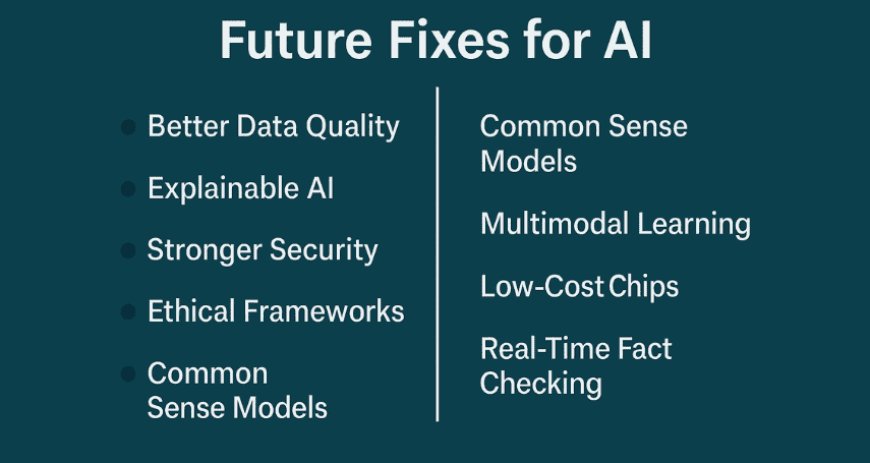
Future Fixes: How AI’s Limitations Will Improve in the Next Decade
Here’s what researchers believe will change:
1. Better Common Sense Models
Using simulations, robotics, and hybrid models.
2. Hallucination-Free AI (Partially)
Real-time data + fact-checking + retrieval models.
3. Ethical & Fair AI
More balanced datasets, audits, and fairness frameworks.
4. Low-Cost AI Models
Efficient small models with near-big-model performance.
5. Emotionally Aware AI
Better tone detection + sentiment models.
6. Transparent AI (Explainability)
Visual reasoning maps that show how decisions were made.
But remember:
AI will always have limits because AI is not human.
AI Has Limits But Also Unlimited Potential
Artificial Intelligence is not perfect.
It makes mistakes.
It lacks common sense.
It carries bias.
It struggles with reasoning.
It raises ethical concerns.
But despite these limitations, AI is still one of the most transformative technologies ever created.
The future of AI is not about replacing humans it’s about enhancing human intelligence.
The best approach is simple:
AI does the heavy work.
Humans make the final decisions.
Together, they create a smarter, safer, more powerful world.