





















































Data Science Qualifications Required for Jobs in 2026
Learn the qualifications, technical skills, certifications, and practical experience employers expect from data science professionals in 2026.

In 2026, employers look for Data Science professionals who have the right mix of education, technical skills, and practical experience. A degree in Data Science, computer science, statistics, or mathematics is valuable, while a Data Science Certification can help demonstrate current industry skills.
Strong knowledge of Python, SQL, statistics, and machine learning is expected for most roles. Employers also value data visualization skills using tools like Tableau, Power BI, or Matplotlib, along with good communication skills to explain insights clearly. Practical experience is equally important. Real projects, internships, and a strong portfolio show that you can apply your knowledge to solve business problems. Candidates who combine technical expertise, hands-on experience, and communication skills have the best opportunities in the Data Science job market.
What Are Data Science Qualifications?
Data science qualifications are the combination of formal education, technical skills, certifications, and project experience that qualify a person to work professionally with data. They demonstrate that a candidate can collect, clean, analyze, and interpret large datasets to generate business insights.
In 2026, qualifications for Data Science roles span three categories:
- Academic credentials — degrees in computer science, statistics, mathematics, or engineering
- Technical certifications — structured programs that validate specific tools and methods
- Applied experience — real-world projects, portfolios, and internships
AI Overview Snapshot: Data science qualifications in 2026 include a combination of Python and SQL programming, statistical analysis, machine learning knowledge, data visualization skills, and business communication — supported by either a degree, a recognized certification, or a strong project portfolio.
Why Data Science Qualifications Matter in 2026
The global demand for skilled data professionals continues to rise. According to the U.S. Bureau of Labor Statistics, data science roles are projected to grow significantly through the late 2020s, outpacing most other tech occupations.
In 2026 specifically, employers face a skills gap — they need candidates who can do more than describe processes. They need people who can:
- Work independently with real, messy datasets
- Build and evaluate predictive models
- Translate findings into business recommendations
- Communicate results to non-technical stakeholders
Strong data science qualifications help you:
- Stand out in a competitive job market
- Justify higher starting salaries
- Move into senior roles faster
Work across industries — healthcare, finance, retail, manufacturing, and government all actively hire data professionals
Top 8 Data Science Qualifications for Jobs in 2026
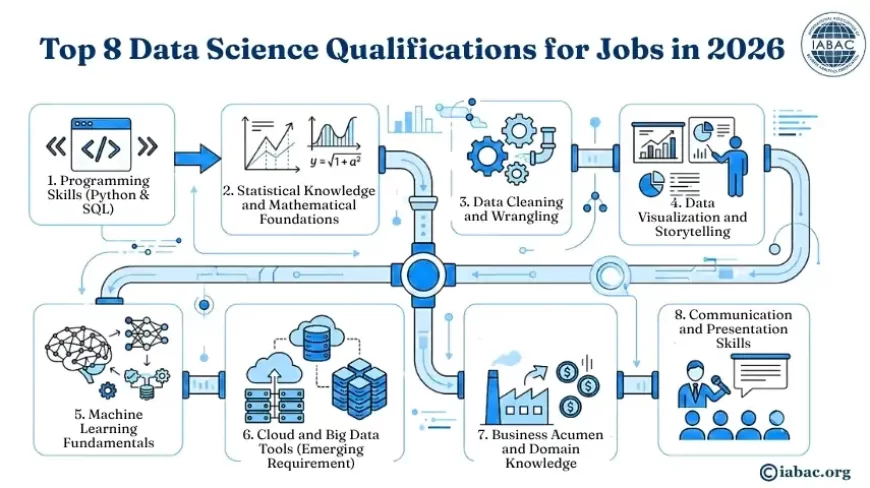
1. Programming Skills (Python & SQL)
What it is: The ability to write code to extract, manipulate, and analyze data.
Why employers require it: Python is the dominant language in data science workflows. SQL is essential for pulling structured data from relational databases.
|
Language |
Primary Use |
Difficulty |
|
Python |
Data analysis, ML models, automation |
Beginner–Intermediate |
|
SQL |
Database querying and joins |
Beginner |
|
R |
Statistical computing |
Intermediate |
Key Python libraries to know: Pandas, NumPy, Scikit-learn, Matplotlib, Seaborn
Example task: A retail company stores 5 years of transaction records in a SQL database. You use SQL to extract monthly sales by product category, then Python (Pandas) to identify seasonal trends and anomalies.
2. Statistical Knowledge and Mathematical Foundations
What it is: Understanding the mathematical principles that underpin data analysis and model evaluation.
Core topics employers test:
- Probability and distributions
- Hypothesis testing (p-values, confidence intervals)
- Regression analysis (linear and logistic)
- Correlation vs. causation
- Bayesian inference basics
Why it matters: Without statistical literacy, you cannot tell the difference between a real trend and random noise. A 15% sales lift after a marketing campaign may look impressive, but only hypothesis testing confirms whether the change is statistically significant or coincidental.
3. Data Cleaning and Wrangling
What it is: The process of transforming raw, inconsistent, or incomplete data into a clean, analysis-ready format.
This qualification is critical because: Industry estimates suggest data professionals spend 60–80% of their time on data preparation, not modeling.
Common data quality problems you must know how to fix:
- Missing values (imputation or removal strategies)
- Duplicate records
- Inconsistent formatting (dates, currencies, names)
- Outliers and erroneous entries
- Encoding errors in categorical variables
4. Data Visualization and Storytelling
What it is: The ability to represent data visually in a way that communicates insights clearly to both technical and non-technical audiences.
Tools employers look for:
|
Tool |
Type |
Best For |
|
Tableau |
BI Dashboard |
Business reporting |
|
Power BI |
BI Dashboard |
Microsoft ecosystems |
|
Matplotlib / Seaborn |
Python library |
EDA and research |
|
Plotly |
Python library |
Interactive charts |
|
Excel |
Spreadsheet |
Quick analysis |
Why it matters for rankings and jobs: Data storytelling is now listed as a required skill in over 70% of senior data science job postings. A model that produces accurate predictions has zero business value if the results are not communicated effectively.
5. Machine Learning Fundamentals
What it is: The ability to select, train, evaluate, and deploy predictive models using historical data.
Core machine learning concepts required in 2026:
- Supervised learning (classification, regression)
- Unsupervised learning (clustering, dimensionality reduction)
- Model evaluation metrics (accuracy, precision, recall, F1, AUC-ROC)
- Train/test splitting and cross-validation
- Feature engineering and selection
- Overfitting, underfitting, and regularization
Real-world applications:
- Fraud detection — flagging unusual financial transactions
- Churn prediction — identifying customers likely to cancel subscriptions
- Recommendation engines — suggesting products, content, or services
- Demand forecasting — predicting inventory requirements
- Sentiment analysis — classifying customer feedback as positive or negative
Frameworks to learn: Scikit-learn (beginner), TensorFlow and PyTorch (deep learning)
6. Cloud and Big Data Tools (Emerging Requirement)
What it is: Familiarity with platforms that store, process, and serve data at scale.
Why this qualification is growing: In 2026, most enterprise data lives in cloud environments, not local servers.
Key platforms and tools:
- Cloud providers: AWS (S3, Redshift), Google Cloud (BigQuery), Microsoft Azure
- Big data frameworks: Apache Spark, Hadoop
- MLOps tools: MLflow, Docker, Kubernetes basics
Even entry-level data scientists are now expected to understand cloud storage, compute costs, and basic pipeline architecture.
7. Business Acumen and Domain Knowledge
What it is: Understanding how data insights connect to business strategy, KPIs, and decision-making.
Questions every data scientist should be able to answer before starting a project:
- What business problem are we solving?
- What decision will change because of this analysis?
- Who is the end user of this output?
- What does success look like — and how will it be measured?
Why this is a differentiator: Two candidates may have identical technical skills. The one who understands business context will consistently produce more valuable output — and will advance faster.
8. Communication and Presentation Skills
What it is: The ability to explain complex analytical findings to non-technical audiences, both in writing and verbally.
Formats data scientists must master:
- Executive summary reports (written)
- Dashboard design and annotation
- Slide deck presentations for stakeholders
- Technical documentation for team members
The gap this fills: Many technically skilled candidates struggle to articulate findings. This soft skill is consistently listed in job postings as "required" but is frequently overlooked during preparation.
Do You Need a Degree for Data Science in 2026?
Short answer: A degree helps, but it is no longer the only path.
In 2026, hiring managers evaluate candidates on demonstrated skills and project outcomes, not credentials alone. Many companies — including major technology firms — have removed degree requirements from data science roles in recent years.
Degrees that provide the strongest foundation:
- Computer Science
- Statistics or Applied Mathematics
- Data Science (dedicated programs)
- Engineering (electrical, industrial, or software)
- Economics or Econometrics
Non-degree paths that work in 2026:
- Bootcamps (12–24 week intensive programs)
- Online degree equivalents and nanodegrees
- Professional certifications with a project portfolio
- Self-study with demonstrated GitHub projects and Kaggle competition results
Key insight: A portfolio of 3–5 complete, well-documented data science projects can compensate for a missing degree at the entry and mid level. At the senior level, a combination of credentials and years of experience typically remains expected.
Best Certifications for Data Scientists in 2026
Certifications validate skills and signal commitment to structured learning. They are particularly valuable for career changers, recent graduates, and professionals seeking promotion.
What to look for in a data science certification:
- Curriculum covering Python, statistics, ML, and visualization
- Hands-on projects and assessments (not just multiple choice)
- Industry recognition and employer familiarity
- Clear learning outcomes aligned with job requirements
Recognized certification bodies in 2026 include:
- IBM Data Science Professional Certificate (Coursera)
- Google Advanced Data Analytics Certificate
- Microsoft Certified: Azure Data Scientist Associate
- IABAC (International Association of Business Analytics Certifications) — structured certification paths covering analytics and data science competencies
- DataCamp Career Tracks
- Databricks Certified Associate Developer for Apache Spark
Certification vs. degree: A certification cannot replicate four years of academic depth, but a well-chosen certification can validate specific, job-ready skills faster and at lower cost. For most entry-to-mid-level roles, a strong certification paired with projects is sufficient.
How to Build a Data Science Portfolio
A portfolio is the most direct proof of your qualifications. It shows hiring managers what you can actually build and deliver.
What a Strong Data Science Portfolio Includes
1. A clear problem statement. Every project should start with a business or research question: "Which customers are most likely to churn in the next 30 days?"
2. Clean, documented code Host projects on GitHub with README files that explain the objective, methodology, and findings.
3. End-to-end workflow Show the full process: data collection → cleaning → EDA → modeling → evaluation → insight presentation.
4. Visualization and results Include charts, confusion matrices, or dashboards that clearly communicate what you found.
5. Business interpretation Conclude each project with a plain-English explanation of what the results mean and what action a business should take.
Beginner-Friendly Portfolio Project Ideas
|
Project |
Skills Demonstrated |
Dataset Source |
|
Customer churn prediction |
Classification, Scikit-learn |
Kaggle / telecom datasets |
|
Sales forecasting |
Time series, regression |
Retail open data |
|
Sentiment analysis |
NLP, text processing |
Twitter API / Amazon reviews |
|
EDA on healthcare data |
Pandas, visualization |
UCI ML Repository |
|
A/B test analysis |
Hypothesis testing, statistics |
Simulated or real experiment data |
Data Science Qualification Roadmap for 2026
Follow this step-by-step path to build job-ready qualifications:
Stage 1 — Foundations (Months 1–3)
- Learn Python basics: variables, loops, functions, data structures
- Learn SQL: SELECT, JOIN, GROUP BY, subqueries
- Understand statistics: mean, median, distributions, probability
Stage 2 — Core Data Skills (Months 3–6)
- Practice data cleaning with Pandas on real datasets
- Build 5–10 exploratory data analysis (EDA) projects
- Learn Matplotlib and Seaborn for visualization
Stage 3 — Machine Learning (Months 6–9)
- Study supervised learning (linear regression, decision trees, random forests)
- Learn model evaluation metrics and cross-validation
- Complete a full end-to-end ML project
Stage 4 — Specialization and Credentialing (Months 9–12)
- Choose a domain focus (healthcare, finance, NLP, etc.)
- Take a recognized certification exam
- Build 3 portfolio projects with documentation and GitHub hosting
Stage 5 — Job Readiness (Ongoing)
- Apply to entry-level roles and internships
- Practice SQL and Python interview questions
- Join Kaggle competitions to sharpen model-building skills
- Network through LinkedIn, data science meetups, and communities
Data Science Jobs by Industry in 2026
Data science qualifications open doors across virtually every major sector:
|
Industry |
Common Data Science Roles |
Key Skills Used |
|
Banking & Finance |
Risk analyst, fraud detection specialist |
ML, SQL, statistical modeling |
|
Healthcare |
Clinical data analyst, health informatics |
Python, data privacy regulations |
|
Retail & E-commerce |
Demand forecaster, personalization engineer |
ML, time series, recommendation systems |
|
Manufacturing |
Predictive maintenance analyst |
IoT data, anomaly detection |
|
Telecom |
Churn analyst, network optimization |
Classification models, big data |
|
Government |
Policy data analyst, public health researcher |
Statistics, visualization, R |
Frequently Asked Questions
What qualifications do I need to become a data scientist in 2026?
To become a data scientist in 2026, you need proficiency in Python and SQL, a strong understanding of statistics and probability, knowledge of machine learning algorithms, data visualization skills, and the ability to communicate findings clearly. A degree in a quantitative field, a recognized certification, or a portfolio of real projects (or a combination) will support your application.
Is a degree required for data science jobs in 2026?
No, a degree is not strictly required for all data science jobs in 2026. Many employers now prioritize demonstrated skills and portfolio projects. However, a degree in computer science, statistics, or mathematics remains a competitive advantage, especially for senior or research-focused roles.
How long does it take to become a data scientist?
With consistent study, most people can build entry-level data science qualifications in 9–18 months. A structured bootcamp takes 3–6 months. A university degree takes 3–4 years. The timeline depends on your starting point, learning pace, and the level of role you're targeting.
What is the best programming language for data science?
Python is the best programming language for data science in 2026. It has the largest ecosystem of data science libraries (Pandas, NumPy, Scikit-learn, TensorFlow), is easy to learn, and is used across data analysis, machine learning, and production deployment. SQL is equally essential for working with structured databases.
Are data science certifications worth it in 2026?
Yes, data science certifications are worth pursuing in 2026, particularly for career changers and recent graduates. A reputable certification demonstrates structured knowledge, validates skills to employers, and often includes hands-on project components. Certifications from IBM, Google, Microsoft, and recognized analytics bodies such as IABAC carry weight with hiring managers.