


















































Understanding Artificial Intelligence from Foundations to Generative AI
Comprehensive guide covering AI basics, machine learning, neural networks and generative AI concepts, applications, tools and career pathways.

The AI Universe: From Foundations to Generative AI
Artificial Intelligence (AI) is not just a single technology — it is an entire universe of interconnected concepts, models, and systems. From speech recognition to robotics, from machine learning to generative AI, every layer builds upon another to create the intelligent systems we use today.
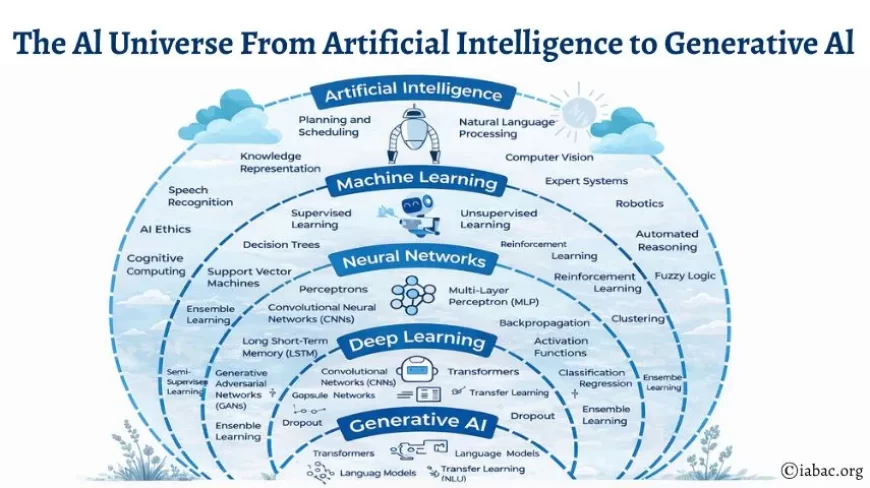
To truly understand AI, you need to see how everything connects. This blog will guide you through the complete AI landscape — starting from Artificial Intelligence at the outer layer, moving through Machine Learning and Neural Networks, diving into Deep Learning, and finally reaching the core: Generative AI.
Let’s explore the AI universe step by step.
Artificial Intelligence: The Outer Layer
Artificial Intelligence (AI) represents the broadest and most comprehensive field within modern intelligent technologies. It focuses on creating machines and software systems capable of performing tasks that normally require human intelligence. These tasks include reasoning, learning from experience, problem-solving, perception, language understanding, and decision-making.
Rather than being a single technology, AI is an umbrella discipline that integrates multiple specialized areas. Its goal is to enable machines to act intelligently, adapt to new information, and perform complex cognitive functions in dynamic environments.
Core Domains within Artificial Intelligence
AI encompasses several major domains, each addressing different aspects of intelligent behavior:
- Natural Language Processing (NLP): Enables machines to understand, interpret, generate, and interact using human language. Applications include chatbots, translation systems, and text summarization.
- Computer Vision: Allows machines to interpret and understand visual data from images and videos. It powers technologies such as facial recognition, object detection, medical image analysis, and autonomous driving perception systems.
- Robotics: Combines AI with mechanical systems to build machines capable of interacting with the physical world. Robots can perform industrial automation, assist in surgery, explore hazardous environments, and support logistics operations.
- Expert Systems: Simulate the decision-making ability of human experts using rule-based reasoning and knowledge databases. These systems are often used in medical diagnosis, troubleshooting, and financial advisory applications.
- Speech Recognition: Enables systems to recognize and convert spoken language into text or commands, supporting voice assistants, transcription services, and hands-free system control.
- Planning and Scheduling: Helps machines organize tasks, allocate resources, and determine optimal action sequences, widely used in logistics, manufacturing, and project management systems.
- Knowledge Representation: Focuses on storing and structuring information so machines can reason about it. This includes ontologies, semantic networks, and logical frameworks.
- Automated Reasoning: Allows systems to make logical deductions and solve problems using formal reasoning techniques, crucial for verification systems and intelligent decision support.
- AI Ethics: Addresses fairness, transparency, accountability, privacy, and societal impact issues surrounding AI technologies, ensuring responsible and safe deployment.
- Cognitive Computing: Attempts to mimic human thought processes, including learning, reasoning, and contextual understanding, to assist decision-making in complex environments.
- Fuzzy Logic: Handles uncertainty and approximate reasoning, allowing systems to make decisions with incomplete or ambiguous information.
Practical Examples of AI in Action
AI technologies are now embedded in everyday systems, often operating behind the scenes:
- Virtual assistants interpret spoken commands and provide responses or services.
- Recommendation systems suggest movies, products, or music based on user preferences.
- Industrial robots automate manufacturing processes with precision and efficiency.
- Fraud detection systems analyze transaction patterns to identify suspicious activity.
- Medical AI systems assist doctors by analyzing scans and predicting diseases.
- Smart navigation systems calculate optimal routes based on real-time traffic data.
AI as a Collection of Approaches
Importantly, AI is not a single algorithm or tool. Instead, it consists of many approaches and methodologies designed to solve different types of intelligent tasks.
One of the most influential and widely used approaches within AI is Machine Learning, which allows systems to learn patterns from data rather than relying solely on predefined rules. Machine Learning and its subfields form a powerful foundation for many modern AI applications.
Machine Learning: Teaching Machines to Learn
Machine Learning (ML) is a subset of Artificial Intelligence. Instead of programming every rule manually, ML allows systems to learn patterns from data.
Traditional AI systems relied on fixed rules. Machine Learning changed that by allowing algorithms to improve automatically through experience.
Machine Learning is broadly divided into:
Supervised Learning
The model learns from labeled data.
Examples:
- Classification (spam detection)
- Regression (price prediction)
Unsupervised Learning
The model finds hidden patterns in unlabeled data.
Examples:
- Clustering
- Dimensionality reduction
Semi-Supervised Learning
Uses a combination of labeled and unlabeled data.
Reinforcement Learning
The model learns through rewards and penalties.
Machine Learning also includes techniques such as:
- Decision Trees
- Support Vector Machines
- Ensemble Learning
- Feature Engineering
As data became larger and more complex, traditional ML methods started reaching their limits. This led to the rise of Neural Networks.
Neural Networks: Inspired by the Human Brain
Neural Networks are inspired by how the human brain processes information. They consist of layers of interconnected nodes (neurons) that process input data and generate output.
Important neural network concepts include:
- Perceptrons
- Multi-Layer Perceptron (MLP)
- Backpropagation
- Activation Functions
Neural networks made it possible to process complex data such as images, speech, and text more effectively than traditional ML models.
But as problems became even more complex, researchers started building deeper neural networks — giving birth to Deep Learning.
Deep Learning: Powering Modern AI
Deep Learning is a specialized subset of Machine Learning that uses multi-layered neural networks to model highly complex patterns.
It has revolutionized industries because it performs exceptionally well with large amounts of data.
Key deep learning architectures include:
- Convolutional Neural Networks (CNNs): Used mainly for image processing and computer vision.
- Recurrent Neural Networks (RNNs): Designed for sequential data like time series and speech.
- Long Short-Term Memory (LSTM): A special type of RNN that handles long-term dependencies.
- Generative Adversarial Networks (GANs): Used to generate new data samples like images or videos.
Capsule Networks
Improve feature representation in vision tasks.
Deep learning enables:
- Face recognition
- Self-driving cars
- Medical image analysis
- Voice assistants
- Language translation
As deep learning matured, it paved the way for the most transformative layer yet — Generative AI.
Generative AI: The Core of the AI Revolution
Generative AI sits at the center of the AI universe. Unlike traditional AI systems that classify or predict, generative models create entirely new content.
Generative AI can produce:
- Text
- Images
- Audio
- Code
- Videos
It is powered by advanced deep learning architectures such as:
Transformers: The foundation of modern language models.
Language Models: Systems trained to understand and generate human-like text.
Transfer Learning: Using pre-trained models for new tasks.
Self-Attention Mechanism:Allows models to focus on relevant parts of input data.
Natural Language Understanding
Helps AI interpret context and meaning.
Examples of Generative AI applications:
- Chatbots and AI assistants
- AI content creation
- Code generation
- AI art and design
- Automated report writing
Generative AI is transforming industries because it goes beyond analysis — it creates.
How All Layers Connect
The AI universe is structured like concentric layers:
Artificial Intelligence
→ Machine Learning → Neural Networks → Deep Learning → Generative AI
Each inner layer is more specialized and advanced than the outer one.
You cannot fully understand Generative AI without understanding Deep Learning.
You cannot master Deep Learning without knowing Neural Networks.
You cannot grasp Neural Networks without understanding Machine Learning.
And all of these exist within Artificial Intelligence.
This layered structure explains how AI evolved over time — from rule-based systems to intelligent, creative machines.
Why Understanding the AI Universe Matters
If you are a student, developer, business leader, or AI enthusiast, understanding this layered structure helps you:
- Choose the right learning path
- Identify career opportunities
- Understand how AI tools actually work
- Build strong foundational knowledge
- Avoid confusion between AI buzzwords
Today, many people use AI tools without understanding the technology behind them. But professionals who understand the ecosystem gain a major advantage.
Career Opportunities Across the AI Universe
Each layer opens different career paths:
|
AI Layer |
Career Opportunities |
|
Artificial Intelligence |
AI Researcher AI Strategy Consultant AI Product Manager |
|
Machine Learning |
Machine Learning Engineer Data Scientist ML Researcher |
|
Neural Networks & Deep Learning |
Deep Learning Engineer Computer Vision Engineer NLP Engineer |
|
Generative AI |
Prompt Engineer AI Automation Specialist AI Content Engineer LLM Application Developer |
As AI continues evolving, the demand for skilled professionals will only grow.
The AI universe is vast, layered, and constantly expanding. What began as simple rule-based systems has evolved into self-learning, pattern-recognizing, content-generating intelligent machines. Understanding the full ecosystem — from Artificial Intelligence to Generative AI — gives you clarity, direction, and confidence in navigating this rapidly changing field.
AI is not just a trend. It is a technological revolution reshaping industries, careers, and the way we interact with machines.
And this universe is only getting bigger.