













































What is Workforce Analytics and How Does It Work?
Learn what workforce analytics is, how it works, key metrics, benefits, tools, and trends to make smarter HR decisions and improve business results.

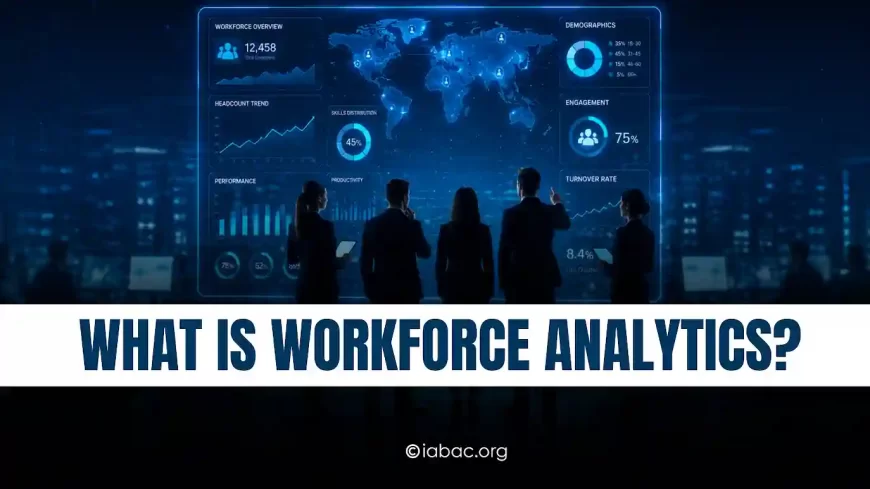
Every organization collects workforce data, from hiring records and performance reviews to employee engagement surveys. But collecting data alone doesn't improve business decisions. The value comes from understanding what that data reveals about hiring quality, employee retention, workforce planning, and productivity.
Workforce analytics helps organizations turn HR data into meaningful business insights. Rather than simply reporting what happened, it identifies patterns, explains why they occur, and supports better decisions across recruitment, talent management, and long-term workforce planning.
In this guide, you'll learn what workforce analytics is, how it works, the different types and metrics organizations use, its business benefits, common challenges, emerging trends, and the skills needed to build expertise in this growing field.
Key Takeaways
-
Workforce analytics uses employee and business data to explain why workforce trends happen, not just what happened.
-
It differs from basic HR reporting because it connects people data to business outcomes like revenue, retention, and productivity.
-
Four core types exist: descriptive, diagnostic, predictive, and prescriptive workforce analytics.
-
Common workforce analytics metrics include turnover rate, time-to-fill, quality of hire, employee engagement, and internal mobility.
-
Retention and turnover remain the single most common use case for workforce analytics adoption across HR functions.
-
Building workforce analytics capability increasingly requires structured, certified training rather than spreadsheet skills.
What is Workforce Analytics?
Workforce analytics, sometimes called HR analytics or people analytics, is the systematic use of employee, operational, and business data to inform HR decisions and workforce strategy. Workforce analytics is typically supported by a combination of HR analytics tools and business intelligence platforms. Instead of relying on instinct, HR and business leaders use workforce analytics to identify patterns in hiring, performance, engagement, and attrition, and to connect those patterns to measurable business outcomes.
The distinction between reporting and workforce analytics matters. A standard HR report might state that turnover sits at 15% for the year. Workforce analytics goes further, showing that a disproportionate share of that turnover is concentrated among employees in their first 18 months, correlated with a specific manager, or tied to limited access to career development. That shift, from a static number to an explanation with a clear next action, is what separates data reporting from true workforce analytics.
Workforce analytics draws on several connected disciplines. People analytics and HR analytics are often used interchangeably with workforce analytics, though people analytics tends to emphasize employee experience and behavior, while workforce analytics leans more heavily into planning, staffing, and cost. Talent analytics narrows the focus to acquisition and development. In practice, most organizations blend these terms and simply refer to the overall function as workforce analytics.
Why Workforce Analytics Matters
Workforce analytics matters because people costs are typically the largest controllable expense on a company's income statement, yet workforce decisions have historically been among the least data-informed. When hiring, retention, and workforce planning decisions are guided by structured data rather than assumption, organizations reduce costly errors: over-hiring in one department while under-resourcing another, losing high performers to preventable causes, or missing early signals of a skills gap that later becomes a business-critical shortage.
Beyond cost control, workforce analytics has become central to how HR earns a seat in strategic conversations. Business leaders overwhelmingly recognize its impact on the HR function, with the vast majority reporting that people analytics elevates HR's credibility inside the organization, and most HR executives who use it describing it as essential to their overall people strategy.
Workforce analytics also matters because of how work itself is changing. AI adoption, hybrid work models, and generational shifts in the workforce mean that the assumptions HR teams relied on five years ago often no longer hold. Deloitte's 2026 Global Human Capital Trends research highlights how quickly organizations are being asked to redesign work around human-AI collaboration, and workforce analytics is the mechanism that lets HR teams track whether those redesigns are actually working, rather than guessing.
How Workforce Analytics Works
Workforce analytics works through a repeatable cycle: define the business question, gather and clean relevant data, analyze it, and translate the findings into action.
1. Start with a business question, not a dataset
Effective workforce analytics projects begin with a specific question, such as "Why is regrettable turnover higher in our technical teams than the company average?" rather than an open-ended instruction to "analyze the data." A narrow, business-relevant question keeps the analysis useful and prevents analysis paralysis.
2. Consolidate the data
Employee data typically lives across multiple systems: the HRIS, applicant tracking system, payroll, performance management platform, and engagement surveys. Workforce analytics requires pulling these sources together into a single, consistent view, which is often the hardest and most underestimated step in the process.
3. Clean and validate
Duplicate records, inconsistent job titles, and missing fields undermine even the most sophisticated analysis. Before any modeling happens, workforce analytics teams need to confirm that the underlying data is accurate and complete.
4. Analyze and model
Depending on the maturity of the organization, this ranges from straightforward descriptive statistics (attrition by department) to statistical modeling and machine learning (predicting flight risk based on tenure, engagement scores, and manager changes).
5. Translate insight into action
The output of workforce analytics should never be a dashboard for its own sake. Every finding needs an owner and a recommended next step, whether that's a targeted retention program, a revised sourcing strategy, or a workforce plan adjustment.
Types of Workforce Analytics
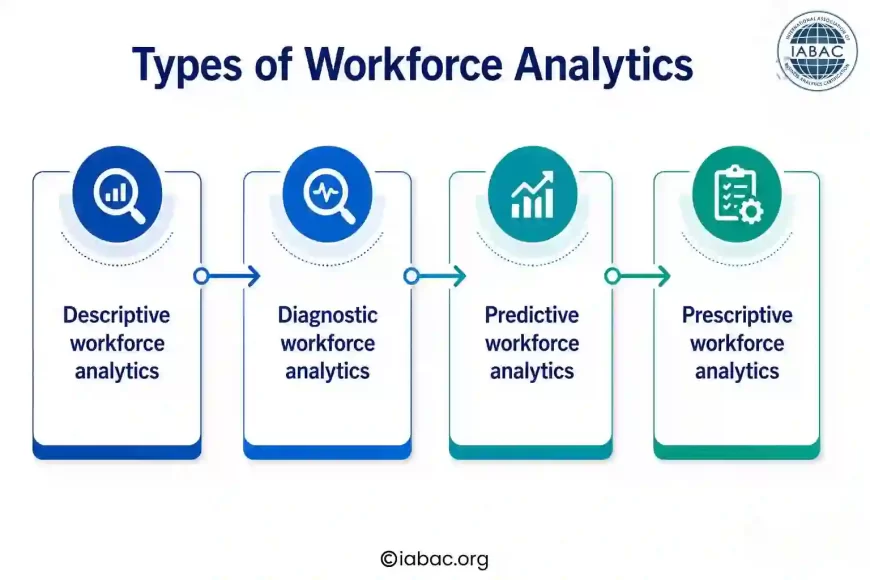
Descriptive workforce analytics looks backward. It answers "what happened," using metrics like headcount, turnover rate, and absenteeism to describe the current or historical state of the workforce. This is the foundation most organizations start with.
Diagnostic workforce analytics goes a step further and asks, "Why did it happen?" It looks for correlations and root causes behind the patterns that descriptive analytics surfaces, such as identifying that turnover spikes coincide with a specific onboarding gap or compensation band.
Predictive workforce analytics uses historical data and statistical or machine learning models to forecast future outcomes, such as which employees are at elevated flight risk or how many hires a growing department will need over the next fiscal year based on project pipeline and historical hiring patterns. The same predictive techniques are widely used across finance, marketing, and operations, making predictive analytics an increasingly valuable skill beyond HR functions.
Prescriptive workforce analytics is the most advanced type, recommending specific actions based on predicted outcomes, for example, suggesting which retention interventions are likely to be most effective for a specific at-risk employee segment.
Most organizations move through these stages in order. Attempting predictive or prescriptive workforce analytics without a solid descriptive and diagnostic foundation usually produces unreliable models built on messy data.
Workforce Analytics Metrics
The right workforce analytics metrics depend on the business question, but several categories recur across nearly every organization:
-
Recruiting and hiring: time-to-fill, cost-per-hire, quality of hire, offer acceptance rate, and source-of-hire effectiveness.
-
Retention and turnover: overall turnover rate, voluntary versus involuntary turnover, turnover by manager or department, and regrettable versus unregrettable turnover.
-
Engagement and culture: engagement survey scores, participation rates, and sentiment trends segmented by tenure or team.
-
Workforce planning: skills inventory coverage, succession readiness, internal mobility rate, and span of control.
-
Performance and productivity: performance distribution, productivity per employee, and manager effectiveness ratings.
A common mistake is tracking too many workforce analytics metrics at once. Most practitioners recommend starting with three to five metrics tightly aligned to a specific business priority, then expanding coverage as the organization's data maturity grows.
Best Workforce Analytics Tools
Organizations use a combination of HR platforms, analytics software, and business intelligence tools to collect, analyze, and visualize workforce data. The right tool depends on the organization's size, existing HR systems, reporting needs, and analytics maturity.
-
Workday: Provides built-in workforce analytics, dashboards, and planning capabilities for HR, finance, and talent management.
-
SAP SuccessFactors: Offers people analytics, workforce planning, and reporting features integrated with core HR processes.
-
Oracle HCM Cloud: Combines workforce data, predictive analytics, and AI-powered insights to support hiring, performance, and workforce planning.
-
Visier: A dedicated people analytics platform that helps organizations analyze workforce trends, predict attrition, and make data-driven talent decisions.
-
Microsoft Power BI: Enables HR teams to build custom dashboards by combining data from HRIS, payroll, engagement surveys, and other business systems.
-
Tableau: Creates interactive workforce dashboards and visualizations for analyzing employee performance, turnover, hiring, and productivity.
-
Microsoft Excel: Still widely used for basic workforce reporting, KPI tracking, and ad hoc analysis, particularly in smaller organizations or during the early stages of workforce analytics adoption.
While selecting the right platform is important, the quality of the underlying workforce data and the business questions being addressed have a far greater impact on the value workforce analytics delivers than the software itself.
Key Benefits of Workforce Analytics
Organizations that build strong workforce analytics capabilities can realize several business benefits:
-
Better hiring decisions: Recruiting analytics identify which sourcing channels and hiring processes produce high-performing, long-tenured employees rather than simply filling roles quickly.
-
Improved employee retention: Diagnostic and predictive analytics help HR teams detect attrition risks early, enabling proactive retention strategies.
-
More effective workforce planning: Forecasting future talent needs helps organizations allocate resources and plan hiring based on business demand instead of historical headcount.
-
Enhanced employee experience: Engagement and culture analytics uncover specific issues affecting employees, allowing organizations to make targeted improvements.
-
Stronger strategic decision-making: Data-backed workforce insights give HR greater credibility in workforce planning, budgeting, and executive decision-making.
Challenges of Workforce Analytics
Organizations commonly face the following challenges when implementing workforce analytics:
-
Data fragmentation: Workforce data is often spread across HRIS, payroll, applicant tracking systems (ATS), and performance management platforms, making it difficult to create a unified view.
-
Data privacy and ethics: Since workforce analytics uses employee data, organizations must establish clear governance, access controls, and responsible use of predictive insights.
-
Skills gaps: Successful workforce analytics requires a combination of HR expertise, statistical knowledge, and data analysis skills, which many teams are still developing.
-
Change management: Managers accustomed to intuition-based decision-making may hesitate to adopt analytics-driven recommendations without clear communication and business context.
-
Over-reliance on historical metrics: Focusing only on past performance limits the value of workforce analytics. Organizations gain greater benefits by using predictive insights to anticipate future workforce challenges.
Future Trends
Several trends are shaping the future of workforce analytics through 2026 and beyond:
-
AI-powered HR analytics: AI is moving from experimental pilots to built-in functionality within workforce analytics platforms. Features such as natural-language querying, automated anomaly detection, and AI-generated insights are becoming standard capabilities.
-
Skills-based workforce planning: Organizations are shifting from role-based workforce planning to skills-based models, tracking and forecasting capabilities at the skill level as automation reshapes job responsibilities.
-
Real-time workforce analytics: Continuous monitoring is replacing quarterly or annual reporting, enabling organizations to respond more quickly to workforce changes and emerging business needs.
-
Greater focus on AI governance: As predictive models become more common in HR, organizations are placing increased emphasis on responsible AI use, data governance, and ethical decision-making.
-
Growing demand for workforce analytics professionals: Organizations continue to seek professionals who combine HR expertise with analytical skills, driving greater interest in structured learning through programs.
Frequently Asked Questions
Is workforce analytics the same as HR analytics?
The terms are largely used interchangeably. Workforce analytics sometimes emphasizes planning, staffing levels, and cost, while HR analytics can cover the same ground plus broader people-management topics. In most job postings and business conversations, the two terms describe the same discipline.
What is the difference between workforce analytics and people analytics?
People analytics typically focuses more on individual employee experience, behavior, and engagement, while workforce analytics often leans toward planning, staffing, and organization-wide trends. In practice, the two overlap heavily, and many organizations use them interchangeably.
Do I need to know how to code to work in workforce analytics?
Not always. Many workforce analytics roles rely on tools with built-in dashboards and visual query builders. That said, familiarity with statistics and, ideally, a query language like SQL significantly expands what an HR analytics professional can do independently.
What is the first step for a company with no existing workforce analytics capability?
Start small: pick one specific, high-priority business question (often related to turnover or time-to-fill), consolidate the data needed to answer it, and build a repeatable process before expanding to a broader dashboard or platform.
What industries use workforce analytics?
Workforce analytics is widely used across industries including IT, healthcare, manufacturing, retail, BFSI, education, logistics, and government. Any organization that manages employees can use workforce analytics to improve hiring, retention, workforce planning, and productivity.
How is AI changing workforce analytics?
AI in HR is making workforce analytics faster and more accessible by automating pattern detection, generating narrative summaries of dashboard data, and improving the accuracy of predictive models like attrition risk scoring. It is not replacing the need for sound data governance or human judgment in interpreting results.
Workforce analytics delivers the greatest value when organizations move beyond reporting and start using data to guide everyday workforce decisions. Starting with the right business question, reliable data, and a clear set of workforce metrics creates a foundation that can scale into predictive and AI-driven workforce planning over time.
If you're ready to build expertise in this field, IABAC's Certified HR Analytics Professional certification provides practical training in workforce metrics, predictive analytics, and data-driven HR decision-making, helping you apply workforce analytics with confidence in real business scenarios.