























































What Is Narrow AI and How Does It Work in 2026?
Narrow AI explained: how it works, real examples, and 2026 trends. From ChatGPT to fraud detection, discover what every business leader must know.

Key Highlights
-
Narrow AI is designed to perform specific tasks rather than general human-level intelligence.
-
Nearly all AI systems deployed today fall into the Narrow AI category.
-
Machine learning, deep learning, and neural networks are core technologies behind Narrow AI.
-
Examples include ChatGPT, recommendation engines, fraud detection systems, and computer vision applications.
-
Narrow AI excels within defined boundaries but struggles outside its training scope.
-
Modern AI agents and multimodal systems are still considered forms of Narrow AI.
-
Businesses increasingly rely on Narrow AI for productivity, automation, and decision support.
-
Understanding its limitations is just as important as understanding its capabilities.
What Is Narrow AI?
Narrow AI, also called Artificial Narrow Intelligence (ANI) or Weak AI, refers to AI systems designed to perform a specific task or a limited set of related tasks.
Unlike humans, Narrow AI cannot transfer knowledge freely across different domains. A system trained to identify tumors in medical images cannot suddenly become an expert financial analyst.
This specialization is what makes Narrow AI both powerful and limited.
Why Is It Called Weak AI?
The term "Weak AI" does not mean the technology is ineffective. In fact, Narrow AI often outperforms humans in highly specialized tasks.
The term simply distinguishes it from the theoretical concept of Artificial General Intelligence (AGI), an AI system capable of learning and performing any intellectual task a human can do.
Key Characteristics of Narrow AI
-
Designed for specific tasks
-
Trained using specialized datasets
-
Excels within defined boundaries
-
Cannot generalize like humans
-
Requires ongoing monitoring and updates
-
Often depends on machine learning models
A useful analogy is to think of Narrow AI as a world-class specialist rather than a universal expert.
How Does Narrow AI Work?
At its core, Narrow AI learns patterns from data and uses those patterns to make predictions or decisions.
Step 1: Data Collection: Every AI system starts with data.
For example:
-
Fraud detection systems analyze transaction histories.
-
Medical AI systems analyze imaging scans.
-
Chatbots analyze text from books, websites, and conversations.
The quality of the data directly affects performance.
Step 2: Model Training: Machine learning algorithms process training data to identify patterns. During training, the model adjusts internal parameters until it can reliably recognize relationships within the data.
This process may involve:
-
Supervised learning
-
Unsupervised learning
-
Reinforcement learning
Step 3: Pattern Recognition: After training, the model can identify patterns in new information.
For example:
-
A spam filter identifies suspicious email characteristics.
-
A recommendation engine predicts content preferences.
-
A computer vision system recognizes objects in images.
Step 4: Prediction and Decision-Making: The AI uses learned patterns to generate outputs.
Examples include:
-
Suggesting products
-
Flagging fraudulent transactions
-
Generating text responses
-
Diagnosing abnormalities in scans
Why Narrow AI Appears Intelligent
One of the biggest misconceptions about AI is that it "understands" information the way humans do.
In reality, most Narrow AI systems excel at statistical prediction rather than true understanding.
Their outputs can be remarkably useful, but they remain constrained by their training data and architecture.
Types of Narrow AI
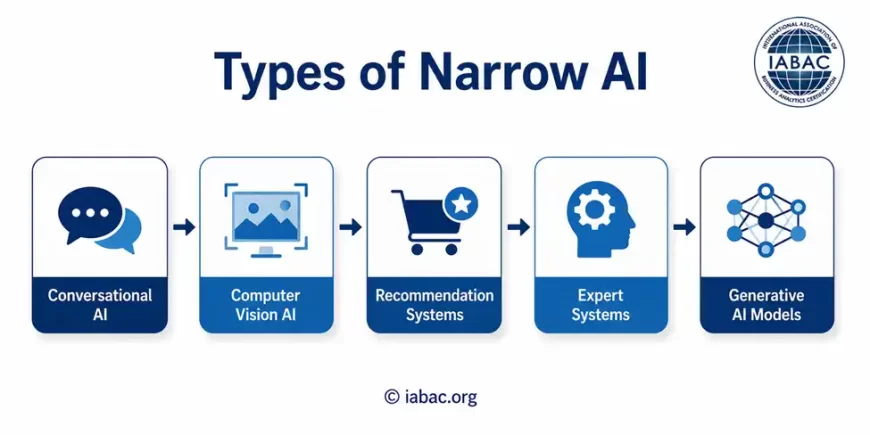
1. Conversational AI: These systems process and generate human language.
Examples include:
-
Virtual assistants
-
Customer support systems
-
AI writing tools
2. Computer Vision AI: Computer vision enables machines to interpret visual information.
Common applications include:
-
Facial recognition
-
Medical imaging
-
Manufacturing inspections
-
Autonomous vehicles
3. Recommendation Systems: Recommendation engines analyze behavior patterns to predict user preferences.
Examples include:
-
Streaming recommendations
-
E-commerce product suggestions
-
Personalized content feeds
4. Expert Systems: These systems emulate decision-making within specific domains.
Common examples include:
-
Diagnostic tools
-
Financial risk assessment systems
-
Compliance monitoring software
5. Generative AI Models: Generative AI creates new content based on patterns learned during training.
Examples include:
-
Text generation
-
Image creation
-
Audio synthesis
Narrow AI Examples in Everyday Life
Many people interact with dozens of Narrow AI systems every day without realizing it.
-
Generative AI Assistants: Voice assistants interpret spoken commands and perform predefined actions.
-
Recommendation Platforms: Streaming and shopping platforms use AI to personalize experiences.
-
Fraud Detection: Banks use AI to identify unusual transaction patterns in real time.
-
Healthcare Diagnostics: Medical AI assists healthcare professionals by identifying abnormalities in scans and test results.
-
Navigation Systems: Modern navigation tools continuously optimize routes using traffic and location data.
-
Autonomous Driving Features: Advanced driver-assistance systems rely heavily on Narrow AI for lane detection, object recognition, and hazard prediction.
Narrow AI Use Cases Across Industries
Healthcare
Healthcare organizations use Narrow AI for:
-
Medical imaging analysis
-
Disease prediction
-
Drug discovery support
-
Clinical decision assistance
Finance
Financial institutions use AI for:
-
Credit scoring
-
Risk assessment
-
Algorithmic trading
Retail
Retailers leverage AI to:
-
Personalize recommendations
-
Forecast demand
-
Optimize inventory
-
Improve customer support
Manufacturing
Manufacturers apply AI for:
-
Predictive maintenance
-
Quality control
-
Production optimization
Cybersecurity
Cybersecurity teams use AI to:
-
Detect anomalies
-
Identify threats
-
Monitor network activity
-
Improve incident response
Narrow AI vs General AI
The distinction between Narrow AI and AGI remains one of the most important concepts in artificial intelligence.
|
Feature |
Narrow AI |
General AI |
|
Scope |
Specific tasks |
Any intellectual task |
|
Learning |
Domain-specific |
Cross-domain |
|
Adaptability |
Limited |
Human-like |
|
Current Availability |
Exists today |
Not yet achieved |
|
Examples |
ChatGPT, fraud detection |
Hypothetical |
Is ChatGPT Narrow AI?
Yes. Despite impressive capabilities, modern large language models remain Narrow AI because they operate within defined objectives and lack true general intelligence.
They can perform many tasks, but they do not possess human intelligence, understanding, consciousness, or autonomous reasoning across all domains.
Can Narrow AI Become AGI?
This remains an open research question. Some researchers believe scaling current AI systems may eventually lead toward AGI. Others argue entirely breakthroughs are required.
As of June 2026, there is no consensus.
Benefits and Limitations of Narrow AI
Benefits
-
High Accuracy: Specialized AI systems often outperform humans in repetitive, data-intensive tasks.
-
Increased Efficiency: AI automates routine processes and reduces time and manual effort.
-
Scalability: Organizations can deploy AI systems across large operations without proportionally increasing staff.
-
Faster Decision Support: AI helps identify patterns and opportunities more quickly than traditional approaches.
Limitations
-
Lack of Common Sense: AI cannot reliably apply human reasoning beyond its training.
-
Dependence on Data: Poor-quality data produces poor-quality results.
-
Bias Risks: AI systems can inherit biases present in training data.
-
Limited Generalization: Success in one domain does not automatically transfer to another.
-
Common Misconception: Many assume AI systems "understand" the world like humans. In reality, Narrow AI remains highly specialized and task-focused.
Key Developments of Narrow AI in 2026
1. AI Agents and Automation: One of the most significant developments in 2026 is the rise of AI agents. These systems can coordinate multiple tasks, access tools, and complete workflows with minimal supervision. However, they remain Narrow AI because they operate within specific goals and constraints.
Deloitte reports that 74% of enterprises expect AI agents to become a key part of their operations within the next two years, signaling growing confidence in agentic AI.
2. Multimodal AI: Modern AI increasingly combines:
-
Text
-
Images
-
Audio
-
Video
This enables more natural interactions while remaining task-specific.
3. Industry-Specific AI Models: Organizations are increasingly adopting AI systems trained for specialized domains such as healthcare, finance, legal services, and manufacturing. These domain-specific models often outperform general-purpose systems in professional environments.
What Businesses Should Expect
Businesses should expect continued improvements in:
-
Productivity
-
Automation
-
Decision support
-
Human-AI collaboration
The most successful organizations will focus on solving specific business problems rather than chasing broad AI hype.
Why Narrow AI May Dominate Longer Than Many Expect
A common assumption is that AGI will soon replace Narrow AI. However, practical business adoption suggests a different possibility. Many organizations do not need human-level intelligence. They need reliable systems that solve specific problems.
A specialized fraud detection model, medical imaging system, or customer support assistant often delivers more value than a hypothetical general-purpose intelligence.
As a result, the future may involve thousands of highly specialized AI systems working together rather than a single universal AGI. This is one of the most overlooked realities in current AI discussions.
Takeaway
Narrow AI remains the foundation of modern artificial intelligence. From recommendation engines and healthcare diagnostics to generative AI tools, most AI applications today are designed for specific tasks. Understanding its capabilities and limitations helps individuals and organizations make more informed decisions about AI adoption and use.
If you want to strengthen your understanding of AI fundamentals, generative AI, and real-world applications, explore IABAC’s AI certifications. They provide a structured learning path to help you build practical AI knowledge and skills.
FAQ
What is Narrow AI in simple terms?
Narrow AI is artificial intelligence designed to perform a specific task or limited set of tasks, such as language generation, fraud detection, or image recognition.
Is ChatGPT a Narrow AI?
Yes. ChatGPT is considered Narrow AI because it operates within defined objectives and does not possess human-level general intelligence.
How does Narrow AI work?
Narrow AI learns patterns from data through machine learning and uses those patterns to make predictions, decisions, or generate outputs.
What are common examples of Narrow AI?
Examples include recommendation systems, virtual assistants, fraud detection software, medical imaging tools, and generative AI models.
What is the difference between Narrow AI and AGI?
Narrow AI specializes in specific tasks, while AGI would be capable of performing any intellectual task that a human can perform.
Why is Narrow AI called Weak AI?
The term distinguishes it from AGI. It does not imply poor performance; many Narrow AI systems outperform humans in specialized tasks.
What industries use Narrow AI most?
Healthcare, finance, retail, manufacturing, cybersecurity, education, and logistics are among the biggest adopters.