




















































AI Agents Explained: What They Are, How They Work & Top Examples (2026)
Learn how AI agents work and make decisions in 2026, including types, use cases, benefits, risks, and real-world business examples.

People think of AI as something that answers questions. Type a prompt, get a response. That's where it ends.
But something has shifted.
In 2026, enterprises are deploying AI that books meetings, writes and runs code, monitors cybersecurity threats, and manages customer queries — end to end, with minimal human involvement.
These are AI agents, and they represent one of the most significant shifts in how organizations operate. If you work in tech, business, or any field touched by automation, understanding AI agents is now essential, not optional.
What Are AI Agents?
AI agents are systems designed to complete tasks and achieve goals with minimal human involvement. Unlike traditional chatbots that only respond to prompts, AI agents can make decisions, use tools, retain context, and execute multi-step workflows autonomously.
For example, instead of simply answering a customer query, an AI agent can investigate the issue, retrieve account details, process a refund, update records, and send confirmation emails on its own.
Traditional software follows fixed instructions. AI agents adapt to changing situations and determine the next best action based on the goal they are trying to achieve.
This ability to reason, act, and self-correct is why AI agents are rapidly transforming industries in 2026. Gartner predicts that by 2028, an average Global Fortune 500 Enterprise will have over 150,000 agents in use.
An AI chatbot responds. An AI agent acts.
Think of it like the difference between a vending machine and a personal assistant.
A vending machine only delivers exactly what you select.
A personal assistant understands your objective, figures out the process, adjusts when problems appear, and continues working until the task is completed.
Why AI Agents Matter in 2026
Agentic AI has moved from research papers to production deployments faster than almost anyone predicted.
According to McKinsey's State of AI report, over 65% of enterprises are now piloting or deploying autonomous AI agents in at least one business function.
The industries leading this shift include:
-
Healthcare: Automating prior authorizations, clinical documentation, and patient intake.
-
Finance: Running fraud detection, compliance checks, and automated reporting.
-
Customer service: Handling complete resolution workflows, not just FAQs.
-
Cybersecurity: Monitoring networks and responding to anomalies in real time.
-
Software development: Writing, reviewing, and deploying code autonomously.
-
E-commerce: Managing returns, inventory updates, and personalized promotions.
AI agents compress time. Tasks that once required a team of specialists coordinating over days can now be handled by orchestrated agents in hours.
How Do AI Agents Work?
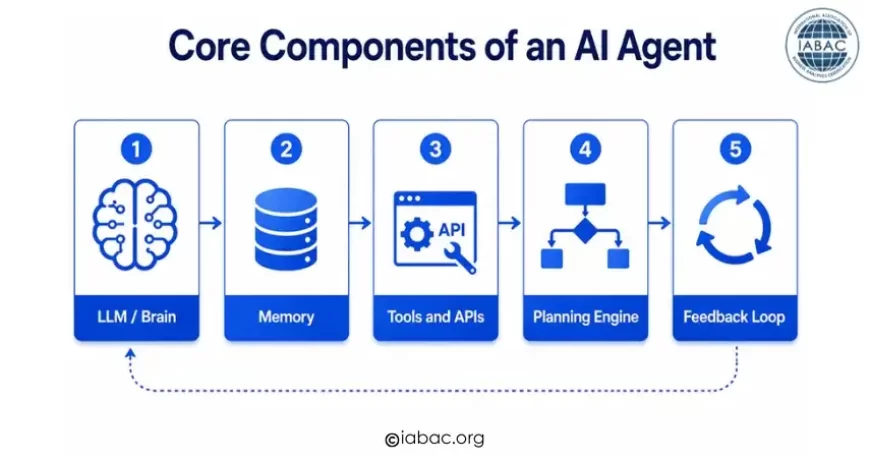
Every functional AI agent is built on a combination of these core components:
1. LLM / Brain: The large language model serves as the reasoning core. It interprets goals, generates plans, and decides which actions to take. Models like GPT-4o, Claude 3.7, and Gemini 1.5 Pro are commonly used as the foundation.
2. Memory: Agents use short-term memory (within a session) and long-term memory (stored externally in vector databases) to retain context across steps and conversations. This is what separates an agent from a one-shot chatbot.
3. Tools and APIs: Agents are connected to the outside world through tools — web search, code interpreters, calendars, databases, email clients, and more.
The ability to use tools is what gives them the power to act, not just generate text.
4. Planning Engine: Before acting, agents break down complex goals into smaller sub-tasks. Frameworks like ReAct (Reasoning + Acting) and Chain-of-Thought prompting help agents logically sequence their steps.
5. Feedback Loop: After each action, the agent observes the result and adjusts. If a web search returns irrelevant data, it reformulates the query. If a code block fails, it is debugged and retried. This self-correction loop is what makes agents resilient.
The AI Agent Workflow - Step by Step
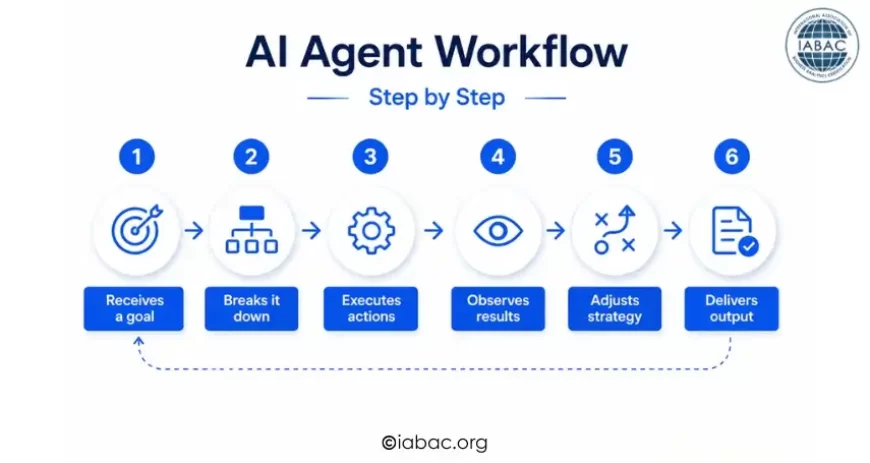
Here's how a typical AI agent handles a task from start to finish:
-
Receives a goal — e.g., "Research the top 5 competitors in our space and summarize their pricing."
-
Breaks it down — identifies sub-tasks: search web, visit sites, extract data, summarize
-
Executes actions — uses tools like a browser, search API, and data extractor
-
Observes results — checks if information is accurate and complete
-
Adjusts strategy — refines searches, revisits sources if needed
-
Delivers output — compiles a structured report and delivers it to the user
The entire loop can happen in minutes. Without an agent, that same task might take a human analyst half a day.
Single-Agent vs Multi-Agent Systems
A single agent handles tasks independently, within its own context window and toolset. Powerful, but limited by the complexity it can manage alone.
Multi-agent systems divide work across specialized agents — one handles research, another drafts content, a third reviews it, and a supervisor agent coordinates the whole operation. This mirrors how human teams work and is how enterprises are scaling agentic workflows.
Frameworks like CrewAI, AutoGen, and LangGraph have made multi-agent orchestration accessible for developers without needing to build from scratch.
AI Agents vs Chatbots: What's the Difference?
|
Feature |
Chatbot |
AI Agent |
AI Copilot |
|
Autonomy |
Low — waits for prompts |
High — initiates actions |
Medium — assists user decisions |
|
Memory |
Session-only |
Short + long-term |
Varies |
|
Planning |
None |
Multi-step planning |
Limited |
|
Tool Use |
Rarely |
Core capability |
Selective |
|
Workflow Completion |
Partial |
End-to-end |
Collaborative |
|
Best For |
FAQs, support scripts |
Complex task automation |
Guided work assistance |
A chatbot answers.
An AI copilot assists.
An AI agent executes.
Types of AI Agents
1. Simple Reflex Agents
Act on current input using predefined rules. No memory, no learning.
Example: a thermostat that adjusts temperature based on a sensor reading.
2. Model-Based Agents
Maintain an internal model of the world to handle situations where the current input alone isn't enough. They track the state over time.
3. Goal-Based Agents
Evaluate actions against a defined goal and choose paths most likely to achieve it. Most modern LLM-based agents fall here.
4. Utility-Based Agents
Go beyond binary goal achievement — they optimize for the best outcome using a utility function. Used in recommendation engines and resource allocation systems.
5. Learning Agents
Improve over time through feedback and experience. Reinforcement learning from human feedback (RLHF) is a key technique here.
6. Autonomous Multi-Agent Systems
Networks of specialized agents that collaborate, delegate, and check each other's work. The most powerful and complex category in production today.
Top AI Agents Examples in 2026
Consumer and General AI Agents
-
OpenAI Operator — Browses the web and completes tasks like booking restaurants, filling forms, and shopping. Best for personal automation. Limitations include the struggles with complex, multi-site workflows.
-
Claude Computer Use (Anthropic) — Controls a computer interface to perform tasks across apps. Particularly strong at structured research and document workflows.
-
Google Gemini Agents — Integrated with Google Workspace to automate tasks across Gmail, Docs, and Calendar. Strongest for enterprise Google environments.
Developer AI Agents
-
Devin — A fully autonomous software engineering agent. It plans, writes, debugs, and deploys code. Best for greenfield projects and bug resolution. Limitation: still needs oversight on production deployments.
-
AutoGPT — An open-source agent framework for chaining tasks autonomously. Flexible but requires technical setup.
-
CrewAI — Allows developers to spin up multi-agent teams with defined roles and objectives. Growing fast in enterprise AI development teams.
Enterprise AI Agents
-
Microsoft Copilot Agents — Embedded in Microsoft 365, these agents automate document generation, meeting summaries, and workflow routing across Teams and SharePoint.
-
Salesforce Agentforce — Autonomous agents embedded in CRM workflows. Handles lead qualification, case resolution, and customer outreach with defined rules and guardrails.
-
SAP Joule Agents — Enterprise ERP agents that automate procurement, HR workflows, and financial reconciliation. High compliance controls built in.
Workflow and Automation Agents
-
Lindy — A no-code AI agent builder for automating business workflows. Popular among non-technical teams.
-
Browser agents — Headless browser-controlling agents used for web scraping, form submission, and data extraction.
-
Research agents — Specialized agents that traverse academic databases, news sources, and internal documents to synthesize findings.
Real-World Use Cases of AI Agents
1. Customer Support Automation
An e-commerce company deploys an AI agent that handles return requests end-to-end:
-
verifies order status
-
initiates refunds
-
updates CRM records
-
sends confirmation emails
Resolution time drops from 48 hours to under 4 minutes.
2. AI Coding Agents
A software startup uses an AI coding agent to manage bug fixes and repetitive development tasks:
-
reproduces reported bugs
-
writes and tests code fixes
-
runs automated QA checks
-
submits pull requests for review
Engineering teams reduce debugging time significantly and accelerate software releases.
3. Healthcare Workflow Automation
A hospital network implements AI agents to streamline administrative and clinical workflows:
-
pulls patient records securely
-
fills insurance authorization forms
-
schedules follow-ups automatically
-
updates healthcare management systems
Administrative workload decreases while patient processing becomes faster and more accurate.
4. Cybersecurity Monitoring
A financial services company deploys AI agents for real-time threat monitoring and incident response:
-
monitors network activity continuously
-
detects suspicious behavior patterns
-
correlates threat intelligence data
-
isolates high-risk activity automatically
Security teams respond to threats faster and reduce the risk of large-scale breaches.
Benefits of AI Agents
-
Automation at scale — Agents handle thousands of tasks simultaneously without fatigue
-
24/7 operations — No downtime, no shift changes
-
Faster decisions — Real-time data access and reasoning compress decision cycles
-
Cost efficiency — Reduces the cost of repetitive, high-volume work
-
Workflow continuity — Tasks don't stall when team members are unavailable
That said, benefits scale with the quality of the agent's design, guardrails, and oversight structure.
Challenges and Risks of AI Agents
This is where honest conversation matters more than hype.
Hallucinations: Agents can generate plausible but incorrect information. In autonomous workflows, this can cascade into larger errors before anyone catches it.
Security and permissions: Agents with broad tool access are attractive targets. A compromised agent with access to email, files, and APIs poses a significant risk.
Governance gaps: Many organizations deploy agents faster than they build oversight frameworks. Who is responsible when an agent takes a harmful action?
AI drift: Over time, agent behavior can shift in subtle ways that are difficult to detect without proper monitoring.
Over-automation risks: Automating the wrong processes can amplify inefficiencies rather than eliminate them.
Compliance concerns: In regulated industries, AI agent actions must be auditable and explainable. Many current systems fall short here.
How Businesses Are Adopting AI Agents
The most sophisticated enterprise deployments in 2026 follow a layered model:
-
Copilot layer: AI assists humans in decision-making (Microsoft Copilot, GitHub Copilot)
-
Automation layer: Agents handle defined, repeatable workflows (Salesforce Agentforce, SAP Joule)
-
Orchestration layer: Multi-agent systems coordinate complex, cross-functional processes
Microsoft, Anthropic, Google, and OpenAI are all racing to embed agents directly into enterprise ecosystems. The emerging standard involves agent marketplaces, pre-built, compliance-reviewed agents that enterprises can deploy and customize within their existing infrastructure.
Internal AI operations teams are also becoming common in larger organizations — dedicated teams that manage agent deployment, monitoring, and governance the way IT teams manage software infrastructure.
The Future of AI Agents
The next 24 months will bring three major shifts:
Persistent memory and identity: Agents will maintain consistent context across weeks and months, functioning more like ongoing collaborators than one-time tools.
Multimodal and browser-native agents: Agents that see, hear, and interact across voice, video, and web interfaces simultaneously. The browser becomes an action surface, not just an information surface.
Collaborative AI ecosystems: Organizations will run fleets of agents that work together, delegate to each other, and surface exceptions to humans only when genuinely needed. The idea of an "AI workforce" stops being metaphorical.
What won't change: the need for human judgment at critical decision points, and the responsibility organizations bear for the actions their agents take.
Want to Build or Work With AI Agents?
Understanding AI agents requires knowledge of large language models, prompt engineering, automation workflows, NLP, and machine learning systems. Professionals looking to build practical expertise can explore Artificial Intelligence certification programs focused on real-world AI implementation and automation technologies.
Frequently Asked Questions About AI Agents
What are AI agents?
AI agents are autonomous software systems that use large language models, memory, and tools to plan and execute multi-step tasks toward a defined goal — without requiring step-by-step human instructions.How do AI agents work?
They receive a goal, break it into sub-tasks, execute actions using connected tools and APIs, observe the results, and adjust their approach until the task is complete. This loop of planning, acting, and correcting is what makes them autonomous.Are AI agents the same as chatbots?
No. Chatbots respond to prompts within a conversation. AI agents act independently across systems, complete multi-step workflows, and use external tools to get things done. The difference is autonomy and execution capability.What are examples of AI agents in 2026?
Popular examples include OpenAI Operator, Claude Computer Use, Devin (software engineering), Microsoft Copilot Agents, Salesforce Agentforce, and CrewAI for multi-agent systems.Can AI agents replace humans?
They can replace specific tasks, particularly repetitive, high-volume, or time-sensitive workflows. However, complex judgment, ethical decisions, and creative problem-solving still require human involvement. The more accurate framing is augmentation, not replacement.Are AI agents safe to deploy?
With proper guardrails, testing, and human oversight, yes. Without them, the risks like hallucinations, security vulnerabilities, and compliance failures are significant. Safety architecture is as important as capability architecture.What is agentic AI?
Agentic AI refers to AI systems designed to act with a degree of autonomy, pursuing goals, using tools, and making sequential decisions rather than just generating responses to prompts.AI agents have moved well past the experimental stage. They are in production, handling consequential tasks across every major industry. Understanding how they work, where they succeed, and where they fail is essential for anyone building, deploying, or managing them.
The opportunity is genuine, with faster workflows, lower operational costs, and capabilities that genuinely extend what teams can do. But so are the risks, and organizations that treat governance as an afterthought will learn that lesson the hard way.
AI agents are evolving from assistants into autonomous collaborators. The teams that figure out how to work alongside them effectively with clear boundaries, strong oversight, and honest expectations will be the ones that gain a lasting advantage.