

























































How Accreditation Builds Trust for Training Institutes
See how accreditation helps training institutes earn learner trust, improve credibility, attract corporate partnerships, and support long-term growth faster.

Trust is not something a training institute can claim for itself. It has to be earned, and it has to be shown. This is one of the biggest challenges institutes face today. There are hundreds of training providers offering similar courses, similar certificates, and similar promises. So how does a learner, or even a corporate partner, decide who to trust?
The answer, more often than not, comes down to one word: Accreditation.
Accreditation is not just a badge or a logo on a website. It is a signal. It tells the outside world that an institute has been checked, reviewed, and approved by a recognized body. For training institutes trying to grow, build credibility, and attract serious learners, becoming an authorized training provider plays a central role in building that trust.
Why Trust Is Hard to Build in the Training Industry
The training and education industry has a trust problem. Anyone can put together a course, design a nice-looking website, and start enrolling students. There is no easy way for a learner to tell the difference between an institute that delivers real value and one that does not, at least not just by looking at a homepage.
This creates a few common problems:
- Learners are unsure if the certificate they receive will actually be recognized by employers.
- Companies hesitate to send their employees for training if they are not sure about the quality of the institute.
- Institutes struggle to stand out, even when their training is genuinely good.
This is where accreditation steps in. It acts as a shortcut for trust. Instead of learners and companies having to independently verify an institute's quality, accreditation does that verification for them.
What Accreditation Really Means
Accreditation is a formal recognition given by an established, credible organization. It confirms that an institute meets certain standards in areas like curriculum quality, teaching methods, learner outcomes, and industry relevance.
When a training institute becomes accredited, it is not just adding a certificate to its wall. It is entering into a relationship with a recognized body that puts its own reputation behind that institute's quality. This is an important shift. It moves the institute from being "one more training provider" to being part of a trusted, verified network.
Becoming an Authorized Training Provider is not just about gaining a certification to sell. It is about becoming a recognized, trusted name in a specific field.
How Accreditation Builds Trust, Step by Step
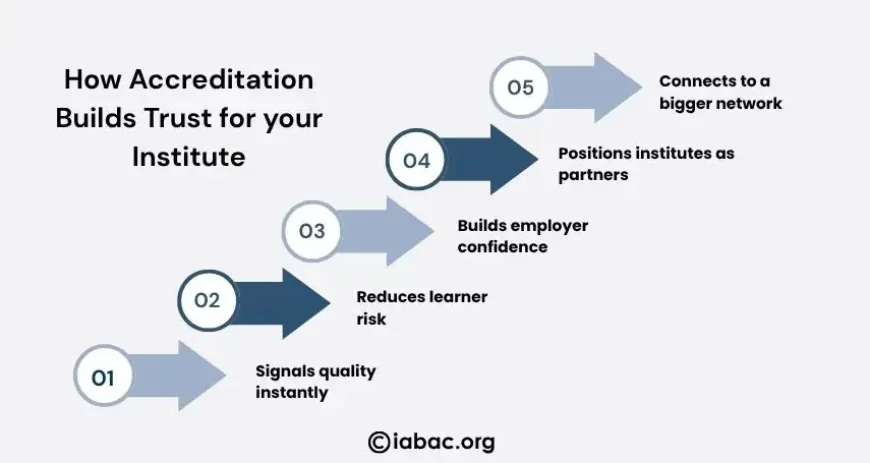
Let's break this down into the actual stages where trust gets built.
1. It Signals Quality Before Anyone Even Talks to You
When a learner or a company is researching training options, they often make quick decisions. They do not have time to deeply evaluate every institute. Accreditation gives them an instant quality signal.
Seeing an accreditation logo tells a potential learner: "This institute has already been checked by someone credible, so I do not have to start from zero."
This is powerful because it works even before any conversation happens. It shapes the first impression.
2. Reduces the Learner's Risk
Every learner who chooses a training program is taking a risk. They are spending time, money, and effort, hoping that the outcome will be worth it. Accreditation reduces this perceived risk.
Learners know that an accredited program has passed certain quality checks. This makes them more comfortable committing to enroll, because the pressure of "what if this is not worth it" gets reduced.
3. Builds Confidence Among Employers
Employers care about what a certificate actually means. A random certificate from an unknown institute may not carry any weight during hiring or promotion decisions. But a certificate backed by a recognized accreditation body tells employers that the training followed a proper, structured standard.
This is especially important in fast-changing fields like AI and data analytics, where employers want proof that a candidate's skills are current and properly validated, not just self-claimed.
4. It Positions the Institute as a Long-Term Partner, Not Just a Vendor
Here is something many institutes miss. Accreditation does not just help you attract more learners. It changes how you are seen at an institutional level.
An accredited institute is often seen as a serious, long-term partner, not just a vendor offering courses. This matters a lot when institutes want to work with corporate clients, government programs, or larger education networks. These relationships require a level of trust that goes beyond a single course or batch of learners.
5. Creates a Sense of Belonging to a Bigger Community
Accreditation is not a one-time transaction. Once an institute becomes accredited, it usually becomes part of an ongoing community or network tied to that accrediting body. This could include:
- Access to updated curriculum and industry insights
- Invitations to webinars, events, or knowledge-sharing sessions
- Being listed publicly as a recognized partner
This sense of belonging adds another layer of trust. Learners and companies see that the institute is not operating in isolation. It is connected to a larger, credible ecosystem.
Accreditation vs Just Offering a Course
It's worth pausing here to highlight the real difference between an institute that simply offers a course and one that offers an accredited course.
| Just Offering a Course | Offering an Accredited Course |
| Quality is based on the institute's own claims | Quality is backed by an external, recognized body |
| Learners have to trust the institute blindly | Learners can verify credibility through the accreditation |
| Certificates may carry limited value in the job market | Certificates carry recognized value with employers |
| The institute is seen as one of many similar options | The institute is seen as a verified, trusted partner |
| Growth depends heavily on marketing and word of mouth | Growth is supported by the reputation of the accrediting body |
This comparison makes it clear. Accreditation is not just a nice addition. It changes the entire trust equation for a training institute.
Why Accreditation Matters in a Crowded Market
The training industry has become extremely competitive. New institutes are entering the market constantly, and many are offering similar programs, especially in high-demand areas like AI, data science, and analytics.
In this environment, learners and companies are becoming more selective. They are asking sharper questions before choosing where to invest their time and money:
- Is this certificate actually recognized in the industry?
- Will this training help in real job opportunities?
- Is this institute credible or just another name online?
Accreditation directly answers these questions. It gives institutes a way to stand out, not by shouting louder in their marketing, but by having real, third-party-backed credibility.
How Accreditation Pays Off for Your Institute
If you are running a training institute and thinking about accreditation, here is the simple takeaway: accreditation is not just a certificate for your wall. It is a trust-building tool that works at every stage of your growth.
It helps you:
- Attract learners who are actively looking for verified, quality training
- Build stronger relationships with corporate and institutional clients
- Position your institute as a long-term, credible partner in your field
- Join a larger network that supports your growth with resources and visibility
For institutes working in specialized, fast-growing fields like AI, data science, and analytics, this becomes even more important. Learners want to know that what they are studying today will still matter tomorrow. Accreditation from a recognized body gives that reassurance.
Final Thoughts
Institutes that wait too long to pursue accreditation often end up playing catch-up. As more training providers in AI, data science, and analytics seek recognized accreditation, early movers build their reputation first, while others are still trying to explain why learners should trust them.
The cost of delaying is not always obvious right away. It shows up slowly, in learners choosing a competitor, in companies asking for proof of quality the institute cannot provide, and in missed chances to join a larger, credible network.
Accreditation is not just about catching up to the market. It is about positioning your institute for where the market is headed.
Institutes that act now are not just building trust for today's learners. They are becoming the trusted name learners and companies turn to for years to come.
The question is no longer whether accreditation matters. It is how soon you are ready to make it part of your story.