





















































How Machine Learning Consulting Helps Organizations Scale AI
Learn how machine learning consulting helps organizations scale AI in 2026 through model development, automation, deployment, and measurable business outcomes.

Machine learning consulting means bringing in outside AI specialists — data scientists, ML engineers, and advisors — to help your organization plan, build, launch, and grow machine learning systems that solve real business problems.
Most companies don't fail at AI because the technology doesn't work. They fail because of messy data, unclear ownership, no system to manage models over time, and no plan to move from a test project into daily use. A good machine learning consulting engagement fixes that gap. It looks at your data and systems, builds a clear plan, ships a working model, and trains your team so you don't stay dependent on outside help forever. Consulting projects usually run 8–20 weeks for a first effort and cost anywhere from $15,000 for a small proof of concept to $500,000+ for a full company-wide AI overhaul.
Key Takeaways
- Most AI projects never reach real use. Industry surveys consistently put the failure rate above 70–80% — and the reason is almost never the model. It's data readiness, clear ownership, and getting people to actually change how they work.
- Machine learning consulting is not the same as software consulting. It combines statistics, data engineering, subject-matter knowledge, and organizational change — a different mix of skills than a typical tech vendor offers.
- There are four main types of consulting work: strategy and advice, build and launch, infrastructure and scaling, and adding contract talent to your team. Most organizations need more than one, in order.
- The biggest hidden cost isn't the consultant's daily rate. It's the cost of doing nothing while competitors keep building their data and automation advantage month after month.
- Hiring the wrong consultant is worse than hiring none. A vague project agreement, no data review, and no handover plan are the three biggest warning signs.
- Credentials matter more than they used to. As the market for independent consultants and small firms has grown, certifications like those from IABAC (International Association of Business Analytics Certifications) give buyers a faster way to confirm that a consultant actually knows their stuff before signing a contract.
- The career path into ML consulting is one of the fastest-growing in tech, because demand for people who can combine technical skill with business sense keeps outpacing supply.
Why We Have AI and AI Is Working Are Two Different Things
Picture two companies. Both bought the same demand-forecasting software eighteen months ago. Both trained a model. Both had a launch meeting with slides that said AI-Powered in a big, confident font.
- Company A's model now runs quietly every night, feeding real numbers into purchasing decisions, and has cut excess inventory by double digits. Nobody in the warehouse even thinks of it as AI anymore — it's just how ordering works.
- Company B's model sits in a notebook file on a laptop that used to belong to a data scientist who left eleven months ago. Nobody remembers the login. The AI-Powered slide is still in the deck, though.
The difference between these two companies is rarely the algorithm. It's almost never a shortage of computing power or enthusiasm. It's everything around the model: whether the data pipeline is trustworthy, whether someone owns the system after launch, whether the organization built the ability to maintain and improve it, and whether the original problem was even the right one to solve. This is the gap that machine learning consulting exists to close. Not just building a model — plenty of internal teams can do that. The real value is in the less glamorous work of getting a model from a demo into daily use, then growing that success across more projects without needing a permanent staff of researchers on payroll.
This guide covers what machine learning consulting actually is, how projects work in practice, what they cost, how to hire a consultant, the mistakes that sink most AI efforts, and where the field is heading — including how to build a career in it.
What Machine Learning Consulting Actually Means
Machine learning consulting is hands-on technical and advisory work delivered by outside specialists to help your organization use machine learning to hit a specific business goal — reducing customer loss, forecasting demand, catching fraud, automating manual work, personalizing a product experience, and so on.
It sits at the meeting point of three skill areas that rarely live in one person:
- Data science and ML engineering — the technical ability to build, test, and launch models into real use.
- Business strategy — the judgment to know which problems are worth solving with ML and which are not.
- Organizational change — the skill to get a new system adopted by people who didn't ask for it and may quietly push back.
A pure software consultant can ship code. A pure data scientist can build a model in a notebook. Neither, on their own, reliably gets an organization from we have an idea to this system runs itself and pays for itself. That full combination is what you're paying for when you hire a consultant.
How It's Different from Traditional IT or Management Consulting
|
Traditional IT Consulting |
Machine Learning Consulting |
|
|
Core deliverable |
Software system or process redesign |
A trained, monitored model |
|
Success measure |
On-time, on-budget delivery |
Model results tied to a business metric, |
|
Biggest risk |
Scope creep, integration bugs |
Data drift, biased results, |
|
Skill mix |
Engineering + project management |
Engineering + statistics + |
|
Timeline shape |
Fairly straight line |
Experimental — many ideas fail before one ships |
How Machine Learning Consulting Works: The Project Lifecycle
Every credible ML consulting engagement follows a version of the same lifecycle. Understanding it helps you spot proposals that skip important steps.
STAGE 1: DISCOVERY & DATA REVIEW
- Business goals interviews
- Data availability, quality, and access check
- Feasibility scoring of candidate use cases
STAGE 2: USE CASE SELECTION
- Score by business impact vs. technical feasibility
- Pick ONE main use case, not five
STAGE 3: PROTOTYPE / PROOF OF CONCEPT
- Build a narrow model on real data
- Validate against a baseline (often: better than the current spreadsheet)
STAGE 4: PRODUCTION BUILD
- Build the data pipeline, not just the model
- Set up monitoring, retraining triggers, fallback plans
STAGE 5: INTEGRATION & ADOPTION
- Connect the model to the actual workflow (CRM, ERP, app)
- Train the people who work alongside the system
STAGE 6: SCALE & HANDOVER
- Document everything
- Train an internal team to own it
- Expand to the next 2–3 use cases
Notice that build the model is only Stage 3 of 6. Consultants who jump straight from discovery to a shiny demo — skipping data reviews and handover plans — are the ones whose projects quietly die a year later.
A Closer Look at Each Stage
- Discovery and data review. This is where most projects are won or lost, and the stage clients most often try to rush. A serious consultant will ask to see actual data before promising anything, because we have ten years of sales data and we have ten years of usable sales data are very different claims. Expect questions about where your data comes from, how it was labeled, what's missing, and who currently owns each data source.
- Use case selection. A common mistake is chasing the most interesting problem rather than the most valuable and achievable one. Good consultants score each option on business impact versus data readiness and push clients toward high-impact, achievable ideas first. Picking an ambitious but low-feasibility idea first is the most common reason first AI projects stall.
- Prototype. The goal here is not a perfect model. It's a fast, honest answer to: Can this work at all, and is it better than what we do today? A prototype that takes six months is already a red flag.
- Production build. This is the less glamorous 60% of the work that never makes it into a case study: data pipelines, retraining schedules, monitoring dashboards, fallback logic for when the model is uncertain, and security review. A model with 95% accuracy in a test environment is worth nothing if it can't run reliably on live data every day.
- Integration and adoption. A fraud-detection model that flags transactions no one reviews changes nothing. A demand forecast that your procurement team quietly ignores because they don't trust it changes nothing. This stage is about redesigning the workflow and communicating to the people affected what the system does, what it doesn't do, and why their judgment still matters.
- Scale and handover. The sign of a consultant who cares about your long-term success — not just their own hours — is a documented, deliberate handover: step-by-step guides, training sessions, and a named internal owner. If a proposal has no handover section, ask why.
Types of Machine Learning Consulting Engagements
Not every organization needs the same kind of help. Broadly, consulting services fall into four types.
1. Strategy and advisory consulting. For organizations that aren't sure where to start. The output is a roadmap: which use cases to pursue, in what order, with what expected return, and what data gaps need closing first. No code is written. Best for leaders who need a clear, defensible plan before asking for budget.
2. Build-and-deploy consulting. The most common type. A consulting team builds a specific model or system end-to-end — a recommendation engine, a churn predictor, a document-sorting pipeline — and launches it into production. Usually scoped as a fixed-length project (8–20 weeks).
3. MLOps and scaling consulting. For organizations that already have one or more models running but struggle to maintain them, retrain them, or repeat the success with new use cases. This is infrastructure-heavy work: automated pipelines for models, monitoring, data management, and governance frameworks.
4. Staff addition and contract talent. Instead of a packaged project, one or more contract ML engineers or data scientists join your internal team for an extended period. Useful when you have the plan and the data but simply need more hands.
Most organizations move through these in order: strategy first, then a build-and-deploy pilot, then scaling help once there's more than one model to manage, with contract talent added wherever there's a gap.
The Real Benefits of Machine Learning Consulting
- Speed to first value. An experienced consulting team has already made — and learned from — the mistakes your internal team hasn't made yet. That compresses a project that might take an internal team a year of trial and error into a matter of months.
- Outside perspective. Internal teams are sometimes attached to a particular tool, vendor, or approach. An outside consultant can recommend the honest answer (your data isn't ready for this yet) without office politics getting in the way.
- Access to specialized skills without a permanent hire. Senior ML engineers and applied researchers are expensive and hard to keep. Consulting gives you access to that skill level for the specific window you need it, rather than carrying a full-time senior salary indefinitely.
- Lower risk. A structured, staged project catches expensive failures early. A bad prototype costs a few weeks; a bad production system that has to be torn out costs far more in both money and trust in future AI efforts.
- Knowledge transfer. The best consulting engagements leave your team more capable than before — with people who understand not just how to run the model, but how to build the next one.
- Competitive advantage that keeps growing. Data and automation advantages build on themselves. A company that gets a working forecasting model live this quarter will have a full year of tuned, learned performance by the time a slower competitor's first pilot even reaches production.
Challenges and Risks — Told Honestly
No honest guide pretends ML consulting is risk-free. Here's what actually goes wrong most often.
- Data problems that only surface mid-project. A client believes their data is clean. Three weeks in, the consulting team discovers that a key field changed meaning eighteen months ago after a system change, quietly corrupting the training data. This is common, not rare — plan for discovery to genuinely turn up surprises, and be careful of any consultant who promises a firm timeline before seeing the data.
- Misaligned incentives. Some consulting firms are built to maximize billable hours, not to make themselves unnecessary as fast as possible. Fixed-scope, outcome-linked contracts help align incentives better than open-ended arrangements.
- Model bias and fairness problems. A model trained on biased historical data will faithfully reproduce that bias at scale — for example, a hiring-screening model trained on past hiring decisions can lock in the very biases an organization is trying to move away from. Serious consultants build fairness testing and explainability in from the start, not as an afterthought.
- Over-reliance and skill loss. If an organization never builds internal capability, it becomes permanently dependent on the consultant — and exposed if that consultant becomes unavailable or raises rates. Insist on documentation and internal training as required deliverables, not optional extras.
- Resistance to change. A technically excellent model that the sales team, underwriters, or floor supervisors don't trust or don't use is a failed project no matter how good the code is. Budget real time and effort for communication and training, not just engineering.
- Regulatory exposure. In regulated industries (finance, healthcare, insurance, HR), an ML system can create legal problems if it can't be explained or audited. This needs to be part of the design conversation from day one, not patched in after a regulator asks a question.
Real-World Patterns: How Scaling Actually Happens
Rather than listing specific companies with numbers that can't be independently verified, it's more useful to walk through the patterns that repeat across successful engagements — because these patterns are consistent across industries.
Pattern 1: Retail demand forecasting. A mid-sized retailer with hundreds of stores was manually forecasting inventory using spreadsheets and gut instinct from regional managers. A consulting team built a forecasting model using three years of sales data, weather data, and local event calendars. The first version wasn't dramatically more accurate than experienced managers — but it was consistent, scalable to every store at once, and freed managers to focus on exceptions rather than routine ordering. Inventory costs dropped meaningfully within two quarters, and the model became the foundation for a second project: adjusting prices in response to demand.
Pattern 2: Financial services fraud detection. A regional lender had a rules-based fraud system generating so many false positives that staff had started ignoring alerts entirely — classic alert fatigue. Consultants didn't just build a better model; they redesigned the alert workflow so that the model's confidence score determined how an alert was handled, not just whether one fired. Fewer, better-targeted alerts meant staff actually acted on them again. The workflow redesign mattered more than the technical improvement.
Pattern 3: Manufacturing predictive maintenance. A manufacturer wanted to predict equipment failures before they happened. An earlier internal attempt failed because sensor data was inconsistent across machine generations, and nobody had reconciled it. The consulting team's first deliverable wasn't a model at all — it was a data standardization layer. The predictive model that followed six months later was almost anticlimactic by comparison. The hard problem had already been solved.
Pattern 4: The stalled pilot, revived. A common and less flattering pattern: an organization runs an internal AI pilot that technically works but never gets adopted, then brings in consultants a year later to figure out why. The finding is almost always the same — the model was built without input from the people who'd actually use it, so nobody trusted the results enough to change their behavior. The fix isn't a better model. It's starting the change-management conversation before the build, not after.
The thread that runs through all four patterns: the technical model is rarely the bottleneck. Data quality, workflow design, and trust are.
Tools and Technologies Behind Modern ML Consulting
A working knowledge of the toolchain helps when reviewing a consultant's proposal — it shows whether they're suggesting modern, maintainable infrastructure or something that will be a problem in a year.
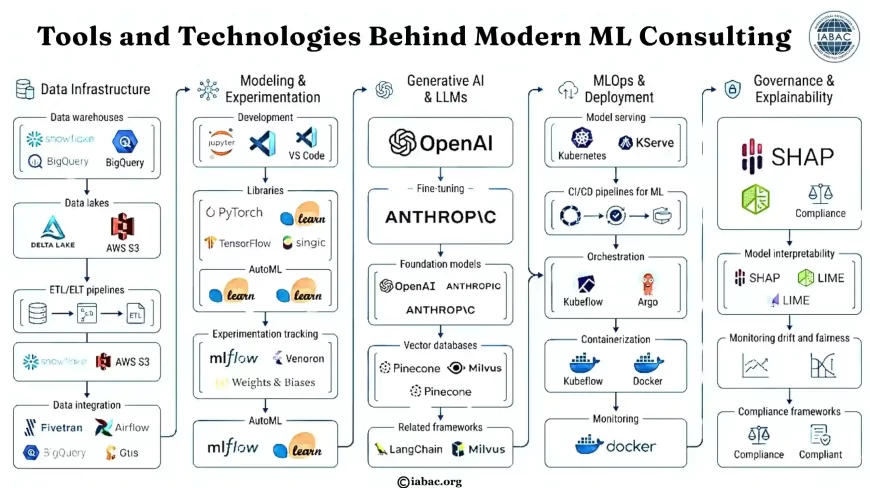
- Data infrastructure: cloud data warehouses (Snowflake, BigQuery, Redshift), data pipeline tools (Airflow, dbt), and feature stores for reusing data work across models.
- Modeling and experimentation: Python is the main language; scikit-learn and gradient-boosting libraries (XGBoost, LightGBM) for structured business data, which covers the majority of real use cases; PyTorch and Hugging Face for deep learning and language-model work; experiment tracking tools (MLflow, Weights & Biases) to keep prototyping organized and repeatable.
- Generative AI and language model tools: As of 2026, most consulting projects touching language tasks — document summaries, customer support tools, internal knowledge search — use large language models via API rather than building models from scratch, combined with retrieval-augmented generation (RAG) to ground outputs in your company's own data and reduce the risk of made-up answers.
- MLOps and deployment: containerization (Docker, Kubernetes) for consistent deployment; automated pipelines adapted for model versioning; monitoring tools that watch not just system uptime but model-specific signals like prediction drift and data drift.
- Governance and explainability: SHAP and LIME for explaining individual predictions, model documentation cards, and bias-auditing tools — increasingly a contractual requirement rather than optional polish, especially in regulated industries.
A capable consultant should be able to explain, in plain language, why they're suggesting a particular tool for your specific data and scale — not just defaulting to whatever is trending.
Implementation Roadmap: A Practical 6-Month Plan
For an organization starting from zero, here's a realistic, step-by-step plan that a competent consulting engagement typically follows.
Month 1 — Discovery. Data review, interviews across business and technical teams, and an honest feasibility check. Output: a ranked list of 3–5 candidate use cases, scored by impact and feasibility.
Month 2 — Prototype. Pick the single best-scoring use case. Build a narrow proof of concept on real historical data. Output: a go/no-go decision backed by measured results against a real baseline, not a vague it looks promising.
Months 3–4 — Production build. Build the actual data pipeline, connect with existing systems, and set up monitoring. This is where most of the engineering effort lives, and where timelines most often need adjusting once real integration complexity appears.
Month 5 — Controlled rollout. Launch to a limited group — one region, one team, one product line — with active monitoring and a fast feedback loop to the people using it daily. Fix what breaks before scaling further.
Month 6 — Full rollout and handover. Expand to the full intended audience. Deliver documentation, train an internal owner, and set a regular review schedule for model performance and retraining needs.
Beyond Month 6: the plan for use case number two should start well before use case number one finishes, since much of the data infrastructure and organizational learning carries over — each new use case gets meaningfully cheaper and faster than the first.
Common Failure Points (And How to Avoid Them)
Starting with the flashiest use case instead of the most feasible one. Fix: score every candidate use case on both business impact and data readiness before committing.
No baseline to compare against. If nobody defines what better than today actually means in numbers before the project starts, no one will agree afterward whether it succeeded. Fix: write the current baseline metric into the contract itself.
Treating the model launch as the finish line. Fix: budget for at least 6–12 months of monitoring and retraining after go-live; models degrade as real-world data shifts.
Skipping the people who will actually use the system. Fix: involve end users in design reviews before the model is finalized, not after.
No internal owner after the consultant leaves. Fix: name an internal owner in month one of the engagement, not month six, so that person is learning throughout rather than inheriting a black box.
Vague contracts with no defined deliverables or success metrics. Fix: insist on a project agreement that specifies exactly what will be delivered, tested against what baseline, and handed over how.
Where Machine Learning Consulting Is Heading Through 2026 and Beyond
Generative AI has changed the starting point, not the fundamentals. Many organizations now begin their AI work with a generative AI or language-model use case — document automation, internal search, customer support tools — rather than a traditional predictive model. But the same rules apply: data quality, integration, and helping people actually change how they work determine success just as much for a chatbot as for a forecasting model.
- Consulting is becoming more modular. Instead of hiring one large firm for everything, more organizations are assembling a mix of a strategy advisor, a specialized build team, and contract infrastructure talent — often sourced through verified independent-consultant platforms and certification bodies rather than a single traditional consultancy.
- Governance and auditability are becoming standard deliverables, not add-ons. Growing regulatory attention on AI decision-making (in lending, hiring, insurance, and healthcare especially) means explainability and bias testing are increasingly written into the original scope of work rather than added on afterward.
- Verified expertise is becoming a filter when you hire a consultant. As the pool of people who call themselves AI consultants has grown faster than the pool who can actually deliver, buyers are relying more heavily on independent verification. Recognized certifications such as those offered by IABAC give organizations a faster, more reliable way to confirm a consultant's actual competence before committing budget — and give independent consultants a credible way to register and stand out.
- Shorter, focused engagements are replacing year-long transformation programs. The market has learned that a six-month plan with a working pilot beats an eighteen-month AI transformation with a beautiful strategy document and nothing shipped.
- Basic AI literacy across teams is becoming a starting requirement, not a bonus. Organizations that invest in making ML concepts understandable to non-technical business teams get more from consulting engagements, because those teams can meaningfully participate in scoping and evaluation instead of treating the model as a mysterious black box.
Career Opportunities in Machine Learning Consulting
For professionals, ML consulting is one of the more resilient and well-paid paths in the broader AI job market, precisely because it demands a rarer mix of skills than a purely technical role.
Common roles:
- ML/AI Strategy Consultant — works with executives to identify and rank use cases; less coding, more business thinking and communication.
- ML Engineer (consulting track) — builds and launches models for client projects; strong software engineering plus applied statistics.
- Data Scientist (consulting track) — focuses on modeling, testing, and analysis, often working alongside an ML engineer.
- MLOps / Platform Consultant — specializes in the infrastructure that keeps models running reliably at scale.
- AI Governance / Responsible AI Consultant — a fast-growing area focused on fairness, explainability, and regulatory compliance.
What makes someone hireable in this field is rarely just technical depth. Clients consistently value consultants who can explain a confusion matrix to a room of non-technical executives just as clearly as they can debug a training pipeline. Communication and business judgment are not soft extras — they're the difference between a consultant who gets repeat work and one who doesn't.
How to register as a consultant. Independent practitioners entering the field typically combine three things: a portfolio of real projects with measurable outcomes, a recognized credential to verify baseline competence, and a presence on a consultant registry or platform where organizations actively search for vetted talent. Bodies like IABAC offer certification paths specifically designed for professionals who want a verifiable, internationally recognized credential in analytics and machine learning before they register as independent consultants — useful both for building client trust and for structuring your own learning.
A Practical Learning Path Into Machine Learning Consulting
Foundation (0–6 months). Solid statistics, Python, and SQL. Understand the difference between correlation and causation cold — it comes up in nearly every client conversation. Complete a few structured projects using real datasets, and document the business reasoning behind each modeling choice, not just the code.
Applied skill-building (6–12 months). Learn the full project lifecycle, not just modeling: data pipelines, model deployment, monitoring, and basic infrastructure concepts. Practice translating a business problem into a measurable ML goal — this skill is what separates a consultant from a technician.
Certification and credibility (run this alongside the above). Pursue a recognized certification to verify your skills to future clients or employers. IABAC's machine learning and data analytics certification paths are a widely recognized option for professionals building a consulting career, since they combine technical assessment with business-application focus rather than testing algorithms in isolation.
Specialization (12–24 months). Choose a lane: industry (finance, healthcare, retail), technical specialty (MLOps, language models, computer vision), or engagement type (strategy vs. hands-on build). Specialists command higher rates than generalists once they have a track record.
Building a track record. Early in a consulting career, smaller, well-documented projects with clear outcomes matter more than chasing big clients. A consultant who can show reduced forecast error by X% for a mid-sized retailer is more hireable than one with an impressive resume and no results anyone can point to.
The Model Was Never the Hard Part
If there's one idea worth carrying away from everything above, it's this: organizations don't struggle to scale AI because the technology is too hard. They struggle because scaling AI is fundamentally an organizational challenge dressed up in a technical costume — data ownership, workflow trust, internal capability, and clear accountability matter more than which algorithm gets used.
Good machine learning consulting isn't really selling you a model. It's selling you a repeatable process for turning we should probably use AI for this into a system that quietly runs itself and gets better every quarter — and, just as importantly, leaving your own team capable of running the next one without outside help.
Actionable Next Steps
- Pick one problem, not five. Identify the single business process where better prediction or automation would create the clearest, most measurable value.
- Review your data honestly before talking to anyone. Know roughly what you have and don't have — it will make every consulting conversation faster and more accurate.
- Define your baseline metric in writing. Decide, in advance, what better will actually mean in numbers.
- Vet consultants on outcomes and credentials, not slides. Ask for references, verifiable results, and recognized certification such as IABAC's, especially when you hire a consultant who is independent rather than part of a larger firm.
- Name an internal owner on day one. The single best predictor of long-term success is having someone inside the organization who is learning the system as it's built, not inheriting it afterward.
- Plan for month 12, not just month 1. Budget for monitoring, retraining, and a second use case before the first one even launches.