


























































How Analytics Consulting Actually Works in Real Businesses
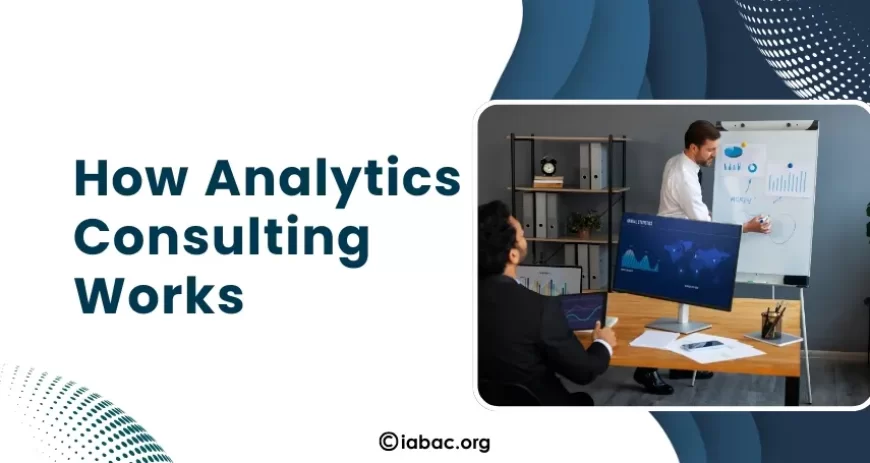
Analytics consulting turns messy data into decision intelligence by refining KPIs, fixing measurement gaps, and aligning insights with real business goals.

Most modern businesses are not short of data. Dashboards visualize performance, reports track metrics, and analytics platforms generate a continuous stream of numbers. Yet, despite this abundance of information, many organizations continue to struggle with a surprisingly persistent challenge:
Why does decision-making still feel uncertain even when analytics systems are in place?
This contradiction is far more common than it appears. Companies invest in powerful tools expecting clarity, only to discover that insights remain fragmented, metrics conflict across departments, and reports often describe activity without guiding action. The issue, in most cases, is not a lack of technology but a gap in structure, interpretation, and measurement logic.
Analytics consulting exists precisely to resolve this gap.
Rather than replacing tools, analytics consulting helps organizations make sense of their data environments, refine measurement frameworks, and transform analytics from passive reporting into practical decision intelligence.
Why Analytics Initiatives Often Stall Despite Good Tools
One of the most common misconceptions surrounding analytics is the assumption that technology alone guarantees insight. In practice, businesses frequently encounter obstacles that limit the value of even the most advanced analytics platforms.
Organizations often experience challenges such as inconsistent metrics, delayed reporting cycles, unclear KPI definitions, or dashboards that look impressive but fail to answer critical business questions. Over time, decision-makers may begin to distrust analytical outputs, not because the systems are incorrect, but because interpretation lacks coherence.
Several factors commonly contribute to this problem:
-
Data sources may be fragmented across multiple systems
-
Metrics may lack standardized definitions
-
Analytical outputs may not align with decision-making needs
-
Performance indicators may measure activity rather than outcomes
These issues create noise rather than clarity, making analytics feel complex instead of empowering.
What Analytics Consulting Actually Changes
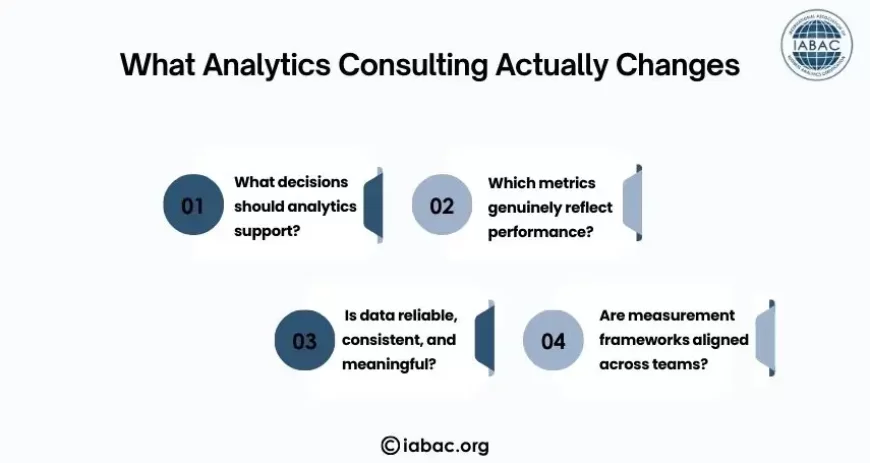
Analytics consulting does not simply analyze datasets or build dashboards. Its real value lies in reshaping how organizations structure, interpret, and apply data.
Consultants help businesses step back and evaluate fundamental questions:
✔ What decisions should analytics support?
✔ Which metrics genuinely reflect performance?
✔ Is data reliable, consistent, and meaningful?
✔ Are measurement frameworks aligned across teams?
By addressing these core considerations, consulting engagements frequently improve not only analytical accuracy but also decision confidence.
How Analytics Consulting Typically Works in Real Organizations
While consulting engagements vary based on industry, scale, and objectives, most follow a logical progression designed to stabilize analytical foundations and enhance usability.
Starting With Business Context Rather Than Data
Effective analytics begins with understanding business priorities. Without context, data analysis risks becoming technically accurate but strategically irrelevant.
Consultants work closely with stakeholders to understand operational challenges, performance bottlenecks, growth objectives, and decision-making uncertainties. For instance, an organization experiencing fluctuating revenue patterns may require deeper analysis of demand dynamics, segmentation models, or process inefficiencies rather than additional reports.
This stage ensures analytics initiatives remain purpose-driven.
Diagnosing Hidden Data and Measurement Frictions
Many organizations assume their analytics environments are coherent until examined closely. Consulting engagements frequently reveal inconsistencies that distort interpretation.
These may include conflicting metric definitions, incomplete datasets, integration gaps, or silent quality issues. Even modest discrepancies can significantly influence analytical conclusions, leading to confusion or misleading signals.
Consultants focus on identifying and resolving such structural frictions to improve reliability.
Refining Measurement Frameworks and KPIs
Analytics consulting places strong emphasis on measurement clarity. Not all metrics carry equal decision value, and excessive reporting can obscure rather than illuminate performance.
Consultants help organizations define structured KPI hierarchies, standardize definitions, and eliminate misleading indicators. Even incremental improvements in measurement logic often produce noticeable gains in interpretive consistency and alignment.
Preparing Data for Insight Reliability
Raw datasets rarely support meaningful analysis without normalization and logical structuring. Data may contain anomalies, duplications, inconsistencies, or noise.
Consultants design workflows that cleanse, normalize, and structure datasets to ensure analytical outputs reflect genuine patterns. This stage frequently uncovers insights previously hidden by irregularities.
Extracting Insights Aligned With Decisions
Analytics consulting emphasizes interpretation aligned with business priorities. Rather than focusing solely on statistical outputs, consultants explore patterns, correlations, and anomalies that inform strategic and operational decisions.
Insights often relate to:
-
Identifying inefficiencies
-
Recognizing behavioral trends
-
Detecting emerging risks
-
Highlighting optimization opportunities
The objective is clarity that drives action.
Communicating Findings With Decision-Maker Clarity
Even robust analytics loses value if poorly communicated. Consultants translate complex findings into accessible formats that reduce cognitive overload and support adoption.
Deliverables may include dashboards emphasizing critical indicators, executive summaries highlighting implications, or scenario models supporting planning.
Refinement as Business Conditions Evolve
Analytics systems are dynamic. Market conditions change, data flows evolve, and measurement priorities shift.
Consulting engagements often support iterative refinements that maintain accuracy and relevance. Organizations commonly observe measurable improvements as analytical maturity develops over time.
Where Analytics Consulting Creates Visible Business Value
Analytics consulting proves especially beneficial when organizations encounter persistent interpretive or measurement challenges. Businesses commonly seek consulting support when metrics conflict, decision uncertainty remains high, data environments scale rapidly, or analytical outputs lack coherence.
In many cases, consulting helps compress prolonged trial-and-error cycles into more efficient resolution paths.
Why Consulting Differs Fundamentally From Analytics Tools
Analytics tools generate outputs.
Consulting structures understanding.
Tools process data, while consultants ensure analytical outputs align with business logic, measurement frameworks, and decision-making realities. This distinction explains why many organizations combine analytics technologies with consulting expertise.
Analytics consulting helps organizations transform analytics from isolated reporting mechanisms into structured decision intelligence systems. By refining measurement logic, stabilizing data foundations, and clarifying interpretation, consulting enhances both analytical reliability and strategic confidence.
As businesses increasingly depend on data-driven operations, organizations continue adopting analytics consulting services to improve clarity, efficiency, and long-term performance outcomes.