























































How to Become a Data Analyst in India - A Step-by-Step Guide 2026
Data analyst jobs in India are growing fast in 2026. Learn the exact skills, projects, and roadmap freshers need to land their first role.


According to the NASSCOM Industry Report, India will need 11 million data professionals by 2030, with demand growing at 27% annually for fresher-level roles.
The demand for data analysts in India is rising rapidly in 2026, driven by data-first decision-making across industries. Yet, a large number of aspiring professionals struggle to break into the field, not due to lack of effort, but due to an unstructured learning approach and the absence of real, demonstrable skills.
A common pattern repeats: months spent on tutorials, basic Python practice, and scattered learning with little to show recruiters in terms of practical capability. The issue is not what to learn, but what to learn first, what to skip, and how to convert knowledge into proof.
This step-by-step guide provides a structured roadmap to becoming a data analyst in India. Whether you are from a non-technical background, switching careers, or starting as a fresher, each stage focuses on building the right data analyst skills, projects, and portfolio needed to meet current hiring expectations.
Who is a Data Analyst?
A data analyst is a professional who collects, cleans, and interprets data to help businesses make informed decisions. They transform raw data into actionable insights using tools like SQL, Excel, and visualization platforms. Their role bridges data and business strategy by identifying trends, solving problems, and supporting decision-making with evidence.
What Does a Data Analyst Actually Do Day-to-Day?
Before building skills, understand what you are building them for. A data analyst in India, at a company, typically does the following in a given week:
• Pull and clean data from databases using SQL
• Build or update dashboards in Power BI or Tableau for business teams
• Analyze campaign performance, sales trends, or operational metrics
• Prepare weekly or monthly reports with a written summary of findings
• Answer ad hoc questions from product managers, marketing leads, or finance heads
Take a concrete example. A data analyst in the fintech industry might be asked: 'Why did loan approvals drop 18% last month?' The analyst would query transaction data, segment by region and loan type, cross-reference it with changes in underwriting policy, and come back with an answer that includes a visualization, the probable cause, and a recommendation. That entire process, from query to insight, is the job.
The job is 40% data preparation, 30% visualization and reporting, 20% stakeholder communication, and 10% learning new tools. Know this before you start.
Data Analyst Skills Required: The Non-Negotiables vs. Good-to-Haves
Most resources give you a list. Here is the actual breakdown of what hiring managers in Indian companies look for in data analytics skills in 2026:
|
Skill Area |
Tools/Topics |
Priority Level |
|
Data Querying |
SQL (Joins, Window Functions, CTEs) |
Essential |
|
Data Manipulation |
Python (Pandas, NumPy) |
Essential |
|
Visualisation |
Power BI / Tableau |
Essential |
|
Spreadsheet Analysis |
Excel (Pivot Tables, XLOOKUP) |
Essential |
|
Statistics |
Hypothesis Testing, Regression |
Important |
|
Storytelling |
Data Narratives, Slide Decks |
Important |
|
Domain Knowledge |
Finance / Marketing / Healthcare |
Good to have |
One thing most beginners misunderstand: Power BI dominates Indian enterprise companies, while Tableau is more common in MNCs and consulting firms.
If you are targeting a role at TCS, Wipro, or Infosys, learn Power BI first. If you want to work at a global consultancy or a product company with US stakeholders, Tableau adds weight.
The Step-by-Step Data Analyst Roadmap for India (20-Week Plan)
|
Phase |
Duration |
Focus Areas |
Outcome |
|
Phase 1 |
Weeks 1–4 |
Excel, Basic Statistics, SQL Fundamentals |
Comfortable with data tables |
|
Phase 2 |
Weeks 5–10 |
Advanced SQL, Python Basics, Power BI |
Build first dashboard |
|
Phase 3 |
Weeks 11–16 |
Portfolio Projects, Kaggle Datasets |
3 projects on GitHub |
|
Phase 4 |
Weeks 17–20 |
Interview Prep, Resume, LinkedIn |
Job-ready |
Phase 1: Build the Foundation (Weeks 1–4)
Start with Excel and SQL, in that order.
Most freshers skip Excel because it 'feels basic.' Do not. Excel is tested in the majority of mid-size Indian company interviews through pivot tables, XLOOKUP, SUMIFS, and conditional formatting.
Master these before anything else.
SQL follows immediately. Work through joins (INNER, LEFT, FULL OUTER), GROUP BY, HAVING, subqueries, and window functions like RANK, ROW_NUMBER, LAG, and LEAD.
LeetCode's database section is the most India-relevant practice resource because these exact question types appear in interview rounds at companies like Swiggy, Razorpay, and Zoho.
Phase 2: Add Python and Visualisation (Weeks 5–10)
Python is no longer optional in India's mid and senior analyst market.
Start with Pandas for data manipulation and NumPy for numerical operations. You do not need to know machine learning at this stage.
Focus on reading CSVs, cleaning messy data, merging datasets, and producing summary statistics. Once comfortable, move to Power BI and learn DAX for calculated columns and measures.
A common shortcut that backfires: learning Python before solidifying SQL. Companies test SQL in technical rounds far more frequently than Python. Get SQL right first.
Phase 3: Build a Portfolio That Gets Interviews (Weeks 11–16)
This is where most people underinvest and then wonder why applications go unanswered.
Three well-documented projects that show the full workflow, from raw data to business insight, will get you more calls than a resume full of certifications.
Project ideas that actually impress Indian recruiters:
• Download IRCTC booking trends or IPL dataset from Kaggle, build a Power BI dashboard, and write a 200-word insight summary as if presenting to a business team
• Use public RBI data to analyze loan disbursement trends across states, present with SQL queries and a Tableau story
• Take a retail sales CSV, clean it with Python Pandas, find anomalies, and create an interactive dashboard showing seasonality
Upload each project to GitHub with a clear README that explains: the business question, your approach, key findings, and recommendations.
The README matters as much as the code.
Phase 4: Interview Prep and Job Applications (Weeks 17–20)
Indian data analyst interviews typically follow this format: a SQL round with 2–3 problems testing window functions, a case study round asking you to diagnose a business problem using data, and an Excel or Power BI practical task.
Practice each of these separately.
For the case study, structure your answer around: 'What data would I look at, what hypotheses would I test, and how would I present the findings.'
Data Analyst Courses in India: What to Look For in 2026
The Indian online learning market is flooded with data analytics courses promising 100% placement. Here is how to cut through the noise:
• Check if the curriculum includes hands-on projects with real datasets, not just theoretical modules
• Look for courses that include SQL, Python, Power BI, or Tableau, and statistics, all in one program
• Verify whether the placement support means actual job connections or just resume help
• Prioritize programs affiliated with internationally recognized certification bodies like IABAC, which carries global recognition across 50 countries, and the curriculum aligns directly with what industry employers test for.
According to the LinkedIn India Jobs on the Rise report, data-related roles have appeared in the top 15 fastest-growing jobs every year since 2021, and the trend shows no sign of reversing.
Data Analyst Certification India: Which Ones Actually Matter?
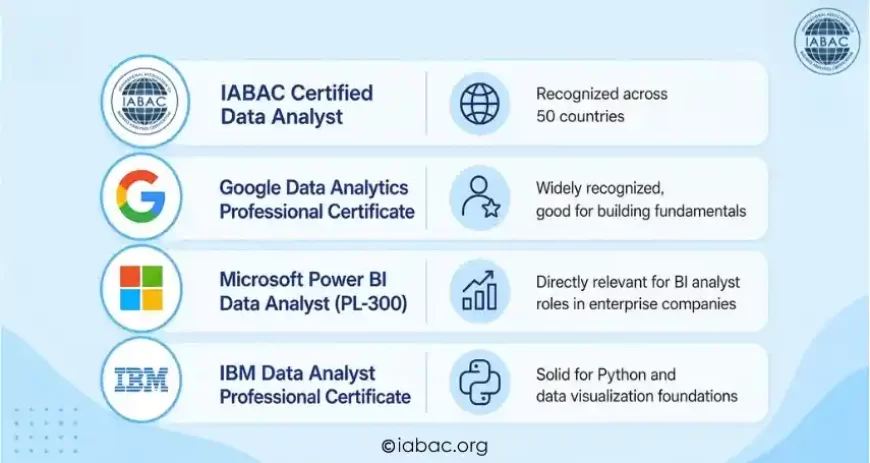
Certifications can open doors, especially for career switchers who lack a traditional data background. These are the ones that carry weight with Indian and global employers:
• IABAC Certified Data Analyst: Recognized across 50 countries, strong in multi-industry hiring cycles
• Google Data Analytics Professional Certificate: Widely recognized, good for building fundamentals
• Microsoft Power BI Data Analyst (PL-300): Directly relevant for BI analyst roles in enterprise companies
• IBM Data Analyst Professional Certificate: Solid for Python and data visualization foundations
Where Most Beginners Go Wrong
-
Spending months on tutorials without building projects
Fix: Start working on real projects by week 6, even if your skills feel incomplete. -
Applying for analyst roles without a visible portfolio
Fix: Add your GitHub portfolio link to your resume and LinkedIn profile before applying. -
Learning tools without checking market demand
Fix: Review job descriptions in your target industry and prioritize tools (e.g., Power BI vs Tableau) based on actual demand. -
Listing tools on your resume instead of outcomes
Fix: Show impact. Example: “Built a Power BI dashboard tracking 12 KPIs, reducing reporting time by 3 hours weekly.” -
Ignoring the business context behind data
Fix: Focus on connecting your analysis to business decisions. Companies hire analysts who solve problems, not just write queries.
Data Analyst Salary in India: What to Expect at Each Stage
Salary ranges vary by city, company type, and skill depth. Here is an honest data analyst salary breakdown:
• Fresher (0–1 year): Rs. 4 - 6 LPA in tier-2 cities; Rs. 5–8 LPA in Bengaluru, Hyderabad, Mumbai
• Mid-level (2–4 years with Python, Power BI): Rs. 8–14 LPA
• Senior analyst (5+ years with domain specialization): Rs. 15–22 LPA
Product companies typically pay 40–60% higher than IT services companies for the same role.
Specializing in high-demand domains like Fintech, Healthcare Analytics, or Marketing Analytics accelerates salary growth significantly.
Freshers with SQL + Power BI + one domain certification can expect Rs. 5–7 LPA in 2026, even without prior work experience.
(Source: Naukri data analyst salary insights)
Frequently Asked Questions
1. Do I need a Computer Science degree to become a data analyst in India?
No. Many working analysts come from Commerce, Arts, Engineering, and even non-technical fields. Skills and a demonstrable portfolio matter far more than your degree stream in 2026. That said, a degree in any quantitative field gives you a head start with statistics.
2. How long does it take to become a data analyst in India from scratch?
With consistent daily effort of 2–3 hours, most people become job-ready in 4–6 months. The timeline stretches when people do passive learning without building projects. The portfolio phase is what most people underestimate.
3. Is Python mandatory for entry-level data analyst roles in India?
Python is preferred, but not always mandatory, at the entry level. Most job postings for analyst roles in Indian product companies list Python as required or strongly preferred. SQL and Excel are the true non-negotiables. Python becomes a differentiator that pushes your salary higher.
4. Which is better for data analysts in India: Power BI or Tableau?
Power BI for Indian enterprise companies and IT services firms. Tableau for MNCs, consulting firms, and companies with US stakeholders. Learn Power BI first if you are unsure, then add Tableau as a secondary skill.
5. Can I become a data analyst without work experience?
Yes, and the path is through a strong portfolio. Three well-documented projects showing the full analytics workflow replace early work experience in most Indian hiring conversations. An internship, even an unpaid one, accelerates the process further.
The biggest trap in this field is the illusion of progress through constant learning without building. The data analyst career in India in 2026 is genuinely accessible to almost anyone who follows a structured sequence: master the core tools, build projects that prove it, and apply consistently.
Start with Excel and SQL this week. Download a public dataset from Kaggle. Build something with it. That one project will teach you more about what it means to become a data analyst in India than three months of watching video playlists.
The demand is there. The salary is real. The path is clearer than it has ever been. The only variable left is whether you start building.