















































The Complete Guide to Data Analytics in HR for 2026
Learn how data analytics in HR helps you hire smarter, cut turnover, and make better people decisions. Your complete guide for 2026 starts here.

Think about the last time your HR team made a big decision, maybe it was a hiring call, a restructure, or a new engagement program. How was that decision made? Was it based on real evidence, or was it mostly experience, gut feeling, and a few spreadsheets?
For most HR teams, the honest answer falls somewhere in between. And that's exactly the gap that data analytics in HR is closing in 2026.
This guide is written for HR professionals who want to understand what HR analytics really means, how it works in practice, where most teams go wrong, and how you can build these skills in a way that actually moves your career forward.
What Does Data Analytics in HR Actually Mean?
Let's be clear about something first. Data analytics in HR is not about turning HR into a numbers department. It's about using the information you already have and connecting the dots to make better decisions.
Right now, most HR teams collect information in separate systems that never talk to each other. HR analytics brings all of that together and asks: what is this data telling us about our people?
There are four levels of analytics that HR teams typically work through:
-
Descriptive analytics answers "What happened?" things like turnover rate last quarter, average time-to-hire, or headcount by department. Most teams are already doing this, even if they don't call it analytics.
-
Diagnostic analytics goes deeper and asks "Why did it happen?" for example, understanding why turnover spiked in one specific team or why employee satisfaction dropped after a policy change.
-
Predictive analytics takes it further: "What is likely to happen next?" Using patterns in historical data, HR teams can forecast which employees are at risk of leaving, which teams may face a skills gap, or where hiring demand will rise.
-
Prescriptive analytics is the most advanced level it not only predicts an outcome but recommends a specific action. It might flag that a particular manager's team shows early signs of disengagement and suggest coaching before anyone actually quits.
Most organizations in 2026 are still sitting between descriptive and diagnostic. The opportunity and the competitive advantage are in moving toward predictive.
Why 2026 Is a Turning Point for HR Analytics?
The pace of change in workplaces over the past few years has been relentless. Hybrid work, rising attrition, skills shortages, and economic pressure have all combined to put HR under a microscope.
Leaders want answers. They want to know why certain departments lose people faster than others. They want to understand whether their training investments are actually improving performance. They want HR to be at the table with evidence, not just experience.
According to Gallup's 2025 State of the Global Workplace report, only 21% of employees worldwide are engaged at work, a number that has dropped for the second time in a decade.
That means nearly 8 out of 10 employees are going through the motions, quietly disengaged, and costing organizations an estimated $8.9 trillion in lost productivity globally.
Without data, most HR teams would never even know which of their employees fall into that category until it's too late.
What's shifted in 2026 specifically is accessibility. Analytics tools that used to require a dedicated data science team are now built into everyday HR platforms. The barrier to getting started has never been lower.
The question is no longer whether your organization can afford to use HR analytics; it's whether you can afford not to.
The Most Valuable Use Cases of Data Analytics in HR
Reducing Turnover Before It Happens
Replacing a single employee typically costs between 1.5 to 2 times their annual salary. The real damage, though, isn't just financial; it's the disruption to the team, the lost institutional knowledge, and the time it takes for a new hire to reach full productivity.
Predictive analytics helps HR teams identify flight risks early by looking at signals like:
-
A drop in engagement survey scores over consecutive months.
-
Performance ratings that have plateaued or declined.
-
Employees who haven't had a development conversation in a long time.
-
Increased absenteeism or changes in work patterns.
When these signals cluster together, it's often a sign that someone is quietly heading for the door. Acting early, even with something as simple as a meaningful one-on-one, can change the outcome.
Making Hiring Less of a Guessing Game
Data analytics in HR is making recruitment more precise. Teams can now look at:
-
Which sourcing channels consistently produce the strongest long-term performers.
-
Which interview assessments actually predict on-the-job success.
-
What characteristics appear most often in employees who stay and grow.
-
Where bias tends to creep into shortlisting and selection decisions.
This doesn't mean reducing people to numbers. It means using evidence to reduce the bias that already exists in traditional hiring bias that often works against great candidates for reasons that have nothing to do with their ability to do the job.
Connecting Training to Business Results
One of the oldest frustrations in HR is the inability to prove whether a training program actually worked. Data analytics changes that conversation. By linking learning data to performance metrics, HR teams can track:
-
Whether employees who completed a program improved their output.
-
Whether they were promoted faster than those who didn't participate.
-
Whether engagement scores improved following specific development initiatives.
-
Which programs are delivering ROI and which ones aren't?
That kind of evidence doesn't just validate the training budget it helps HR design smarter programs and confidently cut the ones that aren't delivering.
Workforce Planning with Real Foresight
Reactive hiring, posting a job only when someone leaves, is expensive and disruptive. Strategic workforce planning means looking ahead by:
-
Mapping current skills against future business needs.
-
Projecting headcount requirements based on growth plans and attrition trends.
-
Identifying internal candidates ready to step into more senior roles.
-
Modeling scenarios so HR isn't caught off guard by sudden changes.
Data analytics makes this possible because it turns scattered workforce information into a coherent picture of where you are and where you're headed.
Where Most HR Teams Get It Wrong
Here's something that doesn't get discussed enough: having data is not the same as having good data.
One of the most common reasons HR analytics projects fail quietly is data quality. If job titles aren't standardized, if performance ratings are applied inconsistently, if departments record turnover differently any analysis built on that foundation will give you a misleading picture. As the saying goes: garbage in, garbage out.
Before meaningful analytics work can happen, teams need to:
-
Audit the HRIS for missing, duplicate, or inconsistent records.
-
Standardize job titles, department names, and key HR fields.
-
Agree on common definitions across teams (what counts as voluntary turnover, for example).
-
Make data entry as consistent as possible at the source.
Another common mistake is starting with data rather than questions. Analytics works best when it's driven by a specific business problem. Start with the question your leadership team is already asking, then figure out what data would help answer it.
The Human Side That Often Gets Overlooked
There's a conversation that doesn't show up often enough in guides like this: employee trust.
When HR teams start tracking behavioral signals and engagement data at an individual level, it raises legitimate questions.
Do employees know their data is being collected?
Do they understand how it's being used?
Do they trust it's being used fairly?
Good HR analytics practice includes:
-
A clear, accessible data ethics policy that employees can actually read and understand.
-
Transparency about what is measured, why, and how decisions are made from it.
-
Strong data privacy protections, especially for sensitive personal information.
-
A genuine commitment to using workforce data to support employees, not just monitor them.
Organizations that use analytics transparently tend to see stronger participation in surveys and more honest feedback. Those that don't are taking a reputational risk that no insight is worth.
How Smaller HR Teams Can Get Started
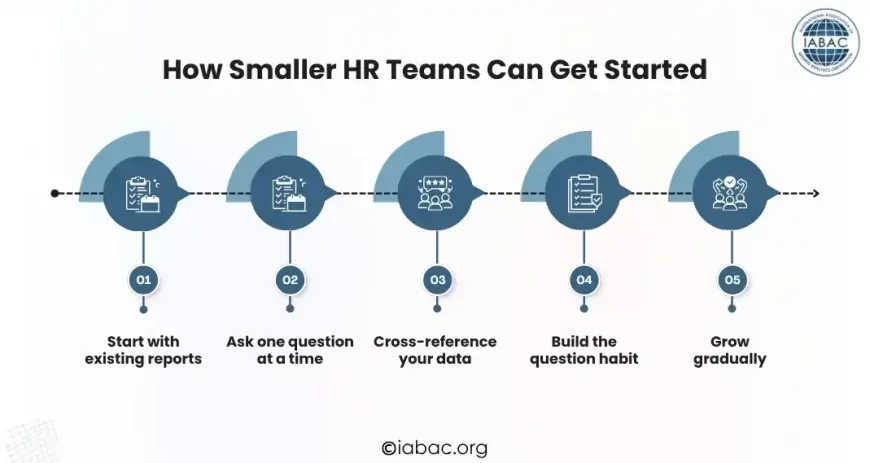
You don't need enterprise software or a dedicated analytics hire to get started with data analytics in HR. Here's a practical starting point:
-
Start with existing reports: Most HRIS platforms include basic reporting that teams never fully use. Pull turnover by department, time-to-hire by role, and engagement scores by team.
-
Ask one question at a time: Don't try to analyze everything at once. Pick one problem your leadership cares about and focus there first.
-
Cross-reference your data: Compare engagement scores with performance ratings, or absenteeism trends with manager data. Simple comparisons often reveal surprising patterns.
-
Build the question habit: Get your team used to asking "what are we trying to find out?" before opening a spreadsheet. That discipline alone lifts the quality of your analytics work.
-
Grow gradually: Start simple, prove value, then invest in more advanced tools and skills as your confidence builds.
Building Your Skills: Get Certified with IABAC
Whether you're an HR professional looking to grow into analytics or a team lead building data literacy across your function, structured learning makes a real difference.
The IABAC Certified HR Analytics Professional (CHRAP) certification is specifically designed for HR professionals who want to use data to make better workforce decisions. The program covers:
-
HR metrics and key performance indicators
-
Data collection, cleaning, and preparation
-
Statistical analysis and predictive modeling
-
Data visualization and dashboard reporting
-
Applying analytics to talent management, engagement, and workforce planning
IABAC is built on the European Commission's EDISON Data Science Framework, giving its certifications genuine global recognition. What makes their approach stand out is the focus on applied, practical learning; you're working through real HR scenarios, not just studying theory.
For those at different stages, IABAC also offers:
-
Data Analytics Foundation - for HR professionals who are just starting.
-
Data Analytics for Managers - for HR leaders who want to lead data-driven teams without becoming deep practitioners.
In a field where employers are actively looking for HR professionals who speak the language of data, an IABAC certification is a credible, globally recognized signal that you have the skills to back it up.
Data analytics in HR is not something that's coming — it's already here, and the gap between organizations using it well and those that aren't is widening every year.
The good news is that you don't need to be a data scientist to make a meaningful difference. You need curiosity, a willingness to ask better questions, and a commitment to building the right skills over time.
Start where you are. Use what you have. Learn as you go. And if you're ready to take that learning seriously, IABAC's HR analytics certifications give you a structured, recognized, and practical path to get there.