























































What Is the Difference Between Weak AI and Strong AI?
Weak AI performs specific tasks. Strong AI (AGI) doesn't exist yet. Learn what sets them apart, with real examples and why it matters for your AI career.

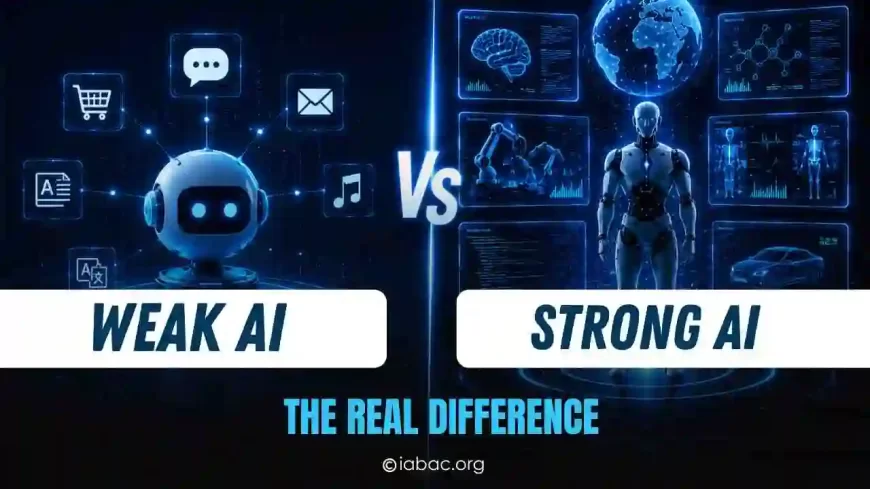
Weak AI vs Strong AI is one of the most common comparisons in artificial intelligence. While both terms describe forms of AI, they represent fundamentally different concepts.
Weak AI (Narrow AI) refers to AI systems designed to perform one specific task or a limited set of tasks.
Strong AI (Artificial General Intelligence or AGI) refers to a theoretical form of AI that could perform any intellectual task a human can, learning and reasoning across different domains without being limited to a single purpose.
Every AI system in active use today including ChatGPT, Siri, recommendation engines, fraud detection systems, and self-driving technologies is classified as Weak AI. Strong AI does not currently exist.
Weak AI vs Strong AI: Quick Comparison
|
Weak AI (Narrow AI) |
Strong AI (AGI) |
|
Exists today |
Does not exist |
|
Designed for specific tasks |
Designed for any intellectual task |
|
Cannot transfer knowledge across domains |
Could transfer knowledge across domains |
|
Uses pattern recognition |
Would require genuine understanding |
|
No self-awareness |
Would require consciousness and intentionality |
|
Examples: ChatGPT, Siri, fraud detection systems |
No verified examples |
Why This Question Matters
If you have spent any time reading about artificial intelligence, you have almost certainly encountered the terms Weak AI and Strong AI. They appear in research papers, business strategy discussions, AI course materials, and media coverage. Yet the two concepts are often confused, leading many people to overestimate what today's AI systems can actually do.
Understanding the difference is not just an academic exercise. It affects how organisations invest in AI, how professionals plan their careers, and how learners build realistic expectations about the technology.
For example, a business that assumes today's AI can independently manage an entire business process without human oversight may underestimate the need for governance, monitoring, and expert review. In reality, current AI systems remain specialised tools that perform well only within their intended scope.
According to McKinsey's State of AI survey, 88% of organisations report regular AI use in at least one business function, yet many organisations are still experimenting with or piloting AI initiatives. Understanding the actual capabilities and limitations of today's AI is essential for making those investments successful.
What Is Weak AI?
Weak AI, also known as Narrow AI or Artificial Narrow Intelligence (ANI), refers to AI systems designed and trained to perform one specific task or a limited range of related tasks.
According to IBM, Narrow AI can perform a single or narrowly defined task often faster and more accurately than humans, but it cannot operate beyond the purpose for which it was designed.
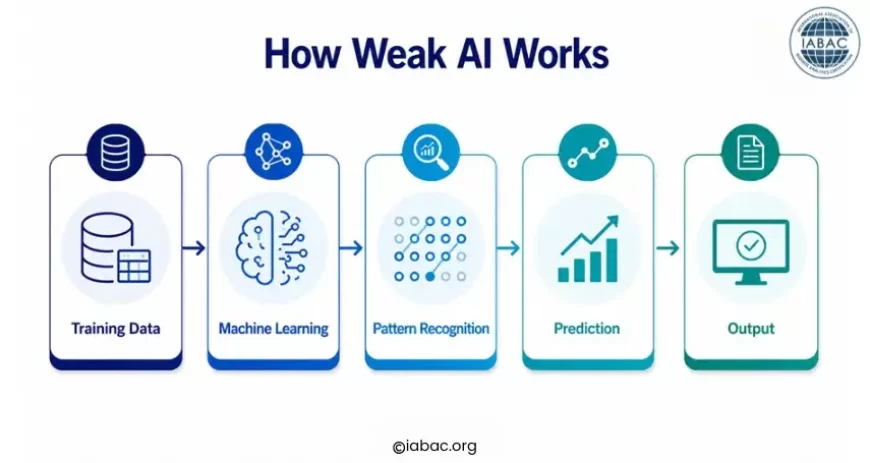
Although Weak AI can appear intelligent, it does not think, reason, or understand information in the same way humans do. Instead, it identifies statistical patterns in data and produces outputs based on what it has learned during training.
This is why it is still called artificial intelligence. The term refers to machines performing tasks that normally require human intelligence, even though today's systems do not possess genuine understanding, consciousness, or human-like reasoning.
Common Examples of Weak AI
Voice Assistants
-
Siri
-
Amazon Alexa
-
Google Assistant
These systems understand spoken commands only within their trained capabilities. They cannot independently reason or transfer that ability to unrelated domains.
Recommendation Engines
-
Netflix
-
Spotify
Recommendation systems analyse user behaviour to suggest relevant content, but they operate only within the datasets and objectives for which they were designed.
Image Recognition Systems
A model trained to identify diseases in chest X-rays cannot suddenly analyse financial reports or write software. AI models are highly specialised and cannot automatically transfer knowledge between unrelated tasks.
Other Examples Identified by IBM
-
Self-driving cars
-
Fraud detection systems
-
Spam filters
-
Customer service chatbots
Each system performs exceptionally well within its intended purpose but cannot generalise beyond that domain.
Why ChatGPT Is Still Weak AI
Many people assume ChatGPT is moving toward Strong AI because it can write essays, answer questions, generate code, and hold natural conversations.
However, according to IBM, ChatGPT is still classified as Weak AI because it remains specialised in language-based tasks. While it can perform many different activities through natural language, they all rely on predicting and generating text based on patterns learned during training.
It cannot independently acquire new knowledge, transfer learning across unrelated domains without retraining, develop its own goals, or demonstrate genuine understanding in the way Strong AI would require.
Current Limits of Weak AI
According to the International AI Safety Report 2026, today's general-purpose AI systems can:
✓ Engage in fluent conversation
✓ Write and debug code for well-defined tasks
✓ Solve graduate-level exam questions
However, they still cannot:
✗ Independently execute complex multi-day projects
✗ Generate completely reliable outputs without hallucinations
✗ Solve problems requiring genuinely novel insight
In AI, a hallucination refers to an output that sounds convincing but contains fabricated or incorrect information. Although modern AI systems have become more accurate, hallucinations remain one of their key limitations.
These limitations represent the current ceiling of Weak AI.
What Is Strong AI?
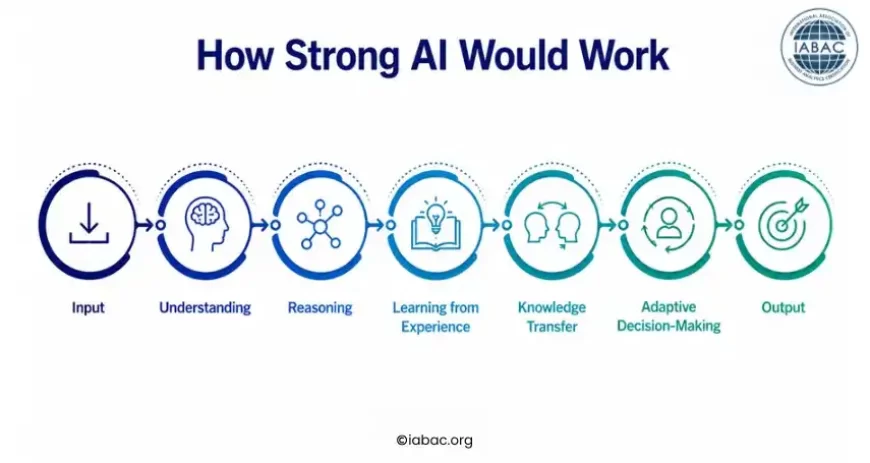
Strong AI, also known as Artificial General Intelligence (AGI), refers to a hypothetical form of artificial intelligence capable of understanding, learning, reasoning, and applying knowledge across virtually any domain at a level comparable to human intelligence.
Unlike Weak AI, Strong AI would not be limited to one specific task. Instead, it could adapt to unfamiliar situations, transfer knowledge between different fields, and solve entirely new problems without requiring separate training for each one.
Origin of the Term
The concept of Strong AI was introduced by American philosopher John Searle in his influential 1980 paper Minds, Brains, and Programs.
According to the Stanford Encyclopedia of Philosophy's explanation of the Chinese Room Argument, Searle argued that an appropriately programmed computer would not simply simulate intelligence but, under the Strong AI hypothesis, would actually possess a mind.
He contrasted this with Weak AI, where computers imitate intelligent behaviour without genuinely understanding the information they process.
What Would Strong AI Be Able to Do?
A true Strong AI system could theoretically:
-
Learn completely new skills without explicit programming.
-
Transfer knowledge between unrelated domains.
-
Reason abstractly across different disciplines.
-
Understand meaning, context, intent, and consequences.
-
Adapt to unfamiliar situations without retraining.
-
Solve entirely new problems using prior knowledge and experience.
Unlike today's AI systems, Strong AI would not simply recognise patterns. It would require genuine comprehension and flexible reasoning similar to human intelligence.
Does Strong AI Exist Today?
No. As of 2026, there is no verified example of Strong AI or Artificial General Intelligence (AGI). Although AI systems such as ChatGPT, Gemini, Claude, and advanced robotics have become significantly more capable, they remain forms of Weak AI because they are still limited by their training, objectives, and architecture.
Why Modern AI Still Isn't Strong AI
Recent advances in Large Language Models (LLMs), multimodal AI, and AI agents have made today's AI systems far more capable than earlier generations. They can understand text, generate images, write code, use external tools, and even complete multi-step workflows.
However, these capabilities do not make them Strong AI.
Modern AI systems are still forms of Weak AI because they remain limited by their training, objectives, and architecture. They cannot independently develop general intelligence, continuously learn across unrelated domains without retraining, or demonstrate genuine understanding, consciousness, or human-like reasoning.
For example:
-
Large Language Models (LLMs) generate text, code, and other content by recognising statistical patterns rather than truly understanding concepts.
-
Multimodal AI combines text, images, audio, and video processing, but it still operates within specialised capabilities rather than possessing general intelligence.
-
AI agents can automate sequences of tasks using tools and predefined objectives, yet they remain dependent on human-designed goals, workflows, and oversight.
Although these technologies continue to advance rapidly, researchers generally classify them as increasingly capable forms of Weak AI rather than Artificial General Intelligence (AGI).
Weak AI vs Strong AI: The Key Differences
Although both Weak AI and Strong AI fall under the broader field of artificial intelligence, they differ significantly in their capabilities, learning methods, and real-world applications.
The table below summarises the key differences between Weak AI vs Strong AI.
|
Feature |
Weak AI (Narrow AI) |
Strong AI (AGI) |
|
Current status |
Exists and is widely deployed |
Theoretical; no verified examples |
|
Scope |
Performs specific tasks or operates within a limited domain |
Could perform any intellectual task a human can |
|
Learning |
Learns within its training scope and requires retraining for new tasks |
Would learn continuously across different domains |
|
Knowledge Transfer |
Cannot apply knowledge to unrelated tasks |
Could transfer knowledge between different fields |
|
Understanding |
Recognises patterns without genuine comprehension |
Would understand meaning, context, and intent |
|
Self-awareness |
None |
Would require consciousness and intentionality |
|
Decision-making |
Operates within predefined objectives |
Could reason independently in unfamiliar situations |
|
Examples |
ChatGPT, Siri, fraud detection systems, self-driving cars |
No verified examples |
|
Business Use Today |
Widely used across industries |
Cannot currently be implemented |
The Four Biggest Differences Between Weak AI and Strong AI
1. Scope
Weak AI is designed for specific purposes.
According to IBM, an AI model trained to play chess cannot automatically play Go. Likewise, a language model designed to generate text cannot independently pilot an aircraft or diagnose medical conditions without specialised training.
Strong AI, by contrast, would not be restricted to a single domain. It could apply its intelligence across entirely different tasks without requiring separate programming for each one.
2. Learning
Weak AI learns only from the data and objectives defined during training.
When developers want a model to perform a new task, they typically need to retrain or redesign it using new data and objectives.
Strong AI would instead learn continuously from experience, adapting to unfamiliar situations much like humans do. It could build on previous knowledge and apply it to completely different domains without explicit retraining.
3. Understanding vs Pattern Recognition
This is one of the most important distinctions in artificial intelligence.
Today's AI systems excel at recognising statistical patterns in enormous datasets. They generate responses based on probabilities rather than genuine comprehension.
John Searle illustrated this idea through his famous Chinese Room Argument. In the thought experiment, a person follows a rule book to produce correct Chinese responses without actually understanding the language.
Searle argued that modern computers operate similarly—they manipulate symbols according to learned rules rather than possessing real understanding.
Strong AI, if it ever exists, would require genuine comprehension rather than sophisticated pattern matching alone.
4. Autonomy
Weak AI systems remain dependent on:
-
Human-designed objectives
-
Human-provided training data
-
Human supervision and governance
-
Human evaluation of outputs
They can automate tasks but cannot independently determine their own goals or operate without defined boundaries.
Strong AI, on the other hand, would theoretically be capable of reasoning independently, adapting to unfamiliar situations, and pursuing complex goals across different domains without being limited to a predefined task.
Weak AI, AGI, and ASI: Understanding the Progression
Artificial intelligence is commonly discussed as three broad stages.
|
AI Stage |
Description |
Current Status |
|
Artificial Narrow Intelligence (ANI) / Weak AI |
Performs specific tasks within a limited domain |
Exists today |
|
Artificial General Intelligence (AGI) / Strong AI |
Could perform any intellectual task a human can |
Theoretical |
|
Artificial Superintelligence (ASI) |
Would surpass human intelligence across all domains |
Purely speculative |
This progression is conceptual rather than chronological. While Weak AI already exists, neither AGI nor ASI has been achieved.
Related Terms You Should Know
-
Artificial Narrow Intelligence (ANI) → Another name for Weak AI; refers to AI systems designed to perform specific tasks within a limited domain.
-
Artificial General Intelligence (AGI) → A theoretical form of AI capable of performing any intellectual task that a human can.
-
General AI → A term commonly used interchangeably with Artificial General Intelligence (AGI).
-
Artificial Superintelligence (ASI) → A hypothetical form of AI that would surpass human intelligence across every domain, including reasoning, creativity, and problem-solving.
Common Misconceptions About Weak AI vs Strong AI
Many discussions about artificial intelligence blur the distinction between current AI systems and theoretical concepts. Here are some of the most common misconceptions.
Myth: ChatGPT is Strong AI
Reality: ChatGPT is classified as Weak AI because it performs language-based tasks using learned patterns. It does not possess general intelligence or human-like understanding.
Myth: Self-driving cars are examples of Strong AI
Reality: Self-driving systems combine multiple specialised AI models, including computer vision, sensor fusion, mapping, and planning. Despite their complexity, they remain forms of Weak AI because they are built for a specific purpose.
Myth: Generative AI is the same as AGI
Reality: Generative AI creates text, images, audio, or code within its trained capabilities. Although modern generative models are increasingly capable, they remain examples of Weak AI rather than Artificial General Intelligence.
Myth: Strong AI already exists but companies are hiding it
Reality: There is no credible scientific evidence that Strong AI or AGI currently exists. Leading researchers continue to debate whether it is achievable and, if so, when it might emerge.
Why the Difference Between Weak AI and Strong AI Matters
Understanding the distinction between Weak AI vs Strong AI helps organisations, professionals, and learners make informed decisions about adopting, studying, and investing in artificial intelligence.
For Business Leaders
According to McKinsey's research:
-
88% of organisations use AI in at least one business function.
-
Approximately one-third have begun scaling AI programmes.
However, successful adoption depends on recognising the limits of today's AI.
For example, deploying a customer support chatbot does not eliminate the need for human oversight. While the chatbot can automate routine conversations, humans are still required to handle complex situations, verify sensitive information, and monitor AI outputs for accuracy.
Understanding that today's AI is Weak AI helps organisations build realistic implementation strategies and governance frameworks.
For Professionals
The most in-demand AI skills today are closely aligned with Weak AI technologies, including:
-
Natural Language Processing (NLP)
-
Computer Vision
Developing expertise in these areas prepares professionals for the AI systems currently used across industries.
For New Learners
Many newcomers assume that recent advances in AI represent Strong AI.
In reality, the technologies dominating today's AI landscape including:
-
Large Language Models (LLMs)
-
Generative AI
-
Multimodal AI
are all forms of Weak AI. They perform specialised tasks exceptionally well but do not possess general intelligence or consciousness.
Where Strong AI Research Stands Today
Research into more general forms of artificial intelligence continues across several active fields, including:
-
Large Language Models (LLMs)
-
Reinforcement Learning
-
Neuromorphic Computing
These advances have significantly expanded what AI systems can do, but they have not resulted in Artificial General Intelligence (AGI).
It is also important to distinguish between research progress and scientific consensus. While many organisations and researchers are working toward more capable AI systems, there is currently no agreement on whether existing approaches can achieve Strong AI.
According to the RAND Corporation's Artificial General Intelligence Forecasting and Scenario Report (November 2025), expert opinion has shifted toward earlier AGI arrival dates, but forecasts remain highly uncertain and should be viewed as informed opinions rather than established predictions.
Notable Expert Forecasts
|
Researcher |
Organisation |
Forecast |
|
Demis Hassabis |
Google DeepMind |
Around 2030 |
|
Dario Amodei |
Anthropic |
As early as 2026 |
*These forecasts represent individual expert opinions rather than scientific consensus. There is currently no verified timeline for achieving AGI.
At the same time, several researchers argue that current AI architectures may be fundamentally insufficient for achieving general intelligence.
The International AI Safety Report 2026 highlights several limitations that today's AI systems still face, including the inability to:
-
Independently execute complex multi-day projects
-
Reliably perform useful physical-world robotics tasks
-
Solve problems requiring genuinely novel insight
-
Learn continuously across unrelated domains without retraining
For these reasons, Strong AI remains a theoretical concept rather than an engineering achievement.
Frequently Asked Questions
Is ChatGPT a form of Strong AI?
No. ChatGPT is a form of Weak AI (Narrow AI).
According to IBM, ChatGPT is classified as Weak AI because it is limited to language-based tasks. Although it can write, summarise, answer questions, and generate code, it does not possess general intelligence, independent reasoning, or human-like understanding.
Is Generative AI the same as AGI?
No.
Generative AI refers to systems that create content such as text, images, audio, or code. These systems remain examples of Weak AI because they operate within specialised capabilities rather than demonstrating general intelligence.
AGI, or Strong AI, would be capable of learning, reasoning, and adapting across any intellectual task without being limited to one domain.
Will Strong AI ever exist?
This remains one of the biggest unanswered questions in artificial intelligence.
Some researchers believe AGI may become possible within the next decade, while others argue that major scientific and philosophical challenges remain unresolved.
The RAND Corporation's AGI forecasting report concludes that forecasting methods are still developing and expert opinion remains genuinely divided.
There is currently no scientific consensus on whether or when Strong AI will be achieved.
Is Narrow AI the same as Weak AI?
Yes.
The terms Weak AI, Narrow AI, and Artificial Narrow Intelligence (ANI) all describe AI systems designed to perform specific tasks rather than exhibiting general intelligence.
What is the difference between AGI and Strong AI?
There is no practical difference.
Artificial General Intelligence (AGI) is the term most commonly used in AI research and industry.
Strong AI is the philosophical term introduced by John Searle in 1980.
Both refer to the same theoretical concept of an AI system capable of performing any intellectual task that a human can.
Does understanding Weak AI vs Strong AI help with AI certifications?
Yes.
Understanding the distinction between Weak AI and Strong AI provides the foundation for studying artificial intelligence, machine learning, generative AI, and data science.
Most AI certification programmes begin by explaining the different categories of AI before moving into practical technologies such as machine learning, neural networks, and large language models.
Key Takeaways
-
Weak AI (Narrow AI) performs specific tasks and powers every AI application currently in use.
-
Strong AI (AGI) is a theoretical concept capable of human-level intelligence across all domains.
-
Every commercial AI system available today—including ChatGPT, Siri, recommendation engines, fraud detection platforms, and self-driving technologies—is classified as Weak AI.
-
Current AI systems excel at pattern recognition but do not possess genuine understanding, consciousness, or independent reasoning.
-
Although AGI research continues, there is no verified example of Strong AI as of 2026.
The difference between Weak AI vs Strong AI ultimately comes down to specialisation versus general intelligence.
Weak AI performs narrowly defined tasks exceptionally well.
Strong AI would be capable of learning, reasoning, and adapting across virtually any intellectual challenge in a human-like way.
Understanding this distinction helps businesses adopt AI more realistically, enables professionals to develop relevant skills, and gives learners a clearer understanding of where today's AI technology stands and where future research may lead.
Take the Next Step in Your AI Learning Journey
Understanding Weak AI vs Strong AI is one of the foundational concepts in artificial intelligence. Whether you're exploring AI for your career, your organisation, or your own learning, building a strong understanding of today's AI capabilities is the first step toward making informed decisions.
IABAC offers globally recognised AI certification programmes designed for learners, professionals, and business leaders at every stage of their AI journey.
Explore:
Sources & References
-
Searle, J. R. (1980). Minds, Brains, and Programs. Behavioural and Brain Sciences, 3(3), 417–424 — https://home.csulb.edu/~cwallis/382/readings/482/searle.minds.brains.programs.bbs.1980.pdf
-
Stanford Encyclopedia of Philosophy — The Chinese Room Argument (last revised October 2024): https://plato.stanford.edu/entries/chinese-room/
-
IBM — What Is Strong AI?: https://www.ibm.com/think/topics/strong-ai
-
IABAC — Understanding the Different Types of Artificial Intelligence: https://iabac.org/blog/what-are-the-types-of-artificial-intelligence
-
IBM — Artificial Intelligence Advantages and Disadvantages: https://www.ibm.com/think/insights/artificial-intelligence-advantages-disadvantages
-
Stanford HAI — AI Index Report 2025: https://hai.stanford.edu/ai-index/2025-ai-index-report
-
RAND Corporation — Artificial General Intelligence Forecasting and Scenario Report (November 2025): https://www.rand.org/content/dam/rand/pubs/research_reports/RRA4600/RRA4692-1/RAND_RRA4692-1.pdf
-
MIT Technology Review — The Road to Artificial General Intelligence (August 2025): https://www.technologyreview.com/2025/08/13/1121479/the-road-to-artificial-general-intelligence/