







































How Can a Data Science Consulting Business Help Companies Grow?
Learn how a Data Science consulting business helps companies grow in 2026 by improving decisions, reducing costs, automating workflows, and creating business value.

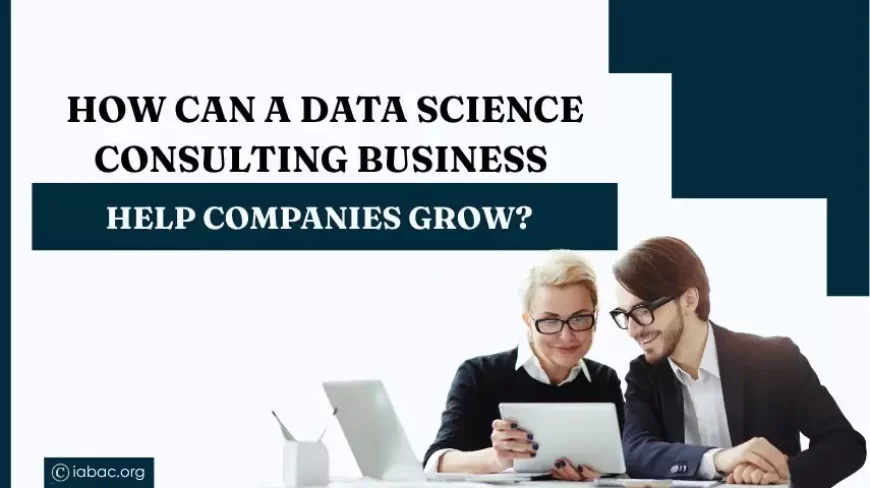
A Data Science Consulting Business helps companies grow by fixing real problems with data. Instead of guessing what went wrong or what might happen next, a company brings in a team that looks at its actual numbers, builds models, runs tests, and gives clear, practical advice. This might mean spotting which customers are about to stop buying, setting better prices, catching fraud faster, or turning a report that used to take a week into something that runs automatically.
For students, Data Science Consulting is also a very real career path — and you don't need a full-time job at a big company to get started. You can build your skills, earn a recognized certification like one from IABAC, work on small projects, and grow from there. This guide covers both sides: how consulting actually helps businesses, and how you, as a student, can build toward this kind of work.
Key Takeaways
- A Data Science Consulting Business is hired to solve one specific problem with data — not to run a company's entire data department forever.
- Companies hire consultants mainly for three reasons: they don't have the skill in-house, they need a quick outside view, or the project is short-term and doesn't need a full-time hire.
- Consulting work usually moves through four stages: understanding the problem, working with the data, building and testing a solution, and helping the company actually use it.
- Students can get into this field earlier than most people think, by combining coursework, a real certification like one from IABAC, and small paid or volunteer projects.
- "Registering as a consultant" is a business step, not just a skill step. It means understanding whether you're working as a freelancer, a registered business, or under an agency.
- The biggest reason consulting projects fail isn't bad math. It's a gap between what the business actually needs and what the data team builds.
- Growth for a student in this field usually looks like: learn the basics, build a small portfolio, take on your first paid project, then choose a specialty.
Picture two students who finish school the same year with almost the same data science coursework. One spends the next year sending applications only to full-time data science roles and hears nothing back for months. The other starts by helping a small local business figure out why its online orders dropped last quarter — for a small fee, using the same skills from class. A year later, that second student has three real projects, a short list of happy clients, and a much stronger resume than a pile of course certificates would ever give.
That second path is Data Science Consulting. It's not just something big firms do for large companies. It works at every level — from a solo student helping a small shop with its sales data, to a full firm running a six-month project for a major company. This guide covers both sides of the question in the title. First, how a Data Science Consulting Business actually helps a company grow, in plain terms. Second, and just as important for a student reading this, how you can build toward this kind of work — including what a certification like IABAC adds to your resume, and what it really means to hire a consultant or register as one.
What Is a Data Science Consulting Business, Really?
A Data Science Consulting Business is a company or an individual that gets hired to solve a specific business problem using data — rather than being hired as a full-time employee doing ongoing daily work. The key difference from a regular data science job is the relationship. An employee is part of the company long-term, handles many changing tasks, and reports to a manager inside the business. A consultant is brought in for a defined piece of work, delivers a result, and then either wraps up the project or moves to the next one. This matters for students because it changes how you can get started. You don't need to be hired full-time by a company to begin doing this kind of work. You need a clear problem to solve, a client willing to pay for that solution (even a small amount at first), and the skill to deliver it well.
What Separates a Consultant From a Freelancer or an Employee?
- An employee works inside one company, usually full-time, with ongoing work that changes over time.
- A freelancer takes on a wide range of smaller, often short tasks — sometimes without much specialization.
- A consultant focuses on solving a specific, often higher-value problem, and is expected to bring outside judgment and a clear recommendation — not just execution.
In practice, especially early in a career, these lines blur. A student's first consulting project might look a lot like freelance work. That's fine. The label matters less than the habit of solving a real problem for a real client and being able to explain your results clearly.
How Data Science Consulting Actually Works
Most Data Science Consulting projects, no matter the size of the client, move through a similar set of stages:
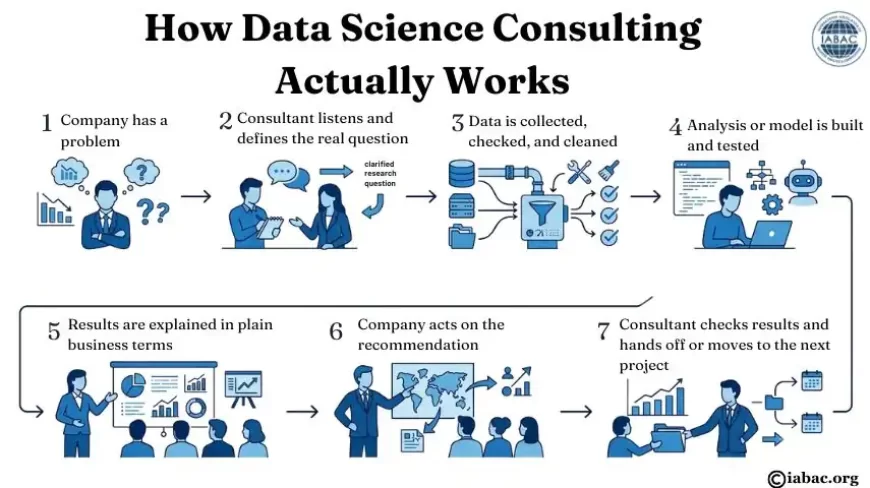
- Company has a problem
- Consultant listens and defines the real question
- Data is collected, checked, and cleaned
- Analysis or model is built and tested
- Results are explained in plain business terms
- Company acts on the recommendation
- Consultant checks results and hands off or moves to the next project
Stage 1: Understanding the Problem
This stage is often skipped by beginners — and it's the one that decides whether the whole project works. A company might say "we want a machine learning model," when what they actually need is a simple report that answers one question clearly. Good consultants ask a lot of questions before writing any code.
Stage 2: Working With the Data
Real business data is almost never clean. Dates are formatted differently across systems, customer records are duplicated, and important numbers are sometimes just missing. A large part of consulting work — especially early on — is cleaning and organizing data before any modeling even starts.
Stage 3: Building and Testing a Solution
This is the part most students associate with "data science": building models, running tests, and checking whether an idea actually holds up. It's an important stage, but it's usually shorter than people expect compared to the first and last stages.
Stage 4: Explaining Results and Helping the Company Act
A model or chart means nothing to a business owner if they can't understand what to do with it. The final — and often hardest — stage is turning technical results into a clear, plain-language recommendation, and helping the company actually put it into action.
Types of Data Science Consulting Work
Data Science Consulting isn't one single kind of job. Here are the common types, from smallest to largest.
By Project Size
- Small, single-question projects — for example, "why did sales drop last month?" These are a great starting point for students, often completed in days or a few weeks.
- Medium projects — building a working system, like a customer churn model or a demand forecast, usually over one to three months.
- Large, ongoing work — helping a company build an entire data strategy or team, often lasting six months or longer, usually done by more experienced consultants or firms.
By Specialty
- Business analytics consulting — reporting, dashboards, and understanding what's already happening in a business.
- Predictive modeling consulting — building models that forecast future outcomes, like demand, churn, or risk.
- Data infrastructure consulting — helping a company set up the systems needed before any serious analysis is possible.
- AI and automation consulting — helping companies apply AI tools to real workflows, a fast-growing area in 2026.
By Client Type
- Small businesses — usually need quick, practical answers on a limited budget. Great starting clients for students.
- Mid-size companies — often need a specific project done well, without hiring a full internal team.
- Large companies — usually work with bigger consulting firms or highly experienced independent consultants for larger, more complex projects.
How Data Science Consulting Helps Companies Grow
This is the heart of the question in the title, so it's worth breaking down clearly.
Faster, Better Decisions
Without data, a lot of business decisions come down to gut feeling. A consultant replaces guessing with evidence: which customers are most likely to leave, which product is actually driving profit, which marketing channel is wasting money.
Access to Skills the Company Doesn't Have In-House
Most small and mid-size companies don't have a full data science team. Hiring one full-time person is expensive and slow. A consultant gives access to that skill set exactly when it's needed — without a long-term commitment.
Spotting Problems Early
Models that flag unusual patterns — like a sudden drop in orders from one region or an unusual spike in returns — let a company respond before a small issue turns into a large loss.
Saving Time Through Automation
A huge part of Data Science Consulting in 2026 involves automating tasks that used to take a person hours or days each week, such as building a report by hand. Freeing up that time lets staff focus on higher-value work.
An Outside, Honest View
Employees inside a company sometimes have reasons — even without meaning to — to see their own work favorably. An outside consultant can look at the numbers without that pressure and give a more honest read on what's actually working.
Growth Through Better Pricing and Targeting
Consulting is regularly used to improve pricing models and to target marketing more precisely — both of which directly affect revenue, often faster than large strategic changes would.
Challenges and Risks in Data Science Consulting
Consulting isn't without its problems — on both sides.
For companies hiring consultants:
- Picking a consultant based only on price, without checking real experience or past work.
- Not being clear about the actual business goal before the project starts.
- Expecting a model to fix a problem that's actually caused by bad internal processes, not a lack of data.
For consultants, including students starting out:
- Pricing early work so low that it's hard to raise rates later.
- Taking on a project outside your actual skill level, which can damage your reputation if it goes badly.
- Not putting expectations in writing, which leads to disagreements about what was actually promised.
- Skipping proper business registration or contracts, which can create legal and payment problems later.
Hiring a Consultant vs. Hiring a Full-Time Data Scientist
|
Factor |
Hiring a Consultant |
Hiring a Full-Time Employee |
|
Best for |
A specific project or short-term need |
Ongoing, long-term data work |
|
Cost structure |
Project-based or hourly, no |
Salary, benefits, long-term cost |
|
Speed to start |
Usually fast |
Slower, due to hiring process |
|
Depth of company |
Builds up during the project only |
Builds up over time, ongoing |
|
Good fit for students |
Yes, a strong entry point |
Harder to access without |
Examples (Illustrative)
The following are made-up examples that reflect common patterns in Data Science Consulting — not reports on specific real businesses.
Case 1: The Small Retail Shop
A small clothing shop noticed weekend sales had quietly dropped over several months but couldn't explain why. A student consultant, working on a small paid project, pulled together the shop's point-of-sale data and found that a specific product line — previously a big weekend seller — had been running low on stock every Saturday because of a supplier delay.
The fix wasn't a complex model. It was a simple, clear finding delivered well: adjust the restocking schedule. Sales recovered within a month. The value here wasn't advanced machine learning — it was careful data work and a clear explanation.
Case 2: The Growing Online Business
An online store scaling quickly needed to know which customers were likely to stop buying, so the marketing team could reach out before they left. A consultant built a churn prediction model using the company's order history.
The real growth didn't come from the model's accuracy alone. It came from the consultant working closely with the marketing team to turn the model's output into an actual email campaign the team could run each month going forward.
Case 3: The Manufacturing Company
A mid-size manufacturer wanted to reduce downtime on its equipment. A consulting team looked at sensor data to predict likely equipment failures before they happened. The project worked not because the math was unusually advanced, but because the consultants spent real time with the maintenance staff first — understanding how failures had historically been handled — before building anything.
The common thread across all three: the technical work mattered, but understanding the actual business problem first is what made each project succeed.
Tools Used in Data Science Consulting
Consultants generally need a mix of technical tools and business-facing tools.
Core Technical Tools
- Python and/or R for analysis and modeling
- SQL for pulling and shaping data from company systems
- Business intelligence and dashboard tools for presenting results clearly
- Cloud platforms for handling larger datasets
Newer, Applied AI Tools
- Generative AI tools for speeding up analysis, writing summaries, and exploring data faster
- Automation tools that connect data work directly into a company's existing systems
Business and Client-Facing Tools
- Clear, simple presentation tools for explaining results to non-technical decision-makers
- Project management and contract tools for managing scope, timelines, and payment
For students, it's worth knowing that being strong in only the technical tools isn't enough. Clients — especially small businesses — care far more about a clear explanation and a real result than about which specific library you used.
How to Hire a Data Science Consultant (For Business Owners)
If you're a business owner rather than a student, here's a practical checklist for hiring a consultant well:
- Write down the actual business problem first — not just we want AI" or "we want data science.
- Ask for examples of past, similar work — even if it's from a smaller project.
- Agree on a clear deliverable and timeline before work starts — in writing.
- Check how the consultant plans to explain results, not just build them. A great model with no clear explanation is close to useless.
- Start small if you're unsure. A short, well-defined first project is a low-risk way to test whether a consultant is a good fit before a bigger engagement.
How Students Can Get Into Data Science Consulting
This section is built specifically for you, if you're a student wondering where to actually start.
Step 1: Build the Core Skills First
Before you can consult on anything, you need real, working skill in statistics, Python or R, SQL, and basic machine learning. This is where structured learning and Data Science Certifications matter. A recognized credential — such as one from IABAC — gives you both the actual skill-building and a way to prove that skill to a future client who doesn't know you yet.
Step 2: Get a Real Certification, Not Just a Course Completion
There's a real difference between finishing a course and earning a certification checked by an independent group. When you're trying to convince your very first client to trust you with their business data, a credential from a recognized body like IABAC gives them a reason to say yes — even without a long work history behind you. Data Science Certifications from trusted organizations carry weight because they signal a verified level of competence. This matters especially early in your career when your portfolio is still small.
Step 3: Build a Small Portfolio Before Looking for Paid Work
Offer to help a local business, a family friend's shop, or a student organization with a small, real data problem — even for free or a small fee at first. One real, well-documented project is worth more to a future client than a long list of course certificates alone.
Step 4: Understand What "Registering as a Consultant" Actually Means
Once you start taking on paid work regularly, it's worth understanding the basic business side of Consulting — not just the technical side. Depending on where you live, this might mean registering as a sole proprietor, freelancer, or small business, and understanding basic tax and contract requirements. Rules vary a lot by location, so check your local business registration authority or speak with an accountant once you're taking on regular paid work. Getting this right early avoids payment and legal headaches later.
Step 5: Take Your First Paid Project Seriously — Even If It's Small
Treat a small project for a local shop with the same care you'd give a large company. Deliver on time, explain your results clearly, and ask for a short testimonial or referral afterward. Your first few clients are often where your next clients come from.
Step 6: Specialize as You Grow
Once you've done a handful of general projects, start noticing what you're naturally drawn to — whether that's marketing analytics, financial data, healthcare data, or something else. Specializing makes you easier to recommend and often lets you charge more, since you're no longer a generalist competing with everyone else in the Data Science Consulting space.
A Roadmap for Companies Working With a Consultant
For business owners or managers reading this, here's a simple roadmap for getting the most out of a Data Science Consulting engagement:
- Share real context, not just the request. Give the consultant access to the actual background of the problem — not just a short task description.
- Assign one internal point of contact. Confusion usually comes from multiple people giving different instructions to the consultant.
- Review progress at clear checkpoints, not only at the very end of the project.
- Ask for a plain-language summary alongside any technical output. You should be able to explain the main finding to someone else in one or two sentences.
- Plan for how the result will actually be used before the project ends, not after. A great model that nobody acts on delivers no real growth at all.
Common Reasons Consulting Projects Fail
- The real problem was never clearly defined. Everyone agrees to start work before agreeing on what "done" actually looks like.
- The company expects a model to fix a process problem. No amount of data will fix a business process that's broken at its root.
- The consultant focuses only on technical accuracy, without spending time explaining results in a way the company can actually use.
- Poor communication during the project leads to a final result that misses what the client actually needed.
- For student consultants specifically: underpricing and overpromising. Charging too little can attract clients who don't respect your time, and promising results that aren't technically realistic damages trust fast.
- No plan for what happens after delivery. A project that ends with a report nobody reads or acts on hasn't actually helped the company grow.
Where Data Science Consulting Is Headed
- AI-assisted consulting is becoming standard. Consultants increasingly use AI tools to speed up early analysis, freeing up more time for the business-understanding and communication parts of a project.
- Smaller, faster projects are more common than large, months-long engagements — especially for small and mid-size businesses that want quicker results.
- Independent and student consultants have more of an opening than before, since AI tools lower the technical barrier to entry. But judgment, communication, and trust remain the harder skills to build — and those come from real experience.
- Specialization is paying off more than being a generalist. Clients increasingly look for consultants who understand their specific industry, not just data science in general.
- Recognized, independently checked Data Science Certifications matter more, not less, as more people enter the field and clients need a fast way to decide who to trust.
Career Paths In and Around Data Science Consulting
For students building toward this path, opportunities include:
- Independent data science consultant — working directly with small and mid-size clients
- Junior analyst at a consulting firm — a structured entry point with mentorship built in
- Freelance analytics specialist — narrower in scope than full consulting, a good stepping stone
- In-house analyst who later moves into consulting — building real company experience first, then going independent
- Specialist consultant — focusing on one industry or one type of problem, once you've built enough general experience
A Learning Path for Students Aiming at Consulting
- Core skills — statistics, Python/SQL, and basic machine learning
- A recognized certification, such as one from IABAC, to prove your skill level to clients who don't know you yet
- A small, real portfolio project, done for free or low cost, but done well
- Your first paid project, treated with real professionalism regardless of size
- Basic business setup, including understanding what registering as a consultant means where you live
- A specialty area, chosen once you've built enough general experience to know what you enjoy and what you're good at
- Ongoing learning, since tools and client expectations keep changing year to year
What does a Data Science Consulting Business actually do for a company?
It solves specific business problems using data, such as predicting customer behavior, improving pricing, automating reports, and providing insights that help companies make informed decisions.
Can a student really start a Data Science Consulting Business?
Yes. Many students begin with small projects for local businesses or organizations, build practical experience, and gradually expand their consulting portfolio.
How do I hire a consultant if I'm a small business owner?
Start by defining the business problem you want to solve, review the consultant's previous work, agree on clear deliverables, and begin with a small project to evaluate the partnership.
What does it mean to register as a consultant?
It means formally setting up your consulting work as a freelancer, sole proprietor, or small business so you can manage contracts, payments, and taxes according to your local regulations.
Is Data Science Consulting a good career path in 2026?
Yes. As businesses continue to adopt AI and analytics, demand for data science consultants is growing. Strong technical skills, business knowledge, and certifications such as IABAC can help professionals stand out.
Next Steps
A Data Science Consulting Business helps companies grow by turning messy, unused data into clear decisions: which customers to focus on, where money is being wasted, and which small fix will actually move the needle. That value doesn't require a huge company or years of experience to deliver. It requires a clear problem, real skill, and the ability to explain results in a way a business owner can actually use.
If you're a student reading this, here's a clear next step:
- Get solid on the core skills: statistics, Python or SQL, and basic machine learning.
- Work toward recognized Data Science Certifications — such as one from IABAC — to give new clients a reason to trust you early on.
- Find one small, real project — even unpaid at first — and do it well enough to ask for a testimonial afterward.
- Take your first paid project seriously, no matter how small, and understand the basic business steps, including what registering as a consultant means where you live.
- Keep learning and specializing as you go. The field is changing quickly, and staying current is part of the job.
Data Science Consulting isn't only something large firms do for large companies. For a student willing to start small and build real, well-documented experience — supported by solid Data Science Certifications from trusted bodies like IABAC — it's one of the most direct paths into a data-focused career.