
























































Top 5 Data Analyst Career Paths You Can Choose in 2026
Planning a career in data analytics? Explore 5 career paths for data analysts in 2026, including salaries, skills, job roles, and future scope.


Data analyst career growth is often reduced to one path: becoming a data scientist. In reality, multiple career directions can be more rewarding, better suited to your skills, and quicker to advance in.
The data analyst career path in 2026 is not a single ladder.
It is more like a junction with five different highways, each with different speed limits, different toll booths, and different destinations.
Choosing the wrong one is not fatal, but choosing deliberately, based on what you are actually good at, makes everything faster.
This guide breaks down the five most viable data analyst career paths in India and globally, with honest assessments of what each requires, what each pays, and who is most likely to thrive in each one.
A Quick Comparison of Data Analyst Career Paths
|
Career Path |
Entry Salary (India) |
Mid-Level |
Top Skill Needed |
Best For |
|
Data Scientist |
Rs. 6–10 LPA |
Rs. 15–25 LPA |
Python + ML + Stats |
Analytical thinkers |
|
BI Analyst |
Rs. 5–8 LPA |
Rs. 12–20 LPA |
Power BI / Tableau |
Dashboard builders |
|
Analytics Manager |
Rs. 14–20 LPA |
Rs. 22–35 LPA |
Leadership + Strategy |
People managers |
|
Data Engineer |
Rs. 7–12 LPA |
Rs. 18–30 LPA |
SQL + Python + Cloud |
Backend-minded |
|
Domain Analyst |
Rs. 5–9 LPA |
Rs. 12–22 LPA |
Domain + Analytics |
Industry experts |
(Salary source: AmbitionBox, Glassdoor)
These are starting ranges based on Indian market data. Salaries at product companies and MNCs typically run 40–60% higher than the ranges shown above for IT services companies.
According to the U.S. Bureau of Labor Statistics, data scientist employment is projected to grow 34% by 2034 – one of the fastest growth rates across all occupations. The Indian market mirrors this trend.
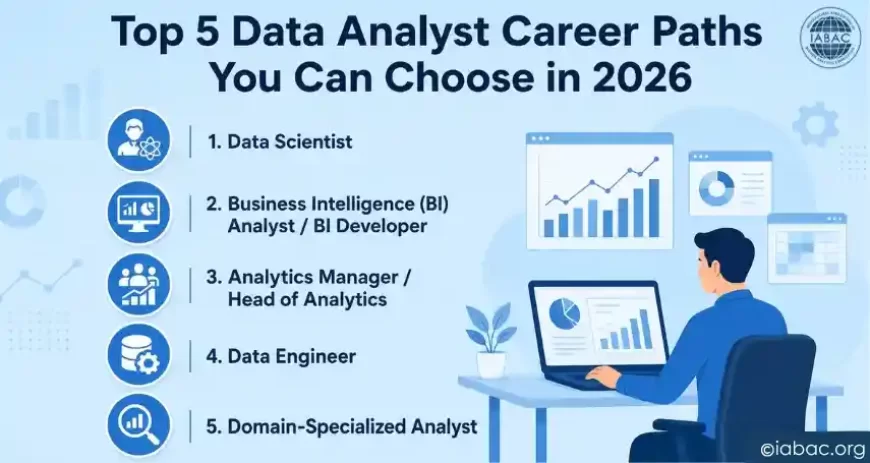
Career Path 1: Data Scientist
This is the path most people who say 'I want to move beyond analytics' are thinking about.
The data scientist role extends the data analyst's toolkit into predictive modeling, machine learning, and statistical inference.
Where an analyst answers 'what happened and why,' a data scientist answers 'what will happen next.'
What Does the Transition Look Like?
A data analyst at a company like Myntra or PhonePe who moves toward data science typically spends 12–18 months deepening their Python, learning Scikit-learn and TensorFlow, and working on forecasting or classification problems alongside their regular analyst work.
The transition is a gradual deepening, not a sudden jump.
For instance, a business analyst at a D2C brand who was tracking customer retention metrics using cohort analysis moved into data science by building a churn prediction model using the same dataset she already worked with.
The domain knowledge he had as an analyst gave her a head start that most fresh data science graduates lack.
Skills Required for This Path
• Advanced Python: Scikit-learn, XGBoost, TensorFlow, or PyTorch basics
• Statistics: Hypothesis testing, regression analysis, probability distributions
• Machine learning: Supervised and unsupervised learning fundamentals
• Experiment design: A/B testing, statistical significance
• Communication: Translating model outputs into business language
Career Path 2: Business Intelligence (BI) Analyst / BI Developer
This is the most natural and common evolution from a junior data analyst role.
The BI path leans heavily into data visualization, reporting architecture, and creating the systems that organizations use to monitor performance.
Think of a BI analyst as the person who builds the instrument panel for the cockpit, the dashboards executives open every morning.
The difference between a data analyst who builds dashboards and a BI analyst is that the BI analyst designs and maintains the entire reporting infrastructure, including data models, calculated measures, and enterprise-level governance.
Skills Required for BI Analyst
• Power BI (advanced DAX, data modeling, row-level security, gateway configuration)
• Tableau or Looker for companies in the MNC or consulting space
• SQL for data modeling: star schemas, fact tables, dimension tables
• Basic data warehousing concepts: Snowflake, BigQuery, Azure Synapse
• Stakeholder management: translating requirements into dashboard designs
According to Fortune Business Insights, the global BI market was valued at $23 billion in 2023 and is forecast to grow at 9% CAGR through 2034. Indian enterprise adoption of BI tools has accelerated, with 74% of large enterprises now running dedicated BI teams.
Career Path 3: Analytics Manager / Head of Analytics
This is the leadership path, and it suits a specific type of analyst: someone who finds as much satisfaction in developing other people's capabilities as they do in solving data problems themselves. Moving into analytics management is often the highest-earning path available to an analyst who stays within the analytics domain rather than pivoting to data engineering or data science.
How Analysts Get Here
The path to analytics manager typically goes: junior analyst (0–2 years) to senior analyst (2–5 years) to lead analyst or analytics manager (5+ years). Promotion into management in Indian companies happens fastest for analysts who proactively work across departments, mentor juniors, and take ownership of strategic reporting initiatives.
Skills Required for This Path
• Strong foundational analytics: you cannot manage what you cannot do
• Project management: handling multiple workstreams and deadlines across teams
• Stakeholder influence: presenting findings to the C-suite without losing the business case
• Team building: hiring, mentoring, and performance-managing analyst teams
• Strategic thinking: aligning analytics output with 3–5 year business goals
Pro Tip: The biggest career mistake analysts make on this path: staying purely technical too long.
Start presenting to stakeholders, writing business recommendations, and mentoring junior colleagues from year 2 onward, not year 5.
Career Path 4: Data Engineer
The data engineering path suits analysts who are more energized by building systems than by interpreting their outputs.
A data engineer is responsible for the pipelines, warehouses, and infrastructure that make data available for analysts and data scientists to work with.
In many companies, a data analyst with strong SQL skills discovers they enjoy the infrastructure side more than the reporting side, and the transition to data engineering becomes a natural one.
How This Differs From the Analyst Path
Where an analyst uses data, a data engineer builds the systems that collect, store, and organize it. The work is more programming-heavy, involves cloud platforms like AWS, GCP, or Azure, and often requires knowledge of orchestration tools like Apache Airflow or dbt.
Skills Required for This Path
• Advanced Python: beyond Pandas, into scripting, OOP, and pipeline logic
• SQL at a deep level: database design, query optimization, indexing
• Cloud platforms: AWS (Redshift, S3, Glue), GCP (BigQuery, Dataflow), or Azure
• ETL/ELT tools: dbt, Apache Spark, Apache Airflow
• Version control: Git and CI/CD basics for data pipeline deployment
Career Path 5: Domain-Specialized Analyst (Fintech / Healthcare / Marketing)
This is the most underrated path in Indian analytics discussions and, for many professionals, the highest return on investment in terms of time and effort. Rather than becoming generically better at analytics tools, the domain-specialized analyst becomes the go-to analytics expert in a specific industry or function.
A marketing analytics specialist at an e-commerce company commands significantly higher compensation than a generalist analyst with the same technical skills, because their interpretation of attribution models, customer lifetime value analysis, and campaign incrementality testing carries domain weight that takes years to develop.
Three High-Demand Domain Paths for Data Analysts in India Right Now
1. Fintech Analytics
India's fintech sector is one of the highest-growth segments for analysts.
Companies like Razorpay, Zerodha, and BharatPe need analysts who understand credit risk, fraud detection patterns, transaction anomaly detection, and UPI flow analysis.
A fintech analyst with both SQL depth and understanding of NBFC regulations earns significantly more than a generic analyst.
2. Healthcare Analytics
With India's health-tech sector expanding through platforms like Practo, 1mg, and Apollo Hospitals' digital division, health data analysts who understand clinical outcomes data, patient journey analytics, and operational efficiency metrics are increasingly in demand.
The domain knowledge barrier here is high, which means less competition and better compensation for those who build it.
3. Marketing Analytics
Growth teams at D2C brands, SaaS companies, and digital agencies need analysts who understand channel attribution, cohort-level CAC and LTV analysis, A/B test design, and funnel diagnostics. This is a path where a background in marketing, combined with SQL and Python skills, creates a very strong profile.
Domain-specialized data analytics roles in Fintech and Healthcare grew 42% in job postings on LinkedIn India between 2023 and 2025, outpacing the growth of generalist analyst roles. (Source: LinkedIn Jobs on the Rise India Report)
Moves That Set Back Your Data Analytics Career Growth
• Chasing job titles over skill depth: 'Senior Data Analyst' at a company where the work is basic report generation will not prepare you for Rs. 20 LPA at a product company two years later.
• Switching paths every 6 months based on which one sounds most exciting: Each path requires compound learning. Pick one for at least 18 months before reassessing.
• Skipping stakeholder communication skills: The best technical analyst who cannot present findings clearly will always lose promotions to someone 20% less technical who communicates 50% better.
• Not specializing within the first 3 years: Generalists are easiest to hire at the entry level. But by year 3, the market pays premiums for depth, not breadth.
• Waiting for a company to train you on leadership before applying for management roles: Build those skills through mentoring juniors, running projects, and presenting to stakeholders before the title change.
Frequently Asked Questions
1. Which data analyst career path has the highest salary ceiling in India?
An Analytics Manager or Head of Analytics at a large enterprise or product company offers the highest ceiling within analytics, often Rs. 40–60 LPA at senior levels. Data engineering can match or exceed this at senior levels with cloud architecture expertise. Data science at top-tier AI-first companies can reach Rs. 50+ LPA for specialists.
2. Is the data analyst to data scientist transition still worth it in 2026?
For people who genuinely enjoy statistical modeling and machine learning, yes. For people who are doing it purely for the salary bump, the data engineering or analytics management paths often provide equivalent compensation with lower technical barriers in the transition.
3. Can I switch from a BI analyst path to data science later?
Yes, but it requires deliberate upskilling in Python and statistics. Many BI analysts who want to move toward data science start by adding predictive components to their existing dashboards, which gives them a portfolio bridge between the two roles.
4. How important is a master's degree for analytics management roles?
An MBA or a master's in analytics helps in large enterprises and consulting firms where credentials matter. In startups and mid-size product companies, a strong track record with measurable outcomes carries more weight than post-graduate degrees.
5. Which path is best for someone coming from a non-technical background?
Domain-specialized analytics or BI analyst. Both paths let professionals leverage existing industry knowledge while building technical skills. A finance professional who adds SQL and Power BI becomes a fintech analyst almost immediately. A nurse who adds Python and SQL is a healthcare data analyst with built-in domain credibility that takes others years to develop.
Choosing Your Path: The One Framework That Works
Answer three questions honestly:
• Where does your strongest existing knowledge already sit? That is your domain advantage.
• Are you more energized by building systems or interpreting output from them? Engineering vs. analysis.
• Do you want to manage people and strategy in 5 years, or stay technical and deepen your expertise? Leadership vs. specialist.
Your answers will point clearly to one of the five paths above. Pick that path, build deliberately toward it, and resist the temptation to lateral-move every time a different role sounds more exciting.
The data analyst career path in 2026 offers genuine optionality. But optionality only creates value when you choose one direction and execute it long enough for compound expertise to kick in. The analysts who earn the most and find the work most rewarding are almost always the ones who chose a direction early and went deep.
Take the next step with IABAC Certifications certification tracks designed for each career path.
Visit iabac.org to explore your options or speak with our experts for personalized guidance on selecting the right direction.