


















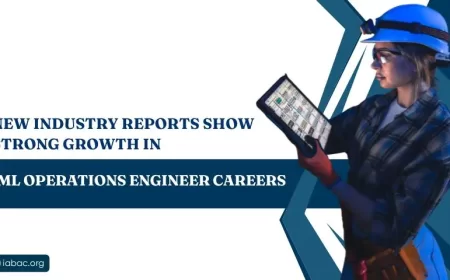




































New Industry Reports Show Strong Growth in ML Operations Engineer Careers
New industry reports highlight rising demand for ML Operations Engineers as organizations expand AI adoption and require scalable, reliable model deployment in 2026.

The phrase ML Operations Engineers is getting more attention because modern AI is no longer just about training a model and cheering when the notebook runs once. The real work begins when a model must go live, keep working, stay accurate, and be watched over like a careful shopkeeper watching the cash box. That is where MLOps comes in. Official guidance from Google Cloud, AWS, and Microsoft describes MLOps as the process of managing the machine learning life cycle from development to deployment, monitoring, retraining, and ongoing model care. There is also a strong career signal behind this topic. The World Economic Forum’s Future of Jobs Report 2025 lists AI and machine learning specialists among the fastest-growing jobs, while the U.S. Bureau of Labor Statistics projects data scientists to grow 34% from 2024 to 2034 and software developers, quality assurance analysts, and testers to grow 15% over the same period. That does not give an exact MLOps number, but it does show the same direction: companies are hiring more people who can build, ship, and support intelligent systems in production.
What is MLOps?
MLOps stands for Machine Learning Operations. In simple words, it is the set of methods used to take a machine learning model from an idea to a working production system, and then keep that system healthy. Google Cloud defines it as managing the machine learning life cycle from development to deployment and monitoring. AWS explains that MLOps focuses on automating the ML life cycle, including data collection, training, validation, deployment, continuous monitoring, and retraining. Microsoft also describes MLOps as a way to help data scientists, IT operations, and business teams work together across the full model life cycle. I like to think of MLOps as the calm adult in the room. Training a model is exciting. Production is where questions begin. Is the data still clean? Is the model still useful? Did performance drop after last week’s traffic spike? MLOps gives teams the process, checks, and automation to answer those questions without panic. That is why it matters so much in modern AI work.
Why do companies use MLOps?
Companies use MLOps because machine learning work is more than training code. It includes data intake, data prep, model training, model tuning, deployment, monitoring, explainability, review, and retraining. Google Cloud’s MLOps guidance focuses on CI, CD, and CT for ML systems, which means the model can be improved and released in a repeatable way instead of relying on manual effort each time. Microsoft and AWS both stress that the full ML life cycle needs monitoring and retraining after deployment. A simple way to see it is this: if one model needs ten manual checks every time it changes, and a team manages twenty models, the workload becomes huge very fast. MLOps turns repeat work into pipelines. That saves time, lowers errors, and helps teams respond faster when a model starts drifting. This is the practical reason the career is growing.
MLOps cycle
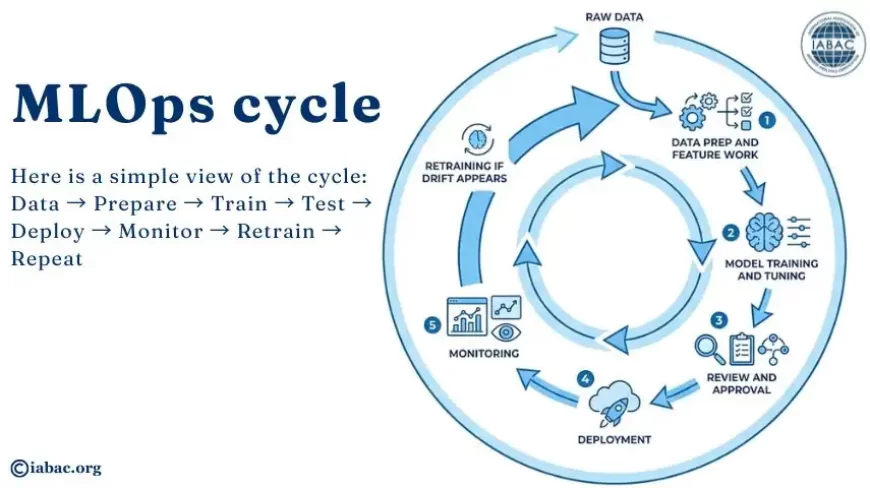
Here is a simple view of the cycle:
Data → Prepare → Train → Test → Deploy → Monitor → Retrain → Repeat
This cycle is the heart of MLOps. Google Cloud’s guidance highlights CI, CD, and CT for ML systems. AWS and Microsoft both describe monitoring and retraining as ongoing parts of the process, not one-time tasks.
This is why MLOps is not just a tool choice. It is a work style. A model that only works in a notebook is a demo. A model that works in production, stays stable, and can be updated is a product. That is the difference.
Main parts of MLOps
The usual MLOps process has several connected parts: exploratory data analysis, data prep and feature engineering, model training and tuning, model review and governance, model serving, model monitoring, and automated retraining. These parts show up in the official descriptions from Google Cloud, AWS, and Microsoft because all of them are needed to keep ML systems useful after launch. In plain language, this means the team must not only build a model, but also track versions, manage changes, watch results, and fix problems quickly. Without that structure, a good model can become a tired model very fast. With that structure, a team can move from test to release with much less chaos.
Best practices for MLOps
The best MLOps practice starts with reproducible work. During EDA, data should be easy to share and edit. During data prep, feature work should be visible to the wider team. During training, tools such as scikit-learn, AutoML, and experiment tracking help teams compare runs and keep results clear. During review and governance, model lineage, versions, and artifacts should be tracked. During serving and deployment, CI/CD helps move approved models into production. During monitoring, teams should watch for drift, latency, and quality drops. During retraining, alerts should trigger action when the live data no longer looks like the training data. These ideas align with the official MLOps guidance from major cloud providers.
A small formula helps here:
Manual effort = steps × models × releases
MLOps lowers that manual effort by turning repeat steps into pipelines. That one change can save many hours each month, especially when a team has several models running at once. This is one reason MLOps roles often sit between data, engineering, and operations.
MLOps vs DevOps
DevOps is about building and shipping software with speed and care. MLOps takes that same spirit and applies it to machine learning systems. Microsoft says MLOps applies DevOps ideas to ML projects so teams can automate the life cycle from training to retraining. AWS and Google Cloud say the ML life cycle needs extra steps that normal software does not need, such as feature work, drift checks, and model retraining. The key difference is this: software code usually behaves the same until someone changes it. ML models can change behavior even when the code stays the same, because the data around them changes. That is why MLOps must watch both code and data. It is a small sentence with a big job inside it.
Why this career is growing
Industry reports point in the same direction. The World Economic Forum says AI and machine learning specialists are among the fastest-growing jobs. The same report also highlights that organizations are paying more attention to AI use cases, business impact, and the systems needed to keep AI running after launch. A 2026 World Economic Forum report goes further and says organizations should introduce MLOps capabilities to support continuous model updating and monitoring. The BLS numbers also help explain the bigger career picture. Data scientists are projected to grow 34% from 2024 to 2034, and software developers, quality assurance analysts, and testers are projected to grow 15%. MLOps sits right between these worlds: it borrows from software delivery, but it also needs data thinking, model thinking, and quality control.
Simple growth snapshot
- Role/signal: Growth signal
- Data scientists: 34% growth, 2024–2034
- Software developers and QA analysts: 15% growth, 2024–2034
- AI and machine learning specialists: among the fastest-growing jobs
- MLOps capabilities in AI programs: needed for continuous updating
This is not a guess. It is the direction shown by official labor data and current global job reports. (Bureau of Labor Statistics)
MLOps and data science learning
Many readers reach this topic through searches like what is the data science, introduction to data science, data science roadmap, data science project, data science syllabus, data science certification, Certification in Data Science Online, cetification for data science, and even datascience. That is a good place to start, because MLOps often comes after the basics of data science are learned well. IABAC’s own data science pages connect certification, practical learning, and career support, and the IABAC website is published at iabac.org. There is also a simple idea behind this connection: data science helps you make sense of data, while MLOps helps you keep the model useful after the work leaves the notebook. That is why a solid data science base makes the move into ML Operations much smoother. The IABAC learning pages also stress foundation topics such as statistics, programming, analysis, machine learning basics, projects, and a structured learning path.
Where IABAC fits in
On the IABAC website, the data science certification pages present certification as a way to show practical skill, not just theory. IABAC also describes itself as a global professional body focused on data science, business analytics, artificial intelligence, and related areas. For a reader looking at ML Operations Engineer careers, that matters because the job sits close to data science, analytics, and applied AI. That is why a page like the IABAC data science page can be useful for a career path conversation. It helps connect learning, certification, and job readiness in one place. For someone planning a data science roadmap, the move from data basics to ML deployment is a natural next step. For someone writing a data science project, the MLOps lens makes the project look more complete and more realistic.
What skills matter for an ML Operations Engineer?
An ML Operations Engineer usually needs a mix of data, software, cloud, and operations skills. The role often includes model deployment, monitoring, pipeline work, version control, testing, automation, and collaboration with data teams. The cloud guidance from Google, AWS, and Microsoft shows that these skills are not extra decoration; they are central to the job.
A simple career path can look like this:
Learn data basics → build a few data science projects → study model deployment → learn CI/CD and monitoring → practice with MLOps tools → apply for ML Operations roles
That path is helpful for people coming from data science, software, or analytics. It is also a nice reminder that this career is not only for one type of learner. It welcomes people who can work with both numbers and systems.
A math example for model monitoring
Suppose a model makes 1,000 predictions per day and its error rate rises from 3% to 6%. That means the wrong predictions rise from 30 to 60 each day. In a simple monitoring view, the model’s error has doubled, even though the system is still “running.” MLOps is what helps the team notice that change early and decide whether to retrain, fix features, or adjust the pipeline. This kind of simple check is part of why monitoring is so important.
Final take
ML Operations Engineer careers are growing because companies want AI that works outside the lab. They want models that can be deployed, watched, corrected, and improved without long delays. Official MLOps guidance from Google Cloud, AWS, and Microsoft all points to the same truth: model life does not end at training. It continues in production, and that is where MLOps earns its place. For readers starting from introduction to data science content, the next step is clear: learn the basics, build projects, understand the data science syllabus, and then move into the tools and habits that support production ML. That path fits well with IABAC’s data science learning pages and with the job market signals from WEF and BLS. In short, the career is not a passing trend. It is becoming part of how modern AI systems stay alive, useful, and trusted.
FAQ
What is MLOps in one line?
MLOps is the set of practices used to take ML models into production and keep them working through monitoring and retraining.
Why is MLOps useful?
It helps teams build faster, reduce manual work, and keep models stable after deployment.
Is MLOps connected to data science?
Yes. Data science often starts the model work, while MLOps helps move that work into production and keep it there.
Can a Certification in Data Science Online help?
It can help build a stronger base in data, modeling, and project work, which supports a move into ML Operations later.