



























































Are You Looking for an IABAC Authorized Training Provider? Here's What to Know
Most people choose the wrong IABAC provider. Here's how to identify legitimate Authorized Training Partners and get certifications recognized globally.

If you're serious about building expertise in Data Science, Business Analytics and Artificial Intelligence, whether you're earning an IABAC certification, upskilling for a new role, or helping your team gain industry-recognized credentials, you've probably heard about "Authorized Training Providers." But what does it really mean for IABAC specifically, and why does it matter when there are countless online training options out there?
The short answer: choosing an IABAC Authorized Training Provider (ATP) can be the difference between earning a globally recognized credential that actually opens doors and wasting time on training that looks good online but carries no real industry weight. IABAC ATPs aren't just trainers; they're part of a vetted network built on international standards.
Let's break down what you need to know about IABAC ATPs before making this decision.
What Is an IABAC Authorized Training Provider?
An IABAC Authorized Training Provider is an organization that has been formally approved by IABAC (International Association for Business Analytics and Consulting) to deliver official Data Science and Business Analytics training and certification courses.
Think of it as a global seal of quality. When an organization becomes an IABAC ATP, they're committing to:
-
Teaching curriculum aligned with international standards (based on the European Commission's EDISON framework)
-
Using instructors who are IABAC-accredited and verified
-
Delivering content that meets global industry expectations
-
Providing certifications recognized on an international platform
Here's the critical difference:
-
IABAC Authorized Training Partners: Deliver courses with IABAC-approved curriculum aligned to European Commission standards. Their instructors are IABAC-accredited, content is internationally vetted, and learners receive certifications recognized globally.
-
Non-authorized providers: May offer "Data Science" or "Business Analytics" training, but their content isn't reviewed by international standards bodies, instructors may lack formal accreditation, and certifications carry minimal weight in global hiring decisions.
It's the difference between earning a credential that international employers recognize versus completing a certificate that raises skepticism in hiring processes.
Why Does "IABAC Authorized" Actually Matter?
You might be wondering: Does it really make a difference if my training comes from an IABAC-authorized provider? Yes, significantly. Here's why:
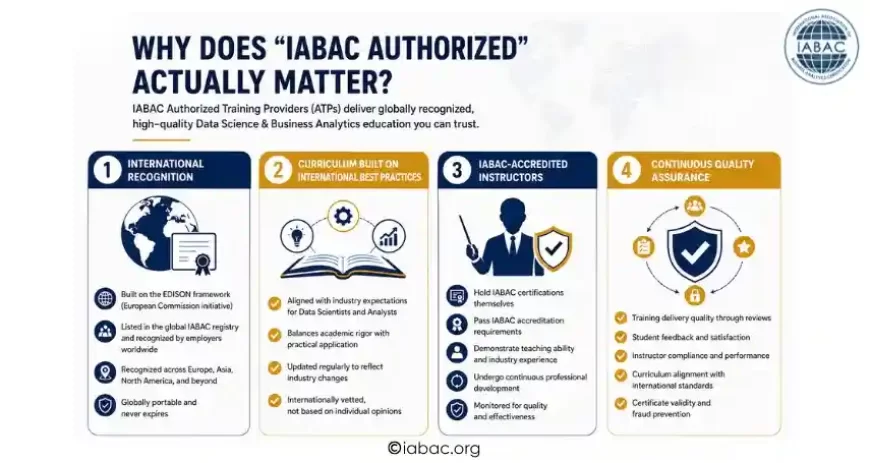
1. Your Certification Will Be Recognized Internationally
IABAC certifications are built on the EDISON (European Data Science Infrastructure for Open Learning) framework, a project initiated by the European Commission. This isn't just a company's internal standard; it's an international framework.
When you earn an IABAC certification through an authorized provider:
-
Your credential is listed in the global IABAC registry
-
International employers recognize the standards it represents
-
Your certification carries weight across Europe, Asia, North America, and beyond
-
The credential doesn't expire or lose value—it's globally portable
Non-authorized training? Your certificate exists in a vacuum. Employers have to Google it, wonder if it's legitimate, and make judgment calls. This friction can cost you opportunities.
2. The Curriculum Is Built on International Best Practices
IABAC ATPs don't get to decide what to teach. The curriculum is developed following the EDISON framework, which means:
-
It's aligned with what the industry expects from Data Scientists and Business Analysts
-
It balances academic rigor with practical application
-
Content is updated regularly to reflect industry changes
-
It's not some trainer's opinion; it's vetted internationally
This matters because you're not just learning what someone thinks is important. You're learning what employers globally expect.
3. Your Instructors Are IABAC-Accredited, Not Self-Proclaimed Experts
Here's something crucial: IABAC doesn't just let anyone teach under their name.
IABAC-accredited instructors must:
-
Hold IABAC certifications themselves
-
Pass IABAC accreditation requirements
-
Demonstrate teaching ability and industry experience
-
Undergo continuous professional development
-
Be monitored for quality and effectiveness
This is different from someone claiming to be a "Data Science expert" because they completed a bootcamp. Your instructor has been vetted by an international body and is accountable for quality.
4. Quality Assurance Happens Continuously
IABAC maintains oversight of its authorized partners. They monitor:
-
Training delivery quality through reviews
-
Student feedback and satisfaction rates
-
Instructor compliance and performance
-
Curriculum alignment with international standards
-
Certificate validity and fraud prevention
This ongoing oversight means IABAC has your back. If an ATP starts delivering subpar training, IABAC will take action.
How to Identify a Legitimate IABAC Authorized Training Provider
So how do you know if a training provider is actually IABAC-authorized? Don't take their word for it. Here's your verification checklist:
Verification Steps:
1. Check the Official IABAC Partner Directory
-
Visit iabac
-
Search for the provider's name and organization
-
Verify they appear with the current authorization status
-
This is the only definitive source; nothing else matters
2. Request Authorization Documentation
-
Legitimate ATPs can provide official IABAC partnership certificates
-
Documentation should include authorization start and renewal dates
-
Authorization periods typically run 1-3 years
-
Expired authorization = not legitimate
3. Verify Instructor IABAC Accreditation
Ask to see:
-
Instructor credentials (specifically, IABAC accreditation status)
-
Their own IABAC certifications
-
Teaching experience and background
-
Years in the Data Science or Analytics field
-
Their listing in IABAC's accredited instructor database
If they can't provide this, they're not an IABAC ATP.
4. Review Their Curriculum Alignment
-
Ask how their curriculum aligns with IABAC standards
-
Request a syllabus showing IABAC content alignment
-
Legitimate ATPs have completed the IABAC curriculum approval
-
The curriculum should be consistent—not customized per student
5. Check Student Success and Feedback
-
Ask for pass rates and certification achievement data
-
Request references from past students
-
Look for honest reviews (not just 5-star testimonials)
-
Inquire about student feedback mechanisms
6. Ask About Their Quality Management System (QMS)
IABAC requires ATPs to have formal quality management systems. Ask:
-
How do they ensure training quality?
-
What feedback loops exist?
-
How do they handle student complaints?
-
How often are instructors evaluated?
If they're unclear about QMS, they may not be meeting IABAC standards.
7. Verify IABAC Renewal Dates
-
Check when their authorization was last renewed
-
IABAC ATPs undergo regular reassessment
-
If the renewal date is unclear or very old, confirm the current status
Red Flags: Walk Away If You See These:
-
Provider can't produce official IABAC authorization documents
-
They're not listed in the official IABAC partner directory
-
Instructor credentials don't include IABAC accreditation
-
They guarantee you'll pass (no ethical provider does this)
-
They pressure you to enroll without answering questions
-
Price seems unrealistically cheap (quality has a cost)
-
No information about their quality management system
-
Reviews are exclusively positive with no constructive feedback
-
They claim to teach "IABAC-aligned" but aren't authorized
Understanding IABAC's Six-Step ATP Approval Process
Curious about what makes an IABAC ATP legitimate? Understanding the application process shows why not every trainer can call themselves an IABAC provider.
The full IABAC ATP approval process takes 10-15 days and involves:
Step 1: Eligibility Check (2-3 working days)
The organization must be:
-
A legally registered entity (proof of incorporation required)
-
Operating for at least one year in business
-
Have a formal Quality Management System (QMS) in place
-
Ready to meet IABAC standards
This filters out one-person operations and fly-by-night organizations.
Step 2: Application & Initial Review
Submit online application with:
-
Organization details and history
-
Proposed curriculum alignment
-
Instructor credentials and IABAC accreditation plans
-
Quality management documentation
-
Training delivery infrastructure
Step 3: Curriculum Review & Alignment
IABAC reviews the proposed curriculum to ensure:
-
Alignment with international standards
-
Coverage of required Data Science and Analytics competencies
-
Balance of theory and practical application
-
Assessment methods and rigor
Curriculum that doesn't meet standards is rejected. Organizations must revise and resubmit.
Step 4: Instructor Accreditation
All instructors must:
-
Complete IABAC accreditation requirements
-
Demonstrate IABAC certifications
-
Show relevant industry experience
-
Pass the teaching quality evaluation
IABAC doesn't delegate this; they directly accredit instructors.
Step 5: Final Approval & Authorization
Once curriculum is approved and instructors are accredited:
-
Organization receives official ATP authorization
-
Listed in the IABAC partner directory
-
Licensed to use IABAC branding
-
Authorized to register students for IABAC certifications
Step 6: Ongoing Monitoring & Renewal
Authorization isn't permanent. IABAC continuously:
-
Monitors student feedback
-
Evaluates completion rates and certification success
-
Reviews curriculum alignment annually
-
Renews authorization periodically (typically 1-3 years)
-
Takes action against underperforming ATPs
This rigor is why IABAC ATPs are trustworthy. The barrier to entry is high, and ongoing standards are enforced.
What You Actually Get as an IABAC ATP Student?
When you train with an IABAC Authorized Training Provider, you're not just getting a course. Here's what's included:
1. IABAC-Aligned Curriculum
The content you learn is structured around:
-
European Commission EDISON framework
-
Global industry standards for Data Science, Business Analytics and Artificial Intelligence
-
Hands-on, practical applications (not just theory)
-
Real-world case studies and projects
-
Competencies employers actually expect
2. IABAC-Accredited Instruction
Your instructor has:
-
Proven expertise (they hold IABAC certifications)
-
Teaching credentials (they're trained to teach)
-
Industry experience (they apply theory daily)
-
Direct accountability to IABAC
-
Ongoing professional development requirements
3. Official Certification Eligibility
Upon completion, you can:
-
Register for official IABAC exams
-
Earn globally recognized IABAC certifications
-
Join the IABAC credential registry
-
List your certification on international job platforms
-
Use IABAC credentials for career advancement globally
4. Quality Assurance & Support
The ATP must provide:
-
Regular assessments aligned with exam standards
-
Practice materials and mock exams
-
Feedback mechanisms to improve teaching
-
Support services (varying by provider)
-
Professional development resources
5. Entry to a Global Network
IABAC certification connects you to:
-
Professionals globally holding the same credential
-
International job opportunities
-
Continued learning opportunities
-
Industry recognition across multiple countries and sectors
Common Mistakes People Make When Choosing an IABAC ATP
1. Not Verifying Authorization
People assume a provider claiming "IABAC training" is actually authorized. Always check the official directory first. This is the most common mistake.
2. Confusing Curriculum Alignment with Authorization
Some providers claim to teach "IABAC-aligned" or "IABAC-based" curriculum without being authorized. Alignment ≠ authorization.
-
Aligned: They follow IABAC standards, but aren't officially approved
-
Authorized: IABAC has formally approved them and monitors quality
There's a huge difference. Only authorized providers have IABAC's seal.
3. Choosing Based Purely on Price
The cheapest option usually skimps on instructor quality, course rigor, or support. IABAC ATPs have higher standards, which has a cost. That cost reflects quality.
4. Ignoring Instructor Credentials
Not all instructors are equal. Ask specifically about IABAC accreditation—not just certifications, not just experience, but actual IABAC accreditation.
5. Not Checking Renewal Status
ATPs need renewal. Ask: "When was your IABAC authorization last renewed?" If it's been years or if they're vague, that's a warning sign.
6. Assuming Online = Legitimate
Just because training is offered online with professional branding doesn't mean it's authorized. The internet is full of convincing-looking fake credentials.
7. Missing the Quality Management System
IABAC requires a formal QMS. If a provider can't explain their quality processes, they may not be meeting IABAC standards.
IABAC Certifications Explained: What You Can Actually Earn
When you train with an IABAC ATP, these are the certifications available:
Data Science Certifications
-
IABAC Certified Data Scientist (CDS): Entry to intermediate level
-
Curriculum covers: statistics, machine learning, data visualization, programming, business acumen
Business Analytics Certifications
-
IABAC Business Analytics Expert (CBAE): Professional analytics credentials
-
Curriculum covers: analytics methods, data interpretation, business strategy, reporting, insights
What Makes IABAC Certifications Valuable
Each certification shows employers that you:
-
Understand international best practices (EDISON framework).
-
Can apply theory to real business problems.
-
Meet global professional standards.
-
Commit to continuing professional development.
-
Are qualified for roles in multinational organizations.
The certifications aren't vendor-specific (like some bootcamp certs). They're recognized across industries and countries.
Questions to Ask Before Enrolling in an IABAC ATP
During Your Discovery Call:
-
"Can you verify your IABAC authorization in the official directory?" (Ask them to share the link to iabac.org where they're listed)
-
"When was your IABAC authorization last renewed, and when does it expire?"
-
"Who will be teaching my course? Can you provide their IABAC accreditation details?"
-
"How is your curriculum aligned with IABAC standards? Can you walk me through specific modules?"
-
"What's your student success rate? Do you track certification pass rates?" (Legitimate ATPs know this number)
-
"What assessment methods do you use to ensure I'm learning at IABAC standards?"
-
"What happens if I don't pass the certification exam after your course?" (Do they offer refreshers? Support?)
-
"What is your formal Quality Management System, and how do you ensure quality?"
-
"What's included in terms of study materials, practice exams, and exam preparation?"
-
"How do you stay current with IABAC standards updates?"
-
"Can you provide references from recent students who've earned IABAC certifications?"
-
"What's the timeline? When can I register for the actual IABAC exam?"
The Bottom Line: Is an IABAC ATP Right for You?
Choose an IABAC Authorized Training Provider if:
-
You want a credential recognized globally
-
You're changing careers and need credibility in the job market
-
Your role requires industry-standard certifications
-
You want to ensure your learning meets international benchmarks
-
You're working toward advancement in Data Science, Business Analytics and Artificial Intelligence
-
You value having accredited instructors with demonstrated expertise
-
You want ongoing career support and professional network access
-
Your employer values internationally recognized certifications
Skip if:
-
You're exploring the field casually with no career stakes
-
Cost is the only factor, and you can't invest in quality training
-
You have 10+ years of field experience and just need a credential stamp
-
You're seeking bootcamp speed over comprehensive learning
How to Take Your Next Step
Step 1: Confirm Your Target IABAC Certification
Know exactly which IABAC certification aligns with your career goals:
-
Certified Data Scientist (CDS)?
-
Certified Business Analytics Expert (CBAE)?
-
Certified Artificial Intelligence Expert (CAIE)?
-
Advanced levels?
Step 2: Find Authorized Providers
Go to the official source: iabac.org/partners/authorized-training-provider
This lists all currently authorized IABAC training providers globally. Filter by:
-
Your region/country
-
Certification type you're pursuing
-
Training format (online, in-person, hybrid)
Step 3: Verify Authorization Independently
Don't just trust their website. Check the official directory yourself. Copy the provider name and verify it appears on IABAC's site.
Step 4: Request Free Consultations
Legitimate IABAC ATPs will offer a no-obligation consultation call to:
-
Understand your background and goals
-
Explain their approach and curriculum
-
Discuss timeline and format options
-
Answer all your questions
-
Clarify what success looks like
Take all of them up on this. It's free and tells you a lot about their professionalism.
Step 5: Make Your Decision
Choose based on:
-
Authorization verified
-
Instructor IABAC accreditation confirmed
-
Clear student success metrics
-
Curriculum alignment explained
-
Your comfort level with instructors and the schedule
-
Quality management system defined
The Real Value of IABAC Training: Beyond the Certificate
Here's something worth considering: The value isn't just in the certificate itself.
When you train through an IABAC ATP, you gain:
Credibility: International employers trust IABAC standards. Your resume says something specific: you meet global benchmarks.
Clarity: You're not wondering if you're learning the right things. IABAC's international framework tells you exactly what the industry expects.
Accountability: Your instructors are accredited and monitored. There's oversight ensuring quality, not just hopes that your instructor is good.
Community: You join a network of IABAC-certified professionals globally. This matters for career growth, mentorship, and opportunities.
Portability: Your credential works in Europe, Asia, North America, and beyond. You're not limited by geographic boundaries.
Advancement: IABAC certifications have progression levels (basic to advanced). Your early certification is a stepping stone, not a dead end.
Final Thoughts: Your Credential Is an Investment
Choosing an IABAC Authorized Training Provider isn't about spending more money. It's about investing in a credential that actually matters.
Think about it this way: If investing in quality IABAC training:
-
Gets you hired 25% faster
-
Increases your starting salary by 15-20%
-
Is recognized globally (not just locally)
-
Opens career doors internationally
-
Positions you for advancement
...that's not an expense. That's ROI.
Your career is too important to gamble on unvetted training. IABAC Authorized Training Providers exist precisely because the field realized that international standards, verified instructors, and quality oversight matter.
The question isn't whether you can find cheap training. The question is whether you can afford not to invest in training that actually works and is recognized where it matters.
Resources to Get Started
Find IABAC Authorized Training Providers:
-
Official Directory: iabac.org/partners/authorized-training-provider
-
Verify authorization status there first
-
Check renewal dates and current status
-
Review provider details and instructor information
Learn More About IABAC:
-
Main website: iabac.org
-
Certification options and requirements
-
Industry partnership information
-
Career resources for certified professionals
Before You Enroll:
-
Verify authorization in the official directory
-
Request the instructor’s IABAC accreditation proof
-
Ask about certification pass rates
-
Schedule a consultation
-
Review their QMS and quality processes
-
Check student references and feedback
Questions? Any legitimate IABAC ATP will answer your questions directly. If they don't, that tells you everything you need to know.