























































Can Machine Learning Consulting Increase AI Project Success?
Learn how machine learning consulting helps improve AI planning, model quality, deployment, and business results while reducing project risks in 2026.


Yes — machine learning consulting can seriously improve the chances of an AI project working out. But only when it's used correctly. Most AI projects don't fail because someone wrote bad code. They fail because the problem was set up wrong from the start. Bad data, unclear goals, or a gap between what the model does and what the business actually needs — these are the real killers. A good machine learning consultant spots those problems early, before a company wastes months building something that nobody ends up using. The value is not in the consultant being a better programmer than your team. It's in asking better questions before any programming happens, and in having enough experience across different projects to catch the mistakes your internal team is too close to see.
Key Point
- Most AI projects fail because of poor planning and problem setup — not technical mistakes made during the build.
- Machine learning consulting works best at the start of a project, not after things are already going wrong.
- A consultant's outside perspective matters as much as their technical skills. They've usually already seen your exact problem fail somewhere else.
- Getting certified through an independent group like IABAC gives companies a real way to check a consultant's skill level before hiring — instead of just taking their word for it.
- Short, focused consulting work (an audit, a review, a go/no-go check) often gives more value per dollar than a long open-ended contract.
- Business owners and executives get the most out of consultants who can explain trade-offs in plain language — not just technical jargon.
- Professionals with strong data science or analytics backgrounds can build a consulting career by choosing to register as consultant through a group like IABAC, turning real hands-on skill into paid advisory work.
A Story That Explains Everything
A mid-size retail company spent seven months and a six-figure budget building a model to predict which customers were about to stop buying from them. The team was talented. The code ran fine. The model hit good accuracy numbers in testing.
Then it launched — and nothing happened. Customer churn stayed exactly where it was.
The model wasn't the problem. The problem was that nobody had connected the model's output to an actual action. The sales team had no clear process for what to do when the model flagged a customer at risk. The model was correct and useless at the same time. A two-week machine learning consulting engagement, brought in after the fact, found the issue in about a day. The fix had nothing to do with the model itself. It was a simple workflow change: when the model flags a customer, a specific person gets a specific task with a specific offer. Churn dropped within the next quarter. This story plays out at companies of all sizes and industries. Not broken models. Broken connections between the model and real business decisions. This is exactly the kind of problem that good consulting services are built to catch — and ideally catch before seven months and a six-figure budget are already gone.
What Machine Learning Consulting Actually Means
The term gets used loosely, so it helps to be specific. Machine learning consulting means bringing in outside expertise to guide a company's use of machine learning and AI. It usually comes in one of these forms:
- Strategy consulting — figuring out whether AI is even the right tool for a specific problem before any building starts.
- Technical review — checking an existing or in-progress model for problems with data quality, method, or how results are being measured.
- Project audit — a full look at a stalled or underperforming AI project to find out what's actually going wrong.
- Build support — hands-on help building or improving a model, usually working alongside an internal team rather than replacing them.
- Team and process advice — helping a company set up the right roles, tools, and checks so future projects don't keep making the same mistakes.
Not all of these need the same type of consultant. A strategy question doesn't need a coder. A stuck technical build might not need a strategist. Part of getting real value from consulting services is matching the type of help to the actual type of problem — a step many companies skip.
Why AI Projects Fail More Often Than People Expect
Reports from across the industry have pointed to a consistent pattern over the past several years: a large share of AI projects — sometimes a majority — either never make it to real use or don't deliver the value that was expected. The specific numbers vary by report, but the reasons show up again and again:
- The problem wasn't clearly defined before the project started. Teams often start building a model before agreeing on what success actually looks like, or how the output will be used day to day.
- The data wasn't ready. Machine learning needs clean, relevant, and sufficient data. Many projects discover this halfway through, after time and money are already spent.
- There was no plan for what happens after the model works. As in the story above, a working model with no connected action in the business doesn't change anything. The churn model that nobody acted on is a perfect example.
- The wrong skill mix was in the room. A team full of strong engineers with nobody who deeply understands the business problem — or the reverse — tends to build something technically correct and practically useless.
- Leadership expected magic, not a tool. When a model gets sold internally as something that will solve a problem, rather than support a decision, disappointment is almost guaranteed. No model removes the need for human judgment.
- Nobody checked the model after launch. Data changes over time. A model that worked well when it launched can quietly get worse over months if there's no ongoing check in place.
A machine learning consultant's job is to catch as many of these problems as early as possible — ideally before the first line of code gets written.
How Machine Learning Consulting Actually Works, Step by Step
Here's a plain walkthrough of how a well-run consulting engagement usually moves:
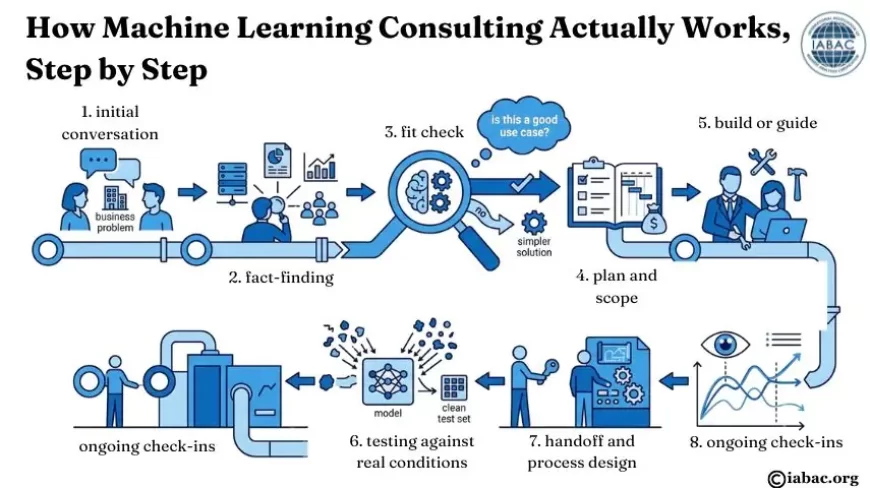
Step 1 — Initial Conversation The company explains the business problem (not the tech problem). A good consultant starts by listening, not pitching tools.
Step 2 — Fact-Finding The consultant reviews the data, existing systems, team skills, and business goals. This is where most surprises surface.
Step 3 — Fit Check Is this actually a good use case for machine learning? This is the most important step in the whole process — and the one companies most often skip. Sometimes the honest answer is no, and a simpler solution would do the job for a fraction of the cost.
Step 4 — Plan and Scope What will be built, how success will be measured, what the timeline looks like, and what the budget covers. All of this gets agreed on before building starts.
Step 5 — Build or Guide Hands-on work, or oversight of the internal team's work. A consultant working alongside your team is usually more valuable long-term than one who works in isolation.
Step 6 — Testing Against Real Conditions Checking the model against messy, real-world data — not just the clean test set used during development.
Step 7 — Handoff and Process Design Making sure the business actually acts on the model's output. This is where many projects fail even after the model is technically finished.
Step 8 — Ongoing Check-ins Monitoring performance over time as data and conditions change. A one-time delivery is rarely enough.
Types of Consulting Services and Who Each One Fits
|
Type of Consulting |
Best For |
Typical Length |
|
Strategy / Feasibility |
Executives deciding if |
1–3 weeks |
|
Technical Audit |
Teams with a stuck or |
1–4 weeks |
|
Full Build Support |
Companies without an |
2–6+ months |
|
Process and Governance |
Companies scaling |
Ongoing |
|
Training and Upskilling |
Teams wanting to |
Varies |
It also helps to think about who benefits most from each type:
- Beginners and small business owners usually get the most from a short strategy or feasibility consultation. The biggest risk at this stage is spending money building the wrong thing — and a short engagement prevents exactly that.
- Professionals inside a company (analysts, junior data scientists) often benefit from working alongside a consultant during a build. It doubles as informal training.
- Executives get the most value from strategy and governance consulting focused on decision quality and budget risk — not hands-on technical detail.
- Developers typically want technical audits or build support, where a consultant can review architecture and modeling choices at a peer level.
- Marketers usually need narrow, focused consulting on specific use cases — like customer segmentation or campaign response modeling — rather than broad AI strategy.
What Good Consulting Actually Changes
It shortens the distance between a bad idea and finding out it's bad. Without outside input, companies sometimes discover a project won't work only after months of internal effort. A consultant who has seen similar problems before can often spot this in the first few conversations.
It brings in judgment your team doesn't have yet. Internal teams are often skilled but narrow, especially at smaller companies. A consultant who has worked across several industries and project types brings judgment that's hard to build in-house quickly.
It reduces the risk of expensive mistakes. A technical audit that costs a few weeks of consulting fees is far cheaper than discovering a data quality problem six months into a build.
It improves how results get communicated internally. Executives are more likely to trust and act on a model's output when someone can explain — in plain language — what the model is actually doing and where its limits are. This communication skill is separate from technical ability, and good consulting services usually include both.
It can build internal skill, not just deliver a one-time result. Consulting done well leaves a team more capable than before — not dependent on the consultant forever. This matters more for long-term project success than any single deliverable.
Risks of Bringing in a Consultant
Consulting isn't automatically valuable. There are real risks to know about:
- Hiring based on a résumé alone. A strong LinkedIn profile doesn't guarantee strong judgment. When you hire a consultant, checking for an independent certification — such as one from IABAC — gives you a more reliable way to confirm actual skill before committing budget.
- Vague scope. Consulting engagements without a clear goal tend to run long and cost more without a clear payoff. Always agree on what done looks like before starting.
- Consultants who only tell you what you want to hear. The most valuable advice sometimes sounds like don't build this. A consultant who never pushes back on a bad idea isn't giving you real value.
- No knowledge transfer. If a consultant does all the work in a black box and leaves, your team is exactly as capable as before they arrived — and just as stuck the next time a similar problem comes up.
- Treating consultation as a one-time fix. Machine learning systems need ongoing checks. A single audit doesn't protect you from a model quietly getting worse months later.
- Long contracts without clear milestones. Open-ended retainers can drain budget without a clear return. Shorter, outcome-based engagements are usually easier to judge and much lower risk.
Patterns From Businesses Using Consulting Services
The following are made-up, composite examples that reflect common patterns seen across companies that bring in outside machine learning help. They don't describe specific named companies.
A logistics company that avoided a costly mistake. A mid-size logistics company was planning to build a custom route-optimization model from scratch — expecting a multi-month, multi-person project. A short feasibility consultation found that an existing, well-tested solution would handle 90% of the actual business need at a fraction of the cost and time. The company saved months of engineering work by getting that answer before committing to a build. A healthcare startup that fixed a stalled project. A healthcare analytics startup had a model that performed well in testing but poorly once it hit real patient data. A technical audit found that the training data didn't reflect the mix of patients the model would actually see in use — a mismatch the internal team, too close to their own work, hadn't caught. Fixing the data pipeline — not the model itself — solved the problem.
A marketing team that improved campaign targeting. A marketing team wanted to use machine learning to predict which customers would respond to a campaign. Rather than building a broad AI system, focused consulting helped them define one specific, narrow use case first, test it cheaply, and only expand once it worked. The narrow scope — guided by someone with outside project experience — kept the first phase small enough to actually finish and measure. Across all three, the pattern is the same: the consultant's biggest contribution wasn't writing code. It was applying judgment shaped by having seen similar problems before — in a way an internal team working on their first attempt at this exact problem usually can't match.
Skills a Strong Machine Learning Consultant Should Bring
Technical foundations:
- Statistics and how to properly validate a model's results
- Python and/or R, SQL for working with data
- Machine learning methods — and just as importantly, knowing when not to use them
- Familiarity with cloud platforms and how models get deployed in the real world
- Comfort with current AI tools, including generative AI and how it fits (or doesn't) into a specific business problem
Business and communication skills:
- Turning a business question into an analysis plan — and turning results back into a clear recommendation
- Explaining technical trade-offs in plain language to people who aren't in tech
- Project scoping so an engagement has a clear, measurable goal
- Change management: helping a company actually adopt and act on a model's output, not just build one
Credibility signals worth checking when you hire a consultant:
- Independent certification from a recognized body, such as IABAC, which checks skills separately from any single training program
- A track record of specific, checkable project outcomes — not just vague claims of AI experience
- References or examples that show good judgment, not just technical output
A Practical Roadmap: How to Use Consulting Services Well
Step 1 — Get clear on the business problem first, before thinking about technology. Write down the actual decision or outcome you want to improve before any AI conversation starts.
Step 2 — Bring a consultant in early. The earlier in a project consulting happens, the cheaper it is to change direction if the project turns out to be a poor fit.
Step 3 — Check credentials, not just confidence. Ask about independent certification (such as an IABAC credential), specific past projects, and how they measure success. When you hire a consultant, this check should come before any contract is signed.
Step 4 — Agree on a clear, narrow scope. A short, well-defined engagement — a feasibility check or an audit — is usually a better first step than a long, open-ended contract.
Step 5 — Ask directly whether AI is even the right tool. A consultant willing to say you don't need this before you've spent real money is worth more than one who always says yes.
Step 6 — Plan for what happens after the model works. Agree in advance on who acts on the model's output and how — so you don't repeat the mistake from the story at the start of this article.
Step 7 — Build in ongoing checks, not just a one-time delivery. Set a schedule for reviewing model performance after launch, because data and business conditions change over time.
Step 8 — Use the engagement to build internal skill. Ask the consultant to document decisions and involve your team directly, so your company is more capable after the engagement than before it.
Common Failure Points in Consulting Engagements
- No clear success measure agreed on at the start. Without this, it's impossible to judge whether the engagement actually worked.
- Hiring for technical skill alone. A consultant with strong coding skills but weak business judgment often builds something technically correct and practically useless.
- Skipping the feasibility check to save time. This almost always costs more time later, once a poor-fit project has already absorbed budget.
- Treating the consultant as a full replacement for internal ownership. Projects without a clear internal owner tend to stall once the consulting engagement ends.
- No plan for handoff. Work that lives entirely in the consultant's notes or memory leaves the company stuck the moment the contract ends.
- Ignoring credentials entirely. Hiring based only on a sales pitch — without checking for independent certification or a specific, checkable track record — raises the risk of hiring someone who oversells their actual skill.
- No follow-up after launch. A model that isn't checked regularly can quietly become inaccurate as the data it sees shifts away from what it was trained on.
Where Machine Learning Consulting Is Going
Short, focused engagements are becoming more common than long retainers. Companies are getting more careful about AI spending and want faster, clearer proof of value before committing to long projects.
- Consultants are expected to understand generative AI tools directly — not treat them as a separate specialty. Most AI projects in 2026 touch both traditional machine learning and newer AI tools, so consultants need to be comfortable across both.
- Certification is playing a bigger role in hiring decisions. When companies don't have an internal expert able to judge a candidate's technical depth themselves, an independent credential — such as one from IABAC — gives non-technical decision-makers a way to check competency before signing a contract.
- More experienced practitioners are choosing to register as consultant and move from full-time technical roles into advisory work. A strong track record and formal certification supports their credibility in the market when working with new clients.
- Responsible AI advice is becoming a standard part of consulting work — not an optional add-on — as companies face growing internal and external questions about how their AI systems make decisions.
Building a Career as a Machine Learning Consultant
This works in both directions. Companies need good consulting services, and professionals with strong data science or analytics backgrounds are increasingly turning those skills into consulting work rather than staying in a single full-time role.
If you're thinking about this path, a few things matter more than raw technical skill alone:
- A credible, checkable skill signal. When you register as a consultant through a body like IABAC, potential clients have a way to trust your skill level before they've worked with you directly. This matters especially for independent consultants, since clients take a bigger risk on someone new than they would on a full-time hire.
- A specific area of focus. Generalist consultants exist, but consultants known for a specific type of problem — churn modeling, demand forecasting, healthcare analytics — build trust and referrals faster than people who claim to do everything.
- A portfolio of real outcomes. Case studies, even anonymized ones, that show a clear before-and-after result carry far more weight than a list of tools you've used.
- Communication skill. Much of a consultant's value comes from explaining trade-offs clearly to non-technical decision-makers. This is often the difference between a consultant who gets repeat work and one who doesn't.
- A registration or certification path recognized outside your own network. Being certified and listed through an independent body like IABAC gives you credibility that doesn't depend entirely on personal referrals — which matters a lot when you're trying to build a client base beyond people who already know you.
Final Thoughts and Next Steps
Machine learning consulting can clearly improve the odds of an AI project succeeding — but the value depends entirely on how and when it's used. Brought in early, with a clear scope and a consultant whose skills you've actually checked, it catches expensive mistakes before they happen and builds real judgment into a company's decision-making. Brought in late, without clear goals, or based only on a confident sales pitch, it adds cost without solving the actual problem.
If you're a business considering AI:
- Get clear on the actual business problem before talking to anyone about models or tools.
- Look for consulting services backed by an independently verified credential — such as an IABAC certification — rather than relying on a résumé or sales pitch alone.
- Start with a short, well-scoped engagement like a feasibility check or audit before committing to a long build.
If you're a practitioner thinking about consulting work:
- Look into certification and registration paths — such as those available through IABAC — to build a credible, checkable signal of your skills for future clients.
- Choose a specific focus area, build a portfolio of real outcomes, and practice explaining technical trade-offs in plain language.
Whichever side of the table you're on, treat the first conversation as a chance to honestly find out whether AI is even the right answer — before any real money moves. Machine learning consulting, used well, isn't about outsourcing your thinking. It's about borrowing judgment that's been tested on other people's mistakes, so you don't have to make the same ones yourself.