
















































How Do Generative AI Solutions Help Businesses in 2026?
Discover how generative AI helps businesses in 2026 with RAG, AI chatbots, document automation, tools, use cases, and risks explained clearly today.

By mid-2026, the question for most leadership teams is no longer whether to adopt generative AI solutions, but why the return on that investment still feels so uneven. Nearly nine out of ten organizations now report regular AI use in some part of the business, yet most have not translated that use into measurable enterprise value. That gap between adoption and impact is exactly where a clear understanding of generative AI business applications, architecture, and governance starts to matter.
This guide breaks down what generative AI solutions actually do inside a business, how they work under the hood, where they create real value, and where they still fall short. It is written for operators, not hobbyists: business owners, IT leaders, and analytics professionals who need to separate genuine capability from vendor hype.
Key Takeaways
-
Generative AI solutions combine large language models (LLMs), retrieval systems, and orchestration layers to automate reasoning-heavy, language-heavy, and content-heavy work.
-
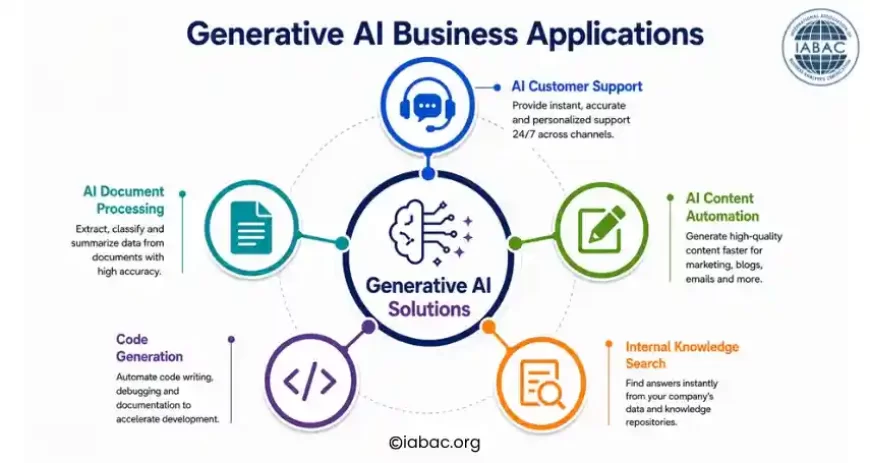
The most common generative AI business applications in 2026 are AI customer support, AI document processing, content automation, code generation, and internal knowledge search.
-
Enterprise generative AI spending has grown sharply, but only a small share of organizations describe their rollouts as "mature" or delivering material bottom-line impact.
-
Retrieval-Augmented Generation (RAG) architecture is now the standard way enterprises ground generative AI tools in their own data instead of relying on a model's static training.
-
Agentic AI systems that plan and execute multi-step tasks are the defining 2026 shift, moving generative AI from a writing assistant to a task-completing colleague.
-
Governance, data quality, and workflow redesign, not the underlying model, are the biggest barriers to converting pilots into value.
What Are Generative AI Solutions?

Generative AI solutions are software systems built on large language models (LLMs) that can produce new text, code, images, structured data, or decisions in response to a prompt, rather than simply retrieving or classifying existing information. Unlike traditional automation, which follows fixed rules, generative AI solutions interpret intent, reason over context, and generate original output.
For a business, "generative AI solutions" rarely mean a single chatbot. In practice, it refers to a layered stack:
-
A foundation model (or a mix of models) that performs the actual reasoning and generation
-
A retrieval layer that connects the model to company-specific documents, databases, or systems
-
An orchestration layer that manages prompts, tool calls, and multi-step workflows
-
An interface layer — chat, voice, embedded assistant, or autonomous agent — where employees or customers interact with the system
This is why generative AI for business looks different across companies. A law firm's generative AI solution might focus on document review and contract summarization. A retailer might focus on personalized marketing copy and demand forecasting narratives. The underlying models are often similar; the value comes from how they are grounded, integrated, and governed.
For a broader look at how these systems are already being used, IABAC's overview of generative AI examples across industries is a useful companion read.
Why Generative AI Solutions Matter for Business in 2026?
Enterprise adoption data makes the case for urgency, but also for caution. According to McKinsey's most recent global survey on the state of AI, roughly 88 percent of organizations report regularly using AI in at least one business function, up sharply from prior years, yet most have not embedded these tools deeply enough into workflows to see enterprise-wide financial impact. McKinsey's research also finds that workflow redesign, not model selection, has the single biggest effect on whether an organization sees an impactful earnings impact from generative AI.
This is the core reason generative AI solutions matter now: the technology has moved past the novelty phase. Business leaders who once asked "does this work?" are now asking "why isn't this paying off yet?" The answer, consistently, is integration, not capability.
Three forces are pushing generative AI business applications from pilot to production in 2026:
-
Competitive pressure: Early adopters in financial services, marketing, and professional services are already using generative AI tools to compress cycle times that competitors still handle manually.
-
Cost of inaction: As enterprise generative AI spending continues to climb, falling behind on AI integration increasingly means falling behind on unit economics, not just innovation optics.
-
Maturing architecture: RAG architecture, agentic frameworks, and enterprise-grade governance tooling have matured enough that generative AI solutions can now be deployed with real data security and auditability, something that was far harder in 2023 and 2024.
How Generative AI Solutions Work
1. The Language Model Core
At the center of any generative AI solution is an LLM for business use — a model trained on large volumes of text (and increasingly, code, images, and structured data) that predicts and generates coherent output. Enterprises typically choose between proprietary models accessed via API, open-weight models hosted privately, or a mix of both, depending on data sensitivity and cost.
2. RAG Architecture
A raw LLM only "knows" what it was trained on, and that knowledge is static and general. RAG architecture (Retrieval-Augmented Generation) solves this by connecting the model to a live, searchable index of company documents, policies, product data, or support tickets. When a user asks a question, the system retrieves the most relevant internal content first, then feeds it to the model as context before generating an answer. This is what allows a generative AI tool to answer accurately about a specific company's pricing, policies, or products instead of hallucinating a generic response.
3. Prompt Engineering and Orchestration
Prompt engineering for business is the discipline of structuring instructions, examples, and constraints so a model produces consistent, on-brand, and accurate output. At the enterprise level, this is rarely manual; orchestration layers manage prompt templates, chain multiple model calls together, and route tasks to the right tool (a database query, a search index, an external API) automatically.
4. AI Integration for Enterprises
Finally, the solution has to plug into existing systems — CRM, ERP, ticketing platforms, document repositories through APIs and connectors. This is often the most underestimated part of any generative AI project. Gartner's 2026 predictions note that AI agents are moving from isolated productivity tools toward becoming embedded, task-specific components inside enterprise applications themselves, with roughly 40 percent of enterprise applications expected to include task-specific AI agents by the end of 2026, up from under 5 percent in 2025. That shift depends entirely on integration quality, not model quality.
Generative AI Business Applications
Generative AI use cases have expanded well beyond chatbots. The most durable generative AI business applications in 2026 fall into five categories.
AI Customer Support
AI chatbot for business use has evolved from scripted FAQ bots to context-aware assistants that pull from a company's live knowledge base via RAG architecture, escalate intelligently to human agents, and handle multi-turn conversations across channels. This remains one of the fastest-scaling generative AI business applications because the ROI from reduced ticket volume and faster resolution is easy to measure.
AI Document Processing
Generative AI solutions can extract, summarize, classify, and compare information across contracts, invoices, compliance filings, and reports. AI document processing reduces manual review time in legal, finance, insurance, and HR functions and is frequently one of the first use cases enterprises deploy because the data is already structured and the risk of a wrong output is easier to contain with human review.
AI Content Automation
From marketing copy and product descriptions to internal reports and sales collateral, AI content automation lets teams produce first drafts at scale, which humans then edit and approve. The value isn't replacing writers; it's compressing the time between "we need this" and "we have a reviewable draft."
Code Generation and Developer Productivity
Generative AI tools embedded in developer environments assist with code completion, refactoring, and test generation. Independent studies cited by McKinsey found that developers using AI coding assistants completed tasks significantly faster than those without them, making this one of the clearest productivity wins among current generative AI business applications.
Internal Knowledge and Decision Support
Enterprise search powered by generative AI solutions lets employees ask natural-language questions across scattered internal systems instead of manually searching multiple platforms. Combined with agentic AI, these systems are starting to not just answer questions but also take the next step, drafting a response, updating a record, or triggering a workflow.
Generative AI Tools for Enterprises
Generative AI tools for enterprises generally fall into four categories, and most companies end up using a combination rather than a single platform:
-
Foundation model providers: API-based large language models that power custom applications
-
Embedded copilots: Generative AI features built directly into existing software (CRM, productivity suites, developer tools).
-
RAG and knowledge platforms: Tools purpose-built to connect LLMs to enterprise data securely
-
Agent orchestration platforms: Newer tools that let businesses design, deploy, and govern multi-step AI agents rather than single-turn chat interactions.
Selecting the right combination depends less on which tool is "best" and more on data sensitivity, existing tech stack, and the specific generative AI business applications a company is prioritizing. This is exactly the kind of decision where independent guidance rather than a vendor's own sales pitch tends to produce better outcomes, which is why many enterprises now bring in dedicated AI consulting support before committing to a platform.
Benefits of Generative AI Solutions for Business
-
Speed: Draft-to-decision cycles shrink across content, code, and document-heavy workflows.
-
Cost efficiency: Deloitte's 2026 State of AI in the Enterprise research reports that organizations are increasingly citing cost reduction, alongside productivity gains, as a driver of continued generative AI investment.
-
Consistency: Generative AI solutions apply the same tone, policy, and quality bar across thousands of interactions, reducing variance that comes from individual human output.
-
Scalable personalization: Marketing, support, and sales teams can tailor messaging at a scale manual processes cannot match.
-
Faster access to institutional knowledge: RAG-based generative AI tools reduce the time employees spend searching for information buried in documents, tickets, and systems.
Challenges of Generative AI Solutions
The adoption data tells an important cautionary story. Despite widespread use, McKinsey has repeatedly found that only a small fraction of companies often cited as around 1 percent describe their generative AI rollouts as fully mature and embedded in workflows.
IBM's research on AI ROI tells a similar story: only around 25 percent of AI initiatives deliver their expected return, and a widely cited 2025 MIT study found that the large majority of generative AI pilots fail to reach production. The gap is not usually the model. It is:
-
Data quality and readiness: Poorly organized, siloed, or inconsistent data undermine RAG architecture before it even starts.
-
Governance gaps: Deloitte's 2026 State of AI in the Enterprise survey found that only around 21 percent of enterprises have a mature governance model in place for agentic AI, even as adoption accelerates, a mismatch that creates real compliance and reliability risk.
-
Workflow inertia: Bolting a generative AI tool onto an unchanged process rarely produces the gains leadership expects; the workflow itself usually needs to be redesigned.
-
Skills shortages: Teams frequently lack the combination of AI literacy, prompt engineering, and data governance skills needed to run these systems safely, a gap that structured, certification-backed training is increasingly used to close.
-
Unclear ownership: Fragmented, bottom-up pilots without clear executive sponsorship tend to stall before they scale.
Future Trends: Generative AI Solutions Beyond 2026
The clearest trend shaping generative AI solutions right now is the shift from single-turn generation to agentic AI, systems that don't just answer a prompt but plan, execute, and adjust across multiple steps with limited human intervention. Gartner projects that a large share of enterprise applications will carry embedded, task-specific AI agents by the end of 2026, with multi-agent systems, where several specialized agents collaborate on a single complex workflow, expected to become mainstream over the following two to three years.
IABAC's Generative AI Roadmap 2026 tracks a similar trajectory for professionals building these skills.
Alongside this, expect:
-
Deeper enterprise AI integration, where generative AI stops being a standalone tool and becomes embedded inside core business applications by default.
-
Stronger governance requirements, as regulators and boards respond to the governance gap highlighted in Deloitte's research.
-
Voice and multimodal interfaces are becoming a standard front end for enterprise generative AI solutions, not just an experimental feature.
-
Rising demand for AI-literate talent, as organizations realize that tooling alone does not close the value gap — people who can design, govern, and operate these systems do.
How Businesses Can Get Started with Generative AI Solutions
Given how uneven current returns are, the organizations pulling ahead share a pattern: they start with a narrow, measurable use case, invest in the data foundation before the model, redesign the workflow rather than just adding a chatbot to it, and put governance in place before scaling.
Bringing in structured consulting support to assess readiness, choose the right RAG architecture, and design a responsible rollout tends to shorten the path from pilot to production considerably. This is the kind of engagement IABAC's AI consulting services are built to support, working alongside internal teams rather than replacing them.
FAQs
What are generative AI solutions in simple terms?
Generative AI solutions are systems built on large language models that create new text, code, or content based on a prompt, often grounded in a company's own data through RAG architecture, rather than relying only on general training data.
How is generative AI different from traditional automation?
Traditional automation follows fixed, rule-based logic. Generative AI interprets intent and context, then generates original output — which makes it more flexible but also requires stronger governance and human review.
What is RAG architecture and why does it matter for business?
RAG (Retrieval-Augmented Generation) architecture connects a language model to a company's own documents and data at the moment of a query, so answers reflect actual company information instead of generic or outdated model knowledge.
Which generative AI business applications deliver ROI fastest?
AI customer support and AI document processing are typically the fastest to show measurable ROI, since ticket volume, resolution time, and manual review hours are easy to track before and after deployment.
Is agentic AI the same as generative AI?
No. Generative AI focuses on producing content or answers. Agentic AI builds on generative AI by adding the ability to plan and execute multi-step tasks with limited human input — it's an evolution of the underlying technology, not a separate category.
What skills does a team need to deploy generative AI solutions responsibly?
Teams need a working understanding of prompt engineering, data governance, RAG architecture, and AI risk management.
Conclusion
Generative AI solutions have moved past the experimentation phase, but the businesses seeing real returns are the ones treating this as an operating model change, not a tooling upgrade. The technology — LLMs, RAG architecture, agentic orchestration is genuinely capable in 2026. The differentiator is execution: clean data, redesigned workflows, real governance, and people who know how to run these systems responsibly.
For teams building that capability internally, working with an experienced partner can close the gap faster than trial and error. IABAC's AI consulting services work with businesses to assess AI readiness, design practical generative AI implementations, and build the governance and skills foundation needed to move from pilot to sustained value.