


















































Generative AI Roadmap 2026
Master the future with the Generative AI Roadmap 2026, gain key AI skills, explore global trends, and lead innovation in the AI revolution.


Generative AI is one of the fastest-growing technologies in the world. It can create text, images, videos, code, and even ideas — changing the way people and businesses work.
By 2026, most companies will not just experiment with AI but will use it every day to run their operations, make decisions, and serve customers.
If you want to start a career in AI or help your organization adopt it, this Generative AI Roadmap will guide you step by step — from learning the basics to applying AI responsibly and effectively.
Building a Strong Foundation in AI
Step 1: Learn the Basics
Before jumping into advanced AI, start with the core skills that form the base for everything:
-
Python programming: Learn libraries like NumPy, Pandas, and Matplotlib for handling and visualizing data.
-
Mathematics: Brush up on Linear Algebra, Probability, and Statistics to understand how AI models work.
-
Data skills: Learn SQL and how to clean and manage data — since data is the foundation of every AI system.
At this stage, focus on understanding how data is collected, organized, and used for learning patterns.
Step 2: Machine Learning (ML) Fundamentals
Machine Learning is the next step. It’s how computers learn from data.
Start with:
-
Supervised & Unsupervised Learning: Training models to predict results or find patterns.
-
Neural Networks (ANNs, CNNs, RNNs): The brain of AI that processes data like text, sound, or images.
-
Model Evaluation & Optimization: Learn how to test and improve models to make accurate predictions.
These concepts help you understand the logic behind intelligent systems.
Step 3: Deep Learning & Transformers
Deep Learning powers the AI systems we use today — from ChatGPT to DALL·E.
Learn about:
-
PyTorch or TensorFlow: Frameworks used to build deep learning models.
-
Transformers and Attention Mechanisms: The technology behind advanced models like BERT, GPT, and T5.
-
Large Language Models (LLMs): Understand how they generate human-like text and perform complex reasoning.
This step is where you’ll truly start building next-generation AI systems.
Step 4: The Core of Generative AI
Now comes the creative side of AI — the part that creates new things.
-
GANs (Generative Adversarial Networks): Create realistic images, videos, or data.
-
VAEs (Variational Autoencoders): Generate structured data or designs.
-
Diffusion Models: Used by tools like DALL·E and Stable Diffusion for generating art and visuals.
-
RLHF (Reinforcement Learning with Human Feedback): Helps models understand and respond the way humans expect.
By 2026, these technologies will drive innovation in almost every industry — from marketing to healthcare and manufacturing.
Step 5: Learn Practical Skills
To use AI in real situations, focus on practical and applied knowledge.
-
Prompt Engineering: Write better prompts to get useful outputs from AI models.
-
Fine-tuning & Transfer Learning: Adapt pre-trained models to your specific needs.
-
LangChain & RAG (Retrieval-Augmented Generation): Combine AI models with real-time data for smarter results.
-
MLOps for GenAI: Learn how to manage, track, and deploy AI systems at scale.
These are the skills that make you job-ready and help you build tools businesses can actually use.
Step 6: Build Projects and Deploy AI
Hands-on experience is the best teacher. Try building projects like:
-
AI chatbots and virtual assistants
-
Text-to-image or code-generation tools
-
APIs and web-based AI apps
-
Deploying models on cloud platforms like AWS, GCP, or Azure
By 2026, over 80% of enterprises will have moved their AI systems from pilot testing to full-scale use.
Businesses now focus on ROI (Return on Investment) and measurable outcomes, not just experimentation.
Step 7: Advanced Learning & Career Growth
If you want to grow into leadership or specialist roles, focus on advanced topics such as:
-
Scaling Laws in LLMs: Learn how performance changes as models grow.
-
AI Ethics and Bias Handling: Build fair and transparent systems.
-
System Design for AI: Architect large, efficient, and secure AI platforms.
As we approach 2026, multimodal AI — systems that understand text, image, audio, and video together — will become standard.
Also, autonomous AI agents capable of reasoning and acting independently will start performing complex business tasks.
Enterprise Adoption Trends (2026)
Here’s how organizations are using Generative AI across industries:
-
From Piloting to Production: Companies are scaling AI beyond small tests into live business systems.
-
Cross-Department Integration: Finance uses AI for compliance checks, HR for talent screening, and Security for real-time threat detection.
-
Hyper-Personalization: AI enables real-time, personalized marketing, recommendations, and customer service.
-
ROI and Risk Management: Projects must show clear business value; those without strong results or data control will be stopped.
In short, AI is becoming part of everyday business, not just a tech experiment.
Technical Advancements getting GenAI
The AI world is changing fast. Here are the key trends shaping its future:
-
Autonomous Agents: AI that can plan, act, and collaborate with minimal human help.
-
Multimodal AI: Models that understand many forms of data (text, audio, video, images).
-
Domain-Specific Models: Tailored AIs built for industries like healthcare, finance, or education.
-
Edge AI & Specialized Hardware: Faster AI running directly on devices instead of relying on cloud servers.
-
Synthetic Data: Safe, AI-generated data used to train models and reduce bias or privacy risks.
These advancements will make AI systems more powerful, responsive, and sustainable.
Responsible AI and Governance
With AI growing so quickly, it’s important to ensure it’s used responsibly and ethically.
By 2026, governments and organizations will enforce global standards like the EU AI Act and India’s AI Governance Framework.
Responsible AI includes:
-
Transparency: Explaining how AI makes decisions (Explainable AI or XAI).
-
Fairness: Reducing bias in data and outputs.
-
Sustainability: Making AI models more energy-efficient.
-
Lifecycle Governance: Managing AI responsibly from development to deployment.
Companies that follow these principles will gain trust and long-term success.
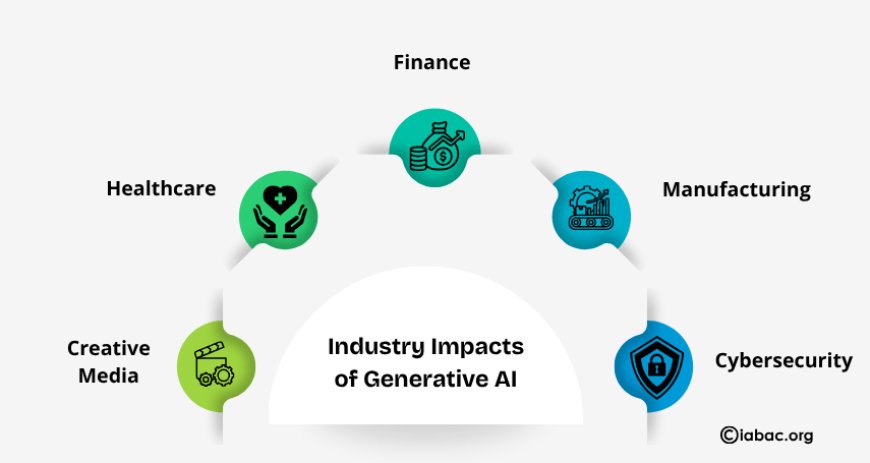
Industry Impacts of Generative AI
Generative AI is transforming every major industry:
-
Creative Media: Video and animation production will become faster and cheaper, boosting human creativity.
-
Healthcare: AI will speed up drug discovery, improve diagnostics, and support personalized treatment.
-
Finance: Automated compliance, fraud detection, and market forecasting will become standard.
-
Manufacturing: AI will power predictive maintenance, quality checks, and human-robot collaboration (“cobots”).
-
Cybersecurity: AI agents will defend systems in real-time, identifying and stopping attacks instantly.
These use cases show how AI is not just a tool — it’s an essential business partner.
Challenges and Risks
While AI brings new possibilities, it also introduces challenges we must address carefully:
-
Data Privacy: Protecting sensitive information used to train and run AI models.
-
Bias and Fairness: Avoiding unfair or inaccurate outcomes caused by flawed training data.
-
Job Disruption: Some tasks will be automated, but new jobs like AI ethicists, prompt engineers, and AI trainers will emerge.
-
Trust and Transparency: People must be able to understand and trust AI decisions before widespread adoption.
To succeed, businesses and professionals must balance innovation with responsibility.
Collaboration Between Humans and AI
Generative AI is not here to replace humans — it’s here to empower them.
By handling repetitive or data-heavy work, AI gives people more time to focus on creativity, critical thinking, and strategy.
The future of work will rely on human-AI collaboration, where success depends on combining human values with machine precision.
Learning how to work with AI — not against it — will be one of the most valuable skills in the coming years.
The Road Ahead: Preparing for 2026 and Beyond
The Generative AI Roadmap 2026 isn’t just a learning plan — it’s a vision for the future of technology and business.
Remember to:
-
Build strong foundations in Python, math, and data.
-
Understand machine learning and deep learning concepts.
-
Learn transformers, diffusion models, and RLHF.
-
Gain hands-on project experience and stay updated on industry trends and ethical AI practices.
Generative AI is already transforming industries and careers. By following this roadmap, you’ll gain the right skills — and the confidence to apply them responsibly in real-world scenarios.