

















































Which course for data science Should You Choose This Year?
Choosing a course for data science in 2026? Compare learning paths, certifications, practical skills, and career options to select the right program.

The best course for data science in 2026 depends on where you're starting from. Beginners should start with basic statistics and analytics before moving into programming and machine learning. People switching careers do best with a structured, project-based certification, like the ones offered through IABAC, that combines applied statistics, Python or R, machine learning, and a final hands-on project. Managers and business owners often get more value from a shorter, business-focused course than from a full technical program. There's no single "best" course. There's a course that fits your current skill level, your budget, and your goal.
Key Takeaways
- Data science is still one of the fastest-growing and best-paid tech careers going into 2026, mostly because more companies are using AI in their daily work.
- A "course for data science" can mean anything from a six-week intro program to a program that takes many months and includes heavy projects. The right pick depends on your background.
- Certificates from trusted groups like IABAC carry more weight because the group that checks your skills is separate from the group that teaches you. This is how many other professional certifications work too.
- The strongest programs in 2026 teach core statistics and programming, plus applied machine learning, some data engineering basics, and, more and more, tools built around AI models.
- Hands-on projects and a portfolio matter more to employers than the course name.
- People often fail to finish or fail to get real value when they skip the basics, jump between tools without learning any of them well, or ignore how to explain their work in plain language.
- Jobs that come out of data science now include analytics engineer, MLOps engineer, decision scientist, and AI product roles, not just "data scientist."
Introduction
Hiring for data science roles didn't slow down after the first wave of AI hype. It just changed shape. Companies in 2026 don't only want someone who can build a model. They want someone who can understand a business problem, work with messy real data, check whether results (including results from AI tools) actually make sense, and explain findings to people who aren't technical. That shift has quietly changed what a good data science course needs to teach.
If you're looking into data science courses or data science certifications right now, you've probably noticed how many choices there are. University programs, independent certification groups, company-run bootcamps, and self-paced online courses. Too many options is part of the problem. Picking the wrong course can waste months of your time and a good chunk of your money.
This guide breaks down how to check a course for data science in 2026: what basics matter, how certification programs are built, which tools and skills you actually need, what a realistic study plan looks like, and how to avoid the most common mistakes. Along the way, we'll look at how a recognized certification group like IABAC builds its analytics and data science credentials, since it shows many of the good habits worth looking for in any program you're considering.
1. The Basics: What Data Science Actually Covers
Before you compare any courses, it helps to be clear on what data science actually is. A vague idea of the subject is the main reason people pick the wrong program.
Data science sits at the meeting point of three areas of skill:
- Statistics and math — probability, testing ideas with numbers, regression, and the math behind machine learning models.
- Programming and building systems — mainly Python and/or R, SQL for pulling data, and more and more, basic skills in building data pipelines and using version control.
- Business sense — the ability to turn a business question into a plan for analysis, and turn the results back into a decision or a recommendation.
A common mistake is treating data science as only a coding skill. In practice, the people who move up fastest can do all three of the above. That's exactly why the strongest data science certifications don't just teach code. They test how you apply your judgment through case studies or projects.
Data Science vs. Data Analytics vs. Machine Learning
These words get mixed up a lot, but they're not the same thing, and some course marketing blurs the lines on purpose. Here's a quick way to tell them apart:
- Data Analytics is about understanding data you already have to answer specific questions. Think dashboards, reports, and looking at what happened and why.
- Data Science goes further. It includes building models that predict what will happen, running experiments, and often writing code that will run in production.
- Machine Learning is one part of data science. It's specifically about building and tuning algorithms that learn patterns from data.
If you're a beginner, figuring out which of these three you actually want to do is the single most useful first step. It will stop you from signing up for a machine-learning-heavy course when what you really needed was analytics basics, or the other way around.
2. How Data Science Certification Programs Work
Most data science courses follow one of two setups, and knowing the difference changes how you should judge them.
Setup A: One Group Teaches and Certifies You
Here, one organization builds the course, teaches it, and hands out the certificate. This is common with university programs and many bootcamps. The upside is a well-matched learning experience. The downside is that the group grading you is the same group that taught you, so the value of the certificate depends fully on that one organization's standards.
Setup B: An Independent Certification Group Plus Training Partners
Here, a certification group, such as IABAC, sets the standard, writes the syllabus and the list of skills you need, and runs the exam on its own. Meanwhile, approved training partners actually teach the course based on that standard. This is close to how many other professional certifications work in different areas, like project management or IT security.
The upside of this setup is a clear split of roles. The group that teaches you isn't the group that certifies you, which cuts down on grade inflation and adds outside credibility. When you compare data science certifications, it's worth asking directly: who wrote the syllabus, and who grades the exam? If it's the same company doing both, look at that certificate a bit more carefully than one from an independent group like IABAC.
A Typical Program Structure
No matter the setup, most solid data science courses share a similar shape:
|
Stage |
What It Covers |
Usual Length |
|
Basics |
Statistics, Python/SQL fundamentals, working with data |
3–6 weeks |
|
Core Analytics |
Charts and visuals, exploring data, framing business questions |
3–5 weeks |
|
Machine Learning |
Supervised and unsupervised learning, checking model results |
4–8 weeks |
|
Applied / Advanced |
Applied AI tools, basic deployment, extra electives |
3–6 weeks |
|
Final Project |
A real project you can show off |
2–4 weeks |
Programs certified through groups like IABAC usually follow a structure close to this one, with the exam sitting at the end as an independent checkpoint rather than a formality.
3. Types of Data Science Courses in 2026
Not every "data science course" is built for the same kind of learner. Here's how the main categories break down.
By Format
- Self-paced online courses — flexible and usually cheaper, but they need strong self-discipline and give you little outside accountability.
- Live, group-based programs — a set schedule, live classes, and other learners around you, which usually leads to a higher chance of finishing.
- Certification-track programs — built around passing an independent exam (like IABAC's tracks), often mixing self-paced material with mentor support.
- University or executive programs — deeper theory, higher cost, longer to complete.
- Company training — built for a specific company's tools and setup, usually not something you can carry over to a different employer.
By Skill Level
- Beginner — basic statistics, basic Python, an intro to analytics. Good for career switchers and people from non-technical backgrounds.
- Intermediate / Applied — the basics of machine learning, building models, SQL at a larger scale.
- Advanced / Specialist — deep learning, MLOps, big data systems, applied AI tools.
- Leadership / Executive — analytics strategy, data rules and governance, measuring return on investment. Built for managers who need to direct data science work, not necessarily do it themselves.
By Career Outcome
- Analytics tracks for people moving from business analyst to data analyst roles.
- General data science tracks for building full predictive models start to finish.
- Specialist tracks — natural language processing, computer vision, big data systems, MLOps.
- Business and executive certifications for non-technical decision-makers who need to read and trust analytics results.
Certification programs under groups like IABAC usually cover several of these levels, from a beginner-level Business Analytics credential through to more advanced Data Scientist and big-data-focused tracks. This lets learners move up a clear ladder instead of jumping between unrelated courses from different providers.
4. Why a Structured Data Science Course Helps
For Beginners
A structured course turns years of trial and error into a guided path. Instead of guessing which Python library or statistics topic actually matters, a good course puts them in the right order and checks your understanding as you go.
For Working Professionals
A certification acts as a trust signal during a career change. Hiring managers looking through hundreds of resumes for a data role often use a known certification, like an independent IABAC credential, as a quick way to check basic skill, especially when your past job title doesn't clearly connect to "data scientist."
For Managers and Business Owners
Managers rarely need to write code themselves, but they more and more need to judge whether a data science team's results make sense, whether a proposed AI project is realistic, and how to split budget between building something in-house or buying it. A shorter, business-focused analytics certification handles this directly, without wasting a manager's time on hands-on coding they won't actually use.
For Developers
Software engineers moving into data science already have programming skills. What they usually lack is the statistical thinking and the habit of checking model results, which is what separates "code that runs" from "a model you can trust." Courses that focus on statistics and checking results, not just how to use a library, close that gap the fastest.
General Benefits for Everyone
- Built-in accountability — deadlines and tests fight the very high drop-off rate that comes with unstructured, self-taught learning.
- A portfolio you can show — final projects become material for your resume and interviews.
- Connections — group-based and certification programs often connect you with peers and mentors in the same area of work.
A clear signal to employers — a known, independently checked certification, like IABAC's, lowers the risk for employers looking at candidates without a traditional data science degree.
5. Problems and Risks to Watch Out For
Not every data science course delivers what it promises. Common problems include:
- An old syllabus. Data science tools change fast. A course that hasn't been updated in the last two or three years may be missing applied AI tools, modern MLOps habits, or current cloud tools.
- Weak certificates that mean nothing. Some "certifications" don't require any real testing. You pay, watch some videos, and get a certificate. These give almost no signal to an employer and can actually hurt you if a hiring manager checks how rigorous the certificate really is.
- Big promises about job placement. Be careful of guaranteed job promises. A good program will describe its career support honestly instead of making promises it can't keep.
- A poor match for your skills. A course that's all theory can leave you unable to build anything real. A course that only teaches tools can leave you unable to explain why a model works, which becomes a real problem in interviews and on the job.
- No outside checking. As covered above, when the same group teaches you and certifies you, there's a built-in conflict of interest. Independent certification groups like IABAC lower this risk, though they don't remove it completely.
- Cost doesn't always match value. A higher price doesn't always mean a better course. Compare how deep the material goes and how tough the testing is, not just the price tag or the name on the certificate.
6. Real Patterns From Career Changers
The following are made-up examples based on common patterns seen among people going through data science certification. They are not reports on specific real people.
Pattern 1: The Business Analyst Making a Switch A mid-level business analyst with strong Excel and reporting experience, but no coding background, took a beginner-level analytics certification followed by an applied data science credential over about nine months. Because the certification group (built in a way close to IABAC's tiered tracks) required an independent final project, the analyst built a real project: a model predicting which customers were likely to leave a retail business. That project became the centerpiece of later job interviews. The main reason it worked wasn't raw technical skill. It was being able to explain what the model meant for the business clearly, a skill the certification specifically tested.
Pattern 2: The Software Engineer Making a Switch A backend developer with strong Python skills but weak statistics knowledge first struggled in machine learning interviews. He could write the code for an algorithm but couldn't explain why he chose it or judge whether the results were any good. After finishing a course with a strong focus on statistics and checking model results, his interview performance clearly improved. This shows that coding skill alone rarely holds engineers back from moving into data science. Understanding statistics does.
Pattern 3: The Manager Approving a Project An operations director in charge of approving her company's first predictive maintenance AI project took a short, business-focused analytics certification instead of a full technical program. The goal wasn't to build models herself. It was to ask the right questions of the vendor and internal team, checking how they tested their model, what assumptions they made about the data, and whether the return-on-investment numbers actually held up, instead of just trusting them.
These made-up patterns all point to the same idea: pick the course that matches the actual job you need to do, not a general idea of "learning data science."
7. Tools a Strong Course Should Teach
A course that hasn't updated its tools in the last couple of years is a warning sign. In 2026, a good data science course should reasonably cover:
Core Programming and Querying
- Python (pandas, NumPy, scikit-learn)
- SQL for pulling and shaping data
- R (still useful in schools, healthcare, and heavy-statistics jobs)
Working With and Showing Data
- Cleaning and preparing data
- Chart and visual tools (matplotlib, seaborn, or business intelligence tools)
- Basic dashboard concepts
Machine Learning
- Supervised learning (regression, classification)
- Unsupervised learning (clustering, reducing the number of variables)
- Ways to check whether a model actually works
- Feature engineering (building better inputs for a model)
Newer, Applied AI Skills
- Basics of generative AI
- Working with AI model APIs for data tasks
- Fair and responsible use of AI, including checking for bias
Basic Awareness of Infrastructure (even without knowing it deeply)
- Version control (Git)
- Basic comfort with cloud platforms
- A basic understanding of data pipelines and MLOps
A course that leaves out applied AI tools entirely is probably behind where 2026 hiring expects you to be, since most data teams now expect some comfort working alongside AI tools instead of treating them as separate from "real" data science work.
8. A Step-by-Step Plan for Choosing and Finishing a Course
Use this as a plan for making a decision, rather than picking a course just because you've heard the name before.
Step 1 — Be honest about where you're starting. Are you starting from zero, from a related technical job, or from a business background with no coding? This tells you whether you need a beginner or intermediate starting point.
Step 2 — Be clear on your goal. "Get better at my current job," "switch careers into data science," and "lead a data team" each call for different depth and different levels of hands-on technical skill.
Step 3 — Check who certifies you, not just who teaches you. Look for programs where an independent group, such as IABAC, checks your skills separately from the instructor or training partner running the course.
Step 4 — Read the syllabus and check it's up to date for 2026. Make sure the course covers applied machine learning, current tools, and at least a basic look at generative AI, not just older statistics content.
Step 5 — Check how tough the testing is. Look for project-based or exam-based testing, not just watching videos. A final project is a strong sign the course is worth the money.
Step 6 — Plan for a realistic amount of time. Most people guess too low. A course that actually builds real skill, from the basics through to the final project, usually takes 4 to 9 months of steady part-time work for most working people, not the 4 to 6 weeks some ads suggest.
Step 7 — Build in some accountability. A group-based structure, a mentor checking in, or a study group all clearly raise your chances of finishing, compared to fully self-paced, unstructured learning.
Step 8 — Treat the certificate as a starting point, not the end. Once you're certified, keep building projects. The certificate gets you in the door for an interview. Your projects and judgment are what get you the job offer.
9. Common Mistakes (and How to Avoid Them)
- Skipping the statistics basics. Jumping straight to machine learning tools without understanding what's happening underneath leaves you with models you can't defend in an interview or fix when something breaks.
- Switching tools too often. Chasing every new library or tool without really learning the core stack (Python, SQL, one solid machine learning tool) leaves you with shallow knowledge you can't actually use.
- No real project work. Finishing video lessons without building anything gives you a certificate but no proof you can actually do the work.
- Ignoring plain-language explanation. Technically strong candidates get passed over often because they can't explain their findings to people who aren't technical. Good certification programs test this on purpose.
- Guessing too low on time. Treating a serious certification like a weekend task leads to rushed, shallow work and poor understanding that fades fast.
- Picking a course only by price. Neither the cheapest nor the most expensive option is a reliable way to judge quality. How deep the material goes and how tough the testing is matter more.
- Not checking whether the certifying group is independent and recognized. As covered above, a training provider that certifies its own students has a built-in credibility problem compared to a credential checked by an outside group.
10. Where Data Science Courses Are Headed After 2026
- Comfort with generative AI is becoming a baseline expectation, not a bonus skill. Most data science jobs now assume you're comfortable working alongside AI tools for exploring data and writing code.
- Responsible use of AI and data rules are being built directly into main courses, not left as an optional extra, as governments pay more attention to how AI systems are used.
- Smaller, stackable certificates are becoming more common. Instead of one big certification, learners more and more build up smaller, checkable skill badges toward a bigger credential, a model independent certification groups are well set up to support.
- Business context is being tested more, and pure coding tests less, since a lot of the coding work is now helped along by AI, while judgment about the business stays a clearly human skill.
- Roles keep splitting into more specific jobs. "Data scientist" is turning into more specific titles, like analytics engineer, decision scientist, MLOps engineer, and AI product analyst. This means picking a course more and more depends on which specific job you're aiming for, not one general path.
11. Jobs You Can Aim For After a Data Science Course
A recognized certification, together with a real project portfolio, usually opens the door to roles including:
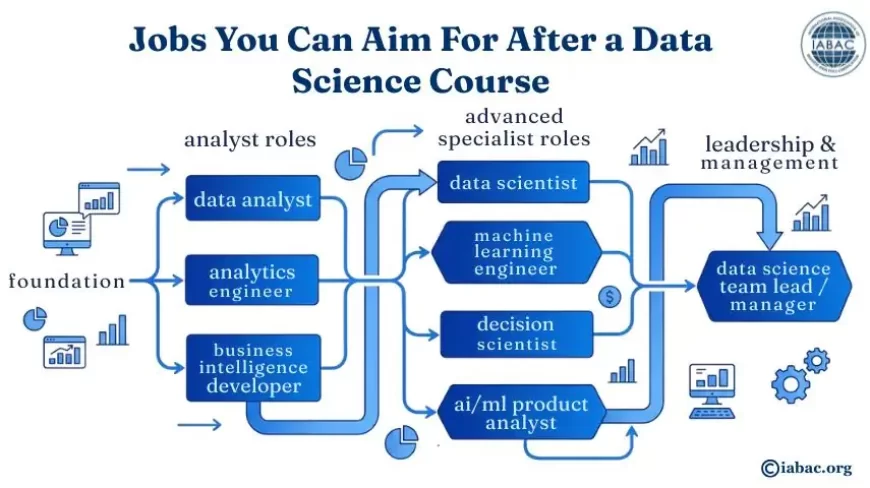
- Data Analyst — reporting, dashboards, looking at what happened and why
- Data Scientist — building models, running experiments, applying machine learning
- Machine Learning Engineer — getting models running in production
- Analytics Engineer — building and cleaning up data pipelines
- Business Intelligence Developer — building dashboards and reporting systems
- Decision Scientist — analytics built directly into big business decisions
- AI/ML Product Analyst — connecting product work with applied AI
- Data Science Team Lead / Manager — for people going after more advanced or executive-level certifications
Pay and seniority vary a lot by region, industry, and past experience, so treat any specific numbers you see elsewhere with some care unless they come from current, checkable local job market data.
12. Checking Cost Against Value Before You Sign Up
Price is usually the first thing people look at when comparing data science courses, and it's usually the wrong place to start. A better way to check value looks at price compared to three things: how deep the material goes, how tough the testing is, and how well the credential travels between employers and regions.
Independent certification groups like IABAC usually publish their skill frameworks separately from any single training partner's marketing material. This makes it easier to compare what you're actually being tested on, instead of only relying on a training provider's own description of its course.
A simple way to think about value: a data science certification isn't mainly about buying a piece of paper. It's about buying a clear path toward a real project, a checked skill level, and a credential that makes hiring easier for a company looking at your resume. If a program is priced mostly around its name rather than around how tough the testing is, take that as a sign to look more closely at what you're really getting. It's also worth planning for time, not just money. A lot of learners underestimate the cost of a rushed, weak course that they'll have to basically relearn later through a better program, which ends up costing more time overall than choosing carefully the first time.
13. A Simple Learning Path You Can Follow
For most learners starting close to zero, a sensible order looks like this:
Statistics and Python/SQL basics (beginner certification level)
- Working with and showing data
- Core machine learning (intermediate certification level)
- Pick one area to specialize in — natural language processing, computer vision, big data, or applied AI tools
- Final project — something real you'd be proud to put on your resume
- Independent certification exam — checking your skill through a group like IABAC
- Ongoing learning — staying current through real projects, not just more courses
Picking the right course for data science in 2026 isn't about finding one "best" program. It's about matching a course's depth, format, and certifying group to where you're actually starting and where you actually want to go. Beginners need the basics before machine learning. Working professionals need independently checked credentials that carry weight with employers. Managers need business understanding, not full technical depth. Developers need statistical judgment layered on top of the coding skill they already have.
As a next step:
- Be honest with yourself about your current skill level, using the plan in Section 8.
- Get clear on your specific goal: career change, getting better at your current job, or getting ready to lead.
- Shortlist programs where the certification is checked independently, such as those offered through IABAC, instead of certified only by the training provider itself.
- Check that the syllabus fits 2026, including some coverage of applied AI.
- Commit to a realistic timeline, and put a real final project ahead of just watching videos.
The right course, picked on purpose instead of by name recognition alone, is still one of the smartest things you can put your time and money into for a data-focused career this year.
Sources Referenced
This article is built on general, widely known patterns in how professional certifications are designed, how technical hiring works, and how data science courses are usually structured, as understood in early 2026. Specific numbers, like pay figures and market growth, change often, so readers should check current data directly through:
- IABAC's official certification and syllabus pages
- Current job market reports from national or regional labor statistics offices
- Well-known professional groups covering data science, analytics, and AI workforce trends
- Job postings and hiring requirements in your own target industry and region, for the most current and locally relevant signal
- Note: This article avoids citing specific numbers that couldn't be checked at the time of writing. If you need current market size, pay, or growth-rate numbers, please check up-to-date, original sources before relying on them to make a decision.