






Why Some Data Science and AI Course Programs Fail to Meet Industry Needs
Some data science and AI programs miss practical projects, cloud tools, and current technologies, leaving learners less prepared for industry roles in 2026.

There is a moment every new data science graduate knows painfully well. You have your shiny Data Science Certification hanging on the wall (or saved as a PDF somewhere in a folder you'll never open again). You walk into your first job interview, chest puffed, Python cheat sheets memorized. Then the interviewer asks you to walk them through a real business problem — not a Kaggle dataset with perfectly cleaned columns, but a messy, chaotic, emotionally devastating pile of real-world data. And you freeze.
This moment is not your fault. But it is a symptom of one of the biggest problems in tech education today: a growing disconnect between what data science and AI course programs teach and what the industry actually needs.
Let's talk about it — seriously, statistically, and with a healthy dose of empathy.
The Enrollment Boom and the Skills Gap Nobody Talks About
Over the last five years, the global demand for data science professionals has exploded. According to the World Economic Forum's Future of Jobs Report, data analyst and AI specialist roles rank among the top five fastest-growing professions globally through 2027. The U.S. Bureau of Labor Statistics projects a 35% growth rate for data scientists between 2022 and 2032 — far outpacing the average for all occupations. So, we're producing more graduates. Enrollment in data science, AI certification, and related programs has surged worldwide. Platforms, universities, and bootcamps collectively enroll millions of learners each year.
And yet — McKinsey's Global Institute estimated that by 2030, up to 85 million jobs could go unfilled globally due to skills mismatches. In data and AI specifically, employers consistently report that new hires lack practical readiness despite holding formal credentials.
Something is broken. Let's diagnose it properly.
Why Many Data Science and AI Course Curricula Are Still Stuck in 2018
Here is a quick test. Take any random data science syllabus from a mid-tier program. There is a good chance you'll find:
- A chapter on Hadoop (largely obsolete for most use cases)
- Basic linear regression with zero mention of modern regularization
- A "Generative AI" section that was added in the last 10 minutes of curriculum planning
- Absolutely nothing about MLOps, LLMOps, or deploying models in production
The introduction to Data Science that most programs offer is structured around textbook foundations — which is not inherently wrong — but the problem is that foundations are taught as the destination rather than the launchpad. The data science roadmap has evolved dramatically. Modern practitioners need fluency in LangChain, RAG (Retrieval-Augmented Generation), vector databases, and Agentic AI systems. Most curricula are still teaching students to draw decision trees by hand.
Here is a rough illustration of the curriculum gap:
What Most Programs Teach vs. What Employers Expect (2024–2025)
A noticeable gap exists between what many Data Science programs focus on and what employers actually expect from job-ready professionals.
|
Curriculum Coverage |
Coverage (%) |
Industry Expectation |
Demand (%) |
|
Python Basics |
85% |
Python with APIs |
90% |
|
Machine Learning Algorithms |
75% |
Machine Learning + AutoML |
70% |
|
Data Cleaning |
60% |
Working with Real-World Messy Datasets |
95% |
|
SQL |
55% |
SQL + NoSQL + Cloud Platforms |
80% |
|
Deep Learning |
40% |
Generative AI & Large Language Models (LLMs) |
75% |
|
MLOps & Deployment |
15% |
MLOps, CI/CD & Model Deployment |
70% |
|
Business Storytelling |
10% |
Communication & Business Problem Solving |
85% |
The mismatch is stark. Curriculum coverage and industry demand are running in opposite directions — especially at the critical end of the pipeline: deployment, communication, and Generative AI.
Why Some Data Science and AI Course Assignments Don't Reflect Real-World Work
Here's a scene from a typical data science project inside a course:
You download the Titanic dataset. It's clean. It has exactly the columns you need. The labels are binary. The Kaggle notebook is already 60% written. You run a Random Forest. You get 83% accuracy. You submit. You pass.
Now here's a scene from a real data science project at a company:
You receive a CSV file from a sales team. Half the column names are abbreviations nobody remembers the meaning of. There are three date formats in the same column. Customer IDs are duplicated because someone merged two databases badly in 2019. The business question isn't "predict churn" — it's "I don't know, just tell me something useful by Friday." The gap between these two realities is enormous. Real-world data science means navigating ambiguity, asking the right questions, and working with stakeholders who speak zero Python. None of this appears in most data science syllabus documents.
A certification in data science online that doesn't simulate real business environments is essentially teaching you to cook in a kitchen where all the ingredients are pre-measured, the stove works perfectly, and someone already plated the dish.
The Statistics Challenge Every Data Science and AI Course Should Address
Here's a quiet, slightly uncomfortable truth: many data science programs rush past statistics and mathematics because they're "hard." They teach enough to get a model running, but not enough to understand what the model is actually doing.
Consider this: a logistic regression model outputs a probability. But what does that probability mean if your training data is heavily imbalanced — say, 95% negative class and 5% positive? Many graduates would proudly report 95% accuracy and call it a day. That model is predicting "not fraud" every single time and still getting 95% correct. It's worse than flipping a coin if you're a fraud detection team.
Understanding this requires knowing:
Precision = TP / (TP + FP)

Recall = TP / (TP + FN)

F1 Score = 2 × (Precision × Recall) / (Precision + Recall)
These are not advanced concepts. But programs that sprint through statistics in Week 2 and never revisit them produce graduates who can't explain why their model is confidently wrong. Probability theory, hypothesis testing, Bayesian thinking, and confidence intervals are not optional accessories. They are the foundation of trustworthy AI. Without them, you're not doing data science — you're doing data decoration.
The AI Certification That Forgot About AI Ethics
This one stings a little. There is a growing category of AI certification programs that spend 40 hours on neural network architectures and exactly 45 minutes on AI ethics, bias, and fairness — typically placed in the last module, labeled "Optional Reading."
This is not just a moral oversight. It is a professional liability.
In 2023, the EU AI Act began shaping how organizations must document and audit their AI systems. In sectors like healthcare, finance, and hiring, biased models don't just underperform — they cause harm and attract regulatory penalties. Companies are now actively seeking professionals who understand fairness metrics, model explainability (SHAP, LIME), and responsible deployment.
A data science and AI course that produces graduates fluent in PyTorch but silent on bias detection is sending people into a burning building with a fire hose they don't know how to use.
Why Placement Support Matters in a Data Science and AI Course
This is where things get emotionally real.
Many programs — especially the expensive ones — sell aggressively on "placement assistance," "industry connections," and "hiring partner networks." The enrollment brochure shows smiling people at top tech companies. The reality, for many learners, is that placement support ends the moment the fee is paid.
True career readiness in data science requires:
- Portfolio building with real, end-to-end data science projects
- Resume tailoring for specific data roles (analyst vs. scientist vs. ML engineer)
- Interview preparation including case studies and whiteboard coding
- Networking guidance and LinkedIn optimization
- Ongoing mentorship from practitioners, not just instructors
The best programs — like those offered through IABAC (iabac.org/certifications) — understand that a certification is not a finish line. It is a starting block. IABAC's approach ties its certification in data science online to globally recognized standards and practical benchmarks that employers across industries actually value. This matters in a world where "certification for data science" has become a crowded, confusing market with wildly varying quality.
Why Every Data Science and AI Course Should Connect Data Skills With Business Knowledge
Here is the dirtiest secret in data science education: most programs teach you how to build models but never teach you how to talk to a CFO about them.
Data, at its core, is a communication tool. Data science isn't just about going from data to data — it's about going from data to decision. And decisions are made by humans who often don't care about your ROC curve. They care about revenue, risk, efficiency, and growth.
A data scientist who can build a demand forecasting model but can't explain in plain language why the company should trust it — or what it means for Q3 inventory — is only half as valuable as they could be.
Great data science education must include:
- Storytelling with data (think Tableau dashboards with narrative, not just colors)
- Stakeholder communication frameworks
- Translating model outputs into business recommendations
- Understanding KPIs, OKRs, and how data informs strategy
This is the human layer of data science, and it is chronically underserved.
What a Good Data Science and AI Course Actually Looks Like
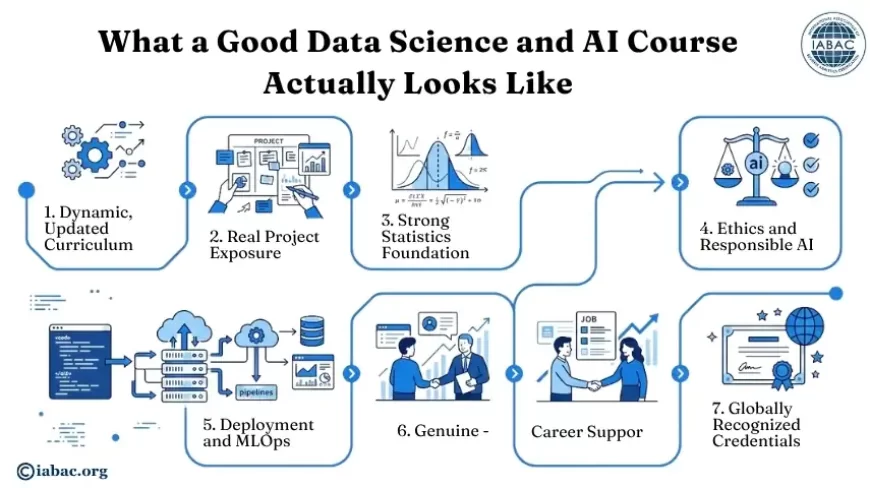
Let's flip the narrative. What does a program look like when it actually works?
1. Dynamic, Updated Curriculum A living data science roadmap that evolves with the field. Includes Python, SQL, ML, Deep Learning, NLP, Generative AI, LangChain, and MLOps — not as buzzwords, but as practiced skills.
2. Real Project Exposure Projects with messy, real-world data from actual industries — healthcare, retail, finance, logistics — where the problem statement is ambiguous by design.
3. Strong Statistics Foundation Hypothesis testing, probability distributions, and model evaluation metrics taught deeply and revisited throughout the program — not crammed into Week 1.
4. Ethics and Responsible AI Dedicated modules on bias, fairness, model explainability, and regulatory frameworks. Not optional. Not last.
5. Deployment and MLOps Docker, cloud platforms (AWS, GCP, Azure), CI/CD pipelines, and model monitoring. Because a model that's never deployed is just an expensive science experiment.
6. Genuine Career Support Mentorship, portfolio review, mock interviews, and connections to real hiring managers — not a PDF of LinkedIn tips.
7. Globally Recognized Credentials Certifications that employers worldwide actually recognize, verify, and trust. IABAC's certification framework at iabac.org/certifications is built on this principle — creating a standard that means something beyond the institution that issued it.
A Note on Generative AI and Why It Can't Be an Afterthought
In 2024, every data science program in the world added "Gen AI" to its brochure. Almost none of them meaningfully integrated it into the learning experience.
Generative AI is not a module. It is a paradigm shift. Working with large language models, building RAG pipelines, understanding prompt engineering, and deploying Agentic AI systems requires a fundamentally different mental model than classical ML. It requires understanding tokenization, embeddings, attention mechanisms, hallucination behavior, and grounding strategies.
This is not entry-level material — but it is urgently necessary material. Programs that treat Gen AI as a guest lecture at the end of a 12-week course are setting their learners up to be perpetually behind.
The Real Skills Gap Behind Every Data Science and AI Course
Here's the part nobody writes in a syllabus but everyone feels.
Thousands of learners worldwide invest real money — sometimes their savings, sometimes a family loan — into a data science and AI course. They sacrifice weekends. They stay up late watching lecture recordings. They genuinely try.
And then they graduate into a job market that doesn't recognize what they've learned, for roles they aren't quite ready for, with a data science certification that looked good on paper but didn't prepare them for Tuesday morning at a real company. That is not a small thing. That is someone's career — and in many parts of the world, someone's economic future. The responsibility on educators and certification bodies is enormous. The industry doesn't just need more data scientists. It needs better-prepared ones. And the difference between those two things lives entirely in the quality of the programs we build.
What Learners Should Look for Right Now
Before enrolling in any data science and AI course, ask these questions:
- Does the curriculum include MLOps, Generative AI, and deployment — not just algorithms?
- Are the projects based on real data, or are they pre-cleaned tutorial datasets?
- Does the program have a current, practicing industry advisory board?
- Is the certification recognized by employers globally — not just the issuing platform?
- What does post-completion support actually look like in practice?
- Is there a community of practitioners, not just a forum full of unanswered questions?
If the answers are vague, the program probably is too.
Explore verified, globally benchmarked pathways at iabac.org/certifications — where the standards are defined not by what's easy to teach, but by what the industry actually needs.
Why the Skills Gap Can Be Closed With the Right Data Science and AI Course
The skills gap between data science education and industry needs is real. But it is not permanent. The programs that will survive — and truly serve learners — are the ones that treat education as a living system, not a static syllabus. The world needs people who can turn data into decisions. Who can build AI systems that are not just powerful, but responsible. Who can walk into a messy, ambiguous business problem and come out the other side with something useful. That person exists in every learner who enrolls. The question is whether their program is good enough to bring that person out.
Some are. Many aren't. And now, at least, you know how to tell the difference.