
























































Benefits of IABAC ATP Program: Grow Your Institute
IABAC ATP transforms institutes with global accreditation, international certification, industry-aligned curriculum, accredited trainers, and growth.

Running a training institute is challenging. You compete with dozens of other organizations, struggle to attract quality students, and constantly work to prove your credibility. What if there was a way to instantly boost your reputation, access a global network, and attract more students?
That's exactly what an IABAC ATP (Authorized Training Provider) partnership offers.
This isn't just another certification. It's a strategic move that can transform how your institute operates, how students perceive your programs, and ultimately, how your business grows.
Let's explore the real, tangible benefits that institutes like yours are experiencing.
What Is the IABAC ATP Partnership?
Before diving into benefits, let's clarify what you're actually getting.
An IABAC Authorized Training Provider is an official partnership with the International Association of Business Accreditation Commission. As an ATP, your institute becomes authorized to deliver accredited training programs recognized internationally.
Think of it as your institute getting a "trust badge" that works globally.
Core Benefits of the IABAC ATP Program for Your Institute
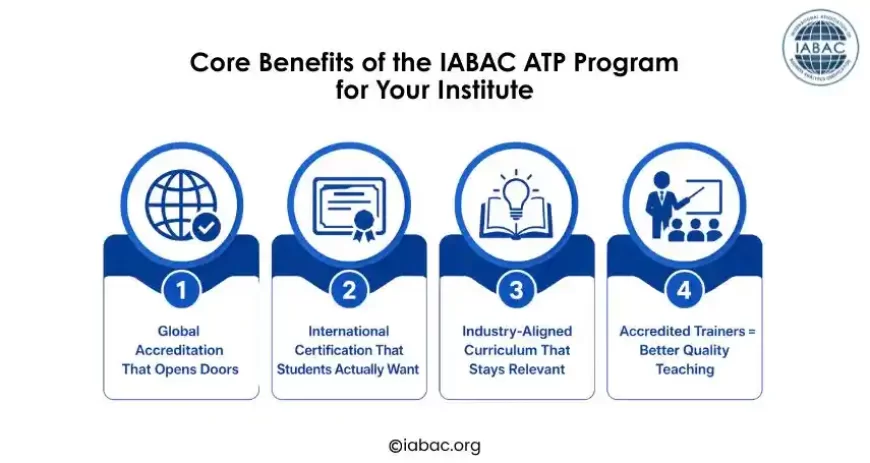
1. Global Accreditation That Opens Doors
What this means: Your institute gets recognized as a legitimate, accredited training provider. This isn't local recognition, this is international credibility.
Real advantages:
-
Students see your programs as globally recognized
-
Employers value certificates from accredited institutes more
-
Your graduates have better job prospects
-
You can attract international students
-
Your marketing becomes easier ("Globally Accredited Institute")
How institutes benefit: When you display the IABAC accreditation badge prominently, students immediately recognize your institute's credibility. Students actively search for and prefer accredited institutions, which translates directly to higher enrollment.
2. International Certification That Students Actually Want
What this means: Your students don't just get a local certificate. They get an internationally recognized qualification.
Real advantages:
-
Graduates can work across countries
-
Certificates are valued in job markets worldwide
-
Students are willing to pay premium fees for international certs
-
Your programs become more attractive compared to competitors
-
Alumni become brand ambassadors globally
Why this matters: International certifications command respect. When a student can say, "I have an IABAC-certified qualification," employers sit up and listen. This translates to higher enrollment and better student retention.
3. Industry-Aligned Curriculum That Stays Relevant
What this means: IABAC doesn't let you create random content. Your courseware must align with industry standards and real market needs.
How the process works:
-
IABAC partners with industry experts
-
Curriculum is regularly updated based on market trends
-
Your courses stay relevant (not outdated in 2 years)
-
Content is structured for actual job applications
-
Students learn skills employers actually need
Benefits for your institute:
-
Lower student dropout rates (relevant content keeps them engaged)
-
Better employment outcomes for graduates
-
Easier to attract corporate training clients
-
Can confidently market "Industry-Backed Training"
-
Reduces the cost and effort of curriculum development
Real-world impact: Instead of guessing what industry needs, you're teaching what industry actually demands. This creates a virtuous cycle: better outcomes = more referrals = more enrollments.
4. Accredited Trainers = Better Quality Teaching
What this means: IABAC doesn't just accredit your institute. They accredit your trainers, too. This means your teaching staff meets international standards.
What IABAC looks for in trainers:
-
Relevant industry experience
-
Teaching competency and methodology
-
Continuous professional development
-
Adherence to quality standards
-
Subject matter expertise
Benefits for your institute:
-
Your trainers are certified as "best-in-class"
-
Trainers maintain high professional standards
-
Student satisfaction improves
-
Easier to market "Expert Faculty"
-
Attracts better trainers to join your team
-
Creates accountability and consistency
Why this matters: A trainer with IABAC accreditation isn't just teaching—they're a credibility asset. Students know they're learning from someone who meets international standards.
Additional Benefits Beyond The Big Four
Growing Your Student Base
How IABAC helps recruitment:
-
Students actively search for "IABAC-accredited courses"
-
Accreditation appears in search results (SEO benefit)
-
Word-of-mouth improves when graduates are successful
-
Corporate clients prefer training from accredited providers
-
Your website ranking improves (trust factor)
Real-world impact: Institutes consistently report increased student inquiries and higher enrollment rates after displaying IABAC accreditation on their websites and marketing materials.
Charging Premium Fees
The business reality: Accredited programs typically command higher fees. Students and corporate clients both recognize the added value of international accreditation.
Pricing advantage:
-
Accredited programs can justify premium pricing
-
Students see more value in IABAC-certified qualifications
-
Corporate clients budget more for accredited training
-
Same content quality, higher perceived value
This directly impacts your bottom line without requiring additional resources. The exact fee structure varies by market and program type.
Access to the IABAC Partner Network
What you gain:
-
Connection with other accredited institutes
-
Collaboration opportunities
-
Knowledge sharing on best practices
-
Potential for joint programs
-
Networking with industry partners
Practical use: You can partner with other ATPs to expand offerings without building everything from scratch.
Continuous Support and Quality Assurance
IABAC doesn't just accredit and disappear. They:
-
Provide regular training on updates
-
Conduct quality audits
-
Offer consultation on program improvement
-
Help with compliance and documentation
-
Support you in staying current with industry changes
Why this matters: You're not left alone to maintain standards. IABAC actively helps you maintain quality.
How IABAC ATP Partnership Impacts Your Bottom Line
Direct Revenue Impact
IABAC accreditation typically leads to:
-
Higher Program Fees - Accredited programs can charge premium pricing
-
Increased Enrollment - More students search for accredited courses
-
Better Student Retention - Relevant, industry-aligned curriculum improves completion rates
-
Corporate Partnerships - Companies prefer accredited training providers
Indirect Benefits
-
Reduced Marketing Spend: Accreditation is free marketing
-
Better Staff Retention: Trainers feel they're part of something credible
-
Less Program Development Cost: IABAC-aligned curriculum is mostly done for you
-
Higher Graduate Success Rate: Better job placements = better reputation
How To Get Started With IABAC ATP
Many institutes ask: "So how do I actually become an ATP?"
Here's the practical roadmap:
Step 1: Assessment
-
Review the current curriculum
-
Evaluate trainer qualifications
-
Check infrastructure requirements
-
Understand compliance needs
Step 2: Alignment
-
Align courseware with IABAC standards
-
Train and certify your trainers
-
Set up quality assurance processes
-
Document everything
Step 3: Application
-
Submit official application
-
Provide curriculum materials
-
Share trainer credentials
-
Detail your infrastructure and support systems
Step 4: Evaluation
-
IABAC reviews your materials
-
Conducts site visit (if applicable)
-
Assesses trainers
-
Reviews quality procedures
Step 5: Approval
-
Receive formal accreditation
-
Get authorized to use IABAC branding
-
Start delivering accredited programs
-
Maintain ongoing compliance
Timeline: Usually 7 days from application to approval.
Common Questions Institutes Ask
"Will accreditation limit our flexibility?"
Not really. IABAC sets standards, but you maintain autonomy in delivery. You can add extra modules, customize for the local market, and innovate, as long as core content meets standards.
"What's the cost of getting accreditation?"
IABAC has transparent fee structures. Costs vary based on program type and size. Most institutes see ROI within 6-12 months through higher fees and increased enrollment.
"Do we need to change everything?"
No. If your programs are already solid, you're mostly documenting and aligning what you already do. It's more about formalization than revolution.
"Will accreditation affect student learning?"
Opposite. It improves learning because:
-
Content is industry-relevant
-
Trainers are certified
-
Quality standards ensure consistency
-
Feedback loops continuously improve programs
"Is IABAC recognized by employers?"
Yes. IABAC-accredited certificates are recognized across industries and countries. Many employers specifically look for IABAC-certified professionals.
Why Your Institute Needs IABAC ATP Now
The training industry is getting competitive. Students have options. Employers are selective.
IABAC ATP isn't a luxury—it's becoming an expectation.
Consider these facts:
-
Students increasingly search for accredited training programs
-
Corporate clients actively prefer accredited training providers
-
Many government initiatives recognize IABAC-accredited programs
-
Employers value IABAC-certified qualifications
-
Job placements improve with internationally recognized certifications
The question isn't: "Should we get IABAC accreditation?"
The question is: "How soon can we start?"
Next Steps
Ready to explore how IABAC ATP can transform your institute?
Here's what you should do:
-
Assess Your Readiness: Review your current programs against IABAC standards
-
Identify Your Programs: Decide which programs you want to accredit first
-
Contact IABAC: Reach out to understand specific requirements for your institute type
-
Plan Your Timeline: Map out the accreditation journey
Don't wait. Every month without accreditation is a month where:
-
You're leaving money on the table (lower fees than accredited peers)
-
Your institute is less competitive than accredited competitors
-
You're missing out on corporate training opportunities
-
Your graduates are at a disadvantage compared to accredited program graduates
Final Thoughts
The benefits of the IABAC ATP program go beyond certificates and badges. It's about:
-
Building trust that attracts better students
-
Creating systems that ensure quality
-
Accessing networks that open opportunities
-
Growing revenue sustainably
-
Building legacy through better-trained professionals
Your institute has potential. IABAC accreditation unlocks it.
Ready to grow your institute?
Learn more about the IABAC ATP partnership requirements and start your accreditation journey today. Connect with IABAC to discover how your institute can join thousands of globally recognized training providers.
FAQ
How long does IABAC accreditation take?
Typically, 7 days from application to approval, depending on your current readiness and program complexity.
Can online institutes get IABAC accreditation?
Yes. IABAC accredits both in-person and online training providers.
What happens if we don't maintain standards?
IABAC conducts regular audits. Non-compliance can result in warnings or loss of accreditation. This motivates continuous improvement.
Can we accredit only some programs?
Yes. You can start with one program and add others over time.
Is IABAC accreditation recognized in my country?
IABAC is internationally recognized. Check their website for specific country recognition details.
What about recertification?
Accreditation requires periodic renewal and ongoing compliance maintenance.