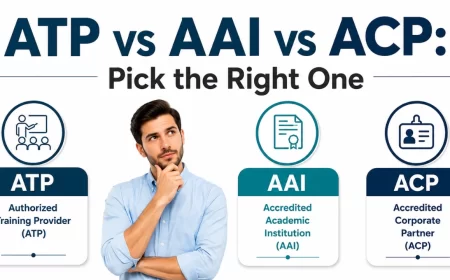













































Why Is Everyone Talking About Accredited Partner Programs?
Accredited Partner Programs are gaining attention as training providers strengthen credibility, offer recognized certifications, and expand learning opportunities in 2026.


Let us be honest for a second. A few years ago, the typical conversation around professional certification went something like this: "Do I really need a certificate, or can I just post on LinkedIn and see what happens?" Spoiler alert — the LinkedIn experiment did not go very well for most people. The world has changed. Dramatically. And a new wave of industry reports is now doing something remarkable: they are all pointing in the same direction. Employers want verified skills. Learners want globally recognized proof of those skills. And training organizations around the world want to align with a trusted, accredited body that can give their offerings real credibility. The demand for structured, internationally recognized certification — and more importantly, for partnerships with a serious Certification Body — has never been higher. This blog dives deep into what the data says, what it means for educators, trainers, and learners worldwide, and why aligning with an accredited body like IABAC is one of the smartest professional moves anyone in the education-to-employment space can make right now.
Section 1: What the Numbers Are Actually Saying
The global professional certification market was valued at approximately USD 4.8 billion in 2022 and is projected to reach USD 9.6 billion by 2030, growing at a compound annual growth rate (CAGR) of roughly 9.1% (source: Allied Market Research, 2023). That is not a niche trend. That is a global structural shift. Meanwhile, the World Economic Forum's Future of Jobs Report 2023 estimated that 44% of workers' core skills will be disrupted within five years, with AI, data analytics, and machine learning at the center of that disruption. Organizations are scrambling. Workers are scrambling. And training providers — especially those without a credible accreditation stamp — are finding it increasingly difficult to compete.
Asia-Pacific leads. North America remains strong. Europe is accelerating fast, particularly in AI governance and data ethics training. The "Rest of World" category — which includes Africa, the Middle East, and Latin America — is the fastest growing in percentage terms, with certification interest rising at nearly 15% annually in several emerging markets. What does all of this mean for a training organization, university, or independent educator? It means the ground beneath their feet is shifting — and those who partner with a recognized Global Certification body right now are positioning themselves years ahead of those who wait.
Section 2: Why Accreditation Is the New Currency
Think of professional certification like a currency. A currency only works if people trust it. A dollar printed in someone's basement is not money. A certificate printed without any legitimate accreditation behind it is not much better — at least not in the eyes of a hiring manager in Singapore, São Paulo, or Stockholm.
Accreditation is the mechanism that transforms a certificate from a PDF with a logo into something employers actually recognize and value. When a Certification Body maintains rigorous standards — curriculum alignment, examiner qualifications, assessment integrity, and ongoing quality assurance — the credential it issues carries weight across borders. This is the core reason the demand for partnerships with accredited training providers and accredited certification bodies is surging. Training organizations are not just looking for a logo to put on their brochures. They are looking for a credible institutional relationship that elevates everything they offer.
Key reasons organizations are actively seeking accreditation partnerships in 2024–2025:
- Employer trust — Corporate HR teams in 78% of Fortune 500 companies now require candidates to show credentials from recognized bodies (LinkedIn Workforce Report, 2023).
- Cross-border recognition — Remote work and global hiring have made locally-only recognized certificates far less valuable.
- Student expectations — Learners today research accreditation status before enrolling. They are not guessing anymore.
- Regulatory alignment — Several governments in the EU, GCC, and Southeast Asia are tying workforce development subsidies to accreditation compliance.
- Institutional reputation — Universities and training institutes that align with established Global Certification bodies see measurable improvements in enrollment, completion, and graduate employment rates.
Section 3: Enter IABAC — The Accredited Body That Gets It
IABAC, the International Association of Business Analytics Certifications, is an internationally recognized Certification Body that specializes in the domains the world is most urgently demanding: Data Science, Artificial Intelligence, Business Analytics, Machine Learning, and related technology disciplines. The IABAC certification ecosystem is built on a simple but powerful idea — that verified competence should be globally portable. A professional certified through IABAC should be able to walk into a job interview in Frankfurt, Nairobi, Manila, or Montreal and have that credential recognized and respected.
You can explore the full IABAC certification catalog at iabac.org/certifications — it is worth a look, even just to understand how comprehensively the ecosystem has been designed.
What sets IABAC apart as an accredited body:
- Multi-tiered certification pathways — From foundational to expert-level credentials, covering individuals at every stage of their career journey.
- Industry-aligned curriculum standards — Certification frameworks are built in consultation with employers, not just academics.
- International reach — IABAC operates across more than 50 countries, with a growing network of accredited training providers and institutional partners.
- Continuous quality assurance — Regular review cycles ensure that IABAC certifications stay relevant as technologies evolve.
- Stackable credentials — Certifications are designed to build on each other, encouraging lifelong learning rather than one-and-done credentialing.
Section 4: The Partner Program — Why So Many Organizations Are Queuing Up
Here is where things get genuinely interesting — and where the new wave of industry reports is sending a very clear signal.
Applications to become a recognized education partner or training partner with established certification bodies have increased sharply. IABAC's own partner inquiry data reflects this trend, with a significant year-over-year increase in organizations across Asia, Europe, the Middle East, and the Americas seeking to partner with us and integrate IABAC credentials into their offerings.
Why are so many organizations moving now? Three big forces are at work:
Force 1: The AI Upskilling Tsunami
The release and rapid adoption of large language models and AI tools in 2023–2024 triggered an enormous wave of upskilling demand. Organizations that had been slowly building AI training programs suddenly found themselves overwhelmed with inquiries. Those aligned with a legitimate accredited body could respond with credible, scalable programs. Those without that alignment scrambled.
McKinsey's 2024 Global Survey on AI found that 72% of organizations had adopted AI in at least one business function, up from 55% the previous year. This created immediate demand for AI literacy certification — and the training providers positioned to meet it were those already inside a trusted certification ecosystem.
Force 2: The Employer Verification Push
Employers are no longer taking certifications at face value. Background verification tools have become sophisticated enough to validate — or invalidate — any credential in minutes. An iabac certification passes that check. A certificate from an obscure, unverified source does not.
A 2023 study from the HR Certification Institute found that 68% of hiring managers now actively verify professional certification claims before making offers — up from 41% just five years ago. The implication for training providers is stark: if their certifications cannot be verified through a recognized Certification Body, they are invisible in the eyes of a growing majority of employers.
Force 3: The "Trusted Brand" Shortcut
Building institutional credibility from scratch takes decades. Partnering with a globally recognized accredited body provides an immediate shortcut. An education center in Lagos that becomes an IABAC education partner instantly inherits a layer of international credibility that would otherwise take years to build.
This is not a small thing. In competitive markets, the difference between being a recognized training provider and being just another training center is often the accreditation partner behind them.
Section 5: What the Partner Program Actually Looks Like
For any organization considering whether to partner with us at IABAC, it helps to understand what the relationship actually involves — not just the marketing language, but the operational reality.
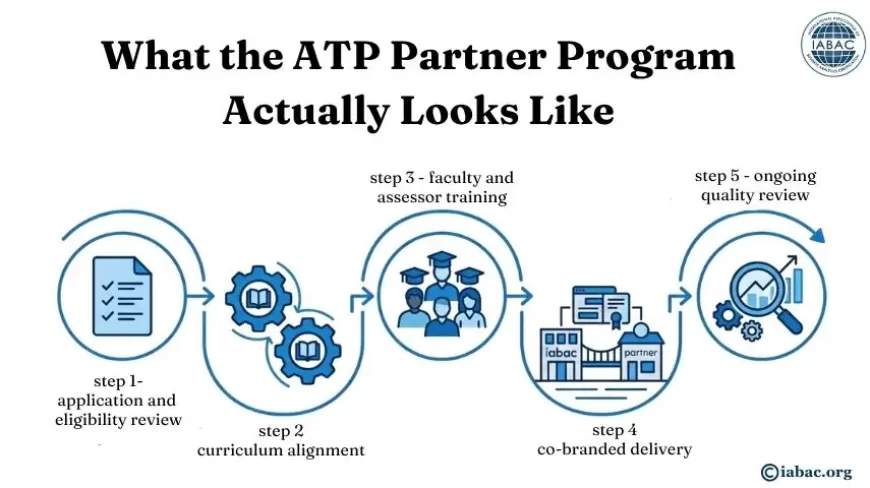
- Step 1 — Application and Eligibility Review: Organizations submit a structured application that covers their existing programs, teaching capacity, faculty qualifications, and market positioning. IABAC reviews this against its quality standards.
- Step 2 — Curriculum Alignment: Once approved, partner organizations work with IABAC to align their curriculum with certification frameworks. This is not about replacing existing content — it is about mapping it to verifiable competency standards.
- Step 3 — Faculty and Assessor Training
IABAC provides training resources and support to ensure that instructors within partner organizations understand the certification standards and how to prepare learners effectively. - Step 4 — Co-Branded Delivery: Partner organizations can deliver IABAC-aligned programs under a co-branded framework, clearly communicating the association with the accredited body to learners.
- Step 5 — Ongoing Quality Review: The partnership is not a one-time transaction. IABAC conducts regular quality reviews to ensure that delivery standards are maintained, and partners receive ongoing support as certification frameworks evolve.
The result is a relationship that benefits everyone in the chain — the training partner gains credibility and competitive differentiation, learners gain a globally recognized credential, and the overall standard of professional certification is elevated.
Section 6: A Real-World Scenario (No Names, Just Truth)
Imagine a mid-sized training institute operating in Southeast Asia. They offer solid data science and analytics courses — good instructors, good materials, decent pass rates. But they are losing learners to competitors who can offer internationally recognized certificates alongside their training. They decide to explore becoming an education partner with IABAC. Within three months of completing the alignment process, they begin co-delivering programs that lead to iabac certification. Enrollment increases. Corporate clients who had previously gone elsewhere start engaging. Their instructors go through IABAC's assessor training and feel — probably for the first time — that their professional expertise has been formally recognized.
Twelve months later, the institute's placement rate among completers has improved meaningfully, not just because learners are better trained, but because the credential on their CV is one that employers recognize and trust. This is not hypothetical. Versions of this story are playing out right now across more than 50 countries where IABAC operates. The partner program is not a theoretical framework — it is an active, functioning ecosystem with real organizations and real learners benefiting from it.
Section 7: The IABAC Data Science Advantage
Data Science is — and will remain for the foreseeable future — the single most in-demand professional skillset on the planet. Every organization, in every sector, in every country, is trying to extract value from data. The professionals who can help them do that are some of the most employable people in the world.
IABAC's data science certification pathway, available through iabac.org certifications, is one of the most comprehensive in the market. It covers:
- Foundations of Data Science and Statistics
- Python and R programming for analytics
- Machine Learning and Predictive Modeling
- Deep Learning and Neural Networks
- Natural Language Processing
- AI Ethics and Responsible AI Practice
- Business Intelligence and Data Visualization
- Real-world project assessment
Professionals who complete this pathway emerge not just with theoretical knowledge but with a portfolio of applied work — and a credential from a recognized accredited body that tells the world they have earned it. For accredited training providers who integrate this pathway into their programs, the value proposition is clear: they are not just teaching data science, they are certifying it. That distinction matters enormously to corporate clients who sponsor employee upskilling programs, and to individual learners investing their own time and money.
Section 8: For Educators, Institutions, and Independent Trainers — What This Means for You
If you are reading this as an educator, an institution leader, or an independent training professional, here is the plain truth: the demand for credentialed professionals is outpacing the supply of credible credential providers. That gap is your opportunity. Becoming part of the IABAC partner network — as an education partner, a training partner, or a corporate learning affiliate — is not a bureaucratic exercise. It is a strategic positioning decision. And based on every data point available right now, the organizations making this decision early are pulling ahead of those who are waiting to see how things develop.
Things to consider when evaluating any partnership with an accredited body:
- Does the body's certification carry employer recognition in the markets you serve?
- Is the curriculum framework rigorous and regularly updated?
- Does the partnership model provide real support, or just a logo and a handshake?
- Are there clear pathways for learners to progress through credential levels?
- Is the body transparent about its accreditation standards and quality assurance processes?
IABAC answers all of these questions clearly and affirmatively — and the evidence is in the growth of its global partner network.
Section 9: The Emotional Core — Why This Matters Beyond the Numbers
Behind every certification statistic is a person. A first-generation university graduate trying to compete in a job market that feels impossibly competitive. A mid-career professional who watched their role get automated and is now rebuilding. A young woman in a developing country who found an IABAC-aligned online program and, for the first time, could see a clear path into a technology career.
Global Certification is not just a business opportunity. It is infrastructure. It is the thing that makes skills legible across languages, cultures, and borders. When a training organization partners with IABAC, they are not just adding a line to their marketing materials. They are joining a mechanism that actually moves people — real people — forward in their professional lives.
That is worth something. Quite a lot, actually.
Section 10: Taking the Next Step
If this blog has done its job, you are now thinking one of two things. Either: I want to get an iabac certification — in which case, start at https://iabac.org/certifications and explore the pathways available. Or: "I want to partner with us to deliver IABAC-aligned programs" — in which case, visit iabac.org and navigate to the partnership section to begin the conversation. The demand is there. The infrastructure is there. The global need for accredited training providers who can reliably, rigorously, and credibly prepare professionals for the AI-driven economy is very much there.
The only question is whether your organization will be part of meeting it.
The Report Speaks — Are You Listening?
Every credible industry report published in the last two years is saying the same thing in slightly different language: the world wants certified, verified, globally recognized professional skills. The training organizations that align with a legitimate Certification Body now are building an asset that will compound in value for years. Those that do not are building a liability. IABAC sits at the center of this opportunity — a trusted accredited body with a serious global network, a rigorous certification framework, and a genuine commitment to quality that goes beyond branding.
The report has spoken. The demand is real. The partnership opportunity is open.