


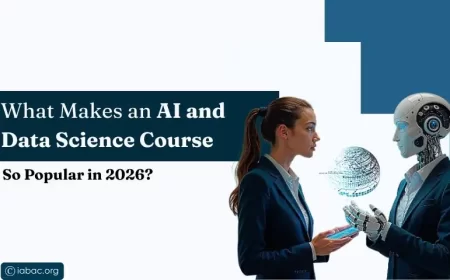















































What Makes an AI and Data Science Course So Popular in 2026?
See what makes an AI and data science course popular in 2026, from practical projects and recognized certifications to GenAI skills and strong career opportunities.

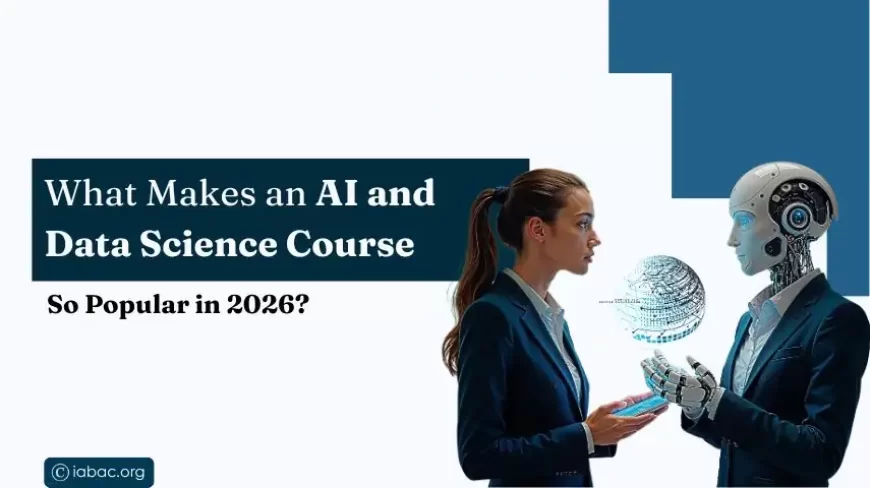
An AI and Data Science course has become the most in-demand credential of 2026 because it directly addresses the world's fastest-growing skills gap. Companies across every industry are racing to deploy AI, but they lack professionals who can build, train, and manage these systems responsibly. A structured course combines statistics, machine learning, deep learning, and real-world tools like Python and cloud platforms with recognized Data Science Certifications and Artificial Intelligence Certification pathways. This blend of practical skill-building, industry validation, and career mobility — often leading to six-figure salaries — is why enrollment in these programs has surged year over year.
Key Takeaways
- AI and Data Science roles are projected to remain among the fastest-growing job categories globally through 2030.
- Employers increasingly value verified credentials — such as those offered through Data Science Certifications — alongside hands-on project experience.
- The best courses in 2026 blend foundational statistics, machine learning, generative AI, and MLOps rather than teaching tools in isolation.
- Career switchers, developers, marketers, and executives are all enrolling — not just traditional computer science graduates.
- Certification bodies like IABAC are playing a growing role in standardizing skills validation across countries.
- Practical, project-based learning consistently outperforms purely theoretical courses in job placement outcomes.
- The biggest failure point isn't lack of access to courses — it's lack of structured, sequential learning paths.
Introduction
Walk into any tech conference, scroll through any hiring platform, or read any quarterly earnings call in 2026, and one phrase keeps surfacing: we need more AI and data talent. It isn't hype anymore — it's a structural shift in how businesses operate. From hospitals predicting patient readmissions to retailers forecasting demand down to the SKU level, data-driven decision-making has become the default operating mode for competitive organizations.
This shift has triggered an unprecedented rise in demand for AI and Data Science courses. But not all courses are created equal, and not everyone enrolling has the same background. Some are computer science graduates looking to specialize. Others are marketing managers who want to understand the models influencing their campaigns. Some are business owners trying to make sense of AI's implications before investing in it. And a growing number are mid-career professionals seeking a strategic pivot into one of the best-paying tech disciplines in the world. So what exactly makes these courses so popular right now — and how do you tell a genuinely valuable program from a superficial one? This article breaks down the fundamentals, the mechanics, the real-world evidence, and a complete roadmap so you can make an informed decision, whether you're a complete beginner or a seasoned developer looking to formalize your skills with a recognized Artificial Intelligence Certification.
1. The Fundamentals: What an AI and Data Science Course Actually Covers
At its core, an AI and Data Science course is designed to teach three interconnected disciplines:
- Data Science — the practice of collecting, cleaning, analyzing, and interpreting data to generate actionable insights. This includes statistics, data visualization, exploratory data analysis, and communication of findings to non-technical stakeholders.
- Machine Learning (ML) — algorithms that learn patterns from data without being explicitly programmed for every rule. This covers supervised learning (regression, classification), unsupervised learning (clustering, dimensionality reduction), and reinforcement learning.
- Artificial Intelligence (AI) — the broader discipline that includes ML but extends into natural language processing, computer vision, generative AI, and increasingly, autonomous agents that can plan and execute multi-step tasks.
A well-structured course doesn't teach these as isolated silos. Instead, it builds a progression: statistics and Python fundamentals first, then classical machine learning, then deep learning and neural networks, and finally applied AI systems including large language models (LLMs) and generative tools. This layered approach mirrors how the field itself evolved, which makes the learning far more intuitive.
Core Curriculum Components
Most reputable programs in 2026 include:
- Python and/or R programming fundamentals
- Statistics and probability theory
- Data wrangling and SQL
- Data visualization (Tableau, Power BI, Matplotlib, Seaborn)
- Machine learning algorithms and model evaluation
- Deep learning frameworks (TensorFlow, PyTorch)
- Natural language processing and generative AI
- MLOps and model deployment
- Ethics, bias, and responsible AI practices
- Capstone projects with real datasets
2. How These AI and Data Science Courses Work: The Learning Mechanism
A well-designed AI and Data Science course follows a structured learning path that gradually builds both technical knowledge and practical skills. Instead of focusing only on theory, learners gain hands-on experience through real-world projects, assignments, and guided practice.
This approach is important because employers look beyond certificates. They want candidates who can apply their knowledge to solve real problems. That's why the best programs combine practical projects, continuous assessments, expert mentorship, and portfolio development to help learners become job-ready.
The Role of Certification
Certifications act as a standardized signal of competency across a global hiring market. When a hiring manager in Berlin, Bangalore, or Toronto sees a recognized credential — such as a Data Science Certification or an Artificial Intelligence Certification — they can trust that the candidate has met a consistent, vetted standard, regardless of which specific school or platform delivered the training. This is especially valuable in a field where self-taught practitioners are common and traditional degree pathways haven't caught up with industry needs.
3. Types of AI and Data Science Courses
Not every learner needs the same course. Here's a quick breakdown of the major formats available in 2026:
- University Degree (BSc/MSc): Best for full-time students seeking deep theoretical grounding; typically 2–4 years.
- Professional Certification Program: Best for working professionals and career switchers; typically 3–9 months, with strong applied focus.
- Bootcamp: Best for fast career transitions; typically 3–6 months, intensive and moderately deep.
- Self-Paced Online Course: Best for independent, budget-conscious learners; flexible timeline, variable depth.
- Executive/Leadership Program: Best for managers and business owners; typically a few weeks, strategic overview rather than technical depth.
- Corporate Upskilling Program: Best for teams within organizations; typically weeks to months, role-specific.
Beyond format, courses also vary by specialization focus — some lean heavily into data analytics and business intelligence, while others focus on deep learning, computer vision, or generative AI engineering. Choosing the right type depends on your career stage, timeline, and whether you need broad literacy or deep technical mastery.
4. Why These Courses Have Become So Popular in 2026
Several converging factors explain the surge in enrollment.
a) Explosive Demand for AI-Literate Professionals
Organizations across finance, healthcare, retail, manufacturing, and government are integrating AI into core operations — not as an experiment, but as infrastructure. This has created sustained hiring demand that outpaces the supply of qualified professionals, pushing salaries upward and making certification programs an attractive, faster alternative to multi-year degrees.
b) Career Flexibility and Cross-Industry Mobility
Unlike many specialized technical skills, data science and AI competencies transfer across industries. A data scientist trained in healthcare analytics can pivot to fintech or retail with relatively modest retraining. This flexibility makes the investment in a course feel lower-risk to learners.
c) Rise of Generative AI and Democratized Tooling
The mainstream adoption of generative AI tools has lowered the barrier to entry for building AI-powered applications, which in turn has increased curiosity and demand for structured learning. People who use AI tools daily in their jobs want to understand what's happening "under the hood" — and courses satisfy that curiosity while building marketable skills.
d) Remote and Flexible Learning Formats
Post-pandemic shifts normalized remote learning, and platforms have matured to offer live mentorship, project reviews, and community support entirely online. This has made high-quality AI education accessible to learners in regions that previously lacked access to specialized university programs.
e) Recognized, Portable Certifications
Global bodies offering Data Science Certifications and Artificial Intelligence Certification pathways have made it easier for employers to standardize hiring criteria, and for learners to prove competency without needing a traditional degree. This portability is a major driver of enrollment among working professionals who can't pause their careers for a full degree program.
f) Business Leaders Seeking AI Literacy
Executives and business owners are enrolling not to become practitioners, but to make informed strategic decisions — evaluating vendors, understanding ROI on AI investments, and managing risk. This has created an entirely new segment of course demand beyond traditional technical learners.
5. Benefits of Enrolling in an AI and Data Science Course
- For Beginners: A structured course removes the guesswork of self-teaching, providing a clear sequence from fundamentals to job-readiness, along with mentorship and peer accountability.
- For Developers: Existing programming skills accelerate learning, allowing developers to specialize in ML engineering, MLOps, or applied AI development — often the highest-paying technical tracks.
- For Marketers and Business Analysts: Understanding predictive modeling and customer segmentation techniques enables more sophisticated campaign design and data-informed decision-making.
- For Executives: Strategic-level AI literacy helps leaders ask the right questions of technical teams, evaluate AI vendor claims critically, and set realistic timelines and budgets for AI initiatives.
- For Career Switchers: A recognized certification provides third-party validation that can offset the absence of a traditional computer science background, making hiring managers more confident in an unconventional resume.
Quantifiable Benefits
- Faster time-to-hire for certified candidates compared to self-taught applicants without credentials
- Higher average salary offers for roles requiring verified certification
- Reduced onboarding time for new hires who've completed project-based training
- Improved internal mobility for employees upskilled through corporate training programs
6. Challenges and Risks in AI and Data Science Education
No discussion of this topic is complete without addressing the real challenges learners face.
Market Saturation of Low-Quality Courses
The popularity of the field has attracted a flood of low-effort content — recycled tutorials rebranded as "comprehensive bootcamps." Learners need to vet course providers carefully, checking for structured curricula, real instructor engagement, and verifiable outcomes.
Skills Mismatch
Some courses teach outdated tools or overly theoretical content disconnected from what employers actually need. A curriculum that hasn't been updated to include generative AI, LLM fine-tuning, or modern MLOps practices risks leaving graduates underprepared.
Certification Without Substance
Not all certificates carry equal weight. A credential from a body with rigorous assessment standards — real project evaluation, proctored exams, or portfolio review — is far more valuable to employers than a certificate awarded simply for watching video lectures.
The Motivation Gap
Self-paced formats have high dropout rates. Without structured deadlines, mentorship, or community accountability, many learners start strong but never complete the program — a persistent risk regardless of subject matter.
Ethical and Bias Risks
As AI systems increasingly influence hiring, lending, healthcare, and law enforcement decisions, courses that fail to address bias, fairness, and responsible AI practices leave graduates unprepared for the ethical dimensions of real-world deployment. This is now considered a core competency, not an elective topic.
7. Real-World Case Studies
Healthcare Analytics Team, Regional Hospital Network A mid-sized hospital network trained a cohort of data analysts through a structured data science certification program to build predictive models for patient readmission risk. Within a year of implementation, the models helped care coordinators prioritize follow-up outreach, contributing to a measurable reduction in avoidable readmissions and demonstrating clear ROI on the training investment.
Retail Demand Forecasting, Mid-Market E-Commerce Company A retail company upskilled its existing business intelligence team using an applied machine learning course rather than hiring external consultants. The internally trained team built demand forecasting models that reduced stockouts during peak seasons and improved inventory turnover — illustrating how targeted upskilling can outperform costly external hires for well-scoped problems.
Career Switch: Marketing Manager to Data Scientist A marketing professional with no formal programming background completed a nine-month certification program combining statistics, Python, and machine learning. Using a capstone project analyzing customer churn, she successfully transitioned into a data science role at a SaaS company — demonstrating that structured, credentialed learning paths can meaningfully bridge non-technical and technical careers.
Manufacturing Predictive Maintenance An industrial manufacturer trained a small team of engineers in applied AI to build predictive maintenance models using sensor data. The resulting models flagged equipment anomalies before failure, reducing unplanned downtime and validating the case for continued investment in internal AI capability rather than relying solely on third-party software vendors.
8. Tools and Technologies Covered in Modern Courses
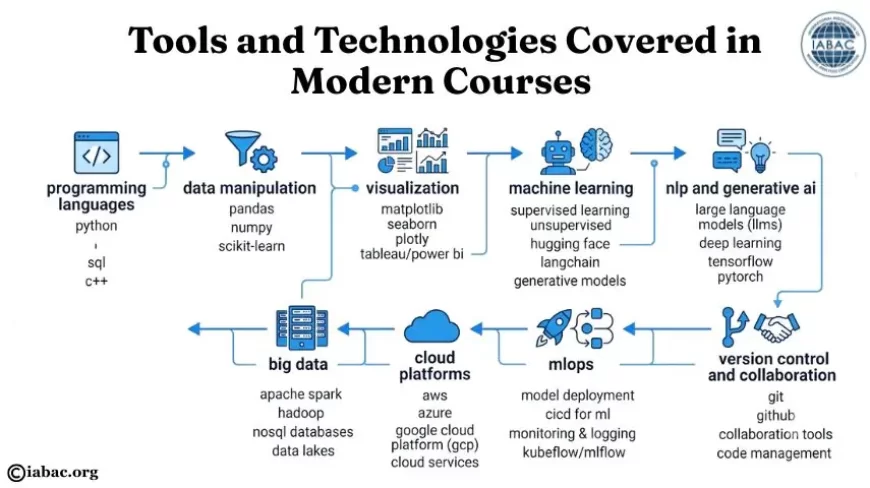
A future-proof AI and Data Science course in 2026 should include hands-on training with:
- Programming Languages: Python (primary), R, SQL
- Data Manipulation: Pandas, NumPy
- Visualization: Matplotlib, Seaborn, Tableau, Power BI
- Machine Learning: Scikit-learn, XGBoost
- Deep Learning: TensorFlow, PyTorch, Keras
- NLP and Generative AI: Hugging Face Transformers, LangChain, prompt engineering frameworks
- Big Data: Apache Spark, Hadoop basics
- Cloud Platforms: AWS SageMaker, Google Vertex AI, Azure Machine Learning
- MLOps: Docker, Kubernetes, MLflow, CI/CD pipelines for model deployment
- Version Control and Collaboration: Git, GitHub, Jupyter/Colab notebooks
The presence of generative AI and MLOps modules is now a strong indicator of a course's currency — programs that stop at "classical" machine learning without addressing deployment and generative systems are increasingly seen as outdated.
9. Implementation Roadmap: How to Choose and Complete a Course Successfully
Step 1 — Clarify Your Goal Are you aiming for a technical role (data scientist, ML engineer) or a strategic role (product manager, executive)? This determines depth versus breadth.
Step 2 — Audit the Curriculum Look for a logical progression: foundations, applied ML, specialization, and a capstone project. Avoid programs that jump straight into advanced topics without grounding in statistics and programming fundamentals.
Step 3 — Verify Certification Credibility Check whether the certifying body has recognized industry standing, transparent assessment criteria, and global acceptance — for example, programs aligned with Data Science Certifications frameworks that are referenced across multiple countries and industries.
Step 4 — Prioritize Project-Based Learning A portfolio of real projects — ideally using public datasets relevant to your target industry — matters more to employers than a certificate alone.
Step 5 — Build a Learning Schedule with Accountability Whether through a cohort-based program, study group, or mentor check-ins, structured accountability significantly increases completion rates.
Step 6 — Apply Skills Immediately Seek opportunities — even small, low-stakes ones at your current job — to apply new skills. This reinforces learning and builds a track record you can reference in interviews.
Step 7 — Pursue Continuous Learning AI and data science evolve rapidly. Treat certification as a milestone, not an endpoint — plan for ongoing skill refreshes, especially in generative AI and emerging tools.
10. Common Failure Points (And How to Avoid Them)
- Skipping fundamentals: Jumping straight to trendy topics like LLMs without understanding statistics or model evaluation leads to shallow, unreliable skills.
- Passive learning: Watching videos without coding along or completing projects rarely translates into job-ready capability.
- Ignoring soft skills: Technical skill alone isn't enough — the ability to communicate findings to non-technical stakeholders is consistently cited by employers as a differentiator.
- Choosing a course based on price alone: The cheapest option is often the most outdated or least supported; value should be measured by outcomes, not just cost.
- No portfolio development: Certificates without demonstrable projects carry less weight in competitive hiring markets.
- Underestimating time commitment: Many learners abandon courses after underestimating the hours required for genuine mastery, particularly while balancing full-time work.
11. Future Trends in AI and Data Science Education
Looking ahead, several trends are shaping how these courses will evolve:
- Agentic AI training: Courses are increasingly incorporating modules on building and managing autonomous AI agents capable of multi-step task execution.
- Domain-specific specialization: Rather than generic data science tracks, expect more industry-specific programs (healthcare AI, financial AI, legal AI) as demand for contextual expertise grows.
- Micro-credentialing: Shorter, stackable certifications that can be combined over time are gaining popularity over single, monolithic programs.
- Emphasis on responsible AI: Regulatory developments globally are pushing ethics, transparency, and bias mitigation from optional modules to core requirements.
- AI-assisted learning tools: Courses themselves are increasingly using AI tutors and personalized learning paths to adapt content to individual learner pace and gaps.
- Greater employer involvement: More companies are co-designing curricula with certification bodies and training providers to ensure direct alignment with real hiring needs.
12. Career Opportunities After Completing a Course
Graduates of well-structured AI and Data Science programs can pursue a wide range of roles, including:
- Data Analyst
- Data Scientist
- Machine Learning Engineer
- AI Research Engineer
- MLOps Engineer
- Business Intelligence Analyst
- AI Product Manager
- AI Ethics and Governance Specialist
- Data Engineer
- AI Consultant
Salary ranges vary significantly by region, seniority, and specialization, but roles requiring machine learning and AI expertise consistently rank among the highest-paid technical positions across industries. Professionals with a recognized Artificial Intelligence Certification alongside demonstrable project experience are typically positioned for faster advancement and stronger negotiating leverage during hiring.
13. Suggested Learning Path
For those starting from scratch, a practical sequence looks like this:
Months 1–2: Python programming, statistics, and SQL fundamentals
Months 3–4: Data visualization and exploratory data analysis
Months 5–6: Classical machine learning algorithms and model evaluation
Months 7–8: Deep learning fundamentals and neural networks
Month 9: Natural language processing and generative AI applications
Month 10: MLOps and deployment basics
Months 11–12: Capstone project, portfolio building, and certification exam preparation
This pacing can be compressed for learners with prior technical backgrounds or extended for those balancing full-time work, but the sequence itself — fundamentals before specialization — should remain consistent regardless of timeline.
The popularity of AI and Data Science courses in 2026 isn't a passing trend — it reflects a genuine, structural shift in how organizations operate, hire, and compete. The convergence of sustained employer demand, accessible and flexible learning formats, recognized global certifications, and the democratizing effect of generative AI tools has created a uniquely favorable environment for learners at every career stage. Whether you're a beginner exploring your first steps into tech, a developer looking to specialize, a marketer seeking a data-informed edge, or an executive aiming for strategic AI literacy, there has never been a more accessible — or more valuable — time to invest in structured, credentialed learning.
Actionable Next Steps
- Define your specific career goal before choosing a course format.
- Audit at least three program curricula for depth, currency, and project-based learning.
- Verify the credibility of any certification body before enrolling.
- Commit to a realistic, accountable learning schedule.
- Begin applying skills to real projects from day one — don't wait until you know enough.
Sources Referenced
- International Association of Business Analytics Certification (IABAC) — Data Science Certification and Artificial Intelligence Certification frameworks
- World Economic Forum — Future of Jobs reports on AI and data-related skill demand
- LinkedIn Emerging Jobs and Workforce reports
- McKinsey Global Institute — reports on AI adoption and workforce impact
- Stanford HAI (Human-Centered Artificial Intelligence) — annual AI Index reports
- Gartner — research on enterprise AI adoption and skills gaps
- U.S. Bureau of Labor Statistics — occupational outlook data for data science and computer/mathematical occupations
- IEEE and ACM publications on machine learning education standards
Disclaimer: Salary figures, statistics, and industry trends referenced in this article are general in nature and should be independently verified against the most current data available, as market conditions evolve rapidly.