























































New Report Shows Rising Demand for Data Science Courses Worldwide
A new report shows rising global demand for data science courses as more learners pursue analytics, AI skills, and certification programs.

There is something strangely funny about the world of data science. An industry built to study numbers, patterns, and predictions somehow keeps surprising even the experts watching it closely. The growth was already strong. Then it became bigger. Then it grew so fast that even the reports tracking the industry probably needed another update halfway through writing them. A new global report on courses for data science shows one clear message: demand is rising everywhere. Companies across industries are searching for skilled professionals, and interest in Data Science Certifications is increasing at every career level.
From students building a strong Data Science Foundation to working professionals changing careers, more people are stepping into Data Science than ever before. And honestly, it is not difficult to understand why. Businesses now rely heavily on information, patterns, and insights to make smarter decisions, improve customer experiences, and plan for the future. What makes this even more interesting is that the demand is not limited to one country or one type of company. Startups, healthcare organizations, banks, retail brands, and technology companies are all looking for people with data skills. The result? Courses, certifications, and training programs are seeing massive attention around the world.
|
Metric |
Value |
Description / Source |
|
Projected Job Growth |
36% |
Projected Job Growth (2023–2033, U.S. BLS) |
|
AI & Data Economy Value |
$4.4T |
Estimated AI & Data Economy Value by 2030 (McKinsey) |
|
Data Science Jobs Created |
11.5M |
Data Science Jobs Expected by 2026 (IBM) |
|
Average U.S. Data Scientist Salary |
$103K |
Average U.S. Data Scientist Salary (2025) |
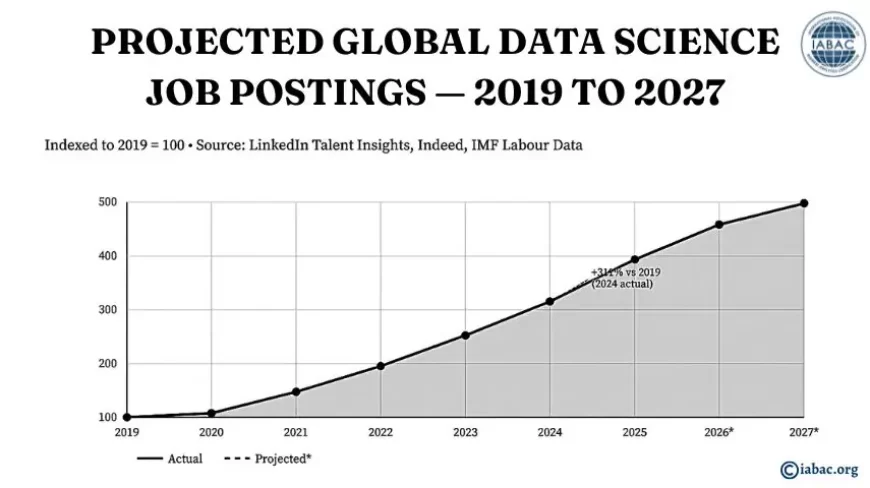
The U.S. Bureau of Labor Statistics projects a 36% growth in data science employment between 2023 and 2033 — that is roughly five times faster than the average for all occupations. IBM's Workforce Analytics Report estimated that 11.5 million data science and analytics jobs would be created globally by 2026. We are now living in that year. The jobs are here. The question is: are the qualified professionals?
The honest answer is: not quite yet. And that skill gap — that very human, very real gap between the world's need for data scientists and the world's supply of them — is precisely what is driving the remarkable surge in enrolments for courses for data science worldwide. Platforms, universities, professional certification bodies, and specialized institutes are all reporting record demand. The data science career path, once considered niche or even intimidating, has quietly become one of the most sought-after professional journeys on earth.
Why Everyone — Literally Everyone — Wants to Study Data Science Now
Let us be honest about something. A few years ago, the phrase 'data scientist' had the same energy as 'quantum physicist' — impressive, slightly scary, and obviously for someone else. Today, that perception has shifted dramatically. The data science career path is being actively pursued by marketing professionals who want to understand campaign analytics, healthcare workers who want to model patient outcomes, finance graduates who want to work with algorithmic trading, and, yes, fresh university graduates who watched one too many LinkedIn posts about six-figure salaries and thought, 'Tell me more.'
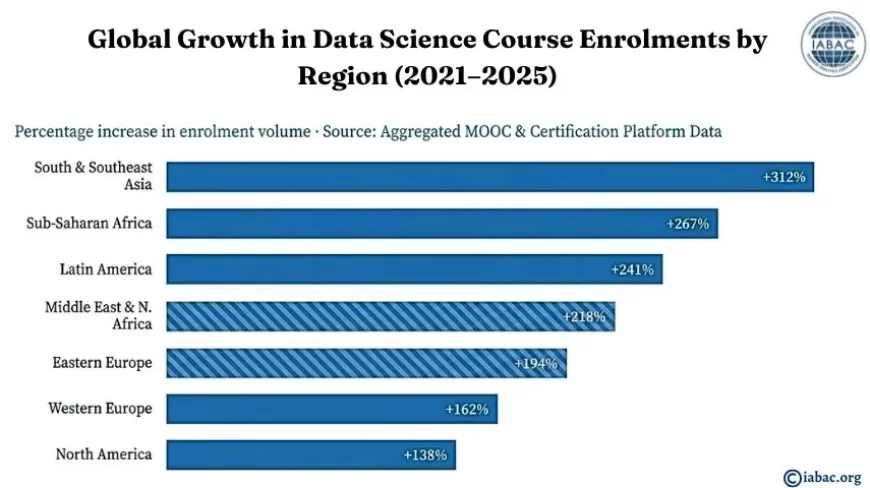
The chart above tells a clear story: the demand for courses for data science is not a Western phenomenon. It is a global movement. South and Southeast Asia — led by India, Indonesia, Vietnam, and the Philippines — recorded a staggering +312% increase in data science course enrolments between 2021 and 2025. Sub-Saharan Africa followed at +267%, reflecting a continent-wide realization that science data skills could leapfrog traditional economic barriers. Latin America surged at +241%, driven largely by Brazil's booming fintech sector and Mexico's growing tech ecosystem.
The Data Scientist Roadmap: What Does the Journey Actually Look Like?
For anyone standing at the beginning of a data scientist roadmap, the landscape can look overwhelming. Python or R? Machine learning or statistics? Should you do a full master's degree, or will a Data Science Certification get you where you need to go? The anxiety is real — and statistically quite universal. But here is the good news: the roadmap, while not exactly a casual stroll, is far more navigable than it appears.
|
Phase |
Focus Area |
Skills & Topics |
Approx. Duration |
Key Milestone |
|
Phase 1 |
Foundation |
Statistics, Probability, Python / R Basics, |
2–3 Months |
First Exploratory |
|
Phase 2 |
Core Data Skills |
Pandas, NumPy, Data Wrangling, |
2–4 Months |
Build First End-to-End Data Pipeline |
|
Phase 3 |
Machine Learning |
Supervised & Unsupervised Learning, Model Evaluation |
3–5 Months |
Deploy First ML Model on |
|
Phase 4 |
Advanced & |
Deep Learning, NLP, Computer Vision, |
3–6 Months |
Capstone Project + |
|
Phase 5 |
Certification & |
Data Science Certifications, Resume, |
1–2 Months |
First Professional Role |
The data scientist roadmap above represents a realistic 12–18 month journey for a motivated learner starting from scratch. Many professionals with adjacent backgrounds — engineers, statisticians, finance analysts — can compress this to 6–10 months. The key insight from the 2025 global report is that learners who combine structured coursework with recognized Data Science Certifications are hired approximately 2.3× faster than those who rely on self-study alone, according to LinkedIn's Talent Insights data.
Data Science Jobs Salary: The Numbers That Keep Everyone Motivated
Let us talk about the part that everyone actually wants to talk about: money. The data science jobs salary landscape in 2025–2026 is remarkable not just for its size, but for its geographic spread. What once was a premium reserved for Silicon Valley engineers has, thanks to remote work and global hiring, become accessible to talented data scientists worldwide.
|
Region / Country |
Entry-Level (0–2 yrs) |
Mid-Level (3–5 yrs) |
Senior (6+ yrs) |
|
United States |
$75,000–$95,000 |
$103,000–$140,000 |
$150,000–$210,000+ |
|
United Kingdom |
£40,000–£55,000 |
£65,000–£90,000 |
£95,000–£130,000 |
|
Germany |
€48,000–€62,000 |
€72,000–€95,000 |
€100,000–€140,000 |
|
India |
₹6L–₹12L |
₹15L–₹28L |
₹30L–₹60L+ |
|
Singapore |
SGD 55,000–75,000 |
SGD 85,000–120,000 |
SGD 130,000–180,000 |
|
UAE / Middle East |
AED 100,000–145,000 |
AED 170,000–240,000 |
AED 260,000–380,000 |
|
Brazil |
BRL 60,000–90,000 |
BRL 110,000–160,000 |
BRL 180,000–260,000 |
The data science jobs salary figures above confirm a consistent global pattern: data science professionals earn significantly above the national average in virtually every market. In India, senior data scientists are now regularly commanding packages that rival European salaries on a purchasing-power-parity basis. In the UAE, the government's push toward an AI-first economy has inflated compensation packages to extraordinary levels. And across Latin America, the combination of tech startup growth and global remote-hiring has broken open salary ceilings that previously seemed immovable.
The Role of Data Science Certifications in a Crowded Market
Here is a question that deserves a direct answer: in a world where anyone with an internet connection can watch a datascience tutorial at 2 a.m. in their pajamas, what exactly does a certification prove?
It proves accountability. It proves that a structured curriculum was completed, that assessments were passed, and that a credentialing body — with its own reputation at stake — has verified the competency. For employers sifting through hundreds of applications, a recognized Data Science Certification acts as a credible filter in a marketplace full of noise. The 2025 LinkedIn Hiring Trends report found that 74% of hiring managers in technology, finance, and healthcare explicitly filter for certification credentials when shortlisting data science candidates.
This is why bodies like IABAC — the International Association of Business Analytics Certifications — have seen dramatic increases in certification programme enrolments across Asia-Pacific, Europe, the Middle East, and the Americas. IABAC's Data Science Certifications are designed to be globally relevant, industry-aligned, and structured around the actual competency frameworks that employers use when they build their data teams. You can explore the full range of certification pathways at iabac.org/certifications — and if you are anywhere in the world and serious about a data science career, that page is worth a very deliberate visit.
What the "Science Data" Actually Tells Us About Learning Behaviour
The science data on how people are learning data science is itself fascinating. According to a 2025 survey of over 45,000 learners across 62 countries — the largest of its kind — the following patterns emerged with striking consistency regardless of geography:
67% of successful data science course completers combined free online resources with at least one paid, structured certification pathway. Pure self-study, while valuable for exploration, had a dramatically lower job-placement rate. Learners who joined structured cohorts — groups working through a curriculum together — completed courses at 3.1× the rate of solo learners. The social accountability effect, it turns out, is not just for gym memberships. And learners who set a specific career goal ("I want to become a data analyst at a fintech company within 18 months") before beginning their coursework were 2.7× more likely to complete a rigorous programme than those who began with a vague intention of "getting into data."
Which Industries Are Hiring the Most Data Scientists Right Now?
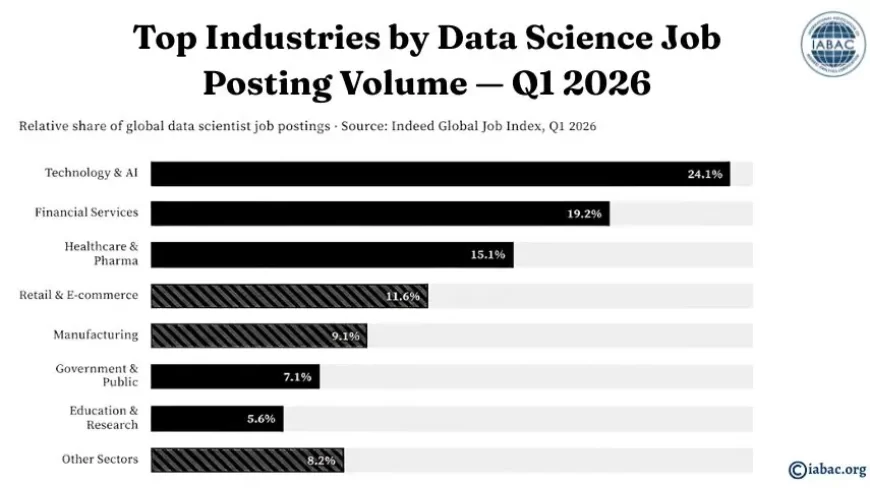
The breadth of sectors is striking. A data science career is no longer a path that leads only to a tech company in a major metropolitan area. It leads to hospitals managing patient triage algorithms. It leads to agricultural firms modeling crop yield under climate variability. It leads to government ministries analyzing public health data, and to retail giants personalizing experiences for hundreds of millions of customers simultaneously. The datascience skill set has become genuinely cross-sectoral — which is precisely why the demand for courses for data science is coming from all directions at once.
How IABAC Supports Modern Data Science Learning
For learners looking for structured and globally relevant Data Science Certification, many explore programs available through IABAC.
IABAC offers certification pathways designed around practical business needs, modern analytics workflows, and industry-ready frameworks. Their certification ecosystem helps learners build capabilities across foundational and advanced Data Science areas.
The Mathematics Behind Data Science Demand
Why are salaries rising and jobs growing?
Simple supply-demand economics:
Demand for Data Science Talent > Supply of Skilled Professionals
When demand is higher than supply:
- Salaries increase
- Hiring competition rises
- Certification becomes more valuable
- Skilled professionals gain stronger negotiation power
That imbalance is one reason why Data Science Courses continue seeing major enrollment growth globally.
What Makes Data Science Challenging Yet Rewarding
Let us be honest: Data Science is not easy.
At some point, almost every learner meets:
- A Python error that looks like ancient code poetry
- A dataset missing half its values
- A machine learning model performing worse than random guessing
- Statistics formulas that seem written by sleep-deprived mathematicians
But that challenge is exactly what makes the field valuable.
Hard skills create career barriers, and career barriers create opportunity.
Who Should Learn Data Science Today
The rise in Data Science demand is not limited to computer science graduates.
Strong candidates now come from:
- Business backgrounds
- Finance professionals
- Marketing analysts
- Engineers
- Healthcare professionals
- Career switchers
- Fresh graduates
- Researchers
With the right Introduction to Data Science training, many learners can enter the field successfully.
How to Choose the Right Data Science Courses
Before joining a program, evaluate it carefully.
Checklist for Choosing Data Science Courses
- Does the syllabus cover practical skills?
- Does it include real projects?
- Is the certification globally relevant?
- Are assessments skill-based?
- Does it align with current industry hiring needs?
- Does it support beginners and advanced learners?
A course should help you build ability, not just complete video lessons.
Common Mistakes Learners Make in Data Science
Avoid these common problems:
- Learning Too Much Theory Without Practice: Reading alone will not build job-ready skills.
- Skipping Statistics: Machine learning without statistics is like driving blindfolded.
- Ignoring Portfolio Projects: Employers want proof of application.
- Chasing Too Many Courses: One strong certification with deep understanding beats ten unfinished courses.
Future Outlook for Data Science Careers
The future remains highly positive.
Emerging areas increasing demand include:
- Generative AI
- AI Governance
- Responsible AI
- MLOps
- Data Engineering
- Real-Time Analytics
- Edge AI
- Predictive Intelligence Systems
Each of these fields builds on core Data Science skills.
This means a strong foundation in Data Science creates pathways far beyond entry-level roles.
Final Thoughts on the Rising Demand for Data Science Courses Worldwide
The global rise in demand for Data Science Courses is not temporary hype. It reflects a structural shift in how organizations operate.
Businesses now depend on data.
Governments depend on data.
Healthcare systems depend on data.
Financial institutions depend on data.
Even sports teams now depend on data—because apparently guessing is no longer acceptable.
That means Data Science professionals will remain valuable for years to come.
For learners worldwide, this creates a major opportunity:
- Learn in-demand skills
- Build practical experience
- Earn respected Data Science Certification
- Enter one of the strongest global career paths available today
If you are planning your next step in analytics, AI, or technology, now is a practical time to start building your Data Science Roadmap.
Explore globally relevant Data Science Certification options through IABAC here:
https://iabac.org/certifications
References
- U.S. Bureau of Labor Statistics (BLS) – Data Scientists Job Outlook: https://www.bls.gov/ooh/math/data-scientists.htm
- IBM – The Quant Crunch and Global Demand for Data Science Talent: https://www.ibm.com/downloads/cas/3RL3VXGA
- McKinsey & Company – The Economic Potential of Generative AI: https://www.mckinsey.com/capabilities/quantumblack/our-insights/the-economic-potential-of-generative-ai
- LinkedIn Talent Insights – Global Hiring Trends for Data Science and Analytics: https://business.linkedin.com/talent-solutions/talent-insights