



















































What Does a Certified AI Business Leader Actually Do in 2026?
What a Certified AI Business Leader does in 2026, including key responsibilities, essential skills, AI governance, strategy, and career opportunities.

The organizations gaining the most value from artificial intelligence in 2026 are not necessarily those with the biggest AI budgets. They are led by people who understand how to connect AI capabilities to business strategy, governance, operations, innovation, and measurable outcomes.
This is where the modern AI business leader comes in.
An AI business leader is no longer a technology specialist sitting on the sidelines. They are executives, managers, transformation leaders, consultants, and decision-makers responsible for ensuring AI delivers business value while remaining ethical, scalable, and aligned with organizational goals.
As AI moves from experimentation to enterprise-wide adoption, businesses need leaders who can bridge the gap between technology teams and business outcomes. This growing demand has also led to increased interest in becoming a Certified AI Business Leader, a professional who possesses both strategic business knowledge and practical AI leadership capabilities.
The Rise of the AI Business Leader in 2026
A 2026 survey of 266 enterprise leaders conducted by Mayfield found that over 40% of large organizations already have AI agents running in production as live systems, making decisions within business workflows. Yet 60% of those organizations still lack a formal AI governance framework. As AI adoption expands faster than organizational readiness, the need for skilled AI business leaders has become increasingly apparent.
Organizations use AI for:
-
Strategic planning
-
Customer experience optimization
-
Marketing automation
-
Supply chain forecasting
-
Financial analysis
-
Talent management
-
Risk management
-
Product innovation
However, deploying AI tools is only a small part of the challenge.
The larger challenge is ensuring AI initiatives:
-
Support business objectives
-
Generate impactful ROI
-
Meet governance standards
-
Gain organizational adoption
-
Scale successfully
This responsibility increasingly falls on AI business leaders.
Unlike data scientists who build models or engineers who deploy systems, AI business leaders focus on creating the environment where AI can produce a sustainable business impact.
What Does an AI Business Leader Actually Do?
The role of an AI business leader combines strategy, transformation, governance, innovation, and leadership.
Their primary responsibility is ensuring AI creates business value rather than becoming another technology experiment.
Key responsibilities include:
|
Responsibility |
Business Impact |
|
AI Strategy Development |
Aligns AI initiatives with business goals |
|
AI Investment Decisions |
Maximizes ROI from AI projects |
|
Cross-Functional Leadership |
Connects business and technical teams |
|
Reduces risk and improves compliance |
|
|
Change Management |
Drives adoption across the organization |
|
Innovation Leadership |
Identifies new growth opportunities |
|
Performance Measurement |
Tracks AI-generated value |
In 2026, successful organizations increasingly view AI leadership as a business capability rather than a technical function.
AI Strategy Is Now a Core Leadership Responsibility
One of the most important responsibilities of an AI business leader is developing and executing an AI strategy.
An effective AI strategy answers questions such as:
-
Where can AI create the greatest value?
-
Which business processes should be automated?
-
Which AI initiatives should be prioritized?
-
How should AI investments be measured?
-
What governance frameworks are needed?
-
How can AI scale across departments?
Without strategic leadership, organizations often end up with disconnected AI projects that generate limited business impact.
Modern leaders focus on building an enterprise-wide AI roadmap rather than pursuing isolated AI experiments.
AI Decision Making in Business Has Become a Leadership Skill
The rise of AI has transformed how executives make decisions.
Instead of relying solely on intuition or historical reports, leaders now have access to:
-
Scenario modeling
-
AI-generated recommendations
-
Automated forecasting
However, effective leaders understand that AI should augment—not replace—human intelligence.
Strong AI decision-making requires leaders to:
-
Evaluate AI recommendations critically
-
Understand data limitations
-
Recognize algorithmic bias
-
Balance automation with human oversight
-
Assess business implications
This blend of analytical thinking and business judgment has become a defining characteristic of modern AI leadership.
AI Governance Is No Longer Optional
As AI adoption grows, governance has become a board-level concern.
Organizations face increasing risks related to:
-
Data privacy
-
Regulatory compliance
-
Ethical AI use
-
Bias and fairness
-
Security vulnerabilities
-
Model transparency
An AI business leader plays a critical role in establishing governance frameworks that ensure responsible AI deployment.
Key Governance Areas
-
AI policies and standards
-
Risk assessment
-
Compliance monitoring
-
Data governance
-
Ethical AI guidelines
-
Vendor management
-
Human oversight mechanisms
Businesses that ignore governance often face operational, legal, and reputational risks that outweigh AI's benefits.
Driving AI Business Transformation Across the Enterprise
AI is no longer limited to one department.
Leading organizations are implementing AI across:
-
Marketing
-
Sales
-
Operations
-
HR
-
Customer Service
-
Product Development
This requires leaders who understand organizational transformation.
An AI business leader must:
-
Identify transformation opportunities
-
Prioritize initiatives
-
Secure executive buy-in
-
Manage change
-
Build adoption programs
-
Measure business outcomes
Successful transformation depends as much on people and processes as it does on technology.
The Most Important AI Leadership Skills in 2026
The best AI leaders possess a unique blend of business, technology, and leadership skills.
-
Strategic Thinking: Leaders must identify where AI aligns with long-term business goals.
-
Business Acumen: Understanding revenue, operations, customer needs, and market dynamics remains essential.
-
Data Literacy: Leaders should understand how AI systems use data and how insights are generated.
-
Change Management: AI adoption often requires significant cultural and operational change.
-
Communication Skills: Leaders must translate technical concepts into business language.
-
Ethical Leadership: Responsible AI implementation demands strong ethical decision-making.
-
Innovation Management: AI leaders continuously identify opportunities for competitive advantage.
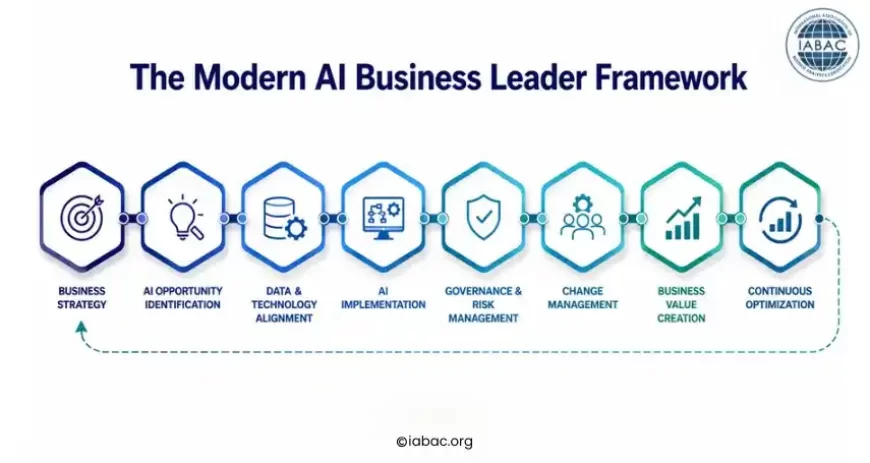
This framework illustrates how AI leadership extends far beyond technology deployment.
How AI for Business Leaders Differs from AI for Technical Teams
A common misconception is that business leaders must become AI engineers.
They do not.
Business leaders need enough AI knowledge to make informed decisions, guide strategy, and evaluate opportunities.
Technical Teams Focus On
-
Model development
-
Algorithms
-
Infrastructure
-
Data engineering
-
System deployment
AI Business Leaders Focus On
-
Business outcomes
-
Investment decisions
-
Adoption strategies
-
Governance
-
Organizational change
-
Competitive advantage
The goal is not coding expertise but strategic AI fluency.
Why Companies Are Hiring Certified AI Business Leaders
As AI becomes a strategic priority, organizations increasingly seek professionals who can lead AI initiatives with confidence.
A Certified AI Business Leader demonstrates expertise in:
-
Business strategy
-
AI governance
-
Digital transformation leadership
-
Organizational adoption
-
AI value realization
Certification helps professionals validate their ability to connect AI technology with real-world business outcomes.
It also provides a structured framework for understanding how AI impacts modern organizations.
How Executive AI Certification Supports Career Growth
The demand for AI-capable leaders continues to accelerate across industries.
Professionals pursuing executive AI certification often work in roles such as:
-
Business Leaders
-
Department Heads
-
Transformation Managers
-
Innovation Leaders
-
Consultants
-
Product Managers
-
Operations Executives
-
Strategy Professionals
-
Entrepreneurs
Organizations increasingly value leaders who can bridge the gap between AI capabilities and business objectives.
This creates significant opportunities for professionals who invest in AI leadership development.
AI Strategy 2026: What the Best Leaders Are Prioritizing
Leading organizations are focusing on five major priorities.
-
AI-Powered Productivity: Automating repetitive tasks and improving workforce efficiency.
-
AI-Augmented Decision Making: Using predictive intelligence to improve strategic planning.
-
Responsible AI: Establishing governance frameworks and ethical standards.
-
Enterprise AI Adoption: Scaling AI across multiple departments.
-
Business Value Measurement: Tracking revenue impact, cost reduction, and operational improvements.
The most successful AI leaders prioritize impactful outcomes over technology hype.
AI Business Leader Competency Model
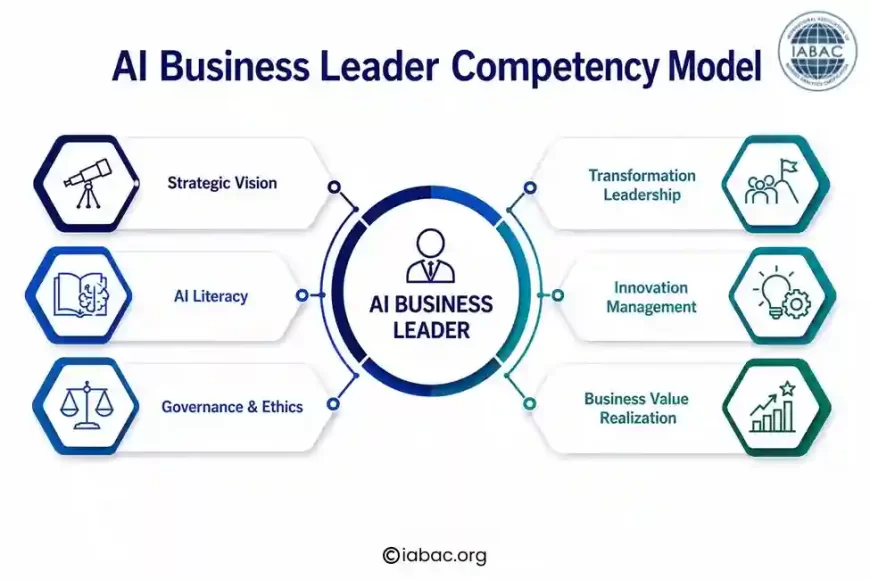
Together, these competencies enable AI business leaders to move beyond technology implementation and lead AI initiatives that create impactful business value.
Is Becoming a Certified AI Business Leader Worth It?
For professionals expected to guide AI initiatives, the answer is increasingly yes.
Organizations need leaders who can:
-
Evaluate AI opportunities
-
Lead digital transformation
-
Govern AI responsibly
-
Drive adoption
-
Create real business value
A recognized certification provides structured learning, credibility, and a practical framework for leading AI-driven business initiatives.
As AI continues to reshape industries, leadership capabilities are becoming just as important as technical expertise.
The Future of Leadership in the Age of AI
The role of business leaders is undergoing a fundamental transformation.
The question is no longer whether AI will impact leadership.
The question is whether leaders are prepared to lead in an AI-powered economy.
The most effective AI business leaders in 2026 are not the ones who know every algorithm. They are the ones who understand how to align AI with strategy, people, governance, and business outcomes.
For professionals looking to develop these capabilities, programs such as the Certified AI Business Leader (CAIBL™) offered by IABAC provide a structured pathway to build the skills needed for leadership in the age of AI.
By combining AI knowledge with business strategy and transformation expertise, today's leaders can position themselves and their organizations for long-term success in an increasingly AI-driven world.