




















































What is Human Intelligence and How Does It Work?
Human intelligence helps people learn, solve problems, think creatively, & make better decisions. Understand how the human brain & intelligence work together.

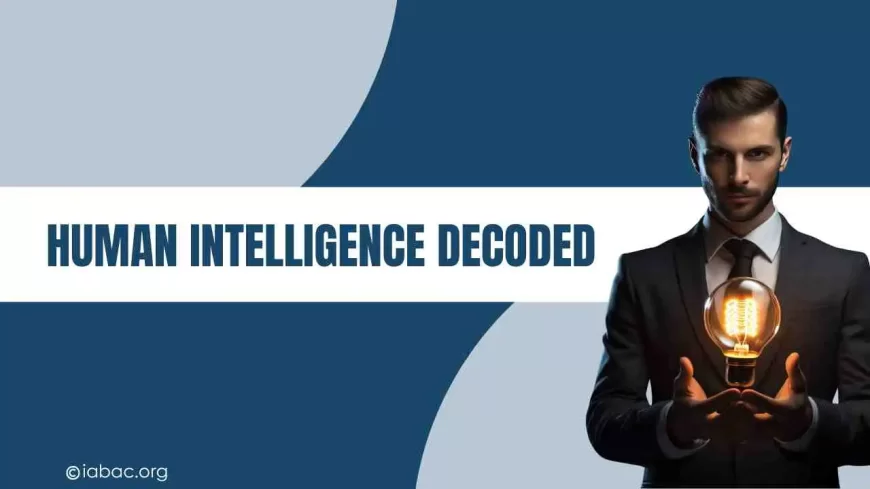
Human intelligence shapes every decision people make, from solving business problems to building relationships, learning new skills, and creating breakthrough innovations.
Yet many people still struggle to define intelligence clearly because it goes far beyond memory or academic performance.
After spending years working around AI, analytics, and workforce transformation, one pattern becomes obvious. The biggest difference between humans and machines lies in how humans connect logic, emotion, creativity, ethics, and experience into one decision-making process.
Understanding human intelligence matters more today because conversations around automation, AI tools, and machine learning continue to grow. Employers increasingly value AI professionals who can think critically, adapt quickly, communicate effectively, and solve complex problems under pressure.
Understanding Human Intelligence
Human intelligence refers to the ability of humans to learn, reason, adapt, solve problems, understand emotions, process information, and apply knowledge across different situations.
Unlike machines that operate through programmed instructions and data patterns, human intelligence combines:
-
Logical reasoning
-
Emotional understanding
-
Creativity
-
Self-awareness
-
Ethical judgment
-
Social interaction
-
Adaptability
The concept of intelligence has evolved significantly over time. Early psychologists measured intelligence mainly through IQ scores.
Modern research shows intelligence includes many interconnected abilities beyond mathematical or linguistic skills.
According to the American Psychological Association, intelligence includes reasoning, planning, problem-solving, abstract thinking, learning from experience, and adapting to changing environments.
How Does Human Intelligence Work?
The human brain contains nearly 86 billion neurons, according to research published by the National Library of Medicine. These neurons communicate through electrical and chemical signals that help humans think, remember, analyze, and react.
The Intelligence Process Inside the Human Brain
Human intelligence functions through multiple cognitive systems working together:
|
Brain Function |
Role in Intelligence |
|
Memory |
Stores and retrieves information |
|
Attention |
Focuses mental energy on tasks |
|
Reasoning |
Evaluates logic and patterns |
|
Emotional Processing |
Interprets feelings and social cues |
|
Decision-Making |
Selects actions based on judgment |
|
Creativity |
Generates original ideas |
|
Learning Ability |
Improves performance through experience |
For example, a marketing strategist analyzing campaign performance uses several layers of intelligence simultaneously:
-
Data interpretation
-
Pattern recognition
-
Emotional understanding of customer behavior
-
Creative thinking for new campaigns
-
Decision-making under uncertainty
Machines can analyze numbers quickly. Humans combine data with context, intuition, and emotional understanding.
That combination remains one of the strongest advantages of human cognition.
The Role of the Human Brain and Intelligence
The relationship between the human brain and intelligence remains one of the most researched topics in neuroscience.
Different regions of the brain contribute to different forms of intelligence.
Prefrontal Cortex
This area handles:
-
Critical thinking skills
-
Planning
-
Decision-making
-
Problem-solving ability
-
Behavioral control
Professionals who lead teams, manage businesses, or negotiate complex decisions rely heavily on this region.
Hippocampus
The hippocampus supports learning and memory formation. Students, analysts, researchers, and educators depend on this process for long-term knowledge retention.
Amygdala
This region processes emotions and emotional responses. It plays a central role in emotional intelligence and social behavior.
Neural Plasticity
One of the most fascinating aspects of human intelligence is neuroplasticity. The brain can reorganize itself through learning and repeated practice.
That means intelligence is not fixed.
People can improve cognitive performance through:
-
Continuous learning
-
Reading
-
Skill development
-
Problem-solving activities
-
Quality sleep
-
Physical exercise
A Harvard Medical School report highlights that regular learning activities help strengthen neural connections linked to memory and cognitive performance.
Types of Human Intelligence
One reason intelligence feels difficult to define is that it exists in many forms.
Psychologist Howard Gardner introduced the theory of Multiple Intelligences, which changed how educators and organizations understand talent and capability.
Here are the major types of human intelligence commonly recognized today.
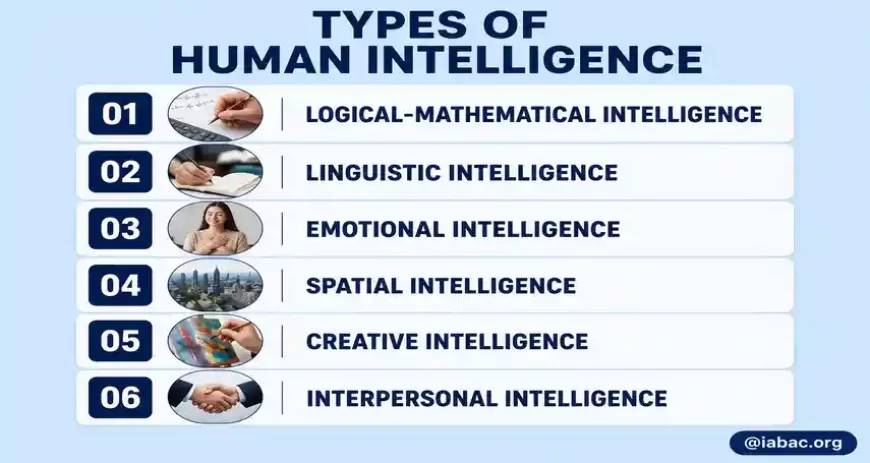
1. Logical-Mathematical Intelligence
This involves:
-
Analytical thinking
-
Pattern recognition
-
Numerical reasoning
-
Structured problem solving
Common among:
-
Engineers
-
Financial professionals
-
Scientists
2. Linguistic Intelligence
This intelligence focuses on:
-
Communication
-
Writing
-
Storytelling
-
Persuasion
-
Language mastery
Strong examples include:
-
Journalists
-
Authors
-
Public speakers
-
Lawyers
3. Emotional Intelligence
Emotional intelligence involves understanding emotions, managing reactions, and building strong relationships.
Daniel Goleman’s work on emotional intelligence transformed leadership development across industries.
Professionals with strong emotional intelligence often:
-
Handle pressure effectively
-
Resolve conflicts calmly
-
Build trust faster
-
Lead teams successfully
According to TalentSmart research, emotional intelligence contributes to nearly 58% of workplace performance across various roles.
4. Spatial Intelligence
This refers to visualizing objects, spaces, and structures mentally.
Common in:
-
Architects
-
Designers
-
Pilots
-
Surgeons
5. Creative Intelligence
Intelligence and creativity often work together. Creative intelligence helps humans generate original ideas and unconventional solutions.
This ability drives:
-
Innovation
-
Entrepreneurship
-
Product design
-
Advertising strategy
-
Artistic expression
A machine can generate patterns from existing data. Human creativity often introduces entirely new concepts.
6. Interpersonal Intelligence
This intelligence helps people understand others effectively.
Key strengths include:
-
Empathy
-
Team collaboration
-
Communication
-
Leadership
Managers, trainers, therapists, and consultants often rely heavily on interpersonal intelligence.
AI vs Human Intelligence
The debate around AI vs human intelligence continues across industries.
Artificial intelligence processes massive amounts of data at extraordinary speed. Human intelligence excels in areas requiring judgment, empathy, ethics, creativity, and adaptability.
Here is a practical comparison.
|
Human Intelligence |
Artificial Intelligence |
|
Learns through experience and emotion |
Learns through data patterns |
|
Applies ethical reasoning |
Operates through programmed objectives |
|
Understands emotional context |
Identifies statistical probabilities |
|
Creates original ideas |
Generates outputs from training data |
|
Adapts naturally to uncertainty |
Requires structured data environments |
For example, an AI tool can identify customer churn patterns in seconds.
A human strategist understands emotional triggers, cultural behavior, market psychology, and brand perception behind those numbers.
That difference matters enormously in leadership, healthcare, education, counseling, negotiation, and innovation.
Human Learning Ability and Cognitive Growth
One of the strongest aspects of human intelligence is adaptability.
The human learning ability allows people to:
-
Learn from mistakes
-
Improve through repetition
-
Transfer knowledge across situations
-
Build intuition over time
A software developer who learns coding principles can later apply logical thinking to business strategy or product development.
Machines generally operate within trained boundaries. Humans transfer learning across domains naturally.
This explains why professionals who continuously learn often outperform technically skilled individuals who stop adapting.
Why Critical Thinking Skills Matter More Today
Modern workplaces increasingly reward professionals who can:
-
Analyze situations independently
-
Verify information
-
Make strategic decisions
-
Communicate ideas clearly
-
Solve unfamiliar problems
These are all components of advanced cognitive computing and intelligence.
Information has become widely accessible. The ability to evaluate information critically has become far more valuable.
This shift explains why employers prioritize:
-
Analytical thinking
-
Decision-making
-
Emotional intelligence
-
Creativity
-
Leadership capability
The World Economic Forum consistently ranks analytical thinking and problem-solving among the top future workforce skills globally.
Modern AI certification programs focused on analytics and AI increasingly emphasize critical thinking, data interpretation, and strategic decision-making because employers value professionals who can combine technical understanding with human judgment.
Common Misunderstandings About Human Intelligence
1. Intelligence Is Only About IQ
IQ matters, though intelligence extends far beyond test scores.
Many highly successful professionals excel because of:
-
Emotional awareness
-
Communication ability
-
Creativity
-
Adaptability
-
Leadership skills
2. Intelligence Cannot Improve
Research on neuroplasticity strongly disproves this idea.
Learning new skills, reading regularly, practicing memory exercises, and solving complex problems can strengthen cognitive function over time.
3. Machines Will Fully Replace Human Thinking
AI systems continue advancing rapidly. Yet human intelligence still dominates areas involving:
-
Ethics
-
Empathy
-
Creativity
-
Relationship building
-
Strategic ambiguity
-
Human-centered leadership
The future likely belongs to collaboration between human intelligence and artificial intelligence rather than replacement.
How to Strengthen Human Intelligence
Improving intelligence involves daily habits rather than shortcuts.
Practical Ways to Improve Cognitive Intelligence
-
Read across multiple subjects
-
Learn new technical and creative skills
-
Practice strategic thinking exercises
-
Improve emotional awareness
-
Engage in meaningful discussions
-
Sleep consistently
-
Exercise regularly
-
Reduce multitasking
-
Solve unfamiliar problems often
Professionals who continuously challenge their thinking patterns usually develop stronger adaptability and decision-making ability over time.
The Future of Human Intelligence
Human intelligence will remain central to innovation, leadership, education, healthcare, and business strategy.
As AI tools become more accessible, uniquely human abilities become even more valuable.
Organizations increasingly seek individuals who combine:
-
Technical understanding
-
Emotional intelligence
-
Critical thinking skills
-
Creativity
-
Ethical judgment
The strongest professionals in the future may not be the people who compete with AI. They may be the people who understand how to work alongside it intelligently.
FAQs
What is human intelligence in simple words?
Human intelligence refers to the ability to learn, think, solve problems, understand emotions, and adapt to different situations using the brain’s cognitive abilities.
How does human intelligence work?
Human intelligence works through interconnected brain functions involving memory, reasoning, emotional processing, creativity, learning, and decision-making.
What are the main types of human intelligence?
Major types include logical intelligence, emotional intelligence, linguistic intelligence, creative intelligence, interpersonal intelligence, and spatial intelligence.
Can human intelligence improve over time?
Yes. Continuous learning, practice, reading, problem-solving, and healthy lifestyle habits can improve cognitive performance and adaptability.
What is the difference between AI and human intelligence?
Human intelligence includes emotional understanding, ethical reasoning, creativity, and adaptability. AI mainly processes data patterns and automation tasks.
Human intelligence remains one of the most powerful and complex capabilities ever studied. It combines reasoning, creativity, emotion, memory, learning, and adaptability into a system that continues evolving throughout life.
Understanding what human intelligence is and how human intelligence works becomes increasingly important as AI reshapes industries and workplaces.
Machines may process information faster. Humans still lead in imagination, empathy, judgment, and innovation.
The future belongs to individuals who strengthen both technical knowledge and deeply human cognitive abilities.
For professionals interested in developing analytical thinking, AI knowledge, business intelligence, and future-ready skills, exploring advanced learning programs through IABAC can help build stronger career adaptability in an evolving digital economy.