




























































How Does Context Engineering Improve AI Responses?
Context engineering improves AI responses by structuring prompts, memory, retrieval, and tools to deliver accurate, relevant, and consistent AI outputs


AI models do not think on their own. They respond based only on the information placed in front of them at that moment. If that information is incomplete, poorly organized, or missing key facts, the response suffers, no matter how advanced the model is.
Context engineering is the practice of fixing this. It shapes what a model sees before it answers, so responses stay accurate, relevant, and useful.
Here's how it actually works and why it matters more than most people realize.
What Is Context Engineering?
Context engineering is the systematic practice of curating and maintaining the right set of information, tokens, tools, and instructions for an AI agent.
It goes beyond basic prompt engineering by giving the AI the exact facts, rules, and context it needs to handle tasks that require multi-step reasoning.
Andrej Karpathy, a well-known voice in applied AI, described context engineering as "the delicate art and science of filling the context window," with the right details added at each step. That description points to something true: this work is both technical and a matter of judgment.
People often mix context engineering up with prompt engineering. Prompt engineering is a smaller piece of this larger practice. It focuses only on how a single instruction is worded. Context engineering covers everything the model sees, not just one message.
Why Context Matters More Than the Model Itself
Many teams assume a stronger model will always give better answers. In practice, the context the model receives often matters more than the model's size or training.
The context window works like the model's short-term memory. It has no memory beyond what is placed inside that window at the time of the request. If the window is missing key facts, poorly organized, or filled with irrelevant details, the model has to guess.
Guessing leads to:
- Inaccurate answers
- Generic responses that miss specific details
- Made-up facts that were never provided
- Responses that miss the actual goal of the request
A smaller model with clean, well-structured context frequently outperforms a larger model with messy or incomplete context. This is why teams building AI products spend as much time on context quality as they do on model selection.
Core Components of Context Engineering
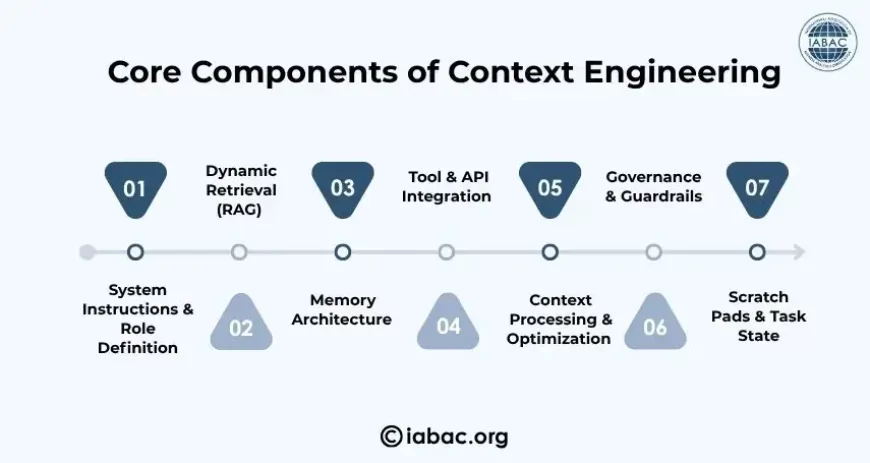
Context engineering rests on several building blocks. Each one plays a distinct role in shaping the final response.
System Instructions & Role Definition
The standing rules, persona, behavioral guardrails, and control flow logic that set the model's core operating principles.
Dynamic Retrieval (RAG)
Frameworks that pull external data, such as vector embeddings from vector databases like Pinecone or Weaviate, graph data, or search APIs, to ground the AI in factual, domain-specific information. Good retrieval is not only about finding the right data. It also depends on how that data is formatted and ordered once it reaches the model. Even accurate, relevant data can get ignored if it is buried or poorly presented inside the context window.
Memory Architecture
Persistent systems that capture short-term conversation states, known as session history, and long-term memory, such as user preferences and past interactions, so the AI keeps continuity across sessions.
Tool & API Integration
Defined functions, parameter definitions, and schemas that let the AI model interact with external tools and take independent actions.
Context Processing & Optimization
Pipelines built to compress, filter, rank, and format information so it fits inside the context window efficiently. This step matters because context windows have a fixed size limit. No matter how much good information exists, only a portion can fit at once, so this step decides what stays and what gets trimmed.
Governance & Guardrails
Rules that keep data access controls, permissions, security, and quality checks in place before information enters the context window.
Scratch Pads & Task State
Temporary workspaces where independent AI agents log their reasoning, to-do lists, and progress markers during multi-step workflows.
How Context Engineering Improves AI Responses
Each component and process step works toward a few clear outcomes. Here is what changes when context is engineered well.
It reduces wrong or made-up answers
When a model lacks specific facts, it fills gaps with guesses that sound correct but are not. Supplying verified, relevant data at the time of the request removes much of that guesswork.
Improves relevance
Well-selected context filters out noise. Instead of handing the model an entire document library, good context engineering narrows the input to what the current task actually needs.
Keeps long conversations consistent
Managed conversation history lets the model remember earlier instructions and prior answers, instead of treating each message as disconnected from the last.
Supports personalization
Including details about the specific user, such as their role or stated goals, lets the model tailor its answer instead of giving a generic response that fits no one well.
It improves accuracy in multi-step tasks
Many AI systems now complete tasks in stages, such as researching a topic and then acting on it. Clean, well-structured input at each stage prevents small errors from carrying forward into the final output.
Prevents context overload
More information is not always better. If a model receives too much at once, important details can get lost. Trimming and prioritizing what gets included keeps the model focused on what matters most.
The Context Engineering Process
Building strong context is not a one-time task. It follows a repeatable process with distinct stages.
Context Selection: Choosing which information to include and removing anything irrelevant or repeated. This step also screens out inaccurate or harmful data before it enters the model's working context.
Context Structuring: Organizing the selected information using clear formats, such as labeled sections or structured data formats, and separating instructions from raw data so the model can read it correctly.
Prompt Design: Framing the instructions themselves, including the rules, constraints, and output format the model should follow.
Context Compression: Fitting more useful information into a limited space through summarizing and removing duplicate content, rather than shrinking the data through technical compression methods.
Context Sequencing: Placing information in the right order. Instructions typically go first, the most relevant facts come next, and older or less important details go further back.
Tool and Memory Integration: Managing how outside tool results get added into context and deciding when the model needs to call a tool because its current context or training data does not cover the answer.
Each stage feeds into the next. Weak selection at the start weakens every stage that follows, no matter how well the later steps are handled.
Context Engineering vs. Prompt Engineering
| Aspect | Prompt Engineering | Context Engineering |
| Focus | Wording of a single instruction | Full information environment around the task |
| Scope | One message | Documents, memory, tools, history, and instructions |
| Goal | Get a specific response from one prompt | Build a system that reliably produces strong responses |
| Example | Rewriting a question for clarity | Deciding which data to retrieve and in what order to place it |
Best Practices for Context Engineering
These practices help keep context clean, relevant, and useful across any system that relies on it.
- Keep context relevant. Include only what the current task needs.
- Prioritize the most important facts and place them where the model is likely to weigh them heavily.
- Summarize long documents instead of feeding entire files.
- Manage conversation memory carefully. Store useful facts, not every message.
- Structure information clearly using headings, labels, or defined sections.
- Test with real scenarios before deploying any system to real users.
- Refresh retrieved data regularly so answers stay current.
Common Mistakes in Context Engineering
Even well-built systems run into the same handful of avoidable problems.
- Overloading the model with unnecessary data, which buries important facts.
- Failing to refresh retrieved information, leading to outdated answers.
- Ignoring conversation history, which causes repeated questions or lost instructions.
- Poor formatting of input data, which makes it harder for the model to find what matters.
- Skipping testing across different scenarios before launch.
Context engineering shapes how accurate, relevant, and useful an AI response turns out to be. By selecting the right information, structuring it clearly, and passing it through a consistent process, teams can reduce wrong answers, support complex workflows, and build AI systems that perform consistently well. As AI systems take on more tasks, the quality of the context behind each response will matter as much as the model generating it.
If you want to build these skills further, an AI certification can help you learn context engineering, prompt design, and related practices in a structured way