


















































Why AI Literacy Is Essential for Career Growth
AI literacy is becoming essential for career growth. Build AI skills, improve decisions, boost productivity, and stay competitive in evolving workplaces.

Key highlights:
- AI literacy has become a career advantage, helping professionals make better decisions, solve problems faster, and contribute more effectively at work.
- Employers increasingly value AI fluency across both technical and non-technical roles, making it a baseline skill for career growth.
- AI-literate professionals stand out by improving productivity, communicating AI-driven insights clearly, and managing AI-related risks responsibly.
- Every industry is being reshaped by AI, creating new opportunities for professionals who understand how to work with AI confidently and responsibly.
- Building AI literacy does not require coding expertise; it requires practical understanding, critical thinking, and the ability to apply AI effectively in real-world work.
The hiring bar has quietly shifted. Across industries, finance, marketing, healthcare, and operations, the professionals moving faster through the ranks share one thing in common: they understand how artificial intelligence works, what it can do, and where it fails.
AI literacy is the foundational ability to work alongside AI systems intelligently, critically, and productively. And right now, most professionals do not have it, which means those who build it are gaining a serious edge.
AI literacy is essential for career growth because it directly determines whether a professional can contribute to, influence, and lead in environments where AI is driving decisions. It is not a bonus skill; it is the new baseline for professional relevance.
What AI Literacy Actually Means
AI literacy is defined as the capacity to understand, evaluate, and effectively use AI tools in real-world contexts. It includes:
- Knowing what different types of AI systems do (generative AI, predictive models, recommendation engines)
- Understanding the limitations and failure modes of AI outputs
- Applying AI tools to solve professional problems
- Recognizing ethical concerns like bias, privacy, and accountability
- Communicating AI-driven insights to non-technical stakeholders
The World Economic Forum has introduced a four-pillar AI literacy framework engaging with AI, creating with AI, managing AI's actions, and designing AI solutions, reflecting how broad and layered the competency truly is. The skill is cross-functional, and it is rapidly becoming a baseline expectation.
The Workforce Shift Is Already Happening
The labor market data is unambiguous. AI is not replacing entire professions overnight, but it is restructuring what gets valued inside every profession.
According to McKinsey, demand for AI fluency has grown sevenfold in just two years, faster than any other skill in US job postings. Meanwhile, the WEF estimates 59% of the global workforce will need reskilling by 2030.
Consider what is changing on the ground:
- Job postings increasingly list AI tool proficiency as a preferred or required skill, even in non-technical roles like HR, content, finance, and operations
- Performance reviews at forward-thinking companies are starting to include how effectively employees leverage AI in their workflows
- Promotions are increasingly going to professionals who can not only do their core job but amplify their output using AI
- Cross-functional projects now regularly involve AI-assisted analysis, and those who cannot engage with the outputs are being sidelined from decision-making
The shift is not hypothetical. A professional who cannot interpret an AI-generated forecast, understand why a recommendation engine made a certain call, or assess whether a generative AI output is reliable is already operating at a disadvantage in collaborative environments.
Why AI Literacy Separates High Performers from the Rest
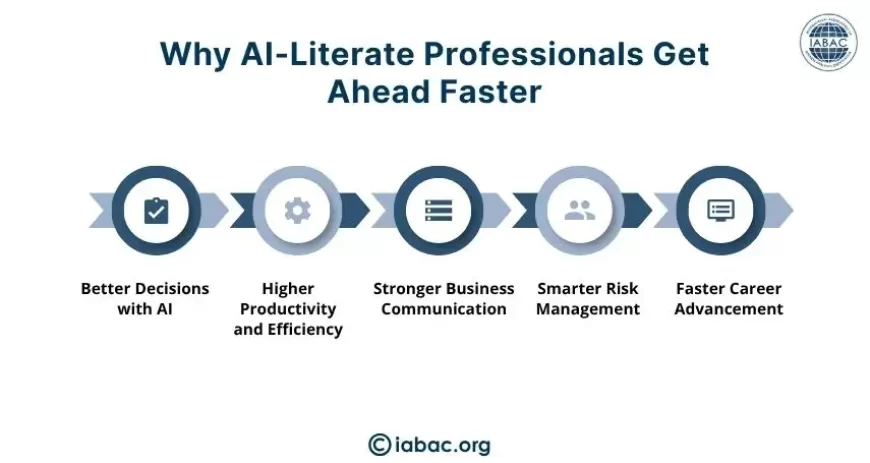
Not all professionals are falling behind at the same rate. The divergence comes down to one variable: how deeply someone understands AI versus how casually they use it. Here is where that difference shows up in practice.
1. Decision Quality Improves Dramatically
AI tools can quickly identify patterns, trends, and predictions from large amounts of data. However, their results still need human understanding and evaluation.
Professionals with AI literacy can:
- Recognize when there is not enough data for accurate predictions
- Identify potential bias in AI-generated results
- Decide when to trust AI recommendations and when to use their own expertise
This ability to evaluate AI outputs leads to better decisions and stronger business outcomes. While AI can provide recommendations, human judgment remains essential.
2. Productivity Gains Compound Over Time
Professionals who integrate AI tools effectively into their workflows do not just save time on individual tasks. They create compounding productivity advantages. A strategist who uses AI to handle research synthesis, data summarization, and draft generation can redirect their cognitive energy to higher-order thinking, relationship building, strategic framing, and creative problem-solving.
Over a year, the output gap between an AI-literate professional and one who avoids AI tools becomes stark. Organizations notice this. Managers notice this. And promotion decisions reflect this.
3. Communication Becomes More Persuasive
One underrated aspect of AI literacy is the ability to communicate AI-driven insights to non-technical audiences. In most organizations, the people making final decisions, C-suite leaders, board members, and senior clients, are not AI experts. They need someone who can translate what the model found into business implications.
An AI-literate professional can bridge this gap. They can explain:
- What the AI analysis revealed and why it matters
- What confidence level is appropriate for the outputs
- What decisions should flow from the findings
This communication skill makes AI-literate professionals disproportionately valuable in cross-functional roles, client-facing positions, and leadership tracks.
4. Risk Management Becomes a Core Competency
AI introduces new categories of professional risk hallucinated outputs, biased recommendations, privacy violations, and model drift. Professionals who lack AI literacy are more likely to miss these risks, or worse, present flawed AI outputs as facts.
An AI-literate professional acts as a quality control layer. They catch errors before they become decisions, flag biases before they become policies, and document AI-assisted processes in ways that protect both the individual and the organization.
In regulated industries, banking, healthcare, and legal services, this risk management capability is not optional. It is a professional requirement.
Industries where AI Literacy Is Creating Career Advantage
The impact of AI literacy is not uniform across sectors, but it is unavoidable in all of them. In some industries the advantage is about speed; in others it is about compliance, trust, or access to higher-value roles. Here is how it is playing out on the ground.
Finance and Banking
Financial analysts who understand AI-based credit scoring, fraud detection, and portfolio optimization models are being positioned for risk management and strategy roles. AI governance and compliance automation skills are in the highest demand in financial services, with a six- to seven-month average time-to-fill for AI positions.
Marketing and Growth
The marketing function has been transformed by AI-powered personalization, content generation, SEO automation, and predictive customer analytics.
Marketers who can work with these tools not just use them superficially, but understand their logic and limitations are driving measurably better campaign results and getting more budget responsibility.
Healthcare and Pharmaceuticals
In the healthcare sector, AI adoption is happening more slowly than in other industries, but the need for AI solutions is acute; healthcare workers are in short supply, and risk-controlled adoption of AI could help plug critical gaps in care.
Clinical professionals and administrators who understand AI-assisted diagnostics and patient risk scoring are becoming essential connectors between medical expertise and technology implementation.
Human Resources
AI is reshaping talent acquisition through resume screening tools, predictive attrition models, and performance analytics. HR professionals who understand how these systems work including their potential for bias are positioned to lead responsible AI adoption within their organizations.
The Confidence Gap: Why Most Professionals Are Still Behind
Despite the clear career case for AI literacy, most professionals are significantly behind where they need to be. There are a few reasons for this:
1. Passive consumption versus active understanding
Many professionals use AI tools (ChatGPT, Copilot, AI-assisted analytics dashboards) without ever developing a conceptual understanding of how they work. Casual usage is not the same as literacy.
2. Fear of appearing non-technical
There is a psychological barrier around AI. Many professionals assume AI literacy requires a technical background, and this assumption keeps them from pursuing it. The reality is that most of the valuable AI literacy for non-technical professionals is conceptual, not computational.
3. Lack of structured learning paths
Most professionals do not know where to start. General AI courses cover too much theoretical ground. On-the-job exposure is too narrow. What is needed is structured, role-relevant AI literacy education, and access to it remains uneven.
4. Organizational lag
Many companies have not yet created formal expectations or training programs around AI literacy. Without organizational pressure, professionals keep doing things the way they always have and fall further behind peers at more progressive companies.
How to Assess Your Current AI Literacy Level
Before learning new AI skills, it helps to know where you already stand. Many people think they are "good with AI" simply because they use it every day. But using AI often is not the same as using it well. To get a true picture, ask yourself:
- Can I explain what an AI tool actually does in my own simple words?
- Am I able to check if an AI's answer is correct before trusting it?
- Do I use AI tools that fit my actual work, or only basic chat apps?
- Would I notice if an AI gave a biased, wrong, or unsafe answer?
If you can answer most of these with a clear yes, you already have a good base to build on. If not, that's fine too; it simply shows you where to focus first.
How to Build AI Literacy Strategically
Building AI literacy does not require a career pivot or a multi-year degree. It requires deliberate, structured effort across three dimensions:
Conceptual Understanding
Start with the fundamentals of how AI systems work. This includes supervised and unsupervised learning, what training data means, how model outputs are generated, and what causes errors or bias. You do not need to code; you need to understand the logic.
Tool Fluency
Develop hands-on familiarity with the AI tools most relevant to your domain. For business professionals, this includes generative AI tools, AI-assisted analytics platforms, and AI features embedded in tools you already use (CRM, ERP, BI platforms). Fluency means knowing how to prompt effectively, evaluate outputs critically, and apply them to real decisions.
Ethical and Critical Framework
Learn to evaluate AI critically, not just use it. This means understanding where AI can be biased, how data privacy works, who is responsible when AI makes mistakes. Professionals with this mindset are the ones organizations trust with high-stakes AI work.
Certification and Credentialing
Structured certification programs that validate AI literacy are gaining recognition among employers. BCG research found a clear threshold: employees who receive at least 5 hours of AI training show significantly higher regular usage and confidence. A recognized credential signals to hiring managers and promotion committees that the professional has built this capability systematically, not just through informal exposure.
AI Literacy Is a Long-Term Career Asset
One of the most important things to understand about AI literacy is that it does not expire quickly. The specific tools will evolve, but the underlying competencies, critical evaluation of AI outputs, understanding of model logic, ethical reasoning, and stakeholder communication will remain relevant regardless of how the technology changes.
Professionals who build genuine AI literacy now are not just optimizing for the current job market. They are building a durable career asset that will compound in value as AI becomes more embedded in every industry and function.
AI literacy is not a technical skill reserved for engineers and data scientists. It is a professional capability reshaping who gets hired, promoted, and trusted with consequential decisions. In every industry, understanding and applying AI intelligently is becoming a baseline expectation.
Structured AI certification programs are one of the most direct ways professionals are building this capability systematically. The professionals pulling ahead in 2026 are not the ones with the longest track records; they are the ones who invested in the right skills early.