





















































Data science has grown into a varied and structured professional sector with various career pathways in analytics, engineering, machine learning, and leadership. Understanding the differences between these roles and how abilities evolve across career stages has become crucial as businesses depend more and more on data-driven insights.
Key career paths in data science, necessary skills, and role-based certification systems that facilitate organized development are all covered in this guide. In a changing data-driven ecosystem, it is intended to assist professionals and learners in making career decisions with clarity, alignment, and long-term focus.
Understanding Data Science Career Paths
Data science is a broad professional ecosystem with several related roles instead of a single job title. These roles vary based on how deeply they focus on data analysis, statistical modeling, machine learning, business decision-making, system design, or research. Selecting a career path that aligns with one's strengths, interests, and long-term goals requires an understanding of these differences.
Common data science job pathways include:
Data Scientist
Data Scientists focus on extracting insights from structured and unstructured data using statistical methods, machine learning algorithms, and predictive modeling. They often work on forecasting, recommendation systems, risk modeling, and optimization problems. This role requires strong foundations in statistics, programming, and analytical thinking, along with the ability to communicate insights to non-technical stakeholders.
Data Analyst
Data Analysts focus on interpreting historical data to support operational and strategic decisions. Their work typically includes data cleaning, descriptive analysis, visualization, dashboard creation, and reporting. While this role may involve less advanced modeling than data science, it plays a critical role in business intelligence and decision support.
Machine Learning Engineer
Machine Learning Engineers specialize in designing, building, deploying, and maintaining machine learning models in production environments. Their work bridges data science and software engineering, emphasizing scalability, performance, and reliability. This role demands strong programming skills, system design knowledge, and experience with ML frameworks and deployment pipelines.
Business Analyst
Business Analysts act as a bridge between technical teams and business stakeholders. They focus on translating business problems into data-driven questions, defining requirements, and ensuring that analytical outputs align with organizational goals. Domain knowledge and communication skills are especially important in this role.
AI Specialist
AI Specialists work on advanced artificial intelligence systems, including deep learning, natural language processing, computer vision, and generative models. These roles are often research-intensive and require a deep understanding of algorithms, mathematics, and emerging AI technologies.
Data Engineer
Data Engineers design, build, and manage the infrastructure that enables data collection, storage, processing, and accessibility. They focus on data pipelines, databases, cloud platforms, and big data frameworks. Without robust data engineering, data science initiatives cannot scale effectively.
Analytics Consultant
Analytics Consultants apply data science and analytics expertise to solve complex business problems for clients. This role requires strong problem-solving abilities, industry understanding, and the capacity to deliver actionable insights under real-world constraints.
Research Analyst
Research Analysts focus on experimentation, hypothesis testing, and exploratory analysis, often in academic, policy, or R&D settings. Their work emphasizes rigor, reproducibility, and methodological soundness.
Each role differs in its balance of technical depth, business context, and system complexity, and many professionals move between these roles as their careers evolve.
Entry-Level to Advanced Career Progression
A data science career typically unfolds across multiple stages, each building upon the skills and experience developed in earlier roles. Understanding this progression helps learners set realistic expectations and plan their development strategically.
Beginner / Entry-Level Roles
At the entry level, professionals focus on:
-
Data preparation and cleaning
-
Exploratory data analysis
-
Basic statistical analysis
-
Creating reports and visualizations
-
Supporting senior team members
These roles emphasize learning how real-world data behaves, understanding business problems, and developing disciplined analytical habits. Entry-level positions build the foundation for more advanced work by reinforcing core concepts and practical exposure.
Mid-Level Roles
Mid-level professionals take on greater responsibility and autonomy. They:
-
Work with larger and more complex datasets
-
Build and evaluate predictive models
-
Automate analytical workflows
-
Collaborate closely with cross-functional teams
-
Contribute to strategic decision-making
At this stage, professionals are expected to understand not just how models work, but why they matter in a business or operational context.
Senior and Specialist Roles
Senior professionals and specialists lead high-impact initiatives. Their responsibilities include:
-
Designing advanced analytical or AI systems
-
Defining technical and analytical standards
-
Mentoring junior team members
-
Leading projects or teams
-
Aligning data initiatives with organizational strategy
This progression highlights the importance of continuous learning, experience-based judgment, and skill validation throughout a data science career.
Skills Required for a Career in Data Science
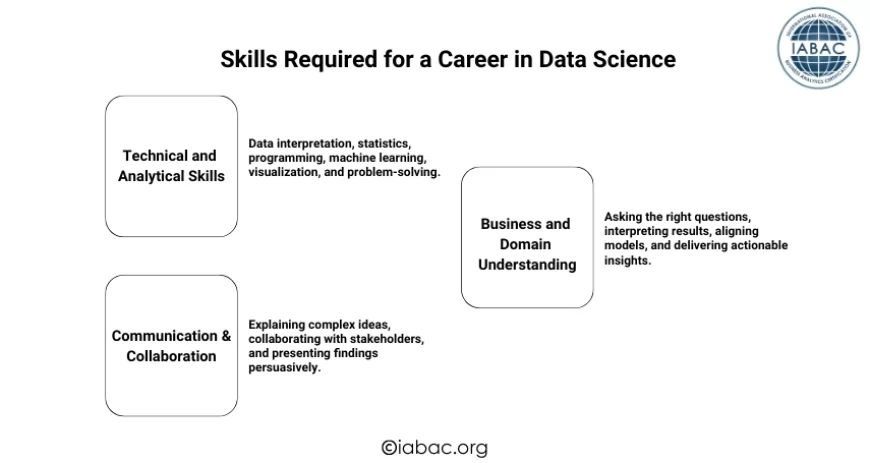
Successful data science professionals develop a balanced skill portfolio that combines technical expertise with analytical reasoning and effective communication.
Technical and Analytical Skills
Key competencies include:
-
Data interpretation and analytical thinking
-
Statistics and probability fundamentals
-
Programming and scripting concepts
-
Machine learning principles
-
Data visualization and storytelling
-
Problem-solving and logical reasoning
These skills enable professionals to transform raw data into meaningful insights and reliable solutions.
Business and Domain Understanding
Understanding the domain in which data is applied is equally important. Domain knowledge allows data professionals to:
-
Ask the right questions
-
Interpret results correctly
-
Align models with real-world constraints
-
Deliver insights that drive action
Communication and Collaboration
Data science rarely happens in isolation. Professionals must:
-
Explain complex ideas clearly
-
Collaborate with engineers, managers, and stakeholders
-
Present findings in an accessible and persuasive manner
The necessity for structured skill development is reinforced by the fact that these skills change over time and differ by role and specialization.
Role of Certification in Data Science Careers
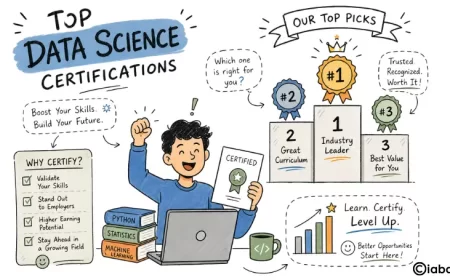
Certifications play an important role in validating knowledge, demonstrating commitment, and providing structured learning pathways, particularly in a competitive job market.
A well-designed certification helps learners:
-
Build a clear and guided learning roadmap
-
Validate foundational and advanced skills
-
Improve employability and professional credibility
-
Demonstrate commitment to continuous growth
-
Align learning with recognized industry standards
Certifications are especially valuable for beginners, career switchers, and professionals seeking formal recognition of their expertise.
Choosing the Right Data Science Certification
Not all certifications offer equal value. When selecting a certification, learners should consider:
-
Alignment with industry-relevant skills
-
Coverage of both theory and practical application
-
Assessment rigor and evaluation standards
-
Recognition and credibility in the job market
-
Structured progression paths across levels
-
Flexibility for working professionals
A strong certification framework emphasizes competence and application, not just course completion or tool familiarity.
IABAC Role-Based Data Science Certification Framework
Modern certificates are becoming more focused on industry alignment and role specialization rather than standard qualifications to facilitate organized career advancement. This role-based approach is reflected in the following IABAC-aligned certification pathways, which allow professionals to authenticate skills at different stages of their data science journey.
Data Science Foundation
The Data Science Foundation certification serves as the entry point into the data science ecosystem.
Focus Areas:
-
Data literacy and analytical thinking
-
Basic statistics and probability
-
Introduction to data structures and datasets
-
Understanding the data science lifecycle
-
Business problem framing
Who It Is For:
-
Beginners and students
-
Career switchers exploring data science
-
Non-technical professionals building data fluency
This certification establishes a strong conceptual base and prepares learners for specialized or advanced certifications.
Certified Data Science Developer
The Certified Data Science Developer certification emphasizes hands-on implementation and applied analytics.
Focus Areas:
-
Programming for data analysis
-
Data preprocessing and feature engineering
-
Implementing basic machine learning models
-
Working with real-world datasets
Who It Is For:
-
Aspiring data scientists
-
Data analysts moving toward modeling roles
-
Early-career professionals seeking applied skills
This certification bridges the gap between foundational knowledge and real-world development work.
Certified Machine Learning Expert
The Certified Machine Learning Expert certification validates deeper expertise in model building and evaluation.
Focus Areas:
-
Supervised and unsupervised learning algorithms
-
Model evaluation and optimization
-
Feature selection and tuning
-
Applied machine learning problem solving
Who It Is For:
-
Mid-level data scientists
-
Machine learning practitioners
-
Professionals specializing in predictive modeling
This certification signals strong modeling competence and analytical maturity.
Certified Data Scientist
The Certified Data Scientist certification represents a comprehensive validation of end-to-end data science capability.
Focus Areas:
-
Advanced statistics and analytics
-
Machine learning and predictive modeling
-
Data-driven decision-making
-
Translating insights into business impact
Who It Is For:
-
Practicing data scientists
-
Professionals handling full analytical pipelines
-
Candidates seeking role credibility and recognition
It reflects readiness to operate independently on complex projects.
Certified Data Scientist – Operations
The Certified Data Scientist – Operations track focuses on operationalizing data science solutions.
Focus Areas:
-
Model deployment and monitoring
-
Data pipelines and workflows
-
Performance tracking and lifecycle management
-
Collaboration with engineering and DevOps teams
Who It Is For:
-
Professionals working on production systems
-
Data scientists involved in deployment and scaling
-
Teams supporting operational analytics
This certification aligns closely with real-world enterprise environments.
Certified Data Scientist – Finance
The Certified Data Scientist – Finance certification specializes, skills for financial applications.
Focus Areas:
-
Financial data modeling
-
Risk analytics and forecasting
-
Fraud detection and compliance analytics
-
Time-series analysis
Who It Is For:
-
Finance and banking professionals
-
Risk analysts and quantitative analysts
-
Data scientists in financial institutions
It validates domain-specific expertise alongside analytical rigor.
Certified Data Scientist – HR
The Certified Data Scientist – HR certification applies data science principles to people analytics.
Focus Areas:
-
Workforce analytics
-
Attrition and retention modeling
-
Performance and engagement analysis
-
Ethical considerations in HR data
Who It Is For:
-
HR analytics professionals
-
Business analysts in people operations
-
Data scientists working with HR datasets
This specialization reflects the growing importance of data-driven human capital management.
Certified Data Scientist – Marketing
The Certified Data Scientist – Marketing certification focuses on customer and market analytics.
Focus Areas:
-
Customer segmentation and profiling
-
Campaign performance analytics
-
Churn and lifetime value modeling
-
Marketing attribution models
Who It Is For:
-
Marketing analysts
-
Growth and CRM professionals
-
Data scientists in digital marketing and e-commerce
It aligns analytics skills with revenue and customer-centric decision-making.
Data Science Certified Manager
The Data Science Certified Manager certification targets leadership and managerial roles.
Focus Areas:
-
Analytics strategy and governance
-
Team leadership and project management
-
Translating analytics into business outcomes
-
Ethical and responsible data practices
Who It Is For:
-
Data science managers
-
Analytics leaders
-
Professionals transitioning into leadership roles
This certification validates strategic oversight rather than technical execution alone.
Certified Data Engineer
The Certified Data Engineer certification focuses on data infrastructure and engineering capabilities.
Focus Areas:
-
Data pipelines and ETL processes
-
Databases and data warehouses
-
Big data frameworks
-
Cloud-based data systems
Who It Is For:
-
Data engineers
-
Backend and platform engineers
-
Analytics infrastructure specialists
This role is foundational to scalable data science ecosystems.
Certified MLOps Engineer
The Certified MLOps Engineer certification validates expertise in managing the machine learning lifecycle.
Focus Areas:
-
Model deployment and automation
-
CI/CD for machine learning
-
Monitoring, retraining, and versioning
-
Collaboration between data science and engineering
Who It Is For:
-
Machine learning engineers
-
MLOps practitioners
-
Data scientists working in production environments
This certification reflects one of the fastest-growing specializations in modern data science.
Career Growth and Long-Term Opportunities
Data science careers offer exceptional long-term growth and adaptability. As professionals gain experience, they may transition into leadership, strategy, or specialized roles such as:
-
Data Science Manager
-
AI Architect
-
Analytics Lead
-
Research Scientist
-
Chief Data Officer
-
AI Strategy Consultant
These roles require not only technical mastery but also leadership, ethical awareness, and strategic thinking. Continuous learning and domain specialization play a critical role in sustaining long-term success.
Why Career Planning Matters in Data Science
Without a clear roadmap, learners often struggle with:
-
Choosing the right tools or courses
-
Understanding role expectations
-
Managing skill overload
-
Measuring progress effectively
A structured career path helps individuals:
-
Focus on relevant competencies
-
Track development milestones
-
Align learning with professional goals
-
Make informed certification decisions
Career planning transforms data science learning from an exploratory activity into a purpose-driven journey.
A data science career is not defined by a specific role, tool, or certification. It is shaped by continuous learning, flexibility, moral accountability, and smart career planning. In a data-driven world, knowing available career routes and certification frameworks helps people to make informed decisions, stay clear of typical errors, and create long-lasting, future-ready professions.
This sub-pillar connects desire with structure, learning with application, and skill development with long-term career advancement, providing a fundamental framework for navigating the changing landscape of data science professions.