























































5 Questions Every CEO Should Ask Before Investing in AI
Before investing in AI, ask these 5 critical questions. Learn how CEOs can avoid costly mistakes, assess AI readiness, and maximize ROI.


95% of enterprise AI pilots fail. The difference isn't the algorithm — it's the questions asked before the contract is signed.
Boardrooms across the world are moving fast on AI. McKinsey's 2025 State of AI report found that 88% of organisations now use AI in at least one business function. The budgets are there. The vendor demos are polished. The pressure from the board to 'do something with AI' has never been louder.
And yet, the results tell a different story.
MIT's landmark report, The GenAI Divide: State of AI in Business 2025, reviewed 300 public AI deployments and surveyed 350 employees across enterprises. Its conclusion was stark: despite $30–40 billion in enterprise investment, only five percent of AI initiatives are producing measurable returns. Separately, S&P Global data shows that 42% of companies scrapped most of their AI projects in 2025 — up from just 17% the year before.
Here is the uncomfortable truth every CEO needs to hear: this is not a technology problem. It is a leadership problem. The most common misstep, confirmed by IBM, BCG, and McKinsey alike, is starting with the technology instead of the business objective.
"The difference often lies not in the algorithm, but in the questions asked before signing the first contract."
-Adilson Galleti, founder of RedWolf AI, writing for IT Inside Online
The CEOs who are winning with AI — the ones in the 5% generating real returns — are not necessarily spending more. They are asking sharper questions before the first dollar is committed. Here are the five questions that separate disciplined AI investment from expensive experimentation.
Question 01
What Specific Business Problem Are We Actually Solving?
Start here, and start here every time. Not with the tool. Not with the vendor. Not with a competitor's case study. With the problem.
AI is not a strategy — it is an instrument. The organisations that generate the clearest returns are those that focused on a small set of high-impact use cases rather than broad experimentation. They did not ask 'how can we use AI?' They asked 'what is costing us the most, and can AI help fix it?'
Experts at Return on AI Institute describe this as the 'Outcome First, AI Next' framework — a deliberate inversion of how most companies approach the question. Instead of starting with AI capabilities and searching for applications, you begin with desired business outcomes and work backward to identify whether AI is the right tool.
The pilot trap is a real and insidious risk. Enterprises ran dozens of proofs-of-concept in 2025 while failing to ship a single production system at scale. AI Head at esynergy Prasad Prabhakaran captured it precisely: they 'mistook Proof of Concept activity for progress.'
The antidote is brutal clarity upfront. Before any vendor is called, ask your team to write the business problem in one sentence — without using the word 'AI.' If they struggle, the investment is not ready to proceed.
CEO SELF-CHECK
"Can my team define the specific business problem we're solving in one sentence — without mentioning AI?"
Question 02
Is Our Data Actually Ready for This?
AI does not fix bad data. It amplifies it. If your data is inaccurate, siloed, or inconsistently governed, your AI initiative will produce inaccurate, siloed, and inconsistently governed outputs — at scale, and at speed.
Wipro's State of Data4AI 2025 report found that only 14% of business leaders believe their data maturity can support AI at scale. Yet 79% believe AI is essential to their company's future. That gap — between ambition and readiness — is where most AI investments quietly die.
The structural culprits are consistent across industries: siloed systems, unclear data ownership, and legacy governance models that were never designed for AI's volume or velocity. An AI implementation specialist cited in a 2026 AI & Data Insider analysis put it bluntly: 'Many leaders treated GenAI as a plug-and-play solution. Historical biases in training data amplified inequities in sectors like healthcare and finance, turning promising projects into costly liabilities.'
A data readiness assessment is not optional — it is a prerequisite. It belongs on the agenda before the AI strategy discussion, not running parallel to it. If your CTO or CDO cannot tell you with confidence where your data lives, who owns it, and how clean it is, that is the first project to fund. Not the AI pilot.
CEO SELF-CHECK
"If we turned AI on tomorrow, what data would it use — and do we trust it enough to make business decisions with it?"
Question 03
Do We Have the People to Make This Work?
This is the question most CEOs underestimate. Not because they ignore it — most say talent is critical — but because they underestimate exactly where the people problem shows up.
It is not usually at the top. Leadership is generally aligned. It is not usually at the bottom. Engineers and analysts are often excited. The drag happens in the middle layer: operations managers, team leads, and department heads whose cooperation is essential for AI to embed into real workflows — and who are often the last to be consulted and the first to resist.
The KPMG 2025 Global CEO Outlook, surveying more than 1,300 global leaders, found that 70% of CEOs are concerned about competition for AI talent and 77% highlight workforce upskilling as a challenge. Bessemer's AI upskilling research is equally direct: 64% of CEOs believe succeeding with AI depends more on people's adoption of the technology than on the technology itself.
The upskilling gap is structural. Only 35% of leaders report having a mature, organisation-wide AI upskilling programme. Most training is fragmented, optional, and disconnected from actual job tasks — which Deloitte's 2026 State of AI in the Enterprise report identifies as the single biggest barrier to AI integration.
IABAC EXPERT PERSPECTIVE
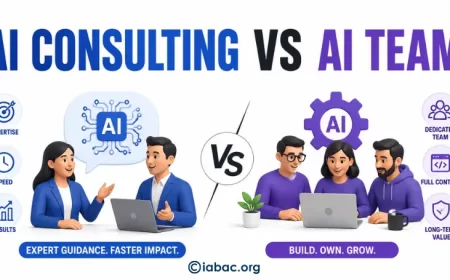
This is precisely why many forward-thinking organisations are working with AI certification and consulting partners like IABAC (iabac.org/ai-consulting) to bridge the skills gap systematically — before or alongside AI deployment, rather than discovering the talent problem after the vendor contract is signed. Structured AI readiness programmes, role-specific certifications, and advisory support help organisations build the internal capability that determines whether a pilot becomes a production system or a costly line item in a post-mortem report.
MIT's research adds one more dimension: purchasing AI tools from specialised vendors and building external partnerships succeeds about 67% of the time, while internal builds succeed only one-third as often. Most organisations simply cannot build fast enough in-house. The question is not build vs. buy — it is whether your people are ready to use whatever you deploy.
CEO SELF-CHECK
"Who inside our organisation will champion this day-to-day — and are they genuinely empowered, trained, and supported to do so?"
Question 04
How Will We Measure ROI — and On What Timeline?
Traditional ROI frameworks were not built for AI. AI investments can reduce costs, increase revenue, enable entirely new business models, or create strategic options that are difficult to quantify in a quarterly earnings framework. This ambiguity is not an excuse for vagueness — it is a warning that the CEO must be more precise about measurement than usual, not less.
Gartner's 2025 CIO survey found that 56% of AI projects fail to deliver expected ROI within two years, mostly due to unrealistic expectations or poor planning. The problem often begins with how success is defined — or more accurately, how it is not defined until after the budget has been spent.
There is a persistent misalignment in where companies spend AI budgets. MIT's research found that more than half of generative AI budgets flow toward sales and marketing tools. Yet the highest and most consistent returns sit in back-office automation — eliminating BPO costs, cutting external agency spend, and streamlining operations. Companies keep funding the most visible use cases while ignoring the ones that actually pay for themselves.
BCG's research adds a structural point. AI leaders commit 20% or more of their digital budgets to AI and invest 70% of their AI resources in people and processes rather than technology alone. They are not just buying tools. They are building operating models.
The discipline required here is simple but rare: define your KPIs before development begins. Set a number. Assign it to a business outcome. Establish a timeline. If the project cannot be measured against something meaningful at the 12-month mark, it is not a strategy — it is a bet.
CEO SELF-CHECK
"If this AI project runs for 12 months, what specific number must move — and by how much — for us to consider it a success?"
Question 05
What Are the Risks — and Who in Our Organisation Owns Them?
AI risk is not a technical matter. It is a strategic, reputational, legal, and competitive matter — and it sits squarely on the CEO's desk, whether they want it there or not.
EY's October 2025 Responsible AI Pulse Survey delivered a figure that should end any conversation about whether AI governance can wait: 99% of surveyed companies reported financial losses from AI-related risks. Of those, 64% experienced losses exceeding $1 million. Only 12% of C-suite leaders could correctly identify the appropriate controls for five key AI risks.
AI risk is multidimensional in ways that traditional enterprise risk frameworks do not adequately capture. Technical risks include model failure and unreliable outputs in high-stakes decisions. Reputational risks emerge when AI produces discriminatory decisions in hiring, lending, or healthcare. Regulatory risks are expanding rapidly, with the EU AI Act, India's DPDP Act 2023, and GDPR creating overlapping obligations with real penalties. And competitive risks cut both ways: moving too slowly cedes ground, but moving without governance invites the kind of headline that erases brand equity overnight.
The governance question is ultimately about accountability. AI decisions need owners. When a customer is denied credit by an algorithm, or a supplier contract is auto-renewed in error, or a predictive model produces a biased shortlist — who in your organisation is responsible for that outcome? And does that person have enough authority to say no to a deployment before it goes live?
Experts advise that as organisations move toward agentic AI — systems capable of making and executing decisions autonomously — this question becomes exponentially more critical. The line between AI assisting a decision and AI making a decision is one that every CEO needs to draw consciously, not discover in a crisis.
CEO SELF-CHECK
"Who in our organisation is responsible for AI governance today — and do they have the authority, resources, and mandate to say no?"
The CEO's AI Investment Checklist
- Define the problem first. Can your team articulate the business problem in one sentence without mentioning AI? If not, pause.
- Audit your data before your tools. Commission a data readiness assessment. Know where your data lives, who owns it, and how trustworthy it is.
- Identify your internal champion. Find the operational leader who will own adoption — not just the CTO who owns implementation.
- Set KPIs before development starts. Define the metric, the baseline, and the target. No measurement framework, no budget approval.
- Assign AI governance ownership. Name the person responsible for AI risk. Give them authority, not just accountability.
The Window Is Narrowing — But the Rush Is Still the Enemy
There is a real cost to waiting on AI. BCG's 2025 research paints a picture of a market splitting in two: a small group of companies investing with clear direction, building data advantages, and pulling ahead — while the majority are still running pilots that go nowhere.
But urgency without discipline is how the 95% statistic is created. The companies generating real returns are not moving faster than everyone else. They are moving more deliberately. They defined the problem. They tested their data. They invested in their people before their platforms. They set measurable goals and assigned governance.
These five questions are not a checklist to slow you down. They are the foundation that lets you move fast without having to retrace expensive steps twelve months from now.
IABAC EXPERT PERSPECTIVE
If your organization is at the early stages of an AI investment decision — or trying to understand why a previous initiative stalled — IABAC's AI consulting and certification programmes are designed to give leadership teams the strategic clarity and workforce readiness to bridge the gap between AI ambition and AI outcomes. Visit iabac.org/ai-consulting to start the conversation.