
















































Best Data Science Certifications in 2026: Top Picks Ranked
The best data science certifications in 2026. Compare top-ranked programs, key skills, career benefits, and certification value.

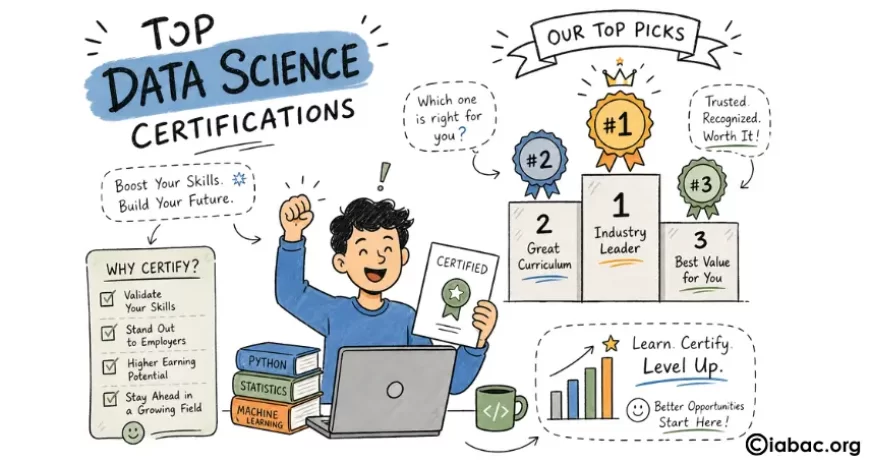
The best data science certifications in 2026 are not all built from the same foundation, and that distinction matters more than most comparison guides acknowledge. The data science certification market is genuinely overcrowded. Bootcamps, platform certificates, vendor exams, and international credentialing bodies all compete for the same search real estate, and many comparison articles treat a Google beginner certificate and a structured professional credential as interchangeable products. They are not.
This ranking evaluates the strongest data science certifications across four dimensions: employer recognition, curriculum rigor, project requirements, and career ROI. The list covers beginners, career switchers, domain professionals, and cloud-focused engineers. One credential on this list is anchored to the European Commission's Edison® Data Science Framework, a structural distinction most US professionals haven't seriously evaluated yet. Here's what each certification actually delivers, what it costs, and who it's built for.
How we evaluated every certification on this list?
Ranking certifications by marketing budget or platform popularity produces a useless list. This evaluation uses a different approach.
Employer recognition was assessed by examining how frequently credentials appear in job postings as preferred qualifications, whether the brand association carries weight with hiring managers, and whether the credential appears as a hard requirement or a soft nice-to-have. Brand recognition and assessment quality are not the same thing, and this ranking treats them separately.
Curriculum rigor and project requirements matter because there is a meaningful difference between a certificate issued after completing video modules and one that requires a proctored assessment or a hands-on capstone project. That distinction matters at mid-level hiring, where technical interviewers push for demonstrated applied skills rather than completion badges.
Cost and time commitment vary significantly across this list. Entry-level platform certificates run around $39/month on subscription models (based on Coursera listings for IBM and Google programs). Cloud vendor exams vary by region, AWS Specialty costs $300 per sitting, while Microsoft exam fees differ by market. More structured programs carry higher flat-fee costs. Whether that investment makes sense depends on your goal: an immediate job application credential or a long-term career positioning asset.
Best data science certifications for beginners and career switchers
If you're entering data science with no formal background, or switching from an adjacent field like marketing, finance, or operations, the goal is to build foundational skills and portfolio evidence at the same time.
1) IBM Data Science Professional Certificate
At approximately $39/month on Coursera with no prerequisites, the IBM Data Science Professional Certificate is one of the most accessible entry points in the market. Most learners complete it in three to six months, covering Python, SQL, data wrangling, machine learning basics, and an applied capstone designed for a GitHub portfolio. The capstone requirement gives it more practical credibility than purely quiz-based programs; you can explore relevant capstone listings on Coursera to get a sense of applied project expectations: Coursera capstone courses. The honest limitation: it is a platform credential, not an independent accreditation. IBM and Coursera define the scope internally, without external competency standards.
2) Google Data Analytics Professional Certificate
Google's certificate runs on the same Coursera subscription model and carries strong brand recognition, particularly for analytics-heavy roles where R, Tableau, and spreadsheet proficiency matter. Career switchers targeting data analyst positions will find it a credible starting credential. One important clarification: this is an analytics certificate, not a machine learning or AI-focused credential. If your goal is a core data scientist role rather than a data analyst role, the Google certificate builds a foundation but won't carry you there independently.
3) CompTIA Data+
CompTIA Data+ is a vendor-neutral, exam-based foundational credential that carries different credibility than platform certificates. It is less name-recognized than IBM or Google among general employers, but it holds value in regulated environments where vendor independence matters. For professionals who want a formal exam-based credential without tying themselves to a specific cloud platform or training subscription, it is a solid foundational option.
The globally structured credential: IABAC and the EU Edison® Framework
Most certifications define their own scope internally. IABAC, the International Association of Business Analytics Certification, operates from an entirely different foundation, one anchored to an externally developed competency standard.
1) Why the EU Edison® framework is a different kind of standard?
The EU Edison® Data Science Framework is a structured competency model developed under the European Commission's EDISON project. It defines what data science professionals should know at each career level, across competence groups including Data Science Analytics, Data Engineering, Data Management, Domain Knowledge, and Scientific Methods. It aligns with the European e-Competence Framework and maps learning outcomes to career stages using proficiency levels derived from Bloom's Taxonomy.
IABAC is among the certification bodies aligned with this framework, a meaningful structural distinction. IBM, Google, AWS, and Azure all define their credential scope internally. IABAC credentials are anchored to an EU-funded, externally developed competency standard, which gives them a structural legitimacy that platform certificates do not have. For professionals in multinational organizations or those seeking credentials with genuine global portability, that alignment is worth evaluating carefully. Details on IABAC's alignment to the EDISON framework are documented on the IABAC site: Data Science Certifications: Career Trends 2026 | IABAC, and through the EU EDISON project pages.
2) Domain-specific pathways that generic certifications
IABAC offers industry-vertical certifications across Finance, Healthcare, HR, Marketing, Manufacturing, and Insurance. This is where IABAC addresses a gap that no Coursera certificate covers. A healthcare administrator who earns an IABAC Healthcare Analytics certification is not earning a generic data science credential and applying it loosely to a healthcare context. That credential is built specifically for applied analytics within that domain, designed for their career track, not for a lateral move into pure data science. Finance professionals, marketing managers, and HR leaders gain the same advantage: AI and analytics skills validated within their existing vertical rather than through a generic credential that requires additional translation.
3) Who benefits most from an IABAC credential in 2026?
Several profiles are particularly well-suited to IABAC certifications. Mid-career domain professionals seeking AI upskilling benefit from the industry-specific tracks. Professionals in multinational organizations gain credentials with global portability that US-centric alternatives are not designed to provide. Early-career candidates who want to differentiate their resume beyond the IBM and Google stack gain a credential with a distinct structural foundation. Corporate L&D teams looking to upskill employees across business verticals benefit from IABAC's enterprise certification programs. The assessment-based process positions an IABAC credential as a credentialed accreditation rather than a completion record. For additional reading on career pathways and certification alignment, see the IABAC career guidance: Career & Certification, IABAC.
Cloud and platform credentials for technical and enterprise roles
If you work inside an established cloud infrastructure environment, the credentials that carry the most weight are issued by the vendors whose tools you use every day.
1) AWS Certified Data Analytics, Specialty
At $300 per exam sitting, AWS Certified Data Analytics is not a beginner credential. AWS recommends five or more years of experience with common data analytics technologies and at least two years of hands-on AWS analytics work before attempting the exam. For professionals already embedded in AWS ecosystems, this certification carries significant weight in roles involving data pipelines, production ML environments, and cloud-based analytics platforms. Preparation typically runs four to twelve weeks depending on existing AWS familiarity. AWS themselves publish recommended study areas for the exam which are useful when planning preparation: AWS study areas for the Data Analytics Specialty exam.
2) Azure Data Scientist Associate
The Azure Data Scientist Associate credential fits best in Microsoft-heavy enterprise environments where Azure Machine Learning is already part of the production stack. It is ML-focused and expects prior experience with Python and ML workflows. Microsoft exam fees vary by country and region; check Microsoft's official exam pricing page for current costs in your market. Preparation timelines range from two to ten weeks depending on existing Azure familiarity. For professionals in large enterprise or consulting environments where Microsoft's cloud stack is standard, this credential carries meaningful recognition with technical hiring managers.
3) Microsoft Data Analyst Associate (Power BI)
This is a strong option for professionals whose data science role leans heavily into business intelligence, dashboards, and enterprise reporting. Employer recognition in traditional enterprise settings is high. One important caveat: this is an analytics and visualization credential, not a machine learning credential. Positioning it as a data science credential in a job application will create misaligned expectations in technical interviews.
What employers actually look for when they see a certification on your resume?
Certifications carry different weight depending on where you are in your career, and most candidates overestimate how much a certificate accomplishes on its own.
1) Entry-level hiring: certifications work best as portfolio support
For entry-level data scientist roles, the employer preference hierarchy is consistent: a relevant degree with strong projects and internships carries the most weight, followed by a degree plus certifications, followed by bootcamp experience backed by a strong portfolio. A New America workforce study found that 77% of certificate holders are employed, but outcomes vary sharply by certificate type and career context. More than half of earners with only a very short-term certificate earn poverty-level wages, which underscores that a certificate alone is not a career strategy. It is a signal that needs supporting evidence. (See the labor-market outcomes analysis by New America for details: New America, short-term credentials labor-market outcomes.)
2) Mid-level hiring: experience matters more than credentials
At mid-level, employers shift focus almost entirely to demonstrated impact: what you have built, shipped, or improved. The hiring question at this stage is not which program you completed, it is what you have influenced. Certifications at the mid-level stage are most valuable when they signal a specific skill gap filled, such as cloud platform proficiency, a new tool, or domain specialization. An IABAC domain certification, for instance, serves as a credible signal of applied expertise in a specific vertical, a different and more targeted value proposition than a general machine learning certificate. For practical advice on matching certifications to career goals, IABAC's guidance on choosing training is helpful: Choosing the Right Data Science Course.
Best data science certifications, how to choose based on where you are right now
The decision framework is simpler than most guides make it seem. Match your profile to the right credential type, and the list narrows quickly.
1) Matching your background to the right credential
Complete beginners and career switchers should start with IBM or Google, build a portfolio alongside the coursework, and treat the certificate as a stepping stone rather than a destination. Domain professionals seeking AI upskilling, finance managers, healthcare administrators, HR directors, will find IABAC's industry-specific certifications the strongest fit; a generic certificate won't demonstrate domain application the way a credential built for that vertical does. Working data analysts moving into engineering roles will benefit most from AWS or Azure credentials, which signal cloud readiness to technical hiring managers. Professionals working in global or multinational contexts should evaluate IABAC's EU Edison® alignment, which provides portability that US-centric alternatives are not structured to offer.
2) The cost-to-recognition trade-off in plain terms
The full cost range across this list runs from $39/month subscriptions for IBM and Google certificates to $300 exam fees for AWS Specialty to higher flat-fee programs for more structured accreditation bodies. The lowest-cost options carry high brand recognition but lower assessment rigor. The most rigorous options require real investment in preparation time and exam readiness. One question clarifies the trade-off: are you earning this credential for an immediate job application, or for long-term career positioning? That answer should determine where on the cost-rigor spectrum you land.
The best data science certifications in 2026
The best data science certifications in 2026 serve different purposes and different profiles. IBM and Google work for early-stage portfolio building and entry-level analyst roles. Cloud credentials from AWS, Azure, and Microsoft serve technical professionals embedded in specific platform ecosystems. IABAC offers a distinct value proposition for domain professionals, mid-career upskilling, and anyone seeking an internationally structured credential aligned to the EU Edison® Data Science Framework, particularly professionals who need global portability beyond US-centric alternatives.
Identify the profile from the decision section that matches your situation, select one or two top data science certifications that align with your actual career goal, and invest in the credential that will still be relevant in three years. The most searched certification this week and the most career-valuable certification for your specific situation are rarely the same thing. Choose for your career, not for the search results.
About IABAC: If you are evaluating IABAC certifications for yourself, your team, or your training institution, visit IABAC.org to explore the full credential catalog, domain-specific pathways, and the Authorized Training Partner program that enables institutes to deliver globally recognized certifications.