





























































What is a Data Scientist? Roles, Skills, Career Path & Salary Explained
Understand what a Data Scientist does, key skills, career path, and salary insights. A simple, practical guide to start your journey in data science today.

Did you know? According to the U.S. Bureau of Labor Statistics, data science roles are projected to grow 35% by 2032, much faster than most professions. In India, demand for data scientists has already increased across startups, enterprises, and AI-driven companies.
If you're trying to understand what is a Data Scientist, this guide gives you a clear and practical breakdown - from roles and skills to salary, career path, and how to enter the field without a degree.
What is a Data Scientist?
A data scientist is a professional who collects, processes, and analyses large and complex datasets to extract meaningful insights and support data-driven decision-making.
The role combines expertise in:
-
Programming
-
Statistics
-
Machine learning
-
Business understanding
Unlike traditional analytical roles, a data scientist focuses on both understanding past data and building models to predict future outcomes. This includes identifying patterns, developing algorithms, and translating data findings into actionable business strategies.
In most organizations, the data scientist plays a critical role in solving real-world problems such as customer behaviour prediction, operational optimization, and revenue growth through data-backed insights.
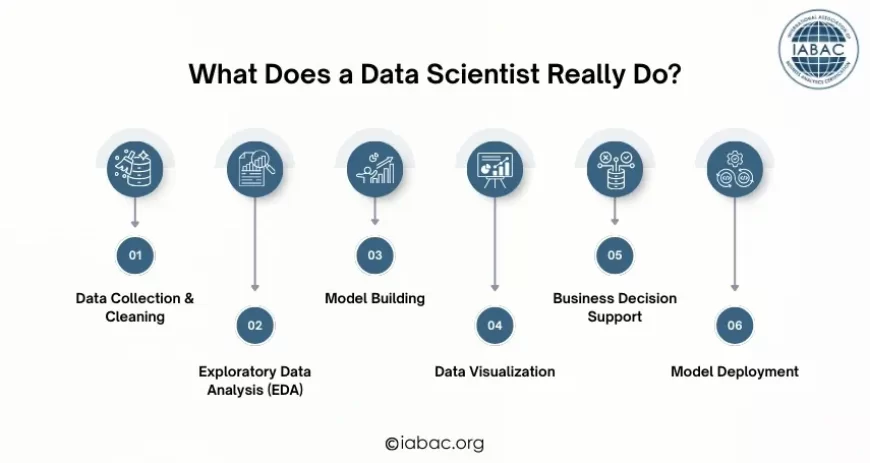
What Does a Data Scientist Really Do?
Many assume data scientists only work with models and algorithms. In reality, the data scientist role and responsibilities go far beyond that. They Do
1. Data Collection & Cleaning
-
Gather data from databases, APIs, logs, or third-party tools
-
Handle missing values, duplicates, and inconsistencies
Real Example: Cleaning customer purchase data before building a recommendation engine
2. Exploratory Data Analysis (EDA)
-
Identify patterns, trends, and anomalies
-
Use tools like Python (Pandas), SQL, Excel
Real Example: Finding why a product’s sales dropped in a specific region
3. Model Building
-
Build machine learning models to predict outcomes
-
Algorithms: Regression, Decision Trees, Neural Networks
Real Example: Predicting customer churn for a telecom company
4. Data Visualization
-
Present insights using dashboards and reports
-
Tools: Power BI, Tableau, Matplotlib
Real Example: Creating a dashboard for leadership to track revenue trends
5. Business Decision Support
-
Translate data insights into actionable strategies
-
Work closely with marketing, product, and leadership teams
Real Example: Identifying that users drop off after signup and recommending onboarding changes that increase conversion rates.
6. Model Deployment (Advanced Role)
-
Deploy models into production systems
-
Monitor performance and improve accuracy
Real Example: Integrating a fraud detection model into a payment system to flag suspicious transactions in real time.
Quick Summary of Data Scientist Job Description
-
Analyse structured and unstructured data
-
Build predictive models
-
Communicate insights to stakeholders
-
Optimize business processes using data
Why Companies Offer High Salary Packages for Data Scientists
The demand-supply gap is the biggest reason. But there’s more to it.
1. Direct Business Impact
Data scientists help companies:
-
Increase revenue
-
Reduce costs
-
Improve decision-making speed
For example, Amazon uses data science to drive its recommendation engine
2. Shortage of Skilled Professionals
According to NASSCOM, India faces a shortage of skilled data professionals, especially in AI and machine learning roles.
3. Cross-Functional Value
One data scientist can support:
-
Marketing campaigns
-
Product development
-
Risk analysis
-
Customer experience
4. AI Adoption Across Industries
Companies investing in:
-
Automation
-
Predictive analytics
-
Personalization
Need strong data science teams.
5. High Complexity Work
This role requires:
-
Programming + Math + Domain knowledge
-
Real-world problem-solving ability
That combination increases compensation significantly.
Skills Required for a Data Scientist
To succeed, you need a blend of technical and practical skills.
Core Technical Skills
1. Programming
-
Python (most used)
-
R (optional but useful)
2. Statistics & Mathematics
-
Probability
-
Hypothesis testing
-
Linear algebra
3. Machine Learning
-
Supervised & unsupervised learning
-
Model evaluation techniques
4. Data Handling
-
SQL for database queries
-
Data cleaning and transformation
5. Data Visualization
-
Tableau / Power BI
-
Matplotlib / Seaborn
Practical Skills
-
Business understanding
-
Problem-solving
-
Communication
-
Storytelling with data
Career Boost Tip
If you're planning to grow faster, focus on in-demand data scientist skills for high paying jobs like:
-
Deep learning
-
NLP
-
MLOps
-
Cloud platforms (AWS, Azure, GCP)
Difference Between Data Analyst and Data Scientist
Many beginners confuse these roles.
Here’s a simple breakdown:
|
Aspect |
Data Analyst |
Data Scientist |
|
Focus |
Past data insights |
Future predictions |
|
Tools |
Excel, SQL, BI tools |
Python, ML libraries |
|
Output |
Reports, dashboards |
Models, Predictions |
|
Complexity |
Moderate |
High |
If you want a deeper breakdown, explore our recent article on the difference between data analyst and data scientist before choosing your path.
How to Become a Data Scientist Without a Degree - Step-by-Step Guide
You don’t need a formal degree to enter this field. Many professionals transition from non-technical backgrounds.
Step 1: Learn the Basics
Start with:
-
Python
-
Statistics fundamentals
-
SQL
Step 2: Take Certifications
Structured certifications help you gain practical exposure and improve your chances of getting shortlisted. Focus on Data Scientist certifications that cover practical learning method:
-
Python for Data Science (Pandas, NumPy)
-
Machine Learning & AI (regression, classification)
-
Data Analysis & Visualization (SQL, Power BI, Tableau)
-
Statistics & Probability
-
End-to-End Data Science Projects
Choose programs that include:
-
Hands-on projects
-
Industry datasets
-
Portfolio-building support
Step 3: Build Real Projects
Examples:
-
Sales prediction model
-
Movie recommendation system
-
Customer segmentation
This builds practical understanding and confidence
Step 4: Learn Machine Learning
Focus on:
-
Regression
-
Classification
-
Clustering
Step 5: Create a Portfolio
Showcase:
-
GitHub projects
-
Case studies
-
Problem-solving approach
Step 6: Apply for Entry Roles
Start with:
-
Data analyst
-
Junior data scientist
-
Business analyst
Step 7: Keep Improving
Data science evolves fast. Keep learning:
-
New tools
-
New algorithms
-
Industry use cases
Data Scientist Career Path
A typical Data Scientist career path looks like this:
-
Data Analyst / Junior Data Scientist
-
Data Scientist
-
Senior Data Scientist
-
Lead Data Scientist
-
Head of Data / AI
Alternative Career Growth
You can also move into:
-
Machine Learning Engineer
-
AI Engineer
-
Data Engineer
Average Salary of Data Scientist in India and Growth Opportunities
Current Salary Updates (2026)
Based on industry data from platforms like Glassdoor and AmbitionBox:
|
Experience Level |
Average Salary |
|
Fresher |
Rs. 6-10 LPA |
|
2-4 years |
Rs. 10-18 LPA |
|
5-8 years |
Rs. 18-35 LPA |
|
10 years |
Rs. 40 LPA |
Bangalore Market Insight
In cities like Bangalore:
-
Top professionals earn Rs. 20 - 40 LPA within 4 - 6 years
-
AI-focused roles command even higher packages
Growth Opportunities
-
Fastest-growing tech career
-
Opportunities in global companies
-
Freelance & remote work options
Industries That Constantly Hire Data Scientists
Data science is not limited to IT.
1. E-commerce
-
Recommendation systems
-
Pricing optimization
2. Banking & Finance
-
Fraud detection
-
Risk analysis
3. Healthcare
-
Disease prediction
-
Medical data analysis
4. Marketing & Advertising
-
Customer targeting
-
Campaign optimization
5. EdTech
-
Personalized learning
-
Performance analytics
6. SaaS & Tech Companies
-
Product analytics
-
User behaviour tracking
Recent Trends in Data Science (2026)
1. Generative AI Integration
Companies are integrating AI tools like ChatGPT into workflows
2. Rise of MLOps
Focus on deploying and managing ML models at scale
3. Data Privacy Regulations
Stronger compliance requirements for handling user data
4. AutoML Tools
Reducing manual model building effort
5. Real-Time Analytics
Demand for instant insights instead of batch processing
FAQs
1. Is data science a good career in 2026?
Yes. High demand, strong salaries, and growth opportunities make it one of the best tech careers.
2. Can a non-IT student become a data scientist?
Yes. Many professionals transition from commerce, engineering, and even arts backgrounds.
3. How long does it take to become a data scientist?
-
6 - 12 months with focused learning
-
Faster if you already have programming experience
4. Do I need coding for data science?
Yes. Python is essential for most roles.
5. Is data science difficult to learn?
It requires consistency, but with structured learning and projects, it becomes manageable.
Data science is one of the most valuable careers today because it directly impacts how businesses grow, compete, and innovate. Understanding the role of a Data Scientist gives you clarity on the role, but real progress comes from building skills, working on real problems, and staying consistent.
If you’re serious about entering this field, start with the basics, build projects, and gradually move into advanced areas. The demand is strong, the opportunities are wide, and the growth potential is significant.