


























































Difference Between Data Analyst and Data Scientist Responsibilities
Understand the difference between data analyst and data scientist responsibilities including data analysis modeling visualization and business insights.

Data is everywhere today. Every time someone orders food online, watches a video, visits a website, or books a flight, new data is created. Companies collect this information because it helps them understand customers, improve services, and make better decisions. But collecting data is only the beginning. Someone must analyze it, interpret it, and sometimes even predict what might happen next. This is where two important roles come into the picture: the data analyst and the data scientist.
Many people entering the analytics field often ask the same question: What is the difference between a data analyst and a data scientist? At first glance, the roles seem almost identical. Both work with data, both use analytical tools, and both help organizations make better decisions. However, there are clear differences in their responsibilities, skills, and career paths. Understanding the difference data analyst data scientist roles is important for anyone planning a career in analytics or artificial intelligence. This article explains the responsibilities, tools, required skills, career paths, industries hiring these professionals, and future opportunities in this rapidly expanding field.
Understanding the Fields of Data Analytics and Data Science
Before comparing roles, it is important to understand the fields themselves.
What is Data Analytics?
Data analytics focuses on examining data to understand what has happened and what is happening now. Analysts collect data, clean it, organize it, and create reports or dashboards to support business decisions.
The field of data analytics has existed for decades. Early forms of analytics appeared in census records and accounting systems. However, modern analytics began to grow significantly in the 1980s with the introduction of relational databases and spreadsheet software.
Today, data analytics includes methods such as:
- Descriptive statistics
- Data visualization
- Database management
- Business intelligence reporting
- Performance metrics analysis
The main goal of data analytics is to make data accurate, accessible, and useful for decision-making.
What is Data Science?
Data science developed later when organizations began collecting extremely large datasets. Traditional analysis methods were not always capable of processing massive volumes of structured and unstructured data.
Data science combines several disciplines, including:
- Statistics
- Computer science
- Machine learning
- Mathematics
- Artificial intelligence
Data scientists often work with complex data environments and create predictive models to estimate future outcomes.
While analytics focuses mainly on understanding existing patterns, data science often focuses on predicting future trends and building intelligent systems.
Difference Between Data Analyst and Data Scientist Responsibilities
Although the two roles share many similarities, their responsibilities are different in several ways.
Common Responsibilities
Both professionals perform tasks such as:
- Cleaning and organizing datasets
- Querying databases using SQL
- Conducting statistical analysis
- Creating charts and visualizations
- Identifying patterns in data
- Communicating insights to stakeholders
Both roles transform raw information into meaningful insights that help organizations make strategic decisions.
However, this is where the similarities begin to diverge.
Key Responsibilities of a Data Analyst
A data analyst focuses on understanding historical data and current business performance.
Typical responsibilities include:
- Collecting data from multiple sources
- Cleaning and preparing datasets
- Developing dashboards and reports
- Identifying operational trends
- Monitoring key performance indicators (KPIs)
- Supporting business decision-making
For example, a data analyst in an online retail company might analyze sales trends to determine which products sell the most during certain months.
In simple terms, data analysts help answer questions such as:
- What happened last quarter?
- Which marketing campaign performed best?
- Which product category generated the most revenue?
Key Responsibilities of a Data Scientist
A data scientist focuses more on advanced analysis, prediction, and modeling.
Typical responsibilities include:
- Designing machine learning models
- Building predictive algorithms
- Processing large-scale data
- Conducting hypothesis testing
- Automating analytical workflows
- Deploying data-driven applications
For example, a data scientist in an e-commerce company might build a recommendation system that suggests products to customers based on previous purchases.
Data scientists often answer questions like:
- What will customers buy next month?
- Which users are likely to cancel their subscriptions?
- How can we predict equipment failures before they happen?
Time Horizon Differences
One of the most important distinctions lies in how each role views data over time.
|
Role |
Time Focus |
|
Data Analyst |
Past and present |
|
Data Scientist |
Future predictions |
A data analyst studies historical performance, while a data scientist develops models that forecast future outcomes.
Reporting vs Modeling
Another difference is the final output of their work.
Data analysts usually produce:
- Reports
- Dashboards
- Business insights
Data scientists often produce:
- Machine learning models
- Predictive systems
- Automated decision tools
In many organizations, analysts and scientists collaborate to turn data into valuable business strategies.
Mathematical Foundations
Both roles require mathematics, but the depth of mathematical knowledge differs.
Example: Basic Statistical Formula
A simple average calculation used in analytics:
Mean=N∑X
Where:
- (X) represents data values
- (N) represents the number of observations
Data analysts frequently use such calculations to measure performance metrics.
Example: Linear Regression Model
Data scientists often use regression models:
Y=b0+b1X
Where:
- (Y) is the predicted output
- (X) is the input variable
- (b_0) and (b_1) are coefficients
This model helps predict outcomes based on existing data patterns
Skills Required for Each Role
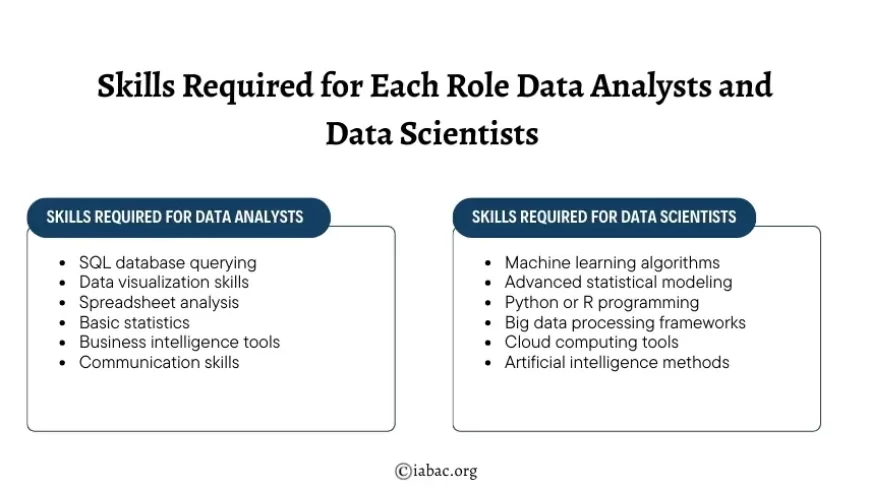
Skills Required for Data Analysts
A data analyst typically needs:
- SQL database querying
- Data visualization skills
- Spreadsheet analysis
- Basic statistics
- Business intelligence tools
- Communication skills
These skills allow analysts to translate data into business insights.
Skills Required for Data Scientists
Data scientists require additional technical capabilities.
Key skills include:
- Machine learning algorithms
- Advanced statistical modeling
- Python or R programming
- Big data processing frameworks
- Cloud computing tools
- Artificial intelligence methods
Their work often involves building complex predictive systems.
Tools Used by Data Analysts
Data analysts commonly use tools such as:
- SQL databases
- Excel or Google Sheets
- Tableau
- Power BI
- R or Python (basic level)
These tools help analyze structured datasets and create visual reports.
Tools Used by Data Scientists
Data scientists often rely on more advanced technologies.
Common tools include:
- Python programming
- R programming
- Apache Spark
- Hadoop frameworks
- Cloud computing platforms
- Machine learning libraries
They frequently build custom analytical solutions rather than relying on pre-built software.
Which Is Easier Data Analyst or Data Scientist?
This is one of the most common questions among beginners.
In general, data analyst roles are considered easier to enter because:
- They require less advanced mathematics
- Entry-level roles often require only a bachelor’s degree
- Many positions do not require programming expertise
Data science roles typically require deeper knowledge of statistics, algorithms, and machine learning.
However, “easier” does not mean less important. Data analysts play a critical role in organizations because they translate complex data into actionable insights for business leaders.
Career Paths
Data Analyst Career Path
A typical career progression might look like:
Junior Data Analyst → Data Analyst → Senior Data Analyst → Analytics Manager → Director of Analytics
Professionals may specialize in areas such as marketing analytics, financial analytics, or operations analytics.
Data Scientist Career Path
Data science careers often progress like this:
Data Analyst → Junior Data Scientist → Data Scientist → Senior Data Scientist → AI Specialist or Chief Data Scientist
Many professionals begin their careers as analysts before transitioning into data science.
Industries Hiring Data Analyst vs Data Scientist
Both roles are widely needed across industries.
Industries Hiring Data Analysts
- Retail and e-commerce
- Banking and finance
- Healthcare
- Marketing agencies
- Telecommunications
- Manufacturing
These industries rely on analysts to monitor performance and optimize operations.
Industries Hiring Data Scientists
- Artificial intelligence companies
- Technology firms
- Financial technology organizations
- Healthcare research institutions
- Autonomous vehicle development
- Cybersecurity firms
These industries require predictive models and intelligent algorithms.
Salary Comparison
Salary differences reflect the complexity of each role.
Typical global salary ranges:
|
Role |
Average Salary Range |
|
Data Analyst |
$60,000 – $90,000 |
|
Data Scientist |
$100,000 – $150,000 |
The difference exists because data scientists usually require deeper technical expertise.
Future Scope Difference Between Data Analyst and Data Scientist
The demand for data professionals continues to grow worldwide.
Future trends include:
- Expansion of AI-powered analytics
- Growth in predictive modeling
- Increased automation in business operations
- Real-time data processing
Both roles will remain important in the future.
Data analysts will continue to support operational decision-making, while data scientists will build advanced systems that drive automation and innovation.
Learning Path for Analytics Careers
Professionals interested in analytics careers should focus on building strong foundations in:
- Statistics
- Programming
- Data visualization
- Machine learning concepts
Certification programs offered through IABAC Global Certifications help professionals develop the technical skills required in modern data careers. These programs focus on practical learning and industry-relevant knowledge that prepares learners for global job markets.
Students and professionals who want to build expertise in analytics often begin with data analysis before moving into data science roles.
Although the difference data analyst data scientist roles can sometimes seem unclear, they serve different purposes within a data-driven organization. Data analysts focus on understanding historical data and producing insights that guide business decisions. Data scientists extend this work by building predictive models and advanced analytical systems that help organizations anticipate future outcomes.
Both roles are valuable and essential for modern companies. Analysts help businesses understand what is happening today, while scientists help predict what might happen tomorrow. For individuals starting their careers, learning the responsibilities and skills of each role can help identify the most suitable career path. With the growing importance of data across industries, both professions offer strong opportunities for growth, innovation, and global career advancement.