






















































What Are Workflow Orchestration Tools? Complete Guide
Compare top workflow orchestration tools in 2026 - Airflow, Prefect, Dagster & more. Automate, monitor, scale pipelines, and improve reliability.

Key Highlights
-
Workflow orchestration tools coordinate multiple automated tasks into end-to-end business or technical processes.
-
Orchestration focuses on dependencies, sequencing, monitoring, and recovery—not just automation.
-
Modern organizations use orchestration across data engineering, AI/ML, cloud operations, DevOps, and business workflows.
-
Popular platforms include Apache Airflow, Dagster, Prefect, Temporal, Azure Logic Apps, and AWS Step Functions.
-
The best solution depends heavily on workflow complexity, scalability requirements, and technical expertise.
-
AI adoption is accelerating demand for orchestration platforms that can manage agents, models, pipelines, and governance.
-
Visibility, observability, fault tolerance, and dependency management matter more than simple task automation.
-
Many orchestration failures stem from poor workflow design rather than tool limitations.
What Is Workflow Orchestration?
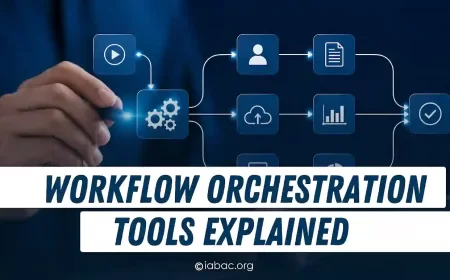
Workflow orchestration is the process of coordinating multiple automated tasks, systems, services, and workflows to achieve a larger business or technical objective. Instead of automating a single action, orchestration manages entire processes.
Business Goal
↓
Workflow Orchestrator
↓
|
Application |
Data System |
Cloud Service |
↓
Coordinated Execution
↓
Successful Outcome
For example,
Imagine an e-commerce company processing customer orders.
A single order may require:
-
Payment verification
-
Fraud detection
-
Inventory validation
-
Warehouse allocation
-
Shipping label generation
-
Customer notification
-
CRM update
-
Analytics logging
Each task may run in different systems.
Workflow orchestration ensures:
-
Tasks execute in the correct order
-
Dependencies are respected
-
Failures trigger recovery actions
-
Stakeholders have visibility
-
The entire process completes successfully
Without orchestration, teams often rely on fragile scripts, manual intervention, or disconnected automation tools.
A 2026 survey of senior data and AI leaders found that 61% of organizations experienced silent failures where monitored metrics appeared normal despite critical issues occurring. This highlights the growing importance of orchestration, monitoring, and observability in modern workflows.
What Are Workflow Orchestration Tools?
Workflow orchestration tools are software platforms designed to coordinate, schedule, monitor, and manage complex workflows across multiple systems.
They provide centralized control over:
-
Task execution
-
Scheduling
-
Dependency management
-
Error handling
-
Monitoring
-
Resource allocation
-
Governance
Think of orchestration software as an air traffic controller for business and technical processes. Individual systems perform work. The orchestration platform decides when, where, and how that work occurs.
Why Organizations Are Adopting Workflow Orchestration Tools
Several trends are driving adoption.
1. Growing System Complexity
Modern enterprises rarely operate from a single platform.
Teams commonly manage:
-
Cloud environments
-
SaaS applications
-
Data platforms
-
AI services
-
Internal APIs
-
Legacy systems
The more systems involved, the greater the coordination challenge.
2. AI and Machine Learning Expansion
AI workflows involve:
-
Data ingestion
-
Data preparation
-
Feature engineering
-
Model training
-
Validation
-
Deployment
-
Monitoring
Without orchestration, these processes become difficult to scale. Industry platforms increasingly support AI pipeline orchestration because model operations require strict dependency management.
3. Data Engineering Growth: Data teams often manage hundreds of daily pipelines.
Workflow orchestration helps coordinate:
-
ETL processes
-
ELT workflows
-
Data quality checks
-
Data warehouse refreshes
-
Reporting systems
This is one reason Apache Airflow became widely adopted in data engineering environments.
4. DevOps and Platform Engineering: Modern software delivery depends on orchestrated workflows.
Examples include:
-
Infrastructure provisioning
-
Security scanning
-
Automated testing
-
Release deployment
-
Rollback procedures
Orchestration improves reliability and reduces manual intervention.
How Workflow Orchestration Tools Work
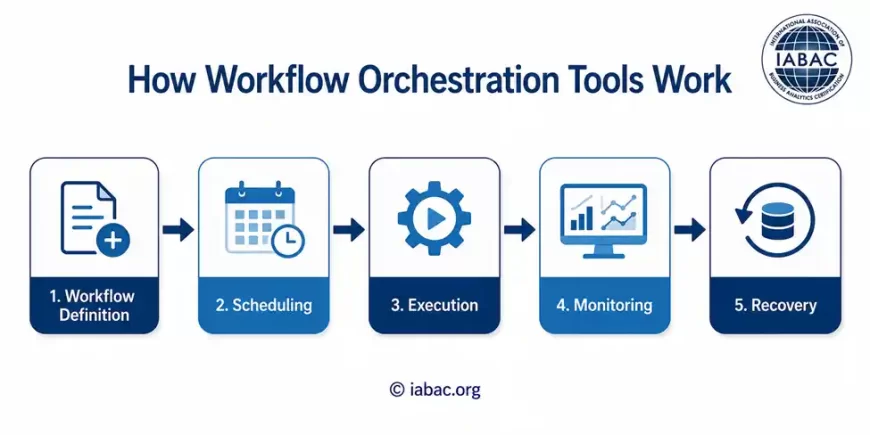
Most platforms follow a similar architecture.
Step 1: Workflow Definition
Teams define tasks and dependencies.
Example:
Task A → Task B → Task C
Or
Task A → Parallel Tasks B and C → Task D
Step 2: Scheduling
The platform determines when workflows run.
Triggers may include:
-
Time schedules
-
API events
-
File arrivals
-
Database changes
-
User actions
Step 3: Execution
The orchestrator distributes work across systems and services.
Step 4: Monitoring
Execution status is continuously tracked.
Teams gain visibility into:
-
Success rates
-
Failures
-
Delays
-
Resource usage
Step 5: Recovery
When failures occur, orchestration platforms can:
-
Retry tasks
-
Trigger alerts
-
Execute fallback actions
-
Roll back workflows
This is one of the most valuable capabilities in production environments.
Core Features to Look For
Not all workflow orchestration software is equally capable. Prioritize these features:
1. Dependency Management
The platform should clearly model task relationships and execution paths.
2. Scalability
Can the system manage:
-
Hundreds of workflows?
-
Thousands of tasks?
-
Distributed environments?
Many teams underestimate future scale requirements.
3. Observability
Look for:
-
Real-time monitoring
-
Logs
-
Metrics
-
Tracing
-
Alerting
Visibility often determines operational success.
4. Failure Handling
Strong orchestration platforms support:
-
Retries
-
Checkpointing
-
Rollbacks
-
Exception workflows
5. Security and Governance
Enterprise environments require:
-
Access controls
-
Audit logs
-
Compliance support
-
Policy enforcement
6. Multi-Cloud Support
Organizations increasingly operate across multiple cloud providers. Cross-platform orchestration is becoming a major evaluation criterion.
Best Workflow Orchestration Tools in 2026
Best for:
-
Data engineering
-
ETL pipelines
-
Analytics workflows
Strengths:
-
Large community
-
Flexible DAG architecture
-
Extensive integrations
Limitations:
-
Operational complexity at scale
2. Dagster
Best for:
-
Modern data platforms
-
Data observability
Strengths:
-
Strong developer experience
-
Data asset awareness
-
Better lineage visibility
Limitations:
-
Smaller ecosystem than Airflow
3. Prefect
Best for:
-
Cloud-native orchestration
-
Developer-friendly workflows
Strengths:
-
Simpler deployment
-
Modern architecture
-
Excellent monitoring
4. Temporal
Best for:
-
Long-running distributed workflows
Strengths:
-
Reliability
-
State management
-
Durable execution
Limitations:
-
Steeper learning curve
Best for:
-
AWS-centric organizations
Strengths:
-
Serverless
-
Deep AWS integration
Limitations:
-
AWS ecosystem dependence
6. Azure Logic Apps
Best for:
-
Microsoft environments
Strengths:
-
Low-code development
-
Enterprise integrations
Limitations:
-
Less flexibility for advanced engineering workflows
Real-World Use Cases of Workflow Orchestration Tools in 2026
1. Data Pipeline Orchestration
Raw Data Sources → Data Ingestion → Data Validation → Transformation → Data Warehouse → BI Dashboards → Business Decisions
A retailer refreshes sales dashboards every hour.
The orchestration workflow:
-
Extract sales data
-
Validate records
-
Transform datasets
-
Load warehouse
-
Update dashboards
-
Notify stakeholders
If validation fails, downstream tasks pause automatically.
Data Validation → Validation Failed? → YES → Alert Team → Stop Downstream Tasks
2. AI Workflow Orchestration
An AI platform may orchestrate:
-
Data collection
-
Training jobs
-
Model evaluation
-
Deployment
-
Drift monitoring
As AI systems become multi-agent environments, orchestration increasingly serves as the control layer.
3. Customer Onboarding
Business process managers often orchestrate:
-
Account creation
-
Identity verification
-
CRM updates
-
Compliance reviews
-
Welcome communications
This creates a seamless customer experience.
4. DevOps Pipelines
A software deployment workflow may include:
-
Code build
-
Testing
-
Security scanning
-
Deployment
-
Verification
-
Rollback triggers
Orchestration reduces release risk.
How to Choose the Right Workflow Orchestration Tool
A common mistake is choosing based on popularity rather than operational requirements.
Use this framework.
What type of workflows dominate?
-
Data pipelines
-
Business workflows
-
DevOps processes
-
AI systems
Different tools excel in different areas.
Who will maintain it?
Engineering-led organizations can adopt highly flexible platforms. Business-led teams may prefer low-code solutions.
What scale is expected?
Design for future complexity, not current complexity. Many organizations outgrow entry-level orchestration tools within two years.
What ecosystems matter?
Consider integration requirements:
-
AWS
-
Azure
-
Google Cloud
-
Snowflake
-
Databricks
-
Kubernetes
Integration effort often determines total cost of ownership.
What governance requirements exist?
Regulated industries need stronger controls around:
-
Auditing
-
Compliance
-
Access management
-
Data lineage
Common Implementation Mistakes to Avoid
-
Treating Orchestration as Automation: Many teams simply migrate scripts into an orchestration tool. The result is a more expensive version of the same problem.
-
Ignoring Failure Scenarios: Production workflows fail. Design recovery processes before deployment.
-
Overengineering Early: Not every workflow requires enterprise-grade orchestration. Match complexity to business value.
-
Neglecting Observability: Without monitoring, troubleshooting becomes difficult as workflows grow.
Critical Workflow Orchestration Insights Most Organizations Overlook
Misconception #1: More Automation Does Not Equal Better Orchestration
Organizations often celebrate the number of automated tasks. The real measure is process reliability. Ten well-orchestrated workflows usually create more value than hundreds of disconnected automations.
Misconception #2: Orchestration Is Becoming an AI Infrastructure Layer
In 2026, orchestration is increasingly moving beyond data pipelines.
It now coordinates:
-
Model routing
-
Evaluation pipelines
-
Human approval workflows
Many enterprises are effectively using orchestration platforms as AI control planes.
Hidden Risk: Workflow Sprawl
As orchestration adoption grows, organizations frequently create hundreds of undocumented workflows. This creates governance challenges similar to shadow IT. Workflow inventories and ownership models are becoming essential.
Emerging Trend: Event-Driven Orchestration
Traditional scheduling is giving way to event-driven architectures. Instead of waiting for scheduled jobs, workflows increasingly respond instantly to:
-
Data events
-
Customer actions
-
AI outputs
-
System signals
This shift improves responsiveness and operational efficiency.
Workflow orchestration tools have evolved from simple scheduling utilities into essential enterprise infrastructure, helping organizations coordinate complex processes across cloud platforms, AI systems, data environments, and business applications.
Choosing the right platform depends on your operational needs, governance requirements, and scalability goals. As demand for data professionals continues to grow, IABAC's Data Engineer Certification can help you build practical, job-ready skills in data pipelines, workflow management, and modern data engineering practices.
FAQ Section
What is workflow orchestration in simple terms?
Workflow orchestration coordinates multiple automated tasks and systems to complete a larger process while managing dependencies, scheduling, monitoring, and recovery.
How is workflow orchestration different from workflow automation?
Automation executes individual tasks, while orchestration coordinates multiple automated tasks into an end-to-end workflow.
What are the best workflow orchestration tools in 2026?
Popular options include Apache Airflow, Dagster, Prefect, Temporal, AWS Step Functions, and Azure Logic Apps.
Why do data engineers use workflow orchestration tools?
They help manage ETL/ELT pipelines, dependencies, scheduling, monitoring, and error recovery across complex data environments.
Can workflow orchestration tools support AI workflows?
Yes. Modern orchestration platforms manage data preparation, model training, deployment, monitoring, evaluation, and AI agent coordination.
Are workflow orchestration tools only for large enterprises?
No. Startups and mid-sized organizations also benefit when workflows span multiple systems and require reliability.
What is a DAG in workflow orchestration?
A Directed Acyclic Graph (DAG) defines task dependencies and execution order within a workflow.
How does orchestration improve reliability?
By handling retries, failures, monitoring, alerts, and dependency management automatically.
What should I look for when selecting workflow orchestration software?
Evaluate scalability, observability, integrations, governance, security, recovery capabilities, and ease of maintenance.
Is workflow orchestration replacing traditional business process management?
Not entirely. Many organizations use orchestration alongside BPM platforms, with orchestration handling execution and BPM managing process governance.