



























































What Is Workflow Orchestration and How It Works
Workflow orchestration simplifies complex tasks by connecting systems, automating steps & improving efficiency. Learn how it works with clear, easy examples.


Every company involves processes involving multiple teams, systems, and tasks. Manually handling them can be disorganized, difficult and prone to mistakes. Coordinating all these moving components, automating laborious tasks, and ensuring smooth operation are all possible with workflow orchestration. I'll give an overview of workflow orchestration, demonstrate its operation, and discuss why it's becoming important for effective corporate operations.
Understanding Workflow Orchestration
What is a “workflow”?
Let's begin with the fundamental concept: a workflow is just a series of actions that must be completed in a specific order in order to accomplish an objective. For example, take an order from a customer, verify the inventory, let shipping know, and then deliver the invoice. Tasks, order, and result make up a workflow.
What does “orchestration” add?
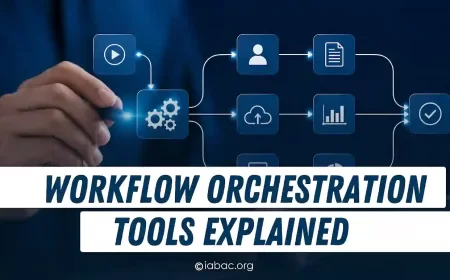
Imagine those tasks not just as a list, but as dominoes that fall, one triggers the next, and they are spread across different teams, systems or departments. That’s where orchestration comes in: it means coordinating many tasks, across many systems, making sure dependencies are handled, the right order is maintained, things don’t break, you have visibility and control. As one source puts it:
So orchestration = workflow + coordination + dependencies + visibility.
Why does this matter?
In simple terms, business and technology are more complex than ever. There are many systems (apps, cloud services, legacy systems), many teams, and many manual handoffs. Without orchestration, workflows are prone to delays, errors, silos and inefficiencies.
By orchestrating workflows, you can:
-
Ensure tasks happen in the right order, at the right time.
-
Connect different systems so that data flows rather than gets stuck.
-
Monitor and detect issues (bottlenecks, failures) and respond.
-
Scale operations: when many tasks need to run across many systems, orchestration helps manage that rather than letting it spiral.
This is a key idea if your company wants to become more automated, data-driven, or agile.
How Workflow Orchestration Works
Now that we understand what it is, let's review the usual process, from design to execution to optimization.

Step 1: Define the process
The first step is to figure out: what tasks need to happen? What is the goal? Who or what performs each task? What systems are involved? What are the dependencies (for example, task B can only start after task A finishes)? Many sources emphasise this as vital.
At this stage, you map your workflow: maybe using diagrams, flow‑charts, or simple lists. You identify the sequence, decision points (if X then do Y), triggers (time‑based, event‑based), and outputs.
Step 2: Choose the tools and architecture
Once you have your process blueprint, the next part is to decide how you will automate and orchestrate it. This involves selecting an orchestration tool or platform (or building one). It must support task sequencing, dependencies, error handling, monitoring and integrations with your existing systems.
You’ll likely integrate:
-
Systems and apps (CRM, ERP, cloud services)
-
Data flows (databases, APIs)
-
Automation scripts or bots for individual tasks
-
Triggers (e.g., when an event happens, the task starts)
-
Monitoring & logging frameworks
Step 3: Implement and integrate
At this stage, you construct your process map within the orchestration system. You design each task, including its trigger and dependencies, connect it to the systems/applications involved, automate each task (scripts, APIs, services), and arrange the tasks in a sequence. The flow of data between tasks is within your control. When jobs can execute concurrently, many orchestration systems also permit parallel execution.
Step 4: Set up monitoring, error handling and visibility
Managing as well as automating is one of orchestration's main benefits. In other words, you need to see what's going on. You must be aware of the jobs that were successful and unsuccessful, as well as the locations of obstacles and delays. You require fallback routes, retries, and error-handling logic. Without it, the automation might fail silently and lead to more serious problems.
Step 5: Test, deploy and iterate
Before you go live, you test the orchestration: simulate inputs, verify the tasks run in correct order, handle failures gracefully, and check data flows. Once you’re confident, you deploy. But your job doesn’t end there: as business needs evolve, tasks change, systems change, so you iterate. You monitor performance, adapt the workflow, and optimise.
Step 6: Optimise and scale
As your organisation grows, you’ll need your orchestrated workflows to scale. That means: more tasks, more systems, more data, more parallelism. You’ll look for optimisation: remove waste, adjust for failures, reuse workflows, simplify. You’ll also refine your orchestration to handle new scenarios, integrate new services, and maintain performance.
Workflow Orchestration in a Simple Example
Here’s a simple, everyday example (not too technical) to make the idea concrete.
Scenario: Customer Order Processing
Imagine an online store. A customer places an order. Here are the steps (tasks):
-
Order received
-
Check inventory
-
If item in stock → reserve item; else → notify back‑order
-
Generate invoice
-
Send shipping request
-
Notify the customer with tracking
-
Update the accounting system
These jobs could be completed manually or in groups in the absence of orchestration: data is sent by the order system, inventory is checked, an invoice is mailed, etc. Errors include a lack of visibility, missing data, and delays.
With orchestration, you define the workflow, build the tasks, and connect systems (order system, inventory database, accounting, shipping API). You specify dependencies (inventory check must finish before shipping request). You set triggers (order received). You set error paths (inventory system down → notify admin). You monitor status (how long each step took, any failures). The whole process becomes repeatable, reliable, and visible.
Why this helps
-
Fewer manual handoffs → fewer delays and errors.
-
Systems talk to each other → data flows smoothly.
-
You see, when something goes wrong → faster fix.
-
You can scale: more orders, more items, more systems.
-
You free human effort to focus on more valuable work.
Key Benefits of Workflow Orchestration
Let's describe the main benefits in simple terms.
Efficiency and automation
Orchestration means tasks that used to require manual attention now run automatically, in the right sequence, without humans having to monitor every step. This saves time and cost.
Reliability and correctness
When you map dependencies, enforce order, and automate error paths, the process becomes more reliable and consistent, resulting in fewer mistakes.
Visibility and control
You gain a “dashboard” view of your workflows: what’s pending, what’s failed, and where bottlenecks are. That visibility means you can manage proactively.
Scalability
Orchestration solutions evolve with your business operations (more orders, more data, more systems); you don't have to start over each time.
Better collaboration & integration
Processes often cross teams and systems. Orchestration helps break down silos, integrate systems, and align people and technology.
Adaptability
Because workflows are defined, monitored and automated, when business rules change, you can update the workflow rather than rebuild it manually. It supports change.
Common Use Cases of Workflow Orchestration
Here are a few examples that provide significant value.
Data pipelines & analytics
When organisations process data from multiple sources, transform it, load it into data warehouses, run analysis and report results, that’s a workflow. Orchestration helps manage all the steps and dependencies.
IT and DevOps workflows
Deploying software, running tests, building containers, and releasing updates are complex workflows across tools. Orchestration keeps all the steps in order, handles dependencies, automates rollbacks, and gives visibility.
Business process automation
Examples include supply chain operations in manufacturing, insurance claims processing, and customer onboarding. Many systems, many tasks, several handoffs, and orchestration all work together.
Cross‑system and cross‑team workflows
When a workflow crosses departments (say sales, operations, finance) or crosses legacy and modern systems, orchestration ensures the pieces talk, the sequence is maintained, and nothing falls through the cracks.
Orchestration is a useful tool to understand and use if your company is dealing with various systems, manual handoffs, delays, errors, or an increase in tasks and data. You may convert complicated procedures into fluid, effective processes by mapping your workflows, choosing orchestration tools, integrating systems, automating tasks, keeping an eye on execution, and iterating changes.
Finally, if you want to advance your skills in this field, you might think about earning the globally recognized Data Engineer Certification to improve your data engineering and workflow orchestration skills.