

















































AI Consulting for Small Businesses: How It Helps Growth (2026 Guide)
Learn how AI consulting helps small businesses cut costs, automate tasks, and grow faster. Includes pricing, tools, and a step-by-step guide.

AI consulting for small businesses is the process of working with an expert to identify, implement, and optimize artificial intelligence tools that solve real operational problems — without wasting budget on technology that doesn't fit your business.
In this guide you'll learn:
-
What AI consulting actually does for small businesses
-
7 proven ways it drives real growth (with ROI numbers)
-
How much it costs — and whether it's worth it
-
Which AI tools work best for which business types
-
How to spot red flags and choose the right consultant
-
The most common mistakes to avoid
Most small business owners have heard the pitch: "AI will transform your business." But between the hype, the jargon, and the endless parade of tools promising to change everything, it's hard to know where to start — or whether it's even worth the investment.
That's exactly the problem AI consulting for small businesses is designed to solve.
This guide cuts through the noise. Whether you run a retail store, a service business, a restaurant, or a professional practice, you'll walk away knowing how AI consulting works, what it costs, and how to use it to grow — without needing a technical background or an enterprise budget.
What Is AI Consulting for Small Businesses?
AI consulting for small businesses is a specialized service where an expert — either an individual consultant or a consulting firm — helps you figure out which artificial intelligence tools and strategies will deliver real, measurable results for your specific operation.
It's not about deploying the latest technology for its own sake. A good AI consultant starts with your business problems, not with tools. They ask: what's slowing you down, where are you losing money, and what would measurably improve your growth? Then they build a plan around those answers.
This is what separates AI consulting from simply buying an AI subscription. Tools are generic. Strategy is specific to you.
AI Consulting vs. AI Tools vs. Hiring In-House
Before going deeper, it helps to understand how AI consulting fits against the alternatives:
|
Factor |
DIY AI Tools |
AI Consulting |
Hiring In-House AI Staff |
|
Upfront Cost |
Low |
Medium |
Very High |
|
Expertise Required from You |
High |
Low |
None (they bring it) |
|
Speed to Results |
Slow (trial and error) |
Fast (proven approach) |
Slow (hiring takes months) |
|
Customization |
Low |
High |
High |
|
Ongoing Cost |
Low |
Medium |
Very High ($80K–$150K+/yr) |
|
Best For |
Solopreneurs testing tools |
SMBs serious about growth |
Enterprise-ready businesses |
Types of AI Consulting Engagements
Not all consulting looks the same. Depending on where you are in your AI journey, you might engage a consultant in one of three ways:
-
One-Time Strategy Session: A focused audit and roadmap. Best for businesses that want clarity before committing.
-
Project-Based Implementation: The consultant designs and deploys a specific AI solution — a chatbot, a forecasting model, an automated workflow — with a defined scope and timeline.
-
Ongoing Retainer: The consultant works with you continuously to optimize, expand, and adapt your AI systems as the business grows.
Why Small Businesses Need AI Consulting Now — Not Later
According to a global survey by TeamViewer, only one in three SMB leaders use AI on a daily basis, and just 16% apply it at least weekly. Meanwhile, 28% of small business leaders who haven't adopted AI effectively report higher operational costs due to missed automation opportunities.
And yet — 72% of SMB leaders believe AI will spark the greatest productivity surge of this century, and 76% view it as essential to improving business performance.
The gap between what small business owners believe and what they actually do is enormous. That gap is costing money right now.
The Hidden Cost of Waiting
Every month without a coherent AI strategy is a month your competitors — who are figuring this out — pull further ahead. The businesses that adopt AI early build compounding advantages: faster customer response times, lower labor costs, smarter inventory decisions, and sharper marketing. Those advantages grow over time, not diminish.
Why DIY AI Usually Fails
Buying AI tools without a strategy creates a predictable outcome: you spend time setting up features you don't fully understand, pull data from disconnected systems, and end up with dashboards that look impressive but don't tell you what to do next. According to research, fewer than 20% of small businesses that test AI tools on their own have a clear plan for how to use them.
The issue isn't the technology — it's the absence of a roadmap. That's where AI consulting for small businesses changes the equation.
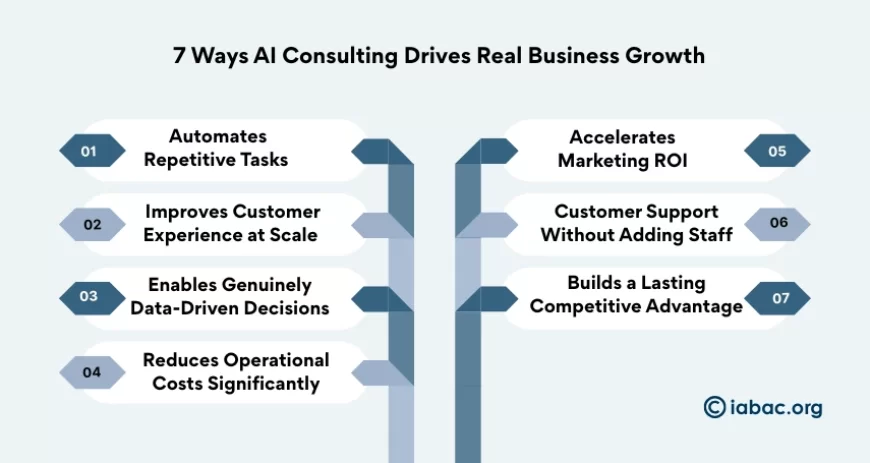
7 Ways AI Consulting Drives Real Business Growth
Here's how working with an AI consultant translates into tangible results for small businesses — not theoretical benefits, but outcomes you can measure.
1. Automates Repetitive Tasks and Frees Up 10–20 Hours Per Week
Small business owners and their teams spend enormous amounts of time on tasks that don't require human judgment: scheduling, data entry, invoice processing, follow-up emails, report generation. AI consulting identifies exactly which of those tasks can be automated and deploys the right tools to handle them.
A service business owner who spends 15 hours a week on scheduling, quoting, and follow-ups can reclaim most of that time. At even a conservative $30/hour labor equivalent, that's $1,800/month in recovered capacity — without hiring anyone new.
2. Improves Customer Experience at Scale
Customers today expect fast, personalized responses around the clock. For small businesses, that's impossible to deliver manually — until AI enters the picture.
AI consulting helps businesses deploy customer-facing tools the right way: chatbots that actually understand context, personalization engines that surface relevant products, and automated follow-up sequences that feel human. Done correctly, these tools improve satisfaction scores and reduce churn. Done incorrectly (which is what happens without guidance), they frustrate customers and damage trust.
3. Enables Genuinely Data-Driven Decisions
Most small businesses make decisions based on intuition and experience. That's not a criticism — it's just reality when you're running lean. AI consulting introduces predictive analytics and machine learning models that turn your existing data into forward-looking guidance.
Which products will sell fastest next month? Which customers are at risk of leaving? Which marketing channel is actually driving revenue versus just traffic? An AI consultant builds the infrastructure to answer those questions reliably — and teaches your team how to act on the answers.
4. Reduces Operational Costs Significantly
One of the most concrete returns from AI consulting for small businesses is cost reduction. Inventory waste, excess support staffing, over-spending on broad marketing campaigns — AI identifies and reduces all of these.
Regional distributors working with AI consultants have documented a 30% reduction in overstock costs after implementing demand forecasting. For a business spending $50,000/year on excess inventory, that's $15,000 back. That's not a projection — it's a documented outcome from guided AI implementation.
Stat to Know: Small businesses using AI consulting report average monthly operational savings of $500–$2,000 after implementation.
5. Accelerates Marketing ROI
AI-powered marketing isn't about replacing your marketing team — it's about making every dollar work harder. AI consulting helps small businesses implement lead scoring (so your sales team focuses on the right prospects), dynamic content personalization (so the right message reaches the right person), and campaign optimization tools that adjust spend in real time based on performance.
The result: lower cost per acquisition, higher conversion rates, and marketing budgets that stretch further without requiring more headcount.
6. Scales Customer Support Without Adding Staff
For small businesses, customer support is often the bottleneck. You can't afford a full support team, but customers expect responsiveness. AI consulting bridges that gap by deploying intelligent support tools — chatbots for tier-1 queries, automated ticketing systems, AI-assisted response drafts for complex issues — that handle the volume without proportional staffing costs.
A well-implemented AI support system can handle 60–70% of routine inquiries automatically, freeing your team to focus on the high-value interactions that actually require human judgment.
7. Builds a Lasting Competitive Advantage
This is the benefit most articles ignore: the compounding effect of early adoption. Businesses that implement AI systems today are building data pipelines, training models, and establishing workflows that become more accurate and more valuable over time. The business that starts this process in 2026 will have a meaningfully better system than a competitor who starts in 2028.
AI consulting accelerates that timeline by eliminating the months of failed experiments and tool-switching that typically precede a working implementation.
Industry-Specific AI Use Cases: What Works for Your Business Type
One of the biggest gaps in most articles on this topic is the assumption that AI consulting looks the same for every business. It doesn't. Here's a breakdown of the highest-ROI AI applications by industry — and the tools consultants most commonly deploy.
|
Industry |
Top AI Use Case |
Example Tools |
Estimated ROI |
|
Retail |
Demand forecasting, inventory optimization |
Blue Yonder, Inventory Planner |
20–30% inventory waste reduction |
|
Restaurant |
Menu personalization, reservation management |
Presto, OpenTable AI |
15% upsell increase |
|
Healthcare / Medical Practice |
Appointment scheduling, patient follow-up |
Klara, Luma Health |
Up to 40% no-show reduction |
|
Legal / Professional Services |
Document review, contract analysis |
Harvey, Clio |
30% time savings on admin |
|
E-commerce |
Product recommendations, abandoned cart recovery |
Klaviyo AI, Nosto |
10–25% revenue lift |
|
Real Estate |
Lead qualification, CRM automation |
Lofty, Follow Up Boss AI |
2x lead response rate |
|
Service Businesses (HVAC, Cleaning, etc.) |
Scheduling, quote automation, dispatch |
Jobber AI, ServiceTitan |
20% booking efficiency increase |
|
Coaching / Consulting |
Lead segmentation, onboarding automation |
ActiveCampaign AI, GoHighLevel |
30% reduction in manual follow-up |
A Closer Look at Three High-Impact Industries
Retail: Inventory is the single biggest cost driver for most retail small businesses. AI forecasting tools — properly configured by a consultant — analyze historical sales data, seasonal patterns, local events, and even weather to predict demand at the SKU level. The result is fewer stockouts, less dead inventory, and better cash flow.
Healthcare / Medical Practices: No-shows cost independent practices an estimated $150 billion annually in the US. AI-powered scheduling and reminder systems — integrated with your existing EHR — use behavioral patterns to identify high-risk appointments and deploy the right intervention (a call, a text, a reminder sequence) at the right time. Some practices see no-show rates drop from 20% to under 12% within the first quarter.
E-commerce: The average cart abandonment rate is 70%. AI-powered recovery sequences — personalized, timed, and triggered by behavioral signals — can recapture 10–15% of those lost transactions. That's pure revenue with no additional acquisition cost.
How AI Consulting Works: The 4-Step Process
Understanding what the engagement actually looks like helps you know what to expect and how to evaluate whether a consultant is doing the job right.
Step 1: Discovery & AI Readiness Assessment
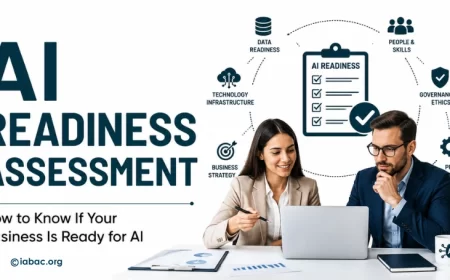
A reputable AI consultant starts by auditing your business before recommending anything. This includes reviewing your current tools and tech stack, evaluating your data quality and accessibility, mapping your core workflows, and identifying the highest-friction pain points.
This step typically takes one to two weeks. At the end, you should have a clear picture of where AI can help and — critically — where it can't.
Step 2: Strategy & Roadmap
Based on the discovery phase, the consultant builds a prioritized AI roadmap. Not everything gets done at once. Good consultants sequence projects by speed-to-value: start with the initiatives that deliver measurable ROI fastest, build confidence and budget internally, then move to more complex implementations.
You'll also define KPIs at this stage — the specific metrics that will tell you whether the AI is working.
Step 3: Implementation & Integration
This is where tools get deployed, APIs get connected, and data pipelines get built. A good consultant manages the technical complexity so you don't have to. They also handle integration with your existing systems — your CRM, your accounting software, your e-commerce platform — because AI that doesn't talk to your existing tools creates more problems than it solves.
Critically, this step includes team training. The best AI system in the world fails if your team doesn't know how to use it.
Step 4: Optimization & Feedback Loops
AI isn't a one-time deployment. It improves with data. A consultant in an ongoing engagement monitors performance, identifies what's working and what needs adjustment, and continuously refines the system based on real-world results.
This is the phase most DIY AI adopters skip — and it's the phase where the real compounding gains happen.
How Much Does AI Consulting Cost for Small Businesses?
This is the question every small business owner wants answered — and it's the one topic completely absent from every competing article on this subject. Here's an honest breakdown.
Pricing Models
|
Engagement Type |
Typical Cost Range |
Best For |
|
One-Time AI Strategy Session |
$500 – $2,500 |
Businesses just starting out, need a roadmap |
|
Project-Based Implementation |
$3,000 – $15,000 |
Deploying a specific AI solution |
|
Monthly Retainer |
$1,500 – $8,000/month |
Ongoing optimization and expansion |
|
Fractional AI Officer |
$2,000 – $10,000/month |
Growing teams that need AI leadership without a full-time hire |
Is It Worth the Investment?
Let's run the numbers for a typical small business:
-
AI automates 15 hours/week of staff time across scheduling, data entry, and follow-up
-
At a conservative $30/hr labor rate: $1,800/month in recovered capacity
-
AI reduces marketing waste by 20% on a $3,000/month ad budget: $600/month saved
-
AI improves customer retention by 10% on $20,000/month revenue: $2,000/month protected
That's a potential $4,400/month in combined value — against a consulting retainer that might cost $2,000–$4,000/month. The math works.
Budget-First Alternatives
If your budget is under $500/month, AI consulting still has a path for you. Many consultants offer entry-level packages that leverage low-code/no-code (LCNC) tools — platforms like Zapier, Make.com, and HubSpot AI that can automate meaningful workflows at minimal cost. A one-time strategy session can identify exactly which LCNC tools to prioritize so you're not paying for features you don't need.
5 Red Flags When Hiring an AI Consultant
Not every AI consultant delivers value. As AI has exploded in popularity, the space has attracted plenty of practitioners who overpromise and underdeliver. Here's what to watch out for.
Red Flag 1: They Promise Guaranteed Results Before Doing an Audit
No consultant can promise specific outcomes — an uplift in revenue, a specific cost reduction — without first understanding your business, your data, and your current operations. If someone leads with guarantees, they're selling, not consulting.
Red Flag 2: They Push One Vendor or Tool Regardless of Your Situation
A good consultant is tool-agnostic. Their job is to solve your problem, not to sell you a particular platform. If every recommendation leads back to the same vendor, ask why.
Red Flag 3: They Can't Explain AI in Plain Language
You don't need to become a technical expert. But you do need to understand what your consultant is recommending and why. If their explanations require a computer science degree to follow, that's a communication problem — and it will cause problems throughout implementation.
Red Flag 4: No Case Studies or Measurable Client Outcomes
Any legitimate AI consultant should be able to point to specific engagements with documented results: time saved, costs reduced, revenue increased. Vague success stories aren't evidence. Ask for specifics.
Red Flag 5: They Skip Straight to Custom Builds
Custom AI development is expensive, time-consuming, and risky. For most small businesses, the right answer is a well-configured existing tool, not something built from scratch. A consultant who immediately recommends custom development — before exhausting proven off-the-shelf solutions — is likely optimizing for their invoice, not your ROI.
How to Choose the Right AI Consultant for Your Business
Once you've filtered out the red flags, here's how to identify the right partner.
Questions to Ask Before Signing
-
"Walk me through a recent engagement with a business similar to mine. What did you implement, and what were the measurable outcomes?"
-
"How do you prioritize which AI use cases to tackle first?"
-
"What does your discovery process look like, and how long does it take?"
-
"How do you measure success? What KPIs will we track?"
-
"What happens if a tool or approach isn't working after 60 days?"
-
"Do you receive any referral fees or commissions from tool vendors?"
Green Flags to Look For
✅ Business-first thinking — they ask about your problems before recommending solutions
✅ Phased rollout approach — they start small, prove value, then scale
✅ Clear KPI definitions — they commit to specific metrics before starting work
✅ Honest about limitations — they tell you what AI can't do for your business
✅ Team training included — implementation means nothing if your team can't use the output
Where to Find Qualified AI Consultants
-
Clutch.co — vetted B2B service providers with client reviews
-
LinkedIn — search "AI consultant" filtered by industry and location
-
Upwork — for project-based engagements with transparent portfolios
-
Referrals — ask your industry network who they've worked with
-
Industry associations — many have vetted vendor directories
✅ Pre-Hire Checklist:
-
[ ] Reviewed at least 2 case studies with measurable outcomes
-
[ ] Confirmed they follow a discovery-before-recommendation process
-
[ ] Verified they're tool-agnostic (not affiliated with one vendor)
-
[ ] Checked that they include team training in their scope
-
[ ] Confirmed pricing and engagement model in writing before starting
Common Mistakes Small Businesses Make with AI (And How to Avoid Them)
Even businesses that hire consultants sometimes undermine their own results by falling into predictable traps. Here are the five most common — and how to sidestep each one.
Mistake 1: Starting With the Tool, Not the Problem
The excitement of a new AI platform can lead business owners to deploy technology first and find use cases second. This is backwards. Always start with a specific, measurable problem — "we lose 30% of leads because we don't follow up fast enough" — and work backward to the tool. The problem defines the solution, not the other way around.
Mistake 2: Skipping Data Cleanup Before Implementation
AI is only as good as the data it runs on. If your CRM has duplicate contacts, inconsistent fields, and years of incomplete records, no AI system will produce reliable outputs. One of the most important — and most skipped — steps in any AI implementation is a data quality audit before deployment begins. A good consultant will insist on this. If they skip it, consider that a red flag.
Mistake 3: Over-Automating Customer Touchpoints
Automation creates efficiency, but it can also create distance. A chatbot that handles 70% of support inquiries is a win. A chatbot that handles 100% of support inquiries — including complex, emotional, or high-value interactions — is a liability. AI consulting helps you find the right boundary between automation and human judgment. Erring too far toward automation damages customer relationships in ways that are hard to recover from.
Mistake 4: Ignoring Team Training and Change Management
Technology adoption fails when people resist it. And people resist new tools when they feel threatened, confused, or excluded from the decision. Successful AI implementation involves your team from the beginning — explaining the why, providing hands-on training, and demonstrating how the AI makes their jobs better (not redundant). This isn't soft — it's the difference between a system that gets used and one that collects digital dust.
Mistake 5: Measuring Vanity Metrics Instead of Business Outcomes
It's easy to get excited about a chatbot that handles 10,000 conversations per month. The better question is: did those conversations reduce support costs, improve customer satisfaction, or drive retention? Vanity metrics feel good. Business outcomes pay the bills. Work with your consultant to define success in terms of revenue impact, cost reduction, or time recovered — and hold both sides accountable to those numbers.
AI Consulting Is a Growth Lever, Not a Cost Center
The businesses growing fastest in 2026 aren't the ones with the biggest budgets — they're the ones making the smartest moves. And for small businesses, one of the smartest moves available right now is treating AI consulting not as an expense, but as an investment in sustainable competitive advantage.
The hesitation is understandable. Budget is tight. The technology feels complex. The results seem uncertain. But that uncertainty largely disappears when you work with someone who has deployed these systems before, knows which tools work for which problems, and can show you exactly what to measure to know whether it's working.
AI without strategy is just software. With strategy, it becomes a growth engine.
Whether you're ready to book a strategy session today or just want to understand your options, the next step is the same: get specific about the problem you're trying to solve. The right AI solution — and the right consultant to help you implement it — will follow from there.