























































When Does a Business Need AI Strategy Consulting?
Thinking of when your business needs AI strategy consulting? Identify key signals, risks of delay, readiness factors, and how to align AI with business goals.

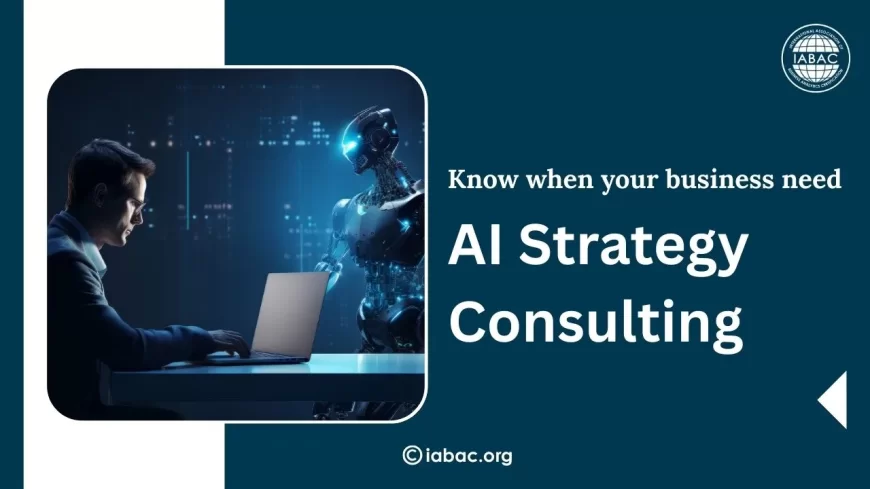
Artificial intelligence has shifted from experimentation to executive priority in a remarkably short time. Boards are asking about generative AI. Investors expect automation roadmaps. Competitors are embedding intelligent systems into products, operations, and customer experiences.
Yet inside many organizations, a quieter reality persists.
AI ambition is high. Execution clarity is inconsistent.
Some companies run multiple trials without growing. Others invest in tools without a unified roadmap. Leadership teams discuss transformation, but departments operate independently. Data exists, yet measurable impact remains limited.
This tension between ambition and structured execution is where timing becomes critical. The question is no longer whether AI has potential.
The more strategic question is
At what point does a business require AI strategy consulting to move forward with clarity and discipline?
Understanding the broader role of AI consulting in enterprise transformation helps clarify why timing matters.
Recognizing that inflection point early can prevent fragmented experimentation, misallocated budgets, governance risk, and stalled initiatives.
What AI Strategy Consulting Actually Solves
AI strategy consulting is often misunderstood as technical implementation support. In practice, it addresses something more fundamental: alignment.
Most AI challenges do not originate from model performance. They emerge from gaps between business priorities, operational processes, data maturity, governance frameworks, and execution discipline.
AI strategy consulting typically resolves:
-
Business–technology misalignment
-
Undefined AI priorities
-
Lack of measurable value frameworks
-
Fragmented departmental experimentation
-
AI adoption without governance
-
Scaling challenges beyond pilot projects
Without structured strategy, organizations frequently accumulate isolated AI initiatives rather than coordinated progress. Strategy consulting introduces decision discipline. It clarifies what to prioritize, what to postpone, and how to evaluate success in business terms.
The Clear Signals Your Business Needs AI Strategy Consulting
AI strategy consulting becomes relevant when complexity begins to outpace coordination. Most organizations do not suddenly decide they need structured AI guidance. Instead, certain patterns emerge that indicate the organization has crossed a strategic threshold.
These are not technical failures. They are decision and alignment failures.
When several of the following signals appear simultaneously, structured AI strategy support often becomes necessary.
AI Initiatives Exist, But Business Impact Is Ambiguous
One of the most common signals is activity without clarity.
The organization may have launched pilots, invested in tools, or formed AI task forces. Yet when leadership asks, “What measurable impact has this delivered?” the answer is uncertain.
Typical indicators include:
-
KPIs that are loosely defined or inconsistently tracked
-
No formal ROI measurement structure
-
Pilot projects that never transition into scaled deployment
-
Overlapping tools across departments
-
Different stakeholders interpreting “success” differently
For example, a manufacturing company may deploy predictive maintenance models in separate plants. Each team reports improvements locally, yet no centralized measurement framework exists to quantify enterprise-level value.
When experimentation accelerates but evaluation lags, strategic instability begins to form.
Executive Interest Is High, but Direction Is Fragmented
In many businesses, AI momentum originates in the boardroom. Leadership recognizes competitive pressure and strategic opportunity. However, without a coordinated roadmap, enthusiasm turns into parallel initiatives rather than unified transformation.
Warning patterns include:
-
Recurring AI strategy discussions without concrete prioritization
-
Departments pursuing independent AI tools
-
Budget conversations that lack allocation clarity
-
Technology decisions being made before business objectives are defined
Without clarity on choosing the right AI consulting firm, fragmentation may simply shift to the vendor layer.
This creates energy without alignment. Over time, fragmentation increases and strategic coherence weakens.
Data Potential Is Recognized, but Value Is Unrealized
Another signal appears when organizations acknowledge that data is valuable yet struggle to operationalize it.
Common realities include:
-
Information trapped within departmental silos
-
Inconsistent governance standards
-
Data quality inconsistencies
-
Integration bottlenecks
-
Architectural limitations
A retail organization, for instance, may hold years of transaction history but fail to integrate online and offline datasets for forecasting. Leadership senses opportunity, but structural barriers prevent execution.
When data ambition exceeds structural readiness, strategic intervention becomes necessary. In many cases, analytics consulting plays a foundational role before scaling advanced AI initiatives.
The Organization Is Preparing to Scale AI Enterprise-Wide
Moving from isolated pilots to enterprise deployment represents a significant complexity jump.
At this stage, organizations must coordinate:
-
Cross-functional integration
-
Unified AI operating structures
-
Governance oversight
-
Security controls
-
Standardized evaluation frameworks
Without structured alignment, scaling often introduces duplication, compliance exposure, and operational friction.
Generative AI Conversations Are Escalating Rapidly
Boards are increasingly asking about large language models, copilots, and generative automation. Pressure to “do something” intensifies.
However, organizations frequently encounter:
-
Confusion about where generative AI fits
-
Uncertainty around data privacy risks
-
No formal output validation processes
-
Limited internal policy guidance
When executive pressure increases faster than governance planning, the risk of unmanaged deployment grows.
Safety Evaluation and Governance Concerns Are Increasing
In restricted sectors, unmanaged AI experimentation can quickly introduce risk exposure.
Signals include:
-
Unclear data protection frameworks
-
Absence of formal AI governance structures
-
Limited model documentation
-
Ethical concerns without defined mitigation processes
-
Audit vulnerabilities
At this stage, AI shifts from opportunity to potential liability if not strategically managed.
AI Readiness: Are You Structurally Prepared for AI Strategy Consulting?
While the previous section identifies signals that consulting may be needed, readiness determines whether engagement will be effective.
Even if complexity exists, successful strategy work requires foundational stability. Leadership teams should evaluate four core readiness dimensions before initiating structured consulting.
1. Organizational Readiness
Organizational readiness reflects whether the company can absorb and operationalize structured AI direction.
Executive ownership must be explicit: There should be a clearly identified leader responsible for AI prioritization and oversight. Passive sponsorship is insufficient; visible accountability is required.
Cross-functional alignment must be attainable: If departments operate in isolation or resist collaboration, AI strategy implementation becomes constrained.
Accountability structures must be definable: The organization should be capable of assigning ownership for model performance, compliance monitoring, and ROI tracking.
Cultural receptivity must exist: Teams should demonstrate a willingness to adopt data-driven decision models. Resistance to analytical insights significantly slows adoption.
Leadership must be prepared to drive change: AI strategy frequently requires workflow redesign and revised decision frameworks. If leadership hesitates to enforce change, consulting outcomes remain theoretical.
Readiness here is about absorption capacity, not enthusiasm.
2. Technical Readiness
Technical readiness evaluates whether infrastructure can support structured AI implementation.
Core systems should be stable: Frequent outages, legacy constraints, or integration breakdowns create implementation friction.
Cloud and integration maturity should allow system interoperability: If systems cannot communicate efficiently, AI deployment becomes fragmented.
Basic deployment processes should exist: Even if not fully optimized, there should be an ability to move solutions from development into operational environments.
Monitoring capability should be achievable: AI systems require performance tracking over time.
Security controls must be enforceable: Access management and data protection safeguards should already be operational.
Technical readiness is not about sophistication. It is about feasibility and operational stability.
3. Data Readiness
Data readiness often determines the success or failure of AI initiatives more than any other dimension.
Relevant data must be accessible: Critical datasets should not be entirely siloed or restricted without governance clarity.
Governance structures should be definable: Ownership, access permissions, and usage policies must be articulable.
Data quality should meet baseline standards: While perfection is unnecessary, significant inconsistency or duplication undermines model reliability.
Compliance obligations must be understood: Organizations should have clarity around regulatory constraints affecting data usage.
Standardization should be achievable: Data definitions and structures should not vary drastically across business units.
If data foundations are unstable, AI strategy becomes premature.
4. Financial Readiness
Financial readiness ensures that AI initiatives are evaluated as structured investments rather than exploratory experiments.
Funding allocation must be identifiable: AI initiatives require dedicated budget planning rather than ad hoc funding.
Leadership must accept realistic time horizons: AI value often accumulates progressively rather than immediately.
Expected value drivers should be defined: Whether efficiency gains, revenue influence, or risk reduction, anticipated outcomes should be articulated.
A long-term evaluation perspective should exist: Leadership must be willing to assess performance beyond short-term fluctuations.
Financial readiness stabilizes expectation management and prevents premature abandonment of viable initiatives.
When It Is Too Early for AI Strategy Consulting
Not every organization requires immediate strategy engagement.
It may be premature if:
Digital infrastructure is incomplete: critical systems and platforms are not fully integrated or modernized, limiting the organization’s ability to support scalable AI initiatives.
Core systems remain manual: Key business processes still rely heavily on human intervention and disconnected workflows, reducing efficiency and data reliability.
Data collection is inconsistent: information is captured irregularly, lacks standardization, or varies across departments, making it unreliable for AI-driven analysis.
Leadership lacks defined objectives: Senior management has not clearly articulated measurable business goals that AI initiatives are expected to support.
Strategic commitment is absent: The organization has not formally prioritized AI within its long-term roadmap or allocated sustained resources to support its adoption.
In such cases, foundational digital transformation may take precedence.
When It Is Risky to Delay AI Strategy Consulting
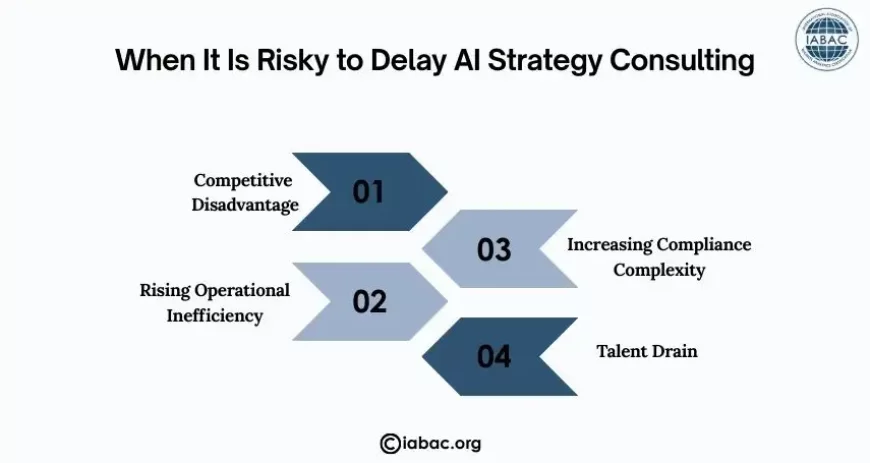
While premature AI investment can lead to wasted effort, excessive delay can create structural disadvantages that are harder to reverse over time. As markets, regulations, and technologies evolve, the cost of inaction often compounds quietly.
Below is a deeper explanation of each major risk area.
Competitive Disadvantage
Organizations that systematically integrate AI into decision-making, operations, customer engagement, and product development often build cumulative advantages. These advantages are not always dramatic in the short term, but they compound over time.
AI-enabled competitors typically:
-
Improve forecasting accuracy
-
Optimize pricing and supply chains
-
Personalize customer interactions
-
Reduce operational waste
-
Accelerate product iteration
When one organization embeds AI into core systems while another remains in discussion mode, performance gaps widen gradually.
Delayed planning can result in:
-
Slower innovation cycles: Competitors test, refine, and deploy improvements faster.
-
Reduced differentiation: Products and services begin to feel interchangeable.
-
Gradual market erosion: Customers migrate toward providers offering smarter, faster, or more personalized experiences.
The risk is not immediate collapse but steady loss of strategic ground.
Rising Operational Inefficiency
As businesses scale, manual processes and reactive decision-making become increasingly expensive.
Without structured AI direction:
-
Data analysis remains slow and labor-intensive
-
Operational bottlenecks persist
-
Forecasting errors increase
-
Resource allocation remains suboptimal
What may feel manageable at a smaller scale becomes costly at an enterprise scale.
For example, a company relying on manual demand forecasting may experience minor inefficiencies initially. However, as product lines expand and supply chains grow more complex, forecasting inaccuracies can lead to significant overstock, stockouts, and wasted capital.
Over time, inefficiencies compound and margins tighten. Delaying structured AI alignment allows these inefficiencies to become embedded in the operating model.
Increasing Compliance Complexity
Regulatory scrutiny around data usage, automated decision-making, and AI accountability is expanding across industries.
Organizations operating without formal AI governance frameworks face growing exposure in areas such as:
-
Data protection compliance
-
Bias mitigation
-
Model transparency
-
Documentation and audit trails
-
Responsible AI standards
Informal experimentation or undocumented model usage may appear harmless in early stages. However, as regulations tighten, gaps in governance can result in:
-
Legal penalties
-
Reputational damage
-
Forced system redesign
-
Operational disruption
Proactive strategy consulting helps establish structured governance before compliance risks escalate.
Talent Drain
Workforce expectations are evolving. High-performing professionals, especially in technical and analytical roles, increasingly prefer organizations that demonstrate clear innovation direction and modern data environments.
When AI initiatives lack structure:
-
Skilled employees may feel underutilized
-
Innovation-minded teams may become disengaged
-
Recruitment of top-tier talent becomes more difficult
Organizations perceived as technologically stagnant often struggle to attract and retain forward-thinking professionals.
Over time, this can create a capability gap where competitors not only advance technologically but also attract stronger talent ecosystems.
Delaying AI strategy alignment rarely results in immediate crisis. Instead, it introduces gradual strategic erosion across competitiveness, efficiency, compliance stability, and talent retention. Recognizing these risks early allows leadership to act before disadvantages become deeply embedded.
Can AI Strategy Consulting Reduce Costs?
AI strategy consulting reduces costs not simply by introducing automation but by ensuring that investments are disciplined, prioritized, and aligned with measurable value. Below is a clearer breakdown of how each element contributes to cost efficiency.
Automation Opportunity Identification
AI strategy consultants help organizations identify where automation will generate the highest economic return.
-
They assess repetitive, rule-based, and high-volume tasks that consume excessive human effort.
-
They prioritize processes where automation can reduce cycle time, error rates, or dependency on manual intervention.
-
They prevent over-automation by focusing only on areas with measurable financial impact.
This targeted approach avoids wasteful automation of low-impact activities.
Process Optimization Planning
AI should not simply replicate inefficient workflows in digital form. Strategy consulting evaluates whether processes should be redesigned before automation.
-
Consultants analyze bottlenecks, redundancies, and decision delays within existing workflows.
-
They recommend structural improvements that enhance efficiency before AI integration.
-
They align AI deployment with operational redesign to maximize productivity gains.
Optimized processes reduce operational friction and improve cost-to-output ratios.
Elimination of Low-Value Experimentation
Many organizations experiment widely with AI tools without structured prioritization, leading to scattered spending.
-
Strategy consulting introduces clear use-case prioritization frameworks.
-
It filters out initiatives that lack measurable business value.
-
It consolidates fragmented departmental experiments into coordinated initiatives.
By eliminating low-impact projects early, businesses prevent budget dilution and strategic distraction.
Avoidance of Failed Initiatives
Failed AI initiatives are often expensive not only financially but also reputationally and operationally.
-
Consultants evaluate feasibility before significant investment is committed.
-
They assess data readiness, infrastructure capacity, and integration complexity in advance.
-
They establish measurable success criteria to prevent ambiguous outcomes.
This reduces the likelihood of large-scale implementation failures and costly rework.
Compliance Risk Reduction
Unstructured AI deployment can introduce regulatory and reputational exposure that results in financial penalties.
-
Strategy consulting establishes governance frameworks and documentation processes.
-
It aligns AI initiatives with industry regulations and data protection standards.
-
It introduces monitoring mechanisms to reduce bias, misuse, and compliance breaches.
Preventing regulatory violations or reputational damage protects both direct financial costs and long-term brand value.
Cost efficiency in AI is rarely achieved through technology alone. It emerges from disciplined prioritization, structured execution, and proactive risk management, all of which are strengthened through strategic consulting.
Common Mistakes Businesses Make Before Seeking AI Strategy Consulting
Many organizations delay structured strategy engagement because early AI efforts appear manageable. However, recurring patterns often precede stagnation or misallocation.
Tool-First Investments
Businesses sometimes purchase AI tools before defining business objectives. Without strategic framing, tools generate activity but limited impact.
Vendor-Driven Roadmaps
Relying exclusively on vendor recommendations may align with product capabilities rather than business priorities. This can create dependency without internal strategic clarity.
No Governance Before Deployment
Deploying AI systems without defined governance frameworks exposes organizations to bias, compliance risk, and reputational vulnerability.
Scaling Pilots Prematurely
Successful pilots in isolated departments do not guarantee enterprise viability. Scaling without integration planning often introduces operational friction.
No ROI Measurement Structure
Organizations may deploy AI initiatives without predefined success metrics. Without baseline measurement, value remains ambiguous.
Fragmented Departmental Experimentation
When departments independently pursue AI initiatives, duplication and inefficiency increase. Centralized coordination often becomes necessary.
Underestimating Change Management
AI adoption frequently requires workflow redesign and workforce adaptation. Ignoring cultural and operational transition can stall otherwise viable initiatives.
How AI Strategy Consulting Addresses Governance and Risk
Structured strategy engagements typically include:
-
Design of an AI governance framework
-
Responsible AI policies
-
Bias mitigation planning
-
Model risk management processes
-
Regulatory compliance alignment
-
Audit and monitoring systems
These elements transform AI from isolated experimentation into controlled capability.
What Happens During an AI Strategy Consulting Engagement
Most engagements follow a structured lifecycle.
Discovery and Assessment: Evaluation of objectives, systems, data, and stakeholder priorities.
AI Maturity Evaluation: Structured readiness assessment across organization, data, technology, and governance.
Use-Case Prioritization: Ranking initiatives based on impact and feasibility.
Roadmap Creation: Phased planning aligned with measurable objectives.
Governance Design: Accountability structures and compliance frameworks.
Implementation Advisory: Ongoing monitoring and refinement.
What Changes Inside the Organization
AI strategy consulting reshapes how the organization operates, makes decisions, and measures performance. The impact extends beyond technology implementation into structural and cultural transformation.
Workflow Redesign
Existing processes are restructured to integrate AI insights into daily operations rather than treating them as add-ons. This ensures automation and predictive outputs directly influence execution, not just reporting.
AI Operating Model Creation
A defined structure is established to clarify how AI initiatives are governed, prioritized, and scaled across departments. This includes ownership models, decision rights, and coordination mechanisms to prevent fragmentation.
Workforce Reskilling Initiatives
Employees are trained to interpret AI outputs, manage automated systems, and adapt to redesigned workflows. This reduces resistance, builds internal capability, and strengthens long-term adoption.
Leadership Accountability Structures
Clear executive ownership is assigned for AI strategy, performance tracking, and governance oversight. Defined accountability prevents diffusion of responsibility and ensures sustained momentum.
Performance Measurement Frameworks
Structured KPIs and evaluation systems are introduced to measure AI impact consistently. This enables leadership to track ROI, monitor risk, and refine initiatives based on measurable outcomes.
Together, these changes transform AI from isolated deployment into an embedded organizational capability.
How to Decide If Now Is the Right Time
Determining the right moment for AI strategy consulting does not require complex analysis. In most cases, the timing becomes evident when certain organizational patterns begin to repeat.
1. AI conversations may occur frequently at the leadership level, yet concrete decisions, prioritization, and execution plans remain unclear. When discussions continue without structured direction, it often signals the need for formal strategy alignment.
2. Operational inefficiencies may begin to scale alongside business growth. Manual workflows, delayed reporting cycles, and reactive decision-making gradually increase costs and reduce agility. At this stage, structured AI planning can help stabilize and optimize operations.
3. Competitive pressure may also intensify. As industry peers adopt intelligent systems and improve efficiency, differentiation becomes harder to maintain. Delayed strategic coordination can widen performance gaps over time.
4. Governance and compliance concerns may start surfacing as AI experimentation expands. Unclear policies around data usage, accountability, or model oversight create risk exposure that requires structured attention.
5. Budget discussions around AI may begin without clear prioritization. When investment conversations occur in the absence of defined objectives and measurable outcomes, disciplined strategy becomes necessary to avoid misallocation.
6. Multiple AI initiatives may run simultaneously across departments without coordination. Fragmented experimentation increases duplication, inefficiency, and inconsistent measurement.
When several of these conditions exist together, the organization has likely reached a stage where structured AI strategy consulting can introduce clarity, alignment, and controlled execution.
Organizations seeking structured AI strategy assessment, governance design, and implementation alignment can explore AI consulting services for a business-focused approach to scalable AI adoption.
AI strategy consulting is not about introducing discipline, clarity, and measurable intent into AI decisions.
For business leaders navigating growth, regulation, and competitive intensity, recognizing the turning point early can transform AI from random experimentation into a structured driver of performance, resilience, and long-term strategic advantage.