























































How to Make Generative AI Services Work for Your Business
See how generative AI services help businesses integrate AI into operations, automate tasks, improve efficiency, and drive measurable business outcomes.

Every business wants to benefit from generative AI, but turning AI into measurable business results is often more challenging than expected.
Security, scalability, and alignment with business goals depend on far more than picking the right language model. This is where generative AI services become essential.
From strategy and implementation to system integration and continuous optimization, these services help businesses transform AI ideas into practical solutions that improve productivity, streamline operations, and deliver measurable value across the organization.
What Are Generative AI Services?
Generative AI services help businesses design, build, deploy, and manage AI systems that generate content, automate knowledge-intensive tasks, and integrate seamlessly with existing business workflows.
Common applications include AI-powered customer support, content generation, software development, enterprise knowledge management, and business process automation.
Unlike standalone AI tools that operate independently, generative AI services connect AI capabilities with existing business systems, allowing organizations to automate workflows, improve collaboration, and generate business value across multiple departments.
Why Businesses Are Investing in Generative AI Services
Businesses are investing in generative AI because they want to improve efficiency, reduce costs, and stay competitive. The decision is usually driven by several business challenges rather than a single benefit.
Competitive pressure
When competitors start using AI, they can work faster, serve customers better, and improve efficiency. Businesses need to adopt generative AI to stay competitive and avoid falling behind.
Rising cost of manual processes
As the amount of work, documents, and transactions increases, handling everything manually becomes more expensive and time-consuming. Generative AI helps reduce costs by automating repetitive tasks.
Growing volume of business data
Businesses create large amounts of documents, customer requests, and records every day. It becomes difficult for employees to review, search, and manage all this information without AI support.
Pressure from leadership for measurable ROI
Business leaders want to see clear returns from AI investments. They expect AI projects to improve productivity, reduce costs, or increase revenue instead of remaining small experiments.
Allowing employees to focus on important work
Skilled employees often spend too much time on repetitive tasks. Generative AI handles routine work, allowing teams to focus on decision-making, innovation, customer relationships, and business growth.
These challenges are making generative AI an important investment for many businesses. Instead of asking whether they should adopt AI, most organizations are now deciding how and when to implement it effectively.
What will You Receive with Generative AI Services
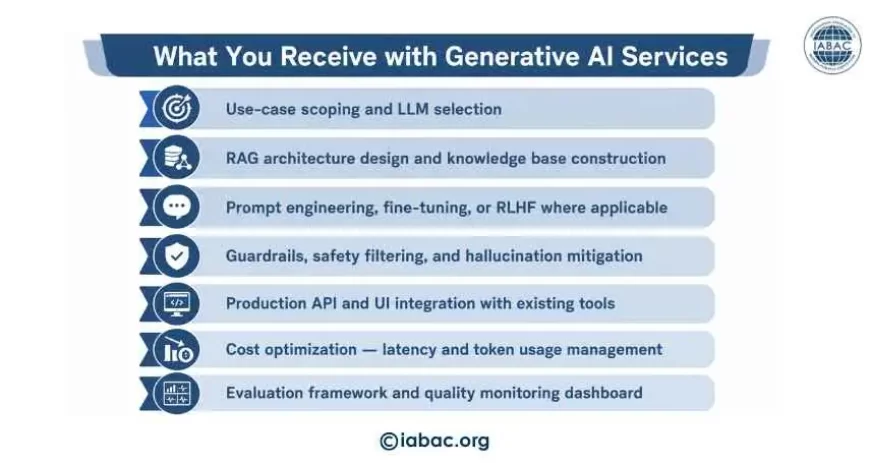
A proper generative AI service engagement is not just "we'll build you a chatbot." It's a structured set of deliverables that take the project from concept to a live, monitored system.
Use-case scoping and LLM selection:
Identifying the right problem to solve and choosing between models like GPT-4, Claude, Gemini, or Llama based on cost, latency, and data sensitivity
RAG architecture design and knowledge base construction:
Building the retrieval pipeline so the AI answers using your actual business data, not general knowledge
Prompt engineering, fine-tuning, or RLHF where applicable:
Tuning the system's behavior and accuracy to match your specific use case
Guardrails, safety filtering, and hallucination mitigation:
Controls that keep outputs accurate, on-brand, and compliant with your industry's requirements
Production API and UI integration with existing tools:
Connecting the AI to the systems your team already uses, so it becomes part of the workflow instead of a separate app
Cost optimization, latency, and token usage management:
Keeping the system fast and affordable to run at scale
Evaluation framework and quality monitoring dashboard:
Ongoing visibility into how the system performs after launch, so issues get caught early
This is the difference between a project that ends the moment it goes live and one designed to keep delivering value months later.
Business Outcomes You Can Achieve with Generative AI Services
The value of generative AI becomes clear once you look at specific, deployable outcomes rather than abstract capabilities.
Enterprise chatbots and AI customer support agents
These handle high volumes of routine customer questions instantly, reducing wait times and freeing support staff for complex issues that need a human touch.
Document Q&A systems for contracts, manuals, and policies
Instead of employees manually searching through hundreds of pages, they ask a question and get a direct, sourced answer pulled from the actual document.
AI writing assistants and content automation
Marketing and communications teams produce first drafts, summaries, and variations faster, cutting the time from brief to publish-ready copy.
Code generation and developer copilots
Engineering teams move faster on repetitive coding tasks, boilerplate generation, and code review, leaving more time for architecture and problem-solving.
AI-powered data extraction and summarization
Systems that read incoming documents like invoices, forms, and reports and pull out structured data automatically cut manual processing time significantly.
Each of these outcomes maps to a specific, measurable business process. That's what separates a useful generative AI deployment from a novelty project.
Typical Timeline to Implement Generative AI Services
A realistic generative AI implementation follows a structured path, usually over about six weeks for a well-scoped project.
Week 1 — Requirements and LLM selection
Understanding the actual problem, the data involved, and choosing the right model for the task.
Weeks 2–3 — RAG and architecture build
Designing the retrieval system and organizing the data the AI will draw from.
Week 4 — Prompt engineering and tuning
Adjusting the system's behavior and accuracy to match business needs.
Week 5 — Integration and safety layer
Connecting the AI to existing tools and building in the guardrails needed for safe, reliable use.
Week 6 — UAT and production launch
Final user acceptance testing before the system goes live.
Timelines shift depending on project scope, the number of systems being integrated, and how complex the compliance requirements are. A single-department chatbot moves faster than a multi-system deployment spanning several business units, but the six-week structure gives a reasonable baseline for planning.
Common Challenges Businesses Face During Generative AI Adoption
Even well-funded projects run into predictable obstacles. Knowing them in advance makes it easier to plan around them.
Selecting the right business use cases
Many teams pick the flashiest use case instead of the one with the clearest ROI. A prioritization process matters more than enthusiasm.
Managing enterprise data quality
AI systems built on messy, incomplete, or poorly labeled data produce unreliable results, regardless of how good the model is.
Integrating AI with existing systems
Connecting to a CRM or ERP without breaking existing workflows takes careful planning and testing.
Protecting sensitive business information
Data governance and access control need to be built in from the start, not added after launch.
Reducing AI hallucinations through proper architecture
A well-designed RAG pipeline and guardrail system significantly reduces incorrect or fabricated outputs.
Driving employee adoption across teams
Even a well-built system fails if staff don't trust it or don't know how to use it. Training and change management matter as much as the technology.
Addressing these challenges early, rather than reacting to them after launch, is what separates projects that scale from projects that stall.
How to Select the Right Generative AI Services
Choosing a provider is one of the most consequential decisions in this process. A few criteria consistently separate strong partners from weak ones.
Enterprise implementation track record
Look for a history of projects that went from pilot to production, not just proof-of-concept demos.
Customization for your specific workflows
Generic, one-size-fits-all AI tools rarely match the nuance of a specific industry or process.
Experience with Enterprise System Integration
A provider should be comfortable working within your CRM, ERP, or internal tools without requiring you to replace them.
Transparent governance and compliance practices
Ask directly how the provider handles data isolation, security, and industry-specific regulations.
Built to scale into new use cases
The system should expand to new departments or applications, not get rebuilt from scratch each time.
Support that continues after launch
AI systems need ongoing tuning as data and usage patterns change. Support shouldn't end the day the system goes live.
Asking a provider direct questions about these six areas during early conversations will tell you a lot about how the engagement is likely to go.
Is Your Business Ready for Generative AI Services?
Generative AI delivers the best results when it solves real business challenges. If your organization is experiencing any of the following situations, it may be the right time to invest in generative AI services.
Your business manages large volumes of information
Finding, organizing, and using information from documents, emails, or internal knowledge bases is becoming slow and difficult.
Customer expectations are increasing
Customers expect faster responses, personalized interactions, and round-the-clock support that manual teams cannot always provide.
Your operations are growing quickly
As the business expands, existing processes are becoming harder to manage without automation and intelligent workflows.
Different teams want to use AI
Departments such as customer support, marketing, HR, or sales have identified opportunities where generative AI could improve their work.
Security and compliance are important
Your business needs AI solutions that protect sensitive data, follow compliance requirements, and integrate securely with existing systems.
You want measurable business outcomes
Rather than experimenting with standalone AI tools, you want solutions that improve efficiency, reduce costs, increase productivity, or enhance customer experience.
If several of these situations apply to your business, it is a strong indication that you're ready for generative AI services. A structured implementation can help turn AI from a collection of experiments into a solution that delivers measurable business value.
Generative AI services create measurable value when they're built on the right strategy, proper system integration, and ongoing optimization, not when they're treated as a one-time project. A single pilot rarely scales on its own; consistent results come from a structured approach that carries through launch and beyond.
Transform your business with tailored AI consulting that automates workflows, enhances productivity, and delivers secure AI solutions designed around your business goals.